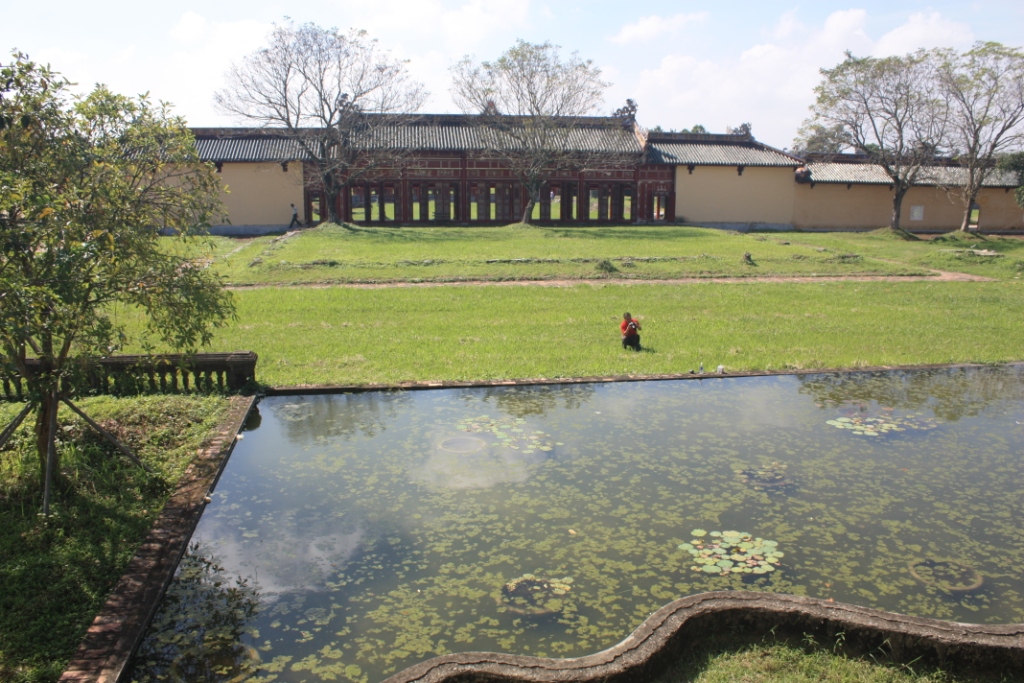
did ancient occupants
 look upon new walls and gates,
  or cloud reflections?

did ancient occupants
look upon new walls and gates,
or cloud reflections?

Cogs without machines
   Don't roll far.

And when they've settled,
   They have no movement.
   They are all existence,
      And no process.
   Their worldlines have
      Flatlined.
   They have no experience,
      (And bliss lies in the
         Experience of experience.)
   They have only a longing
      For non-existence...

Or to be reinstalled.

There was never a sound beside the wood but one,
 And that was my long scythe whispering to the ground.
 What was it it whispered? I knew not well myself;
 Perhaps it was something about the heat of the sun,
 Something, perhaps, about the lack of sound --
 And that was why it whispered and did not speak.
 It was no dream of the gift of idle hours,
 Or easy gold at the hand of fay or elf:
 Anything more than the truth would have seemed too weak
 To the earnest love that laid the swale in rows,
 Not without feeble-pointed spikes of flowers
 (Pale orchises), and scared a bright green snake.
 The fact is the sweetest dream that labor knows.
 My long scythe whispered and left the hay to make.

There once was a virtuous, old monk
 Who never, ever had sex or got drunk.
   He lived in silence,
   And practiced non-violence...
 Till one day, in a funk, he kicked a young monk
      In the junk.

a lone pine stands --
 mangled and misshapen --
  above other trees.

Tap the resonance
   And vibrate at the rate
   Of those eternal emanations --
      The thrumming under-pulse
      Of the Universe.

The ripples that can't be heard
   Or felt haptically,
   But must be tuned into
   To feel, otherwise.

Downshift what is you --
   Put your Self into idle.

Don't panic
   As you start to slide --
      Frictionlessly,
      A lack of friction that's
        Unfamiliar & Uncomfortable,

But which will be the way
     One's worldline plays out --
     Effortlessly -- to the end.
Stoop anywhere and pluck it up,
 But if you look 'round - it's not there.
 Any path may lead you to it.
A stroke of the brush becomes Spring,
 And the flowers are in full bloom. --
 It's like seeing a new year dawn:
 Snatch at it and you won't have it.
 Seize it by force and you'll be poorer.
Be like the old mountain hermit --
 Like duckweed gathered by stream flow.
Find calm amidst storms of feeling
 By knowing Heaven's harmonies.
NOTE: The late Tang Dynasty poet, Sikong Tu (a.k.a. Ssŭ-k‘ung T‘u,) wrote an ars poetica entitled Twenty-Four Styles of Poetry. It presents twenty-four poems that are each in a different tone, reflecting varied concepts from Taoist philosophy and aesthetics. Above is a translation of the tenth of the twenty-four poems.
There once was a popular actress
 Who most found cruel, catty, and tactless,
   But the very worst part
   Was the state of her art,
 She only played herself in a different dress.

Bent double, like old beggars under sacks,
 Knock-kneed, coughing like hags, we cursed through sludge,
 Till on the haunting flares we turned our backs,
 And towards our distant rest began to trudge.
Men marched asleep. Many had lost their boots,
 But limped on, blood-shod. All went lame; all blind;
 Drunk with fatigue; deaf even to the hoots
 Of gas-shells dropping softly behind.

Gas! GAS! Quick, boys! -- An ecstasy of fumbling
 Fitting the clumsy helmets just in time,
 But someone still was yelling out and stumbling
 And flound'ring like a man in fire or lime. --
Dim through the misty panes and thick green light,
 As under a green sea, I saw him drowning.

In all my dreams before my helpless sight,
 He plunges at me, guttering, choking, drowning.

If in some smothering dreams, you too could pace
 Behind the wagon that we flung him in,
 And watch the white eyes writhing in his face,
 His hanging face, like a devil's sick of sin;
 If you could hear, at every jolt, the blood
 Come gargling from the froth-corrupted lungs,
 Obscene as cancer, bitter as the cud
 Of vile, incurable sores on innocent tongues, --
 My friend, you would not tell with such high zest
 To children ardent for some desperate glory,
 The old Lie: Dulce et decorum est
   Pro patria mori.
NOTE: Dulce et decorum est pro patria mori is a line written by Horace in Latin that translates to: “It is sweet and fitting to die for one’s country.”