PROMPT: Love Now

Daily writing prompt
What do you love now, that you hated when you were younger?

Absurdity.

PROMPT: Followed Your Gut

Daily writing prompt
What’s a time you followed your gut and it turned out to be exactly right?

I was hungry, so I ate some food, and I wasn’t hungry afterwards. It actually happens with regularity.

PROMPT: Changed

Daily writing prompt
What’s a piece of media (book, movie, song) that changed how you see the world?

Leaves of Grass by Walt Whitman.

Also: Quiet by Susan Cain; Water Margin by Shī Nài’ān; and Self-Reliance and Other Essays by Ralph Waldo Emerson

PROMPT: Languages

Daily writing prompt
Which languages do you speak and how did that impact your life?

Fluently: English; With a substantial grasp of vocabulary and grammar: Chinese; Only polite words and basic phrases: Spanish, Hungarian, Thai, Japanese, and maybe still some Russian (which I took in Grad School — the worst possible language learning environment.)

Starting to read Chinese has been thrilling. It has opened a whole new world, and the nature of the language is so different that definitely rewires the brain a bit.

PROMPT: Advice

Daily writing prompt
What’s the best advice you’d give to someone younger than you?

Make decisions 25% more nervy than you currently see yourself having the courage to pull off.

Also, develop some uniquely human skill for the time (you are likely to see) when ai/robotics does all productive tasks better, faster, and more efficiently than humans. (Think nursing, philosophy, sex work, cage fighting, etc.)

PROMPT: Inspired

Daily writing prompt
Who are you most inspired by?

Those who reached the escape velocity necessary to truly write their own stories: e.g. Drukpa Kunley, Diogenes the Cynic, Hánshān, Ikkyū, Socrates, and the various Avadhuta.

PROMPT: Successful

Daily writing prompt
What’s your top tip to be successful in life?

Adjust your definition of success until you’re there. It is, after all, a completely subjective term.

PROMPT: First Time

Daily writing prompt
What’s a book, movie, or TV show that you wish you could experience again for the first time?

I would not be the same person. It would not be the same book.

PROMPT: Happiness

Daily writing prompt
What’s a common misconception people have about happiness?

That it’s a worthy object of pursuit, as if it is a stable state. I think both the Taoists and the Buddhists have instructive views on the matter. In Taoism, the Yang contains the seed of Yin and one flows inexorably into the other. In this view, the rock bottom worst life has to offer is a time to rejoice because the light will follow. Whereas, when one thinks life is the best it can get, a fall will come. As for Buddhism, our happiness may reflect an illusion that we’ve momentarily achieved our desires, when desires are inherently great white whales. Aim for contentment. Experience happiness when it comes.
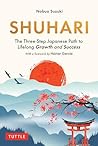
BOOK: “Shuhari” by Nobuo Suzuki

Shuhari: The Three-Step Japanese Path to Lifelong Growth and SuccessShuhari: The Three-Step Japanese Path to Lifelong Growth and Success by Nobuo Suzuki
My rating: 5 of 5 stars

Release date: August 11, 2026

I was introduced to the concept of “shuhari” as a student of Japanese martial arts, and over time I discovered it to be one of the most useful concepts for personal growth and development. Shuhari is by no means exclusive to martial arts and is applied to arts in the broadest sense — really to endeavors of any type (as is true in this book which references not only martial arts, but literary arts, graphic arts, cinematic art, and even sciences.) The idea is this: one begins by repetitively practicing what one is taught in as close to an exemplary fashion as possible (shu,) then one starts adapting the principles one has cultivated to changing and unpredictable circumstances (ha,) and finally one abandons the forms and embraces the spontaneous (ri.) In short, we follow the rules (shu,) break the rules (ha,) and abandon the rules (ri.)

Recent years have seen a flood of books on cultural life philosophies, starting and continuing with those of the Japanese culture, but venturing out into Scandinavian (Sisu and Lagom,) Goan (Susegad,) and many others. One could easily fill a shelf each with the popular books on “ikigai” or “ganbatte.” It’s kind of a surprise to see that it’s taken this long to venture into the invaluable concept of “Shuhari.” It is an idea whose time has come to go global.

In a broad sense, this is a book on learning and creativity, and I’d highly recommend it for anyone looking to reevaluate their approach to learning and / or creating.

View all my reviews
