DAILY PHOTO: Gazing Tiger, Drinking Tiger

Taken November 10, 2013 at Bannerghatta.

Taken November 10, 2013 at Bannerghatta.

White Tiger drinking

White Tiger drinking

Bannerghatta has several tigers, two of which are white tigers, that can be seen on the “safari.” It’s not a safari in the usual sense, as the cats are in fenced off containment zones and segregated from their food. One rides in buses or jeeps in through a double-fenced gate, and then through the area.

At some point it occurs to you that they are in the larger area, with greater freedom of movement, and so in some sense one is on exhibit for the animals. The vehicle even has steel mesh over the windows to make the caging experience complete.  There are periodical camera portals to give one the illusion that it’s all for the humans’ entertainment. 

There are several enclosures to keep lions, tigers, and bears separated.

I saw tigers looking, drinking, walking, stalking, and sniffing–but not crouching. I didn’t see a dragon, and so I must assume that it was hidden.

DAILY PHOTO: Tiny Temple and Wind-blown Trees

Taken November 3, 2013 at Hampi.

Taken November 3, 2013 at Hampi.

These trees, raising like hands out of fresh, graveyard soil in front of this tiny temple really captured my imagination. It would probably be a better picture in low light, when the creepiness of the scene could really root around in your brain–but I took what I could get.  There were a couple of places around Hampi that I thought would make the perfect setting for horror, and this was one. Another was the banyan tree that had many-colored satchets of rock tied to hang from the tree’s drooping roots.

This picture is taken on top of the hill that overlooks Virupaksha temple, not far from the Ganesh temple.

DAILY PHOTO: Gray Langur Watchmonkey

Taken Nov 3, 2013 at Hampi

Taken Nov 3, 2013 at Hampi

Gazing into the distance

he renders his assistance

to the mischievous monkeys–

making him a monkey flunky

A watchman of the langur pranks

yet not a part of their prankish ranks

He screeches warnings now and then

on sight of broom-wielding women

He neither seeks nor needs praise

just the occasional banana raise

He does it not for power or glory

just the occasional funny story

POEM: Lion Eyes (or Lionize or Lyin’ Eyes)

Taken Nov 10, 2013 at Bannerghatta National Park

Taken Nov 10, 2013 at Bannerghatta National Park

The lion is  a kingly beast

Whose eyes no lies can abide

If you don’t wish to be his feast

Please act with tact and don’t chide

He doesn’t take to teasing well

He’s still but to kill is in his blood

His placid face may look swell

But a strong heart pounds THUD-THUD…

THUD-THUD

&

another thing

He may look like a big plush toy

But he’s no fun for a girl or boy

Don’t get your kid a big feline

Unless your exit is a swift beeline

DAILY PHOTO: Climbing Lizard

Taken November 2, 2013 at Hampi.

Taken November 2, 2013 at Hampi.

These little lizards were one of the most common animal lifeforms at Hampi.  They blend into the rock quite well despite the broken white or yellow line of dots on their backs, which itself blends into the splotched pattern of the creature.

I believe they are called Psammaphilus Dorsalis, Peninsular Rock Agamas, or South Indian Rock Agamas. [However, I know nothing about lizards and am open to correction by a herpetologist.]

DAILY PHOTO: Precarious Rock

Taken November 3, 2012

Taken November 3, 2012

Part of what makes Hampi so surreal is all of the precariously balanced boulders. This shot is oriented straight up and down, i.e. the camera is not tilted, and so one wonder’s “How is that rock not falling?”

BOOK CHAT: Walking by H.D. Thoreau

WalkingWalking by Henry David Thoreau

My rating: 5 of 5 stars

Amazon page

Thoreau paints a portrait of walking in such grandiose terms that one will cease to think of putting one foot in front of the other as one of life’s mundane tasks. He’s not talking about just any walking, however. He’s not talking about the mall walkers who briskly exercise in temples of consumerism. He’s not talking about those who walk through the park with top 40 hits blaring from their iPod ear buds.

Thoreau is talking about those individuals he calls saunterers. To saunter, as to stroll, is to walk in a leisurely and aimless fashion. Thoreau’s walking is that which:
-takes place in nature.
-leaves worldly worries behind.
-is not a trivial time commitment.
-is more an exercise of the mind and spirit than of the body.

To the mall walker, Thoreau would point out the error of a missed opportunity to get away from mankind’s chaos and enjoy nature. As he puts it, “The most alive is the wildest.” and “…all good things are wild and free.” He’s also clear in that walking for exercise misses the point by injecting hurriedness into a time that should be about slowing down.

On those with iPods, cellphones, or other contrivances that distract one from the environs, Thoreau is equally clear, “What business have I in the woods if I am thinking of something outside the woods?”

Thoreau’s essay broadens as it progresses. From a commentary on the virtues of sauntering, the essay turns to the glories of nature, the character of America, and the state of thought in his contemporary society. These may seem like unrelated concepts, but there is a string of logic that connects them.

The connection to nature and the virtue of wildness should be clear. It’s nature that is the optimal backdrop of sauntering. It’s in nature that one can be set free from the troubles of the world of man and obtain a glimpse of god. It’s in nature where creativity breeds with chaos turned down and native brilliance turned up.

Thoreau’s discussion of America is tied to the theme of walking in a couple of ways. The first is as a land made for walkers. For example, he points out that a man could pitch a tent almost anywhere in North America without great risk of becoming a meal. The same couldn’t be said of India or Africa or Siberia, where man isn’t the sole predatory creature. The second is America as a place with room to venture out into uncharted territory. Thoreau points out that we may look to the East for the lessons of our predecessors, but a person should look West for opportunities to grow in one’s own right. Of course, Thoreau’s America was different from today’s America.

The end of the essay broadens out even further. Thoreau comments upon mankind and the state of ideas and thought. He echoes Socrates when he talks about that age-old question of whether it’s better to be ignorant (to know one knows little) or deluded (to think one knows a lot, but be drowning in false knowledge.) A reader may suggest that this is a false dichotomy. Why can’t one know most everything and not have a one’s body of knowledge rife with false knowledge? I can’t say, but all of the evidence suggests that if such a state exists, it’s the domain of God or gods (if such entities exist.)

Thoreau also bemoans what he sees as the decline of thinking man. What does this have to do with walking? I think Thoreau answers in the following quote:
“So it would seem few and fewer thoughts visit each growing man from year to year, for the grove in our minds is laid waste—sold to feed unnecessary fires of ambition, or sent to mill—and there is scarcely a twig left for them to perch on.”

I think that everyone should read this thin book–really an essay and not a full-scale book. The problems Thoreau notes have only gotten worse in our modern age. Far too few take the time to walk, and to acquire the benefits of sauntering.

View all my reviews

DAILY PHOTO: Yellow Blossoms

Taken November 2, 2013 at Hampi.

Taken November 2, 2013 at Hampi.

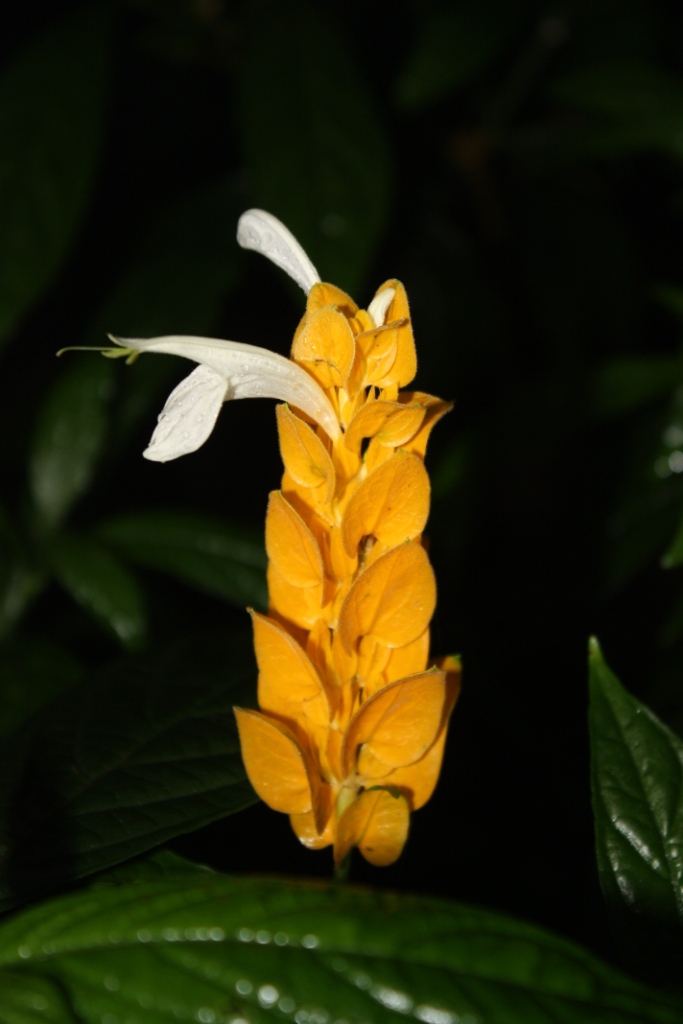
The Hampi area is painted from a different palette than most of Karnataka. Instead of uniform green, the brownish-red of the boulders dominates, and, while green lines the spaces between the rock, the vivid yellow of these flowers decorate the base of many hills.  Of course, there remain islands of green, in the form of corn fields, banana plantations, and palm groves.

9 Nights at an Ashram

Taken October 20, 2013 at Fireflies Ashram.

Taken October 20, 2013 at Fireflies Ashram.

Indian cities don’t whisper. They are often lovely, always lively, but offer little relief from bombardment of the senses. Horns are relentless. Bus and truck air-horns can make a person jump from one’s skin. The smells may be pleasing or putrid, but they’re never faint. There is sign pollution, wherein it’s often impossible to find what one is looking for in the sea of signage–even when it lies right in front of one’s face. Colors pop and glow, not smooth pastels, but oranges and purples that you can practically taste.

It shouldn’t have surprised me when I got to the southern edge of the city to find one of the major land uses was Ashrams. Ashrams in all shapes and sizes, from the small but authentic Narayana Gurukula (mentioned a few DAILY PHOTO installments back) to the massive Art of Living International Center–headed by Bangalore’s most famous guru, Sri Sri Ravi Shankar. Out Kanakapura Road, where monkeys sling through trees and fields of corn remind me of my own Hoosier upbringing, lies a diverse collection of houses of spirituality and reflection. They offer a much-needed island of tranquility amid a sea of chaos.

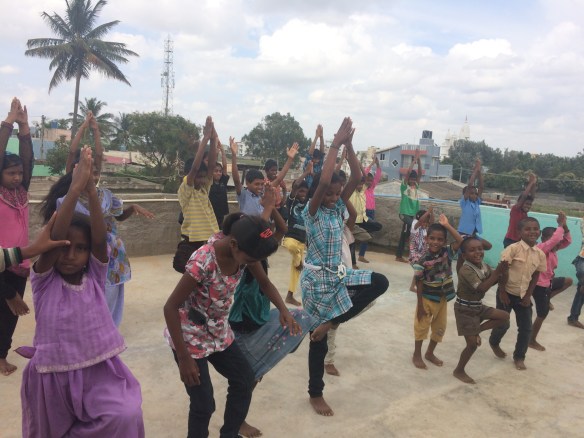
I stayed for nine nights at one of the most singular of these ashrams, Fireflies. One way in which it’s unique is that it’s a “guruless” ashram. That may seem oxymoronic. The terms “guru” and “ashram” seem to go hand in hand. Guru means teacher. My dictionary defines ashram as, “the home of a small community of Hindus.” [I think this definition could be challenged both on the necessity of “smallness” and “Hindu-ness.” As indicated, there are some pretty massive ashrams and there are ones that are associated with non-aligned spiritual groups.] It’s true that the typical ashram has a spiritual leader or yogi as its head. At Fireflies the gurus come and go with the groups that visit. While I was there, besides our group of Thai Yoga Bodywork practitioners, there was a group of psychotherapists and an organization of past life regressionists. Rather than housing a single unified set of beliefs, at this ashram a diverse and sometimes conflicting set of beliefs are harmoniously housed.

As I have little experience with ashrams, I can’t speak authoritatively about other differences. However, it’s my understanding that one other difference between Fireflies and many–more typical–ashrams is that the latter often have limited or non-existent staff. This means that the visitors may do much, if not the bulk, of the work. Fireflies has a staff that does the cooking and takes care of many needs of the visitors. This isn’t to suggest that it’s like a hotel stay. There’s somewhat of an expectation that visitors will take care of the things that they can do for themselves, and the accommodations are basic.

I found the experience of my stay to be beneficial, if not always stress-free. The main source of my stress had little to do with the Ashram. I received my phone sim card right before I left. After a couple of days I got my phone working for a day or two only to have the phone company turn it off because no one was home when they randomly dropped by to verify my address. [Showing up unannounced in the middle of the day and then treating you as non-existent if no one is home is one of the annoying little hallmarks of Indian institutions (corporate and government) that I’ve experienced on more than one occasion.] I will admit that it is a mark of both society’s and my own wussification that we can’t go a few days without being in contact with home and news of the world. Twenty years ago no one would have expected to have such constant verification that all was well in the world. People could go days back then without worrying that the sky was falling. While it wasn’t pleasant to be cut off, it was an eye-opening experience. [I will note that the Ashram property is on a slope and at the low end I got no reception at all, but on the high end I’d get a bar or two–enough to do the job if the phone company wasn’t screwing me over.]

It was also useful to go without brain candy for a while–that is without television and related entertainment. Part of what I hoped to learn from my stay was whether I was prepared to take the 10-day Vipassana meditation course in the spring. The Vipassana course is considerably more spartan level of existence than that of Fireflies.

On some levels, I proved ready, and on others I have yet to do so. I did just fine eating two vegetarian meals and a snack for dinner each day. (I could have had three full meals per day, but I wanted to make sure I was ready to cut my intake adequately. Therefore, I stuck with a snack in the evening and ate reasonable portions for breakfast and lunch.) I found the meals at Fireflies to be quite good, and I had no complaints in that regard. It should be noted that the ashram is not an easy walk to any restaurants or substantial stores (there are a couple small shops up on the corner, but they’re geared toward locals and don’t necessarily have what a traveler needs) so it’s not easy to go out for something–though I did see one auto-rickshaw around the premises at times.

The true test of preparation for the Vipassana course is that there are no books or notebooks allowed. This will be my greatest challenge. I finished two novels and two nonfiction books on Kindle during my stay, plus probably another 100 pages of other books, and I filled 2/3rds of a journal–mostly with notes from the TYB workshop.

Also, at the Vipassana meditation course one is not allowed to speak to anyone but the instructor at a specific time when they take questions about the course. I wasn’t nearly so cut off from humanity at Fireflies. The workshop participants and teachers were around all day and I had occasional conversations in the evening with others at the ashram. Furthermore, I’m a fairly solitary creature.

It was interesting that during the weekends there were so many people around, but during the middle of the week there were few. For a while I thought I was the only non-staff member person at the ashram—though I later found that to be incorrect.

So my time at the ashram was Spartan, but that’s part of the beauty of it.

I should point out that there are some impressive stone carvings located throughout the property. The artists are international in scope. Each of these carvings or sculptures offers its own story. I’ll attach a few pics for your edification.

20120101_16151920120101_16142320120101_155241

DAILY PHOTO: Wistful Monkey in the Mist

Taken September 2013 at Nandi Hills, India

Taken September 2013 at Nandi Hills, India

Sometimes, you just wonder what a monkey is thinking.