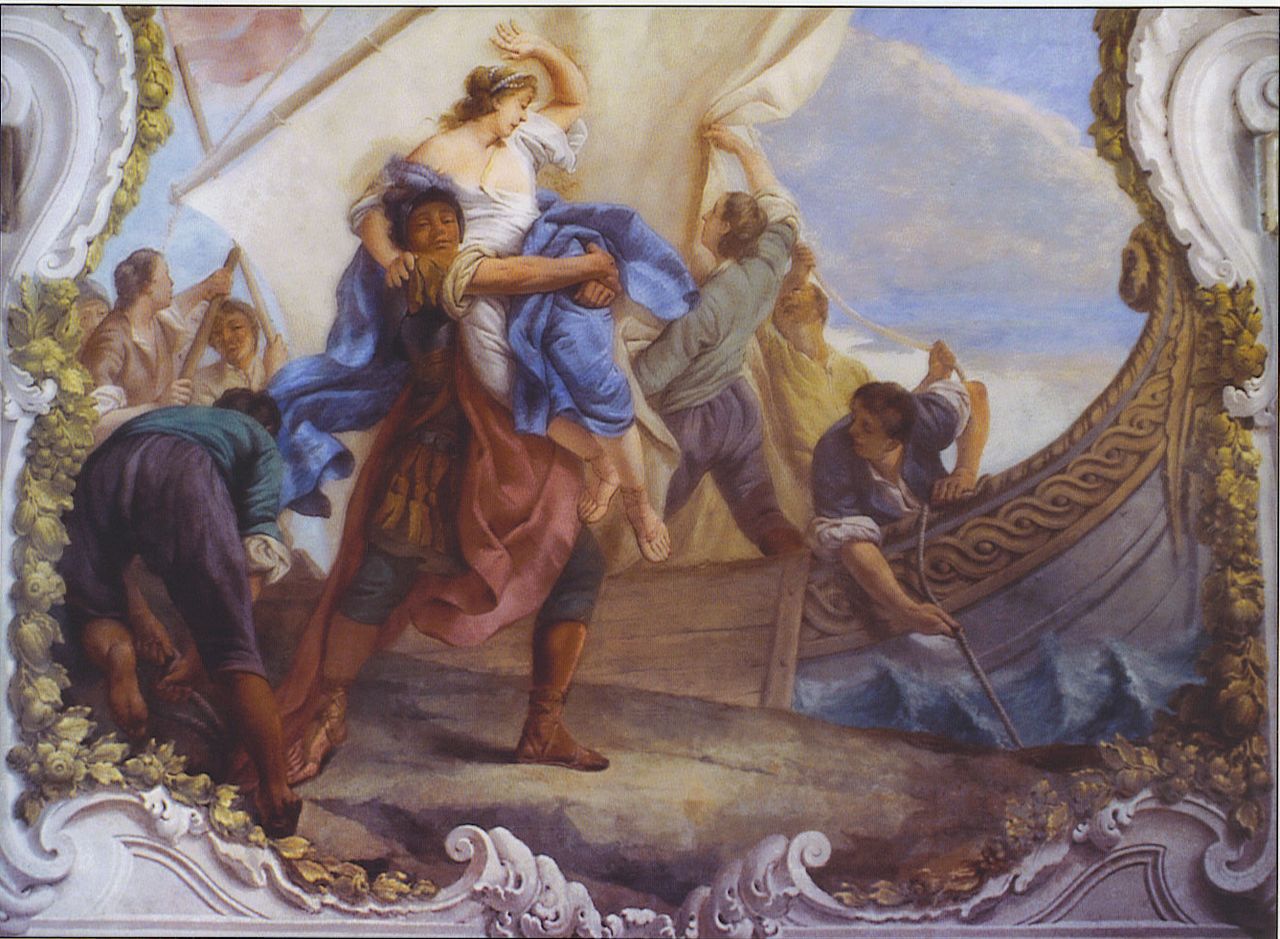
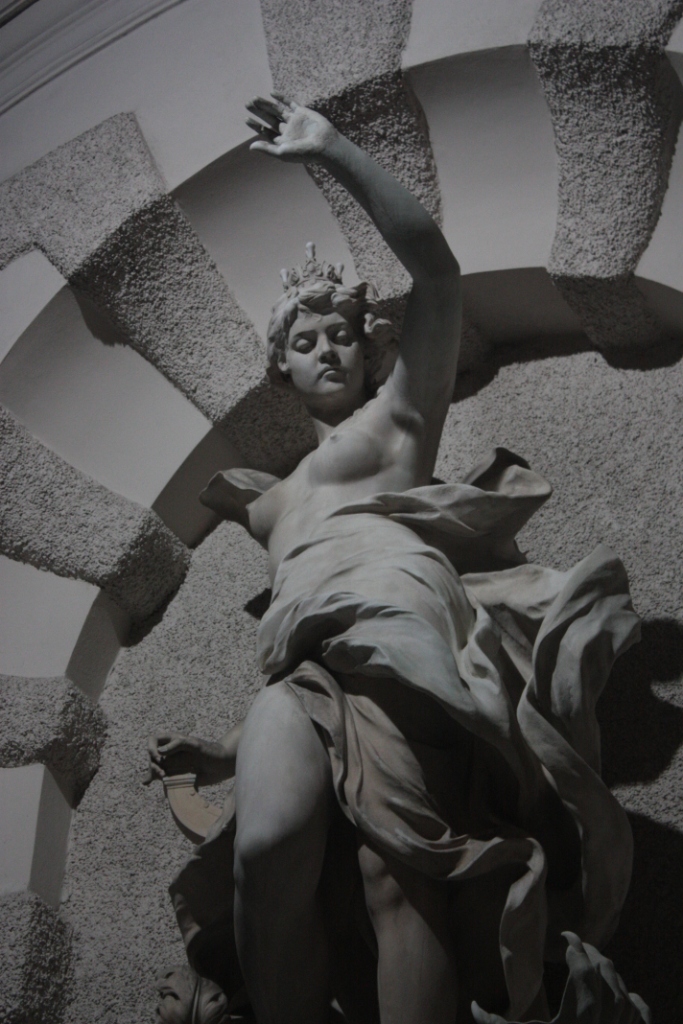
Helen of Troy [Limerick]

Abduction of Helen; (mid-18th cent. Venice)
There was pretty lady named Helen
whose beauty had all the boys yellin'.
No arrows from Cupid;
her glance made 'em stupid.
But did her face split a thousand melons?

BOOK REVIEW: Egyptian Mythology: A Very Short Introduction by Geraldine Pinch

Egyptian Myth: A Very Short IntroductionEgyptian Myth: A Very Short Introduction by Geraldine Pinch
My rating: 4 of 5 stars

Amazon.in Page

It’s a daunting task to provide a flyover of such a fruitful mythological tradition, one that spanned thousands of years. This book does a mixed job of it. When it’s good – it’s exceptional, and when it’s not – it’s not. One can’t fault a book with this one’s editorial mandate for not being comprehensive. However, one can fault it for not using the little space available in the best manner. The book spends too much time discussing art and artifacts, and (to a less objectionable degree) history. I say “to a less objectionable degree” not because there was less space devoted to history but because having some historical and anthropological background is of benefit to understanding a culture’s stories [more so than knowing about their material possessions.] Until I got to chapter three, I thought the book might have been mistitled and should have been “Egyptology: A Very Short Introduction” because it was such a broad discussion of Egypt and its artifacts.

That said, in chapter three, the book does an excellent job of reviewing the gods of Egyptian Mythology. Thereafter, it meanders back and forth between being an excellent introduction to Egyptian Mythology and a rambling discussion of things Egypt. There’s a fascinating presentation of the conflict between Horus and Seth, but most of the discussion of myths are short summations (often one-liners.)

I don’t have any basis for comparison, and, therefore, couldn’t tell you if there is a better introductory guide to Egyptian Myth. That said, it does a good job of presenting an outline of the subject, but expect to spend a fair amount of time reading about subjects that are, at best, tangential to the stories of ancient Egypt.


View all my reviews

BOOK REVIEW: He Who Fights With Monsters by Francesco Artibani

He Who Fights With MonstersHe Who Fights With Monsters by Francesco Artibani
My rating: 4 of 5 stars

Amazon.in Page

Release date: August, 30, 2022

This graphic novel tells a story featuring the Prague Golem, a mighty protector figure from Judaic folklore – formed of clay and breathed to life by magic words. The setting is Nazi-occupied Prague, and the golem is brought to life after a great period of dormancy, having been stored in the rafters of a synagogue, in order to once more act as protector to the Jewish people.

It’s a gripping tale of wartime resistance, but with a flat ending. However, I’m not sure it could have concluded in a satisfying way. That’s the challenge of writing a story of a superhero versus Nazis. The Holocaust is such a colossal tragedy that to rewrite the it resets the book into some alternate reality fantasyland, striking a raw nerve and killing any poignancy in the process.

The artwork is skillfully rendered and captures the grim nature of a city under fascist occupation quite well.

I enjoyed the story, despite not really knowing how to process the ending. Maybe that’s the point, that one can’t turn such mindless brutality into a storybook satisfying ending [by satisfying I don’t mean happy, but rather concluded in the definitive and intrinsically reasonable – if horrifying – way of tragedies.] Still, one is left wondering about apparent changes in character motivation and whether they make any sense — because they don’t feel like they do.

If you’re intrigued by a historical fiction / fantasy mashup set in Prague during the Second World War, check this book out, but expect to be left in an uneasy space at the end.


View all my reviews

BOOK REVIEW: The Stories Behind the Poses by Raj Balkaran

The Stories Behind the Poses: The Indian mythology that inspired 50 yoga posturesThe Stories Behind the Poses: The Indian mythology that inspired 50 yoga postures by Raj Balkaran
My rating: 4 of 5 stars

Amazon.in Page

Released: July 26, 2022

Yoga practitioners will be aware that — while some posture names are banal, straightforward descriptions (e.g. Utthita Hasta Padangusthasana, or “standing hand-to-big toe pose –”) many others invoke animals, sages, or deities for historical, mythological, or symbolic reasons. As this book’s title suggests, it presents the mythological backstories for fifty yoga postures. The vast majority of these fifty poses are common ones that will be readily familiar to most Hatha Yoga practitioners, though a few are advanced or obscure and aren’t likely to come up in your run-of-the-mill studio class. (And a couple may be familiar to some individuals by another name.)

The book is cleanly organized with five sections (Shiva poses, Vishnu poses, Devi / goddess poses, God story poses, and sage poses) each containing writeups for ten poses. Each pose is presented via colorful artwork in the Indian style (typically with the deity or sage in question performing the posture.)

I found the entries to be well-written and clear (Hindu Mythology can be extremely complicated and some authors get lost in the weeds by including too much minutiae or unnecessary details, but that wasn’t the case here.) The full-page artistic renderings of the poses are also clear and tidy, such that anyone familiar with the pose should readily recognize it.

The one thing I think could have been done better (though probably not without messing up the aforementioned clean organizational scheme) would be to cut some of the redundancy in the stories. In a few instances, the same story appeared in multiple chapters. To the author’s credit, these weren’t just copy / pasted, they were written uniquely, sometimes with additional information or a different focus. Still, it was a bit distracting to find myself in the middle of the same story and wondering whether I’d zoned out or lost my place. This might have been dealt with by putting multiple poses with one story and not repeating the tale one or more times. For example, the stories about Vasisthasana and Visvametrasana are inherently coupled, and the poses might be as well. (Perhaps even referencing the fact that the story had already been told might have been helpful and less distracting.)

All-in-all, I thought this book did a fine job of presenting the myths and relating them to the postures. I learned a great deal from reading the book and would recommend it for yoga practitioners and those interested in Hindu Mythology.


View all my reviews

Mythic Love [Free Verse]

Myths cheapen love
with potions &
pointy passion projectiles,

pansies squeezed over 
the eyes of cold souls
[when paired with a proper
incantation] 
can make love from naught
or turn love on its head,

but that which can be
turned on its head
is not love --
& never was love.

Sun Wukong [Common Meter]

The Monkey King with magic staff
outmatched monsters and gods,
defying the Jade Emperor's
edicts against all odds.

He erased himself from out of 
The Book of Life and Death,
and lived through the Crucible --
nearly holding his breath.

Finally, the gods called Buddha,
though some had their qualms,
but the one thing Monkey couldn't do
was leap from Buddha's palm.

BOOK REVIEW: Supernatural Shakespeare by J. Snodgrass

Supernatural Shakespeare: Magic and Ritual in Merry Old EnglandSupernatural Shakespeare: Magic and Ritual in Merry Old England by J. Snodgrass
My rating: 4 of 5 stars

Amazon.in Page

Like – I suspect – most of humanity, I’m a big fan of Shakespeare’s work, but I’m also not alone in feeling that I’ve missed a some of the depth and texture of his plays. Both language and the body of common / popular knowledge have evolved and migrated tremendously since the Elizabethan era. This makes a market for books that offer insight into the age and the role that the beliefs, norms, and daily life played in Shakespeare’s theatrical works. This book is one such work. It focuses on the role supernatural beings and various festivals play in the Shakespearean canon and why they do so.

Conceptions of the supernatural may be one of the areas in which human beliefs have changed most severely since Shakespeare’s day. The book has chapters on witches, ghosts, fairies, and enchanted forests that are interspersed among chapters that deal with various seasonal festivals of Pagan origin. I did find this leapfrogging around a bit odd, but I would speculate two possible reasons for it. First, the author may have wanted to build cyclicality into the overall organization, and thus put beings and creatures that seemed thematically related to a season near its festivals. Second, it may have seemed like a good idea to break up the festivals because that discussion could have felt tedious to a general reader if it’d been clumped together (as opposed to the “sexier” topics of witches and ghosts and the like.) This organization didn’t bother me; it just seemed a bit strange, but I could imagine it being for the best.

I learned a great deal from this book, and my newly gained knowledge wasn’t all about the supernatural elements of Shakespeare. The author dropped some fascinating facts regarding other domains as well – such as Elizabethan sexuality and lifestyles as well as biographical facts about Shakespeare. If you’re looking to expand your understanding of background information relevant to Shakespeare’s plays, this book is worth looking into.

View all my reviews

BOOK REVIEW: Adi Shankara by P. Narasimhayya

Adi ShankaraAdi Shankara by Anant Pai
My rating: 4 of 5 stars

Amazon.in Page

This short, comic book tells stories associated with the Advaita Vedanta sage, Adi Shankara. As it’s a comic book intended for children, it’s more occupied with mythology and magical tales than with describing Shankara’s philosophy or what real world events influenced said philosophy. That said, it’s a quick way to gain some insight into the mythology of Adi Shankara as well as a few sparse biographical details such as the places he traveled and people he met.

At the end, it does have a half-page box of quotes that offers a tiny bit of insight into what Shankara believed and what concepts he emphasized in his teachings.

If one reads it with the expectation that this is a book that is primarily going to offer insight into stories and fantasies bandied about, it’s certainly worth the limited investment of time and effort required to read the book. But it’s kind of boring in the way of Superman-type comic books –i.e. fantasies of a guy who does whatever he can imagine because he’s not bound by the physical laws of the universe. That is, it’s more intended as escape from reality than as education.


View all my reviews

BOOK REVIEW: The Mythology Class by Arnold Arre

The Mythology Class: Where Philippine Legends Become Reality (a Graphic Novel)The Mythology Class: Where Philippine Legends Become Reality by Arnold Arre
My rating: 5 of 5 stars

Amazon.in Page

Out: August 9, 2022

Let’s call this “Breakfast Club” meets “Ghostbusters” but instead of busting ghosts this group of student-misfits is tasked with getting Filipino mythical creatures back to their home domains while saving their own city from the most villainous of the beasts. There’s a lot happening in this graphic novel — action and adventure tied to the daunting task of containing these creatures, some magical and some monstrous, but there’s also a couple love stories that play out, as well.

I enjoyed reading this graphic novel, finding it fast-paced and imaginative. The characters, both human and mythological, are distinct and face meaningful problems. It’s a story that is both lighthearted and humorous, but with the requisite tension and conflict for such a story. If you’re into mythological superhero stories, check this one out.

View all my reviews

Watchable Monsters [Free Verse]

They were written into 
the lives of ancients,

written into the oldest
stories,

carved into cave
& temple, alike.

These beasts terrorized
and defended --
sometimes both
at the same time.

Towering stacks of hours
were lost to the
beastly crunch of their teeth.

Early peoples tried 
feeding bleating creatures 
to these intermediate beasts --
these watchable monsters:

 one's too scary to chase,
but too still to run from.

But they were as relentless
in their non-hunger
as they were in inspiring
long chains of possibility.