BOOK REVIEW: Cave of Tigers by John Daido Loori

Cave of Tigers: The Living Zen Practice of Dharma Combat (Dharma Communications)Cave of Tigers: The Living Zen Practice of Dharma Combat by John Daido Loori
My rating: 4 of 5 stars

Amazon page


This book is a collection of transcripts of what are called dharma encounters, dokusan, or dharma combat. It’s a practice in Zen Buddhism involving a verbal interaction between student and teacher. Each of the twenty chapters takes a teaching of some past master of Zen (mostly Master Dogen), and explores it through these student-teacher interactions. The chapters begin with an introduction to the teaching at hand, conclude with a wrap up paragraph, and in between are an assortment of transcripts.

There’s a clear pro and con. Because information is presented in an unconventional format, there’s potential to gain insights that one might not otherwise. The students are trying to interact with the teacher in an unorthodox and outside-the-box manner. That’s part of the training. So as they relate the teachings to events in their own life or their own unique way of viewing the world, one gains access to those off angles of insight.

On the other hand, reading the transcripts can be repetitive as the teacher is trying to make sure that all students have some common understanding. It’s also not clear whether there was much selectivity in picking the encounters that were presented. Some readers might enjoy that it’s like being there at the monastery, but others might find reading the book a little bit like watching sausage making. While there are clever and insightful students, there are also individuals who seem to just be trying to get there turn over with, who appear to have no interest in the topic at hand, or who think some random action like a war-whoop will be evaluated as a deep and meaningful insight on the subject by the teacher (spoiler alert: it almost never is.) One should also not assume factual correctness in the student’s commentaries (e.g. at one point one of the students incorrectly identifies Vishnu as “the destroyer,” but [in Hindu mythology] Vishnu is the preserver / maintainer and it’s Shiva who is the destroyer. This error is of little consequence to the point being made, but the reader should be aware that the priority was to be faithful in conveying the transcripts rather than to accurately convey information.)

The organization seems sound enough. The book begins with rudimentary topics such as zazen (sitting meditation) and progresses into more philosophical and esoteric topics. As mentioned, there are twenty chapters, each built around a specific teaching and with the same organization. The only ancillary material besides the front matter (a Forward and an “Invitation to Dharma Encounter”) is a glossary (which is a worthy addition given the wide-ranging terminology in English, Japanese, Chinese, and Sanskrit, as well as the many names of individuals and documents that may be unfamiliar to the uninitiated.)

I enjoyed this book. As I say, it has its positives and negatives, but—on the whole—it was insightful and interesting. I’d recommend it for anyone interested in Zen, particularly anyone who intends to spend time at a monastery or meditation center.

View all my reviews

5 Essential TED Talks on Consciousness

5.) Anil Seth: Your Brain Hallucinates Your Conscious Reality


4.) David Chalmers: How Do You Explain consciousness?


3.) Max Tegmark: Consciousness is a Mathematical Pattern


2.) Antonio Damasio: The Quest to Understand Consciousness


1.) Oliver Sacks: What Hallucination Reveals about Our Minds

BOOK REVIEW: Trying Not to Try by Edward Slingerland

Trying Not to Try: The Art of Effortlessness and the Power of SpontaneityTrying Not to Try: The Art of Effortlessness and the Power of Spontaneity by Edward Slingerland
My rating: 5 of 5 stars

Amazon page


This book’s paradoxical title is perfect for its paradoxical subject matter, which is famously expressed in such quotes as, “When nothing is done, nothing is left undone” [ver. 48 of the Tao Te Ching.]  Slingerland lays down the ancient Chinese wisdom of wu-wei and de, but provides something novel by putting it in the context of the positive psychology and neuroscience of today. Wu-wei literally means “no doing,” but can be more meaningfully defined as “effortless action.” De (pronounced “duh”) is a charisma seen in people who have mastered the effortlessness and spontaneity of wu-wei.

While the book is built around the varied approaches of four Chinese philosophers—two Confucians (i.e. Confucius and Mencius) and two Taoists (i.e. Laozi and Zhuangzi)—the author relates this philosophy to the present-day thinking found in Daniel Kahneman’s “Thinking, Fast and Slow,” Mihaly Csikszentmihalyi’s conception of Flow, and the neuroscience of the subconscious.

The book consists of eight chapters. The introduction and the first two chapters outline the concepts of wu-wei and de using both Chinese and Western stories and examples to help clarify these arcane ideas and put them in the context of the social and spiritual spheres. Chapter 1 offers an extensive discussion of the operation of the brain as it relates to the discussion of effortlessness and spontaneity.

Chapters three through six make up the core of the book, and present the approach and thinking of Confucius, Laozi, Mencius, and Zhuangzi, respectively. This “boy-girl-boy-girl” Confucian-Taoist organization offers the reader sound insight into the varied approaches and allows one to see the evolution of thinking. Confucius gets the first cut, but his approach to effortlessness and spontaneity involves a great deal of effort and planning. It might seem that Laozi’s approach–which does away with effort and planning–might be more apropos, but it’s hard to imagine anything of benefit actually being spawned by such a loosy-goosy approach. The more nuanced approaches of Mencius and Zhuangzi offer additional insight, but do not eliminate the paradox. It’s this paradox that’s the subject of chapter seven.

The final chapter examines what the reader can take away–given that the paradox of wu-wei seems inescapable. The author proposes that, paradox or not, there is value in pursuit of effortlessness and spontaneity, and progress can be made by understanding and accepting said paradox.

The book has no graphics, but is annotated and has a bibliography–as well as an appendix table that summarizes the various approaches to wu-wei.

I enjoyed this book and found it fascinating. It’s highly readable, having humor and a wide range of examples from ancient myths to pop culture. The book offers a great value-added by considering the relevance of modern science and psychology to this ancient concept. I’d highly recommend this for individuals interested in Chinese / Eastern philosophy, as well as anyone hoping to bring a little more effortlessness and spontaneity into his or her life.

View all my reviews

BOOK REVIEW: Modern Buddhism: Vol. 1 (Sutra) by Geshe Kelsang Gyatso

Modern Buddhism: The Path of Compassion and Wisdom - Volume 1 SutraModern Buddhism: The Path of Compassion and Wisdom – Volume 1 Sutra by Geshe Kelsang Gyatso
My rating: 4 of 5 stars

Amazon page


This is the first book in a three-volume overview of Buddhism that is available for free (or for the minimum Kindle book price on Amazon.) The book is written by a Tibetan Buddhist scholar-monk, and, therefore, emphasizes the Mahayana approach and specifically that of the Gelug school. (I’m a neophyte, but I don’t think this book goes into so much detail as to be controversial among Tibetan Mahayana Buddhists, but if you are thinking you’ll learn about, say, Zen or Theravadan Vipassana, not so much.) The theme of this volume is an overview of the Limram, which is a sutra describing the path to enlightenment.

The book is divided into four sections. The first offers a broad overview of Buddhism with particular discussion of the Kadam Lamrim (the specific sutra discussed) and Kadampas (which is the name for an individual who pursues practice of the Kadam Lamrim.) The other three sections describe the information needed by an initiate, middling practitioners, and advanced practitioners, respectively.

The section on persons of initial scope (i.e. initiates) emphasizes the need to recognize the limited scope of a human life, to reflect upon one’s imminent death, and to consider the importance of avoiding lower rebirth.

The section on persons of middling scope echoes the four noble truths. They are discussed by way of the four questions: 1.) What one should know? 2.) What one should abandon? 3.) What one should practice? And 4.) What one should attain? In essence, it suggests one understand suffering, the path to is cessation, and that one follow that path.

The largest section, by far, is the portion on individuals of great scope. It is divided into four parts. The first part describes the need to revise one’s approach to love by taking oneself out of the center and practicing loving-compassion for those that one doesn’t know. The second subsection outlines the six perfections (giving, moral discipline, patience, effort, concentration, and wisdom) and the importance of each. The third section is about emptiness and truth. The final section is a brief description of the Lamrim practice.

There are a small number of line drawn illustrations of important figures in the tradition. There are no notations, citations, or ancillary material.

I found this book to offer a concise overview of the subject of Buddhism—specifically from the perspective of the Gelug tradition of Tibetan Buddhism. While there are some historical stories, such as those drawn from the life of Milarepa, the book is not designed to be entertaining reading. It’s a straightforward transmission of knowledge. In that regard it does a fine job, it’s clear and concise.

I’d recommend this book for one who’s interested Tibetan Buddhism, but one should be aware that it’s not a nonsectarian overview of Buddhism as the title might suggest to a reader.

View all my reviews

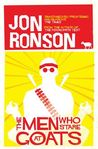
BOOK REVIEW: The Men Who Stare at Goats by Jon Ronson

The Men Who Stare at GoatsThe Men Who Stare at Goats by Jon Ronson
My rating: 5 of 5 stars

Amazon page


Ronson investigates the US military intelligence community’s forays into extrasensory perception (ESP) and mind control. Those who’ve seen the movie loosely based on this book will be aware of the quirky-humorous tone it takes. (If the title wasn’t enough to convey that the author was aiming for quirky humor.) Ronson’s style, favoring punchy simple sentences, offers a kind of deadpan delivery that supports the tone of the book.

That said, the book also has a sad edge as it can be seen as a commentary on military officers who came back from the war in Vietnam damaged and grasping at straws as to how to prevent history from repeating itself. It’s as if what these men experienced made some eager to believe because they so wanted to believe they could win with the mind and avoid the carnage of war.

While the book’s sixteen chapters are not divided by the author, they can be roughly divided into three parts. The first is the pursuit of ESP starting in the late 1970’s. This includes remote viewing and the titular psychokinesis (i.e. starring goats to death.)

The middle section is the resurgence of these esoteric approaches in the late 90’s and, especially, after 9-11 (also speaking to how dire blows to the psyche lead to wild approaches.) Much of this section is about mind control rather than ESP. One may remember the news story of the “I Love You, You Love Me” song from Barney [i.e. the purple dinosaur] being played over and over again to break terror suspects. The question remaining unanswered is whether there was anything else going on besides torture by Barney song (i.e. subliminal messages or sonic / ultrasonic frequencies [as used in non-lethal weapon technology.])

The latter section deals with the famous case of a scientist who jumped from a hotel room window to his death. It was later admitted that the scientist had been the unwitting victim of hallucinogen experimentation as part of the famed MKUltra project, and his death was written off as a trip gone bad. Ronson presents the story of the scientist’s son, a man who firmly believes that the story copped to was neither the full story nor the true story.

This book is interesting and entertaining, despite the fact that many of the questions that Ronson sets out to answer remain unanswered and probably always will. While the author got several key people to talk to him, the projects discussed are highly classified and the possibility of disinformation is ever-present.

Ronson manages to walk a fine line throughout the book. He presents all this quirky and bizarre activity in a way that neither comes across as mocking nor even particularly skeptical. (His punchy delivery does hint at this intention on occasion.) He lets the reader do the mocking and be the skeptic. At times he comes across as a believer. That is, while many of the happenings of the book reflect bat-shit crazy behavior / decisions, he suggests that all but the most hardened skeptics would believe that some of the people involved had inexplicable gifts.

I’d recommend this book. If you’re interested in government sponsored esoteric activities like psi and mind control and related scandals / conspiracies, you’ll find it fascinating. On the other hand, even if you’re not, it’s still an entertaining read that provides a sort of commentary on the effects of war on the psyche.

View all my reviews

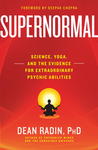
BOOK REVIEW: Supernormal by Dean Radin

Supernormal: Science, Yoga and the Evidence for Extraordinary Psychic AbilitiesSupernormal: Science, Yoga and the Evidence for Extraordinary Psychic Abilities by Dean Radin
My rating: 4 of 5 stars

Amazon page


With this controversial book, Dean Radin presents the scientific evidence for an array of psychic powers, but he frames the discussion in terms of yogic siddhis. “Siddhi” is a Sanskrit term for an ability that isn’t seen among the general population–at least not reliably so– and for the most part these “accomplishments” correspond to the categories discussed in parapsychology (i.e. telepathy, precognition, psychokinesis, and clairvoyance.) [Note: As mentioned, this is a controversial book. I will attempt to provide as unbiased a review as possible. I am generally skeptical, but don’t believe in poo-pooing the study of subjects because they offend my skeptical sensibilities. Furthermore, I try to keep an open mind because: 1.) there is no scientific consensus about what consciousness is or how it works, 2.) quantum biology is a subject in its infancy and we may yet learn there is more quantum “spookiness” going on in the brain than we think. 3.) for all I know we are in an simulation and then it’s all a matter of programming.]

The yogic emphasis doesn’t change the book much from the pop psych literature review of parapsychology studies it would otherwise be, except to necessitate background information on yoga and siddhis. However, this emphasis may or may not have opened up a huge additional readership. Outside of a fringe, siddhis aren’t much in vogue among yoga practitioners these days. Among modern day yogis and yoginis, there are some who believe in them and some who think they’re throwbacks to an era of superstition, malnutrition, and wishful thinking. However, even among the former, siddhis are generally considered a distraction. The advice of most of the great yogis has been to not get lost in the pursuit of such powers because chasing siddhis can derail one from one’s ultimate objective (e.g. liberation.) Still, if even a small fraction of yoga practitioners take an interest, that’s a fairly large readership.

So what exactly is the controversy? Obviously, there are many divergent demographics with differing views on the topic. For hardcore skeptics, parapsychology is right up there with alien abduction, bigfoot /yeti sightings, and the anatomy of the Loch Ness monster with respect to being a legitimate topic for scientific study. On the other hand, there are believers who are offended by the mere notion of studying such phenomena with science, and who say such investigations are an assault on their beliefs.

But that’s not a very interesting controversy—i.e. there are some people who won’t believe in such abilities no matter what the evidence, and others who will believe in them no matter what science has to say. So let’s chop off the hardcore skeptics and hardcore believers and ask what the controversy is as it pertains to those of us who consider evidence when drawing conclusions.

The root of the controversy can be stated rather quickly and clearly. Here it is: the effect size is small but statistically significant. What does that mean? Say this study asks a subject to determine which of five randomly selected shapes has been chosen using nothing but his / her mind. Using pure guessing, one would expect to be right 20% (i.e. 1/5th) of the time. If a person happened to get 32% right in a given trial, that means nothing because small samples don’t give one a convergence towards a mean value. (i.e. Intuitively, you know that if you flip a coin 10 times and get 7 heads, it doesn’t necessarily mean anything. If you repeat that 10-flip set 10,000 times, and still get 70% heads, then you probably have a trick coin or something else odd is going on.) So the issue is that even when experimenters repeat the experiment over and over again such that the average value should converge on 20%, it doesn’t. It stays at, say, 30% (exact effects vary but it’s on this order.)

At this point the reader might be thinking of all the factors that could result in this effect (i.e. cheating [insider or outsider], subconscious observation of facial expressions, random selection that is biased, etc.) Well, so have the scientists. In any study, one wants to account for alternative explanations to the utmost. Over the years, researchers like Radin have put all manner of protections in place from quantum random number generators to booths with extreme sound-proofing and Faraday cages (prevents radio signals from transiting.) Still they get this small positive effect that can’t be explained by alternative explanations.

There is also the issue of the filing drawer problem, which Radin devotes considerable space to discussing. It’s the idea that when drawing conclusions from many similar studies, one must accept that there may be many unpublished studies that sit in file drawers because they didn’t produced negative results. These filed / unpublished studies could negate the outcome of the body of studies of that nature. While this remains an open criticism, there is mathematics for determining how many negative studies would have to be turned up to make the results insignificant. Radin argues that the numbers calculated strain credulity.

So this “small but statistically significant effect” is generally agreed upon by all, excepting conspiracy theorists. Now we get to the controversy, which is how to explain this effect. Skeptics run the gamut from hot-blooded haters who claim that it’s all just a scam perpetrated by hoaxers with tenure, to more diplomatic challengers who provide thoughtful, plausible, and non-nefarious explanations for what they believe are false results. Said objections include file drawer problems, statistical “crud factor” (an observed effect in which large sample size studies can show a significant correlations between any two random variables—i.e. everything is correlated with everything else to some degree), and outlier effects.

The latter is a particularly revealing controversy. Say your study results in this 30% instead of 20% effect, and there’s one subject in the study who (over many trials) got the shape right 80% of the time. If you’re a skeptic, you call that an outlier and you want to cut it out of the study because it may be causing part, most, or all of the effect you see. Your assumption is that that this outlier could be anything from a data entry error to an outright cheater, but it’s obviously not a gifted psychic. If you’re a believer, not only do you want to keep that result, you want to find that person and study them to find out if the result was a one-time fluke, or if you have some rare, gifted person.

The book is arranged into three parts. The first part offers background on yoga and siddhis. The second part is the heart of the book and it presents an overview of results from studies of precognition, telepathy, psychokinesis (both of animate and inanimate objects), clairvoyance, and the effect of meditation on these abilities (which also shows a small positive effect, i.e. the general population outdoes probability by a little bit and experienced meditators outperform the general population by a little bit.) The last section is just a couple chapters about the future of parapsychology.

I found this book to be interesting and thought-provoking. Radin comes across as a reasonable investigator who is willing to accept that there is a lot of duplicity going on out in the world, but yet when one uses the methods of science one obtains results that would be generally accepted as successful across the social sciences. At times he does go on anti-skeptic rants. On the other hand, one can imagine his frustration in dealing with individuals unwilling to pin down how much higher the bar must be for parapsychology results over results in more mainstream topics. I think Radin’s greatest mistake was in discussing levitation. Besides at a quantum level, the effects of gravity are well-understood and non-negotiable. While our lack of understanding of consciousness leaves wiggle room to at least consider some unusual happenings, levitation seems a non-starter. Fortunately, as it hasn’t been studied, Radin just presents a couple historical anecdotes and moves on (while—to be fair–acknowledging the fundamental risk in relying on anecdotes.)

I’d recommend this book. I can’t say it swayed my belief on the topic, which tends skeptical, but it did inform my confusion. (It should be pointed out that not all these abilities are equally reviled by science. Precognition is the most fundamentally opposed because it seems to violate the fundamental cause and effect nature of the universe at our scale and larger [as opposed to the quantum level were all sorts of weird happenings transpire.]) I do agree with Radin that there shouldn’t be taboos in science in which scientists are afraid to study a subject of interest because the prevailing notion is that it probably doesn’t have merit. If there weren’t scientists with the cojones to study “crazy stuff” we’d no doubt be far behind our current understanding of the world.

View all my reviews

5 Bits of Wisdom from The Matrix Movies

5.) Wisdom: Choice is not as it seems.

Quote: No, you’ve already made the choice. Now you have to understand it.
Said by the Oracle to Neo in “The Matrix Reloaded” as they discuss a dream in which he sees Trinity falling.

Interpretation: Studies in neuroscience have repeatedly validated the notion that by the time we think we’re making a decision at a conscious level, we’ve already made it on a subconscious level. While many suggest this means that the verdict is in and free will is completely illusory, another way of looking at it is that one must understand one’s decisions in order to begin to regain the rudder on one’s life.


4.) Wisdom: Courage elevates: or, if you don’t run, he won’t chase you.

Quote: He’s beginning to believe.
Said by Morpheus to Trinity in explanation of why Neo isn’t running from Agent Smith in the subway.

Interpretation: My mother used to say, “If you don’t run, he won’t chase you” with respect to being chased by my older brother. It seemed like insane advice at the time; the alternative to being chased being beaten down. However, now I can see that even taking a butt-whooping elevates one’s spirit over engaging in prey behavior.


3.) Wisdom: Rationality is a thin veneer.

Quotes: Beneath our poised appearance we are completely out of control. & It is remarkable how similar the pattern of love is to the pattern of insanity.
Said by the Merovingian to Morpheus, Trinity, and Neo.

Interpretation: While one might like to dismiss the Merovingian’s comments as the cynicism of a hedonist, the undeniable fact is that we have animal biology and it influences us more than we pretend.


2.) Wisdom: The world contains more Cyphers than not.

Quote: Ignorance is bliss.
Said by Cypher to Agent Smith as he plots his subversion in order to be put back into the Matrix.

Interpretation: Most people are happy with their illusions, rely on them as coping mechanisms, and will respond unfavorably to attempts to strip them way. The illusion in question may not be so much that the world is completely fake as much as biases such as the self-serving bias (i.e. people attribute successes to their inherent awesomeness but blame failures on external sources.)


1.) Wisdom: There are limits to being cerebral.

Quotes: Don’t think you are, know you are. & There’s a difference between knowing the path and walking the path.
Both are said by Morpheus to Neo. The former quote is delivered in the sparring program when Neo isn’t performing up to his potential. The latter is said after Neo & Trinity rescue Morpheus and Neo tries to tell Morpheus what the Oracle revealed, but Morpheus quiets him with said words.

Interpretation: I hope I haven’t muddled this bit of wisdom by choosing quotes in which Morpheus uses the word “know” in two different ways. In the first quote, Morpheus contrasts knowing with thinking, and he means that Neo must not treat it as an intellectual exercise, but rather feel its inherent truth deep down. In the second quote, he contrasts knowing with doing, and in this case “knowing” is the cerebral / thinking activity in comparison to doing (i.e. “walking the path.”) However, the gist is the same, you must approach some things–to use the Oracle’s words–balls to bones.

BOOK REVIEW: Challenger Deep by Neal Shusterman

Challenger DeepChallenger Deep by Neal Shusterman
My rating: 5 of 5 stars

Amazon page


“Challenger Deep” is the story of a smart and artistically talented young man, Caden Bosch, who is afflicted with Schizophrenia. There are essentially two story lines being told in parallel. One is the real world, and in the chapters in this line we see Caden’s descent as it takes place. From references to past events, we gain insight into how Caden was before the disease. In the early part of the book, these chapters are set at school and at home, and then later at the mental hospital at which he’s admitted as a patient.

In the other story, Caden is on a sailing ship headed to the Challenger Deep—the deepest portion of the Marianas Trench at almost 7 miles down, and—symbolically—Caden’s rock-bottom . Shipboard life is Caden’s hallucinated experience of the mental hospital. Over time the reader begins to match up characters from the real world with those from the delusion—both patients and staff members. This is a mutinous vessel, and the tension reflects the pull between Caden’s desire to be well and the appeal of the world of delusion.

Over time the author shows key events in both lines and the reader can connect them up to interpret how delusional Caden experiences the world. The story isn’t strictly told in a chronological order, though the broad sweep of it is. The bits of disjoint create no confusion while helping to convey the nature of a fractured mind. This works, in part, because the book is told over 161 short chapters, and, because the chapters are so short, a diversion doesn’t take one far and it’s easy to show the match up of events. The book artfully conveys the bizarreness of a dreamlike world of delusion while remaining clear and readable. Any confusion in the early chapters becomes rectified as the author reveals how the delusional world and the real world zip together.

This book was imaginative, enjoyable to read, as well as allowing the reader insight into the nature of mental illness. Atypical of a work of fiction, there is a resources section that provides contact information for organizations that support mental health.

I’d highly recommend this book for fiction readers.

View all my reviews

BOOK REVIEW: How We Feel by Giovanni Frazzetto

How We FeelHow We Feel by Giovanni Frazzetto
My rating: 4 of 5 stars

Amazon page


Frazzetto’s book tells us what neuroscience can and can’t tell us about seven core emotions: anger, guilt, anxiety, grief, empathy, joy, and love. Doing so puts the neuroscience of emotion into a broader context of art, philosophy, the humanities, and the legal / political domains. Most often this serves to make the book more interesting by offering stories beyond the case files of neurologists and neuroscience researchers, but it does result in occasional editorializing.

The book consists of seven chapters, each of which is linked to one of the emotions listed in the preceding paragraph. These chapters always tell us the rudiments of what science has learned about the brain’s role in said emotion, but they often offer insights from other disciplines as well as providing more general information about the brain that the author found particularly relevant to the topic at hand.

The first chapter delves into anger. Besides the neuroscience of rage, we learn a bit about the expression of emotion (e.g. through facial appearance; a theme revisited in other chapters), and the degree to which genetics plays a role in proclivity towards anger. This chapter serves to set up general concepts, and so we also learn about what an absence of emotion looks like (e.g. indecisiveness.) And in compliance with the law that every pop science book on neuroscience tell the story of Phineas Gage (the foreman who got rebar shot through his brain and lived to tell the story—though in an uncharacteristically hostile way), Frazzetto knocks it out early.

Chapter two explores the topic of guilt. It should be noted that some of these chapters discuss more than one related emotion, and here we learn how shame and regret are differentiated from guilt. There’s an interesting story about Caravaggio and how his own guilt-ridden story influenced one of his most famous paintings.

Chapter three is about anxiety, and also takes on fear. In addition to the neuroscience, we get a discussion of relevant philosophy, specifically that of Heidegger. Here, the author also describes brain plasticity.

The next chapter investigates grief. As I suggested above, there are multiple points where emotional expression is discussed, and this chapter has one of the most extensive of such discussions. In terms of general concepts, Frazzetto introduces the reader to neurotransmitters. One also learns how grief is related to physical pain.

Chapter five elucidates empathy. A lot of this chapter discusses acting, and the need for actors and actresses to be able to acquire empathy from the audience. The reader learns the story of Stanislavski, and how he went about creating his self-named acting system which remains widely used. This chapter also explains mirror neurons that allow one to recognize expression and to mimic others.

The penultimate chapter is about joy, and here we learn more about expression of emotions and, specifically, the seeming universality of smiles. There is a discussion of poetry as it pertains to the emotion at hand. Having introduced neurotransmitters earlier, the reader learns about dopamine, its role in happiness, and how a number of drugs have been created that increase our natural dopamine’s effect or mimic it.

The last chapter is about love. Of course, we learn about oxytocin and vasopressin, two neurochemicals famously associated with loving behavior. There is also a fascinating discussion of Capgras Syndrome. In this condition, the patient feels that his loved ones have been replaced by impostors. That may not seem relevant until one realizes that the proposed mechanism for this illness is damage to parts of the brain that control emotional connection. Without an emotional connection, the person feels that said individuals can’t be his / her dearest friends and family—though his senses register that they are exact duplicates in every way. The brain builds a rationalization that they must be impostors. Of course, no emotion evokes more resentment towards materialist explanations rooted entirely in biology than that of love.

The book is extensively annotated and also has a bibliography. There are many graphics throughout the book from line drawn diagrams of brains to photos of brain scans to the artwork “David with the Head of Goliath” mentioned relative to the discussion of Caravaggio’s guilt.

There are a number of books in this domain (i.e. the neuroscience of emotion) and if you were only going to read one, I don’t think I’d recommend this one as it. However, if you are into this topic, it is definitely worth a read. It’s interesting and insightful, and has a unique approach.

View all my reviews

BOOK REVIEW: Sitting Still Like a Frog by Eline Snel

Sitting Still Like a Frog: Mindfulness Exercises for Kids (and Their Parents)Sitting Still Like a Frog: Mindfulness Exercises for Kids by Eline Snel
My rating: 4 of 5 stars

Amazon page


Anyone who’s ever taught children mindfulness, concentration, or relaxation knows that one can’t use the same tried and tired approach one does with adults. One must recognize the strengths and weaknesses that children’s level of cognitive development brings. [That said, I’ve found myself in front of a room full of kids who sat with the unflinching stillness of bronze Buddha statues, but that’s because regular practice was part of their school experience.] This is the twin premise of Snel’s book: that one needs to tailor one’s approach to teaching children to be mindful, and that their practice needs to be integrated into their life on the whole.

It should be pointed out that the book isn’t just a collection of exercise for children. It’s also a book for parents to help them align their approach to parenting to the mindfulness that the child is developing. It’s also a book of application. That is, it’s not about practicing mindfulness meditation in the abstract; it’s about using the understanding that arises from that practice to improve behavior and emotional coping.

Chapter 1 introduces the topic of mindfulness and sets up the book’s approach as well as explaining the use of the audio exercise that go along with the book. The second chapter explains a mindful approach to parenting by which parents can adopt a calmer and less emotionally charged approach to interacting with their child. Chapter 3 explains how and why breath is used as the basic anchor point to life in the here and now. Chapter 4 suggests how attention can be improved, and mindful eating is used as a tool to advance this objective. The next chapter explores how mindfulness can be practiced using the body as a means to anchor one’s awareness while simultaneously being more aware of what’s going on with one physically. There is discussion of mindful walking, but most of the chapter is about teaching children to be more cognizant of what they feel as a precursor to being more emotionally aware.

The next several chapters cover emotional awareness and how to improve response to emotional situations (both for the child and for the parent.) Chapter 6 uses the analogy of a weather report as a means for children to evaluate their emotional state. Chapter 7 expands on the topic by considering how one can manage one’s response to emotions. The crucial topic of witnessing the changing nature of emotional states is the subject of Chapter 8.

The last two chapters examine how to cultivated desirable character traits in children. The penultimate chapter describes how kindness can be fostered as a skill in children. The last chapter is entitled “Patience, Trust, and Letting Go” and that probably adequately describes the gist of the topics covered. The concept of an “inner movie theater” is discussed as a tool to facilitate building the desired characteristics.

There’s a single page bibliography and a table of audio exercises at the end. As far as graphics are concerned, they are mostly whimsical drawings of frogs.

I found this book to be concise, informative, and designed to appeal to the child’s need for concrete–as opposed to abstract—conceptualization of this, otherwise cerebral, topic.

I’d recommend this book for parents, teachers, and others who interact with children.

View all my reviews