Taken in April of 2018 on the Annapurna Sanctuary trail


Taken in April of 2018 on the Annapurna Sanctuary trail
 The Graveyard Book by Neil Gaiman
My rating: 5 of 5 stars
This book begins with a family being murdered by Jack, a cold-hearted killer – a family all save the infant. It’s readily apparent that this isn’t a random violent crime. For one thing, the fiend is far more concerned with finding the baby so as to complete his treacherous task than he is with absconding with loot or reveling in carnage. We don’t know why the family is killed or how a baby could possibly be a worthy target for an assassin, but it’s a mystery that will play out over the course of the book. What we do know is that the boy, Bod – short for Nobody [Owens] – crawled from his crib, out of the house, and into a graveyard that night and that he was taken in by the dead [and a vampiric guardian named Silas] and granted free access to the graveyard.
While the plot is about a killer on the loose intent on murdering Bod, a lot of the book deals with the boy’s challenges as the one living human among a community of the dead. Silas and his adoptive – if deceased – parents, the Owenses, are reluctant to let the boy out of the graveyard because they know he is in danger and they can protect him there were a different set of rules apply, but he has a desire to experience the world. An abortive experiment with going to school fails because Bod sticks up for bullied kids and can’t help but employ some of the skills he’s acquired as a denizen of the graveyard. In the graveyard, he is a living person among the dead, but he is no less the outsider among the living.
This is written for a young audience, and is therefore highly readable while avoiding all the gore that one might expect of a book that begins in murder. Gaiman masterfully creates the ghoulishness and suspense without being horror, per se. I’d recommend this book for readers of low (intrusion) fantasy works.
 The Journey to the East by Hermann Hesse
My rating: 5 of 5 stars
This lesser-known Hesse work adopts a theme common throughout the author’s books in that it’s philosophical man-versus-himself fiction. The book’s protagonist, H.H., is a member of a secretive league [called “The League”] with whom he is undertaking a journey of self-discovery. H.H. fails to complete the expedition, and that fact haunts him into old age. Ultimately, H.H. finds Leo, a servant who’d been on the journey with him, with whom H.H. had a great affinity, and whose disappearance (along with some loot) led to H.H.’s abandonment of the trip. In the process, the lead discovers that nothing was what it seemed.The book examines how vulnerable people are to disillusionment and how quickly they can lose their passion, and it urges the reader to consider from what source one draws one’s strength.
This novella is a little under a hundred pages, and is told in five chapters. The first couple of chapters describe the ill-fated journey. The third chapter is a pivot in which H.H. is considering his inadequate attempt to chronicle events, and is advised to get closure by tracking down Leo. In the last two chapters, H.H. does find Leo, receives the man’s wisdom, and ultimately finds out what really happened.
I enjoyed this book. It’s a quick and simple read, but is extremely thought-provoking. I’d recommend this book for anyone who likes to think about life’s big questions.
 How to Hypnotise Anyone – Confessions of a Rogue Hypnotist by The Rogue Hypnotist
My rating: 4 of 5 stars
This is the first book in a popular eBook series on hypnosis. The series is written by an anonymous hypnotist and neuro-linguistic programming (NLP) practitioner from London. As the first book, it addresses the basics of hypnotic induction, including background about what a hypnotic trance is and how it’s achieved, as well as fundamentals of voice and word choice that can influence the hypnotist’s effectiveness. The book also introduces “convincers” and “deepeners,” practices that help get the subject in the right state of mind for hypnosis and which take them deeper into trance, respectively. [Though, the author argues that the former aren’t really necessary.]
This short book consists of 29 chapters and 5 appendices. The “chapters” are as short as a single paragraph and lay out the concepts, and the appendices are scripts for hypnotic induction or trance deepening. This is a short book, and some have complained that it reads more like a detailed outline than a book. While it’s true that it’s a “just the facts” kind of format, many will find that preferable, depending upon how one likes to take in information. As long as you’re not expecting a lot of narrative examples, you may find it’s just what you are seeking. It’s written in a conversational style as if the author were telling one the information in person.
Given the controversial title, a reasonable question to ask is whether the book is practical or a lot of pie-in-the-sky ramblings by someone who doesn’t know what they are talking about. What’s the controversy? While there are many hypnotists and would-be hypnotists who claim that they can induce a hypnotic trance in anyone, regardless of the individual or the situation, the science suggests that there is continuum of degrees of hypnotizability. The distribution along this continuum follows a bell curve. What’s this mean? Almost everyone can be hypnotized to some degree, but at one tail there are people who are extremely suggestible – however, at the other end there are people who just can’t be induced. Because there are so many Hollywood misconceptions (see: “Now You See Me”) and hypnosis related fantasy and fiction, it’s not surprising that there are a lot of wrong ideas out there. [I should point out that everyone probably achieves a trance state at some point organically, but some people seem unable to be induced into that state because of anxiety, resistance, or otherwise.] Having said all that, it seemed that the author knew of what he wrote and was quite open about the myths, misconceptions, and limitations.
Later titles in this series address such topics as the details of language for hypnosis, escaping cultural hypnosis, applications for anxiety reduction, uses for combating addiction, as well as the more bizarre and arcane side of the subject.
I’d recommend this book for anyone looking for a primer on hypnosis. I was not bothered by the sparse approach. It’s quick and readable, and seemed to offer well reasoned approach to hypnotism.
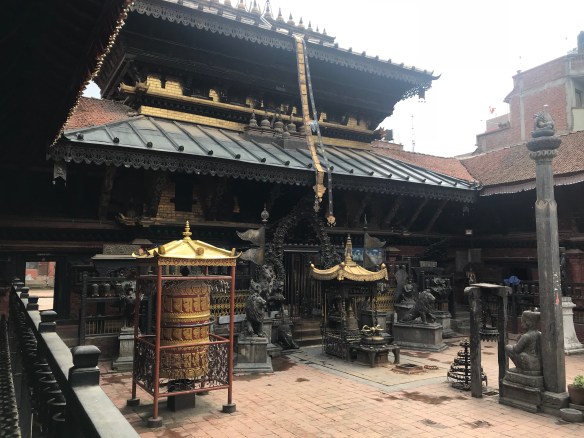
Taken in May of 2018 in Nepal.

In bas relief in Kathmandu’s Durbar Square.

Painted on the wall in Patan’s Durbar Square.