Unknown's avatar

About B Gourley

Bernie Gourley is a writer living in Bangalore, India. His poetry collection, Poems of the Introverted Yogi is now available on Amazon. He teaches yoga, with a specialization in pranayama, and holds a RYT500 certification. For most of his adult life, he practiced martial arts, including: Kobudo, Muay Thai, Kalaripayattu, and Taiji. He is a world traveler, having visited more than 40 countries around the globe.

DAILY PHOTO: Chitradurga Below

Banashankari Temple; Taken on September 11, 2021 at Chitradurga Fort
Gunpowder Mill
Stepwell

BOOK REVIEW: Socrates: A Very Short Introduction by C.C.W. Taylor

Socrates: A Very Short IntroductionSocrates: A Very Short Introduction by C.C.W. Taylor
My rating: 5 of 5 Stars

Amazon.in Page

In Plato’s Socratic dialogues, Socrates is forever challenging sophists and others who propose to know what virtues are while they are demonstrably unable to define or delineate them. I wonder how he would have felt about being one of the foremost examples of a person that people firmly believe they know, when there is good reason to believe that much of what we know is false. Socrates is described in comedic plays like Clouds by Aristophanes, but those descriptions are written for comedic effect. There is a large body of works by Plato describing Socrates’ philosophical jousts, but it seems clear that some of these writings reflect Plato’s views which may or may not have been shared by Socrates. There are a few matters of official records, and numerous isolated mentions from people who either loved or loathed Socrates (loving and loathing not being states conducive to accurate reporting.)

This book attempts to concisely review what is known about Socrates and his philosophy, what is myth, and what can, at best, be regarded as the features of a fictional Socrates. The book starts with a chapter on Socrates’ life and what is widely believed true about his biography. Then the book outlines the body of writings that discuss and describe Socrates, particularly those of Plato, Xenophon, and Aristotle. Next there is a chapter that explores the philosophy Plato’s Socrates, a fictional construct partially based on the man and partly shaped by his student’s views. The last two chapters discuss the legacy of Socrates (real and mythical) in philosophy and culture.

There is a Further Reading section at the end to give the reader some sources to continue their investigations. I found this to be a fine overview, well-organized, and readable. It will be more useful to those who read Plato, and relevant works of Xenophon.

View all my reviews

BOOK REVIEW: Henry VIII by William Shakespeare

King Henry VIIIKing Henry VIII by William Shakespeare
My rating: 5 of 5 stars

Amazon.in Page

This play takes place over a period of time, for want of a better measure, straddling the first two [of six] marriages of Henry VIII. It doesn’t reach the ill-fated end of Anne Boleyn, but rather finishes with the baptism of the girl child she birthed [Elizabeth, who will later be Queen.] [Of course, the failure to produce a male child was the downfall of Katherine of Aragon’s Queenship, so the birth of Elizabeth doesn’t bode well.]

In as much as a history has a theme, this one would be the conflict between the aristocracy and the clergy. This is first, and most extensively, seen through the rise and fall of Cardinal Wolsey, who wins the favor of the King in the Cardinal’s conflict with the Duke of Buckingham, but later Wolsey gets ousted after an aristocratic cabal diverts the Cardinal’s mail to the King. Henry discovers that Wolsey has recommended denial of an annulment of Henry’s marriage to Katherine, despite the fact that Wolsey was telling the King to his face that the marriage’s end had his endorsement. Later, we find aristocrats (the King’s Council) taking on the Archbishop of Canterbury, Cranmer, but Henry sides with the Archbishop as he once had with Wolsey.

The play’s major events are the execution of Buckingham, the divorce from Katherine, the marriage to Anne Boleyn, and the birth of Elizabeth.

This isn’t the most compelling of the Shakespearean histories, but it does have its intrigues. No doubt it would be a bolder play in the absence of the authoritarian nature of monarchy, but it’s still worth reading.

View all my reviews

DAILY PHOTO: Chinese Gates in the Chinese Garden, Rizal Park

Taken in December of 2017 in Manila

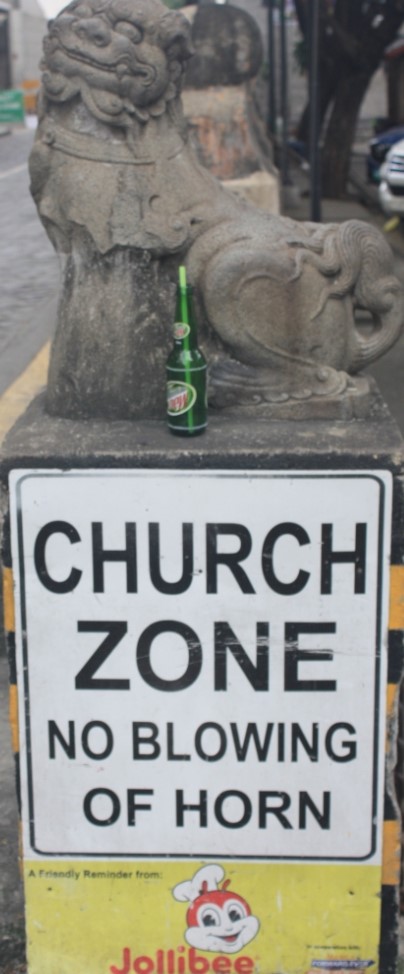
Manila Limerick

There was a grumpy man of Manila
who didn't care the slightest scintilla.
He'd lay on the horn -
even on Sunday morn.
When the sign failed, the Church hired a guerilla.

BOOK REVIEW: Basho’s Haiku Journeys by Freeman Ng

Basho's Haiku JourneysBasho’s Haiku Journeys by Freeman Ng
My rating: 4 of 5 stars

Amazon.in Page

Out: October 19, 2021

The first thing a prospective reader should be clear about is that these aren’t Basho’s haiku. Basho wrote travelogues in haibun (a spare form of prose typically matched with one or more haiku,) and so one might expect the poems to be from them. On a related note, while all of the poetry is haiku in form, not all of it is haiku in substance. That is to say, it’s all presented in a three-line 5 – 7 – 5 syllable format, but some of it reads like a prose description of events chopped up into 5 – 7 – 5 syllable bit-sized pieces. That’s not to say that there aren’t many poems that do have the feel of true haiku, presenting spare natural imagery juxtaposed but not explained, analyzed, or judgement-laden. It seemed like the further into the book I got, the more of the poems felt like proper haiku.

It is a children’s book, so I don’t think it’s a major concern that it focuses on the most rudimentary elements of haiku (i.e. syllable count and nature imagery) at the expense of subtler elements. The Zen nature of Basho’s haiku might be challenging for a young reader. I addition to the colorful and whimsical artwork, showing prominent places from Basho’s travels, there is a single page explanation of haiku to help get kids writing their own.

If you’re looking for a book to get a child interested in nature, haiku, or travel, you should give this one a look.

View all my reviews

What’s in a Name? [Kyōka]

Pantropical Jumping Spider
i was brave
when facing this spider,
until I learned
that within its name
was the word, "Jumping"

DAILY PHOTO: Victoria Falls Bridge in the Light of the Rising Sun

Taken in May of 2017 at Victoria Falls

BOOK REVIEW: After the Fall by Laurent Queyssi

After the FallAfter the Fall by Laurent Queyssi
My rating: 3 of 5 stars

Amazon.in Page

Out: October 12, 2021

This isn’t exactly a thinking person’s read. It’s a fine, if simple, return home quest story with plenty of action. But it feels like the production process began with an artist’s Wishlist – e.g. “I would like to draw a comic that combines my love of dinosaurs, aliens, roided-up dudes, scantily-clad women, fantasy genre weaponry, bare boobies, zombies, and set it all within a crumbling 21st century Earth city.” To which the writer said, “We can do that! I’ve been working on this story about a friend who got his headphones stolen.” And the artist said, “That sounds perfect!”

It’s not until the end of the book that we learn what could create such a disparate set of conditions. We know that nuclear radiation could only account for the super-huge and preternaturally-aggressive animals, as well as the superpowers. How are we to account for the fact that all the men look like Conan the Barbarian, all the women look like their previous gig was sitting atop a muscle car for a muffler shop calendar, and some of the dudes look like video game monsters / aliens? I won’t spoil the mystery radiation that could result in such a range of afflictions, as well as bringing back the dinosaurs, except to say that I didn’t find the explanation compelling.

Unless you’ve been looking for a book that combines pterodactyls, aliens, superpowered anti-heroes, boobies, roided-up dudes, and stylized battle axes, you can probably pass on this one. But, if you’re into such things,…

View all my reviews