
Teachable and Unteachable Lessons

[Note: This is posted in my Jissen Budōka blog as well.]

Source: Wikipedia; Status:  Public Domain

Source: Wikipedia; Status: Public Domain

Miyamoto Musashi, who was undefeated in over 60 duels, claimed that he never had a teacher. Some historians refute this claim. Whether one accepts it or not, the statement astonishes.

Musashi wasn’t talking only about martial arts, but about the many areas in which he was accomplished. Not being a painter or a sculptor, I can’t say how important a teacher is in such domains. But it’s easy enough for me to imagine a successful writer who never took a formal class in writing; someone who read profusely and practiced his (or her) craft relentlessly could do it. (Certainly, one can easily imagine successful writers whose formal education was in some area other than writing because there are so many of them–probably at least as many as those whose education was in writing. Examples include: Vonnegut [Chemistry], Crichton [Medicine], Zane Grey [Dentistry], Ursala LeGuin [Anthropology], and J.K. Rowling [French]. That’s not even to start on the many literary legends who dropped out all together– e.g. Dickens, Faulkner, Twain, H.G. Wells, and Jack London.) This isn’t to say that writing teachers don’t make writing better, but just that there is a path to this skill that doesn’t involve being fed lessons.

However, I struggle to imagine a martial artist achieving so much without a teacher. Boiled down to its most workaday definition, a martial art is a collections of lessons about what works in a combative situation. This is what separates the importance of a teacher in martial arts from that of a discipline like writing. In writing, one has the leisure to make one’s mistakes, learn from them, and self-apply course corrections. Musashi was in life or death duels; he couldn’t learn lessons at such a leisurely pace and in such an iterative fashion.

A martial arts teacher has a number of roles, such as preventing inertia (slacking) from taking hold in the training hall. However, the most fundamental purpose is to pass along the collection of lessons so that a student doesn’t have to learn them all by way of personal experience. Most of us aren’t Miyamoto Musashi; we can’t survive the process of learning all our own lessons.

Needless to say, I am a firm believer in the value of a good teacher. I’ve had several over the years, and I received valuable lessons from all of them–all with different, but no less valid, points of emphasis and flavor.

Having said all that proceeds, there’s much that cannot be taught. Such lessons may be described or discussed, but they cannot be learned except through the initiative of the student. I said that most of us can’t survive the process of learning all one’s own lessons, but I’ve increasingly come to believe that one can’t survive learning none of them either. In the beginning, one must be fed the lessons from a teacher in order grow. However, as the decades pass, one increasingly needs the space to learn one’s own lessons. If one lacks said space, one will stagnate and eventually the wheels will roll off one’s training altogether.

So what are the unteachable lessons? Knowledge can be conveyed, but not everything that a martial artist must learn is knowledge. Confidence cannot be taught. A teacher may explain–or even show–how he or she became confident, but that won’t translate one iota into the student being more confident.  This is like a Buddhist monk telling one that “desire is the root of suffering.” One may understand that statement. One may believe the statement. However, one’s suffering won’t decrease because one has the knowledge.  One’s suffering will only decrease if one conscientiously does the hard work of reducing one’s desires.

Another area of unteachable lessons are the lessons that the teacher has never learned. Loyalty is a great virtue, and so there may be a tendency to restrict one’s learning to the lessons of one teacher. However, even if one has an outstanding teacher and are practicing a great lineage, blind spots happen. The only way to learn whether there is anything of value obscured in those blind spots is to throw off one’s blinders and have a look for oneself.

What blinders? An excellent and tricky  question.  It’s like when someone says, “it’s not what you said, but the way you said it.” We all understand that there is some intangible character in language that is commonly understood but not easily seen or defined. In any culture (and a dōjō contains a culture, believe me) there’s always a collection of norms, rules of thumb, ideas, beliefs, mores, credos, etc. that come to be taken so much for granted that they become an invisible filter through which one sees the world. This isn’t an inherently bad thing, and it’s probably necessary to produce sufficient order in a chaotic world in which to learn and grow. Having said that, some of the ideas and beliefs in our cultural filter may be arbitrary, or at least not universal, but yet we don’t necessarily see the potential for error because we are seeing the world through the cultural filter. We take for granted that grass is green, but what if we see it through a yellow filter? Then it’s blue. Right?

Why I’m a Slacker Lately: or, Mysterious India

What's this India I hear so much about?

What’s this India I hear so much about?

I haven’t been writing, editing, or conducting research much as of late. This has probably gone unnoticed in the vastness of the cyberspace, but in the spirit of blogging I thought I’d answer a question that no one asked. I recently learned that my wife and I will probably be moving to Bangalore, India later in the year. This has kept me physically occupied with home repair and boxing up the house. In my non-labor moments, my mental faculties are largely devoted to understanding the country in which I will be living. I’ve never been there before.

India is a harder nut to crack than one might think. Yes, there is the obvious. At 1.2 billion people, it has the world’s second largest population and is screaming up on China for number one. It’s the seventh largest country by land area. It’s the birthplace of that most excellent yoga that keeps all the twisty people twisty. It’s home of tandoori chicken and naan bread, both of which I love.

However, that’s all superficial. I must sadly admit that–until recently–my in-depth knowledge has come from three sources:

1.) The Jungle Books by Rudyard Kipling

2.) A junior high school field trip to see the film Gandhi, which I had been under the impression was six hours long, but, according to Wikipedia, is only a little over three hours long. I guess that, just as kids think everyone is taller, a kid’s perception of Oscar-winning motion picture run times is greatly distorted.

3.) A ton of reading about the Indo-Pakistani rift and its strategic implications as a graduate student studying International Affairs with a focus on Strategic Studies.

With respect to number 3, the amount of study of this region was not commensurate with the fact that the Indo-Pakistani border region is generally voted “Most Likely Point of Origin for Global Nuclear Winter.” I’m not suggesting that the relationship between India and Pakistan is any more dysfunctional, unstable, or rooted in irrationality than other relationships between nuclear powers. However, the adjacency of the two countries is a problem from the perspective of strategic stability.  When alarms went off in the U.S. or the U.S.S.R. back in the day, there was at least a little time to evaluate and communicate. Being next-door neighbors makes the Indo-Pakistani conflict particularly troubling. That said, they’ve had some pretty big strain tests on their relationship without blowing up the world, so that’s a positive sign.

So why does this country, which should be so front and center in the global consciousness, remain so mysterious? One way we know countries is by those grand competitions through which nations–friends and enemies alike–interact.   In this domain, India really hides its light under a bushel. India has won 26 Olympic medals in 23 games, this is fewer than either Kenya or Jamaica–and both of those countries did it in fewer games. Yesterday, in a post about a book by Nobel Prize-winning Hungarian, Imre Kertész, I may have mentioned that Hungarians have won 12 Nobel Prizes–that’s more than India by a large margin.  Now, while India has had its problems, it’s 100 times more populous than Hungary, and has a history of publishing scientific literature in English (an undeniable advantage in this domain.) Depending upon which country Rudyard Kipling is counted toward, India has either eight or nine Nobel Prize wins. Of course, it would be ridiculous to think that India doesn’t have the human capital to excel in such domains.  While I realize it may not be a representative sample, I think almost every Indian I’ve met in person has had an advanced degree and has been smart as a whip. So it’s certainly NOT true that this is a country that undervalues education.  With a third of the world’s population, statistically speaking, they must be home to physical and mental specimens of humanity that are as impressive as any, but somehow either the will or ability to convert that human capital into winners on the global stage is missing.

I do know a little more about India. It’s the birthplace of both Hinduism and Buddhism, as well as a bunch of other religions. As a martial artist, I’ve heard that  many believe most Asian fighting systems could trace their origins back to India. I don’t know how much truth there is to this belief. Martial arts always evolve into optimization with the local conditions and culture, and, therefore, a lack of superficial similarities doesn’t discount the possibility of such a connection. One of the origin myths the Indo-centric martial arts is the story that Bodhidharma brought a fighting style to China that would be the stepping off point for most of the myriad Asian martial arts. The current consensus among historians seems to be that this part of the Bodhidharma story is not true (See: Meir Shahar’s The Shaolin Monastery.) However, that being said, there is an odd but clear connection between this most pacifistic of world religions, Buddhism, and some of the world’s most kick-ass martial arts. Whether one is talking about China’s Shaolin monks or Japan’s legendary warrior-monk Benkei, it’s clear that some exceptional martial arts have developed in tandem with the spread of Buddhism. Of course, even this just creates more questions, namely: Why should a pacifist religion have legendary fighters sprouting up anywhere near it?

I’m looking forward to getting to know more about India than that it’s huge and its Chicken Vindaloo is scrumptious. It’s a country with a long and intriguing history. I want to see its jungles, its deserts, its mountains, and its beaches. I want to visit its temples and learn from its sages. I’m eager to see its vivid colors and smell [at least some] of its pungent scents. At some point I expect to have some awesome posts about my time there, and hopefully some bold pictures as well. In the mean time, please forgive my slacking.

POEM: Overcast Day

Clouds tugged themselves over the city like a thick quilt
adding to the gritty gray inner-city nightmare.
I rode through this monochrome madness
without seeing a person on the sidewalks.
I felt their eyes peer down through ash-covered windows,
like a hand running over the tips of tiny hairs on my back
A high-pitched tone sounded in my ears
filling the void of chirpless birds and dumbstruck relicts

It can’t be long now.

WRITING DEVICES: The Author Cameo in A Dead Hand

I’ll soon finish reading a novel by Paul Theroux called A Dead Hand. I won’t get into the details of the book in this post because I’ll do a review later, but there’s a writing device in it that really intrigued me. Theroux inserts himself into the novel in a cameo role as a competitor to the protagonist. That is to say, the main character is a traveling writer who writes mostly magazine articles, while Theroux a prolific writer famous for travelogues such as The Great Railway Bazaar and Ghost Train to the Eastern Star,  as well as for many novels which are written with a travel writer’s sensibility for location. (A Dead Hand takes place in and around Calcutta, India.)

I enjoyed the author cameo. It would only work well for a writer like Theroux, one who is both well-known and, because of his nonfiction work, who readers have a feel for as a person. Still, I couldn’t think of another novel I’ve read in which this has been done. I’ve only read Theroux’s nonfiction so far, so maybe this is a running gag with him.

Inserting himself offers some opportunity for adding humor. For example, there’s a part in which the main character’s friend, who is also a go-between who introduces the two writers, says, “He [Theroux] said he wanted to take the train from Battambang to Phnom Penh.”

To which the main character replies, “He would. The bus is quicker!”

This technique also gives one the impression that we are getting some inside insight into the writer. When the main character mistrusts the author, how are we to process that?

Granted it’s a little like an actor looking into the camera and talking straight to the audience.

I’m interested to hear if this is a more widespread technique than I’m aware of? Who else does this?

Your Life is Hard? Try Working with Ninjas,Pirates, and Smugglers!

Ninjas, pirates, and smugglers aren’t exactly chatty. They burn, or shred, their correspondence. They sow seeds of disinformation to confuse the authorities. They lurk in the inkiest of shadow worlds behind doors we don’t even know exist. Still, who wants to do a hatchet job on a pirate? Right?

Did I mention that these are characters in the novel that I’m currently revising (or did I let you believe I was talking about in-the-flesh smugglers so that you’d keep reading.) Sorry, no one ever accused me of NOT being a deceitful bastard. Well, my friend, you’re now more than Tweet deep in this post; that’s quite an investment; it’s the modern-day equivalent of having read The Iliad, so you might as well keep reading.

Kiss the Cobra (my third working title) features a cast of characters of not only the aforementioned occupations but also monks  (both the scholarly and  kick-ass kung fu varieties), an Emperor, a muay Thai master, and a secret society that makes ninjas look like chatty Cathys. Like all good lies, this novel begins with a seed of truth. That seed is the rescue of Emperor Go-Daigo from imprisonment by an evil (ok, quasi-evil) shogun in 1337.  From that seed, it’s my wild imagination run amok… or is it? The Emperor assigns the loyalist ninja who rescued him, Korando, to travel to Southeast Asia to acquire an artifact that legend has it will help him re-consolidate power.

Cut to the present day, a linguistically-talented young man, Matsuo (a.k.a. “Matt”), comes into possession of a scroll. The scroll is Korando’s journal, written and hidden as a confessional. Matt investigates Korando’s journal on an electronic bulletin board only to find himself being chased by nefarious characters. Matt discovers that there are still people willing to kidnap, kill, or commit treason for the secrets that Korando’s journal may possess.

The novel weaves the 14th century journal with this present-day cat and mouse game between the forces of good and evil. There’s murder and mayhem, love and betrayal, victory and defeat, virtue and vice; in short everything you love in a novel is densely crammed into this book.  There’s even one character who may or may not be a Zombie–I’ll let you be the judge.

Now let me just add this screenshot of me to show you ho

Do you ever get a chill on the back of your neck?

Did you ever get an inexplicable chill on the back of your neck?

TODAY’S RANT: The War on Rhyming Verse

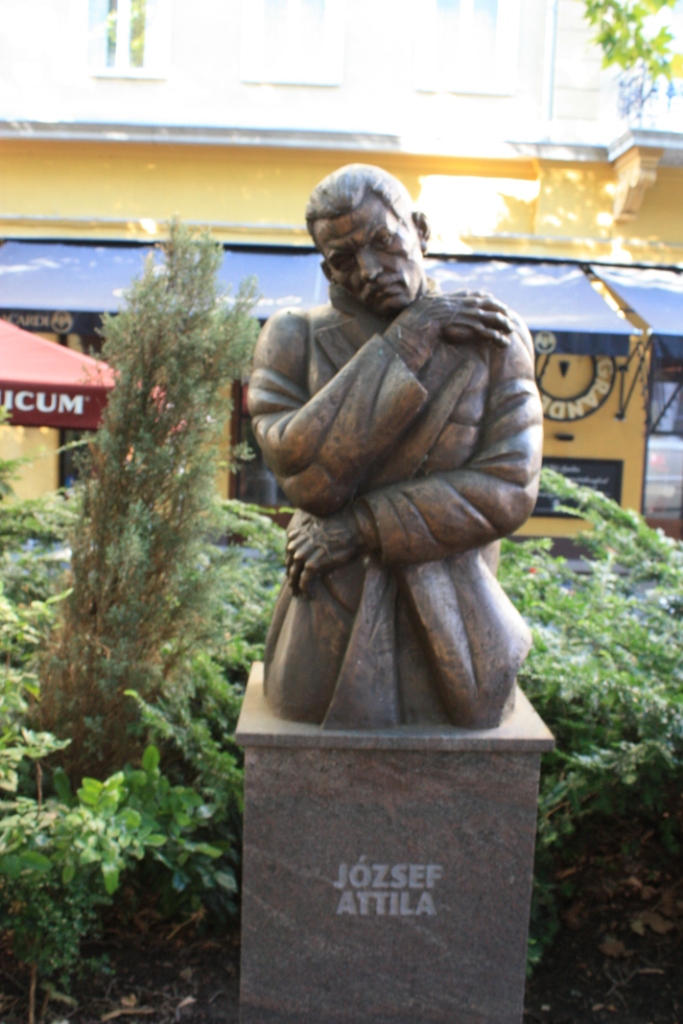
A fine Hungarian poet who Wrote with and without rhyme

A fine Hungarian poet who Wrote with and without rhyme

it’s my cross, my curse
this rhyme in my verse
rhymers aren’t taken seriously
and are berated furiously

“Oh, your poem is so cutsie,
like little baby bootsies.”
call it banal or call it niche
but “cutsie?”, please!, step off bitch

just because my verse ain’t free
don’t act like I’m a perp to slavery
I spare my words the sting of the rod
they’ve never tasted a cattle prod

I’ve never waterboarded my “ands” or “buts”
or kicked a pronoun square in the nuts
I don’t whip my adjectives to get ’em in line
I stand waiting patiently holding a sign

Why steer my words like some stern brigadier?
because it scratches an itch somewhere in my ear
I know my rhymes sometimes lack cachet
because they’re little too Ogden Nash-ay
but from the hilltops I sing
like that guy Rodney King
hear the words of my song
“Can’t the poets all just get along!”

Paintings Through a Writer’s Eyes: 6 of my Favorites

Let me begin by being forthright; I know almost nothing about art. If you’re thinking this post might offer you insight into what makes for a good painting, you’re in the wrong place. A few years back, I did get a couple books on “art for philistines”  (…isms: Understanding Art and 50 Artists You Should Know) Being fascinated by just about everything, I immensely enjoyed both books. However, my objective wasn’t to develop any great expertise, but simply to not be a clod. I wanted to be able to tell Monets from Manets from mayonnaise. And I did learn some nifty lessons, mostly about what art wasn’t. Did you know that Neo-impressionist art is NOT art that makes a new impression on one, as contrasted with paleo-impressionist art that makes one feel their inner-caveman. Secessionism was NOT the art of the Confederate States. Neither sensationalism nor naturalism necessarily involve nudity, darn. One the other hand, Pointillism is exactly what it sounds like, paintings made of little pointills.

As a writer, the story that I see in a painting has a lot to do with its appeal to me. That’s why there aren’t any Jackson Pollack’s or Mark Rothko’s on my list. I’m sure their work is aces in aesthetics, but I don’t get much out of it.

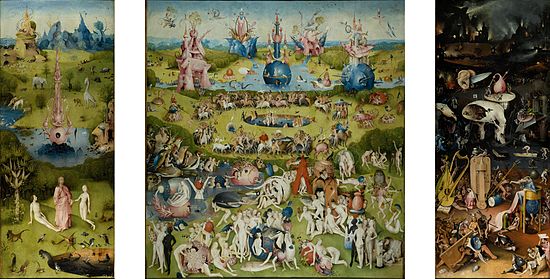
The Garden of Earthly Delights by Hieronymus Bosch, 1510

The Garden of Earthly Delights by Hieronymus Bosch, 1510

I usually don’t care for paintings that are as busy as The Garden of Earthly Delights, but I find it fascinating that an early 16th century artist could produce so much wild surrealism. I didn’t even know they had LSD in the Netherlands back then. Today we have decades of monster movies to help us think up weird and bizarre images, but Bosch had only his imagination.

There are an infinite number of stories packed into this tri-sectional painting. A question being the root of a story, a world in which some people have flowers and berries blossoming from their heinies, makes for a lot of fodder. However, the first thing that strikes the eye is that God is the only one wearing clothing. (Lets avoid a tautology. One could say that the only reason I know that that’s God is that he’s wearing clothing. If he were naked too, the viewer would just assume that he was a perv trying to horn into a menage a trois. I would say the world’s first threesome, but if you look in the middle section, you can see that about everyone is getting their freak on.) So why is God wearing robes?  We can assume that it’s not that he has shame. He’s God, you can be sure he’s sporting the perfect specimen of masculinity (if he cares about such things.)  Is it drafty in heaven? If so, doesn’t his omnipotence extend to the heavenly thermostat, or is it that the Holy Ghost likes to crank the AC? I see tension, and tension is the root of a story. (I realize that I said that a question was the root of a story. Live in the moment.)

The Sea of Ice by Caspar David Friedrich, 1823

The Sea of Ice by Caspar David Friedrich, 1823

Sea of Ice, also called The Wreck of Hope, at first looks like just a landscape. However, if one directs one’s glance to the right hand side, one can see the stern of an old sailing ship. As the alternate title suggests, it’s about a shipwreck. A shipwreck in the sailing age in the Arctic Ocean makes an outstanding setting for a story. Those men are all going to die, but not with the suddenness of drowning. They will freeze to death over the course of hours. If they can start a fire, they may have many hours, but they are not going to be rescued and they cannot walk to home. The tension between wanting to survive and knowing you are just extending your misery is good stuff for story-telling. If this image doesn’t send a shiver down your spine, nothing will.

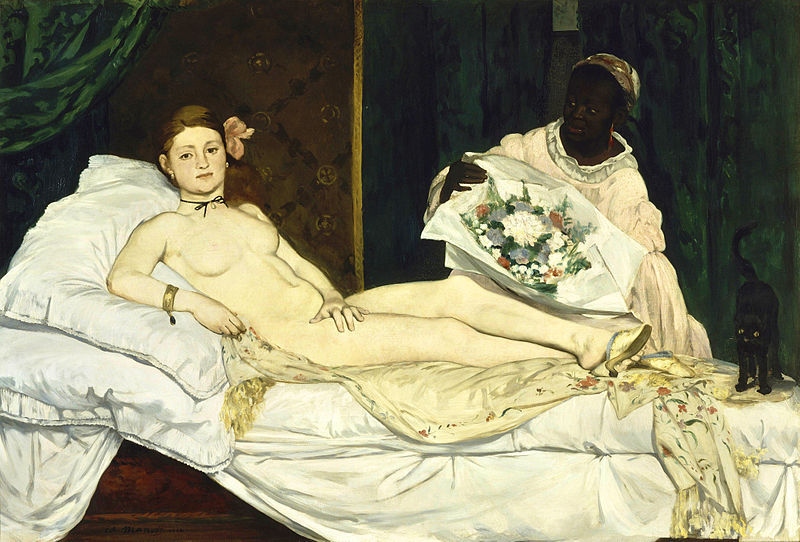
Olympia by Édouard Manet, 1863

Olympia by Édouard Manet, 1863

Olympia was a scandalous painting when Manet first revealed it. Nudity has been around for ever in paintings, right? Certainly, but it’s the context that enraged people. Society was used to characters of classical mythology being nude, e.g. Venus. They were also used to Biblical nudity (see Garden of Earthly Delights above.) However, Olympia made them think of the Parisian prostitutes that they didn’t visit, but somehow knew exactly what they looked like.  There are several stories to be told here. The one that springs to mind is why the servant is about to try to suffocate Olympia with a pillow. Will she, or won’t she, go through with it? If she does, will she prevail? Olympia looks like a fighter. If she doesn’t, will the cat?

Impression: Sunrise by Claude Monet, 1872

Impression: Sunrise by Claude Monet, 1872

In Impression: Sunrise two boats are out on the water, even though the sun has broken over the horizon.  They are rivals. The early bird got the worm, and the other will have to fish with fake lures.

Lighthouse Hill by Edward Hopper, 1927

Lighthouse Hill by Edward Hopper, 1927

Lighthouses make good settings for tragedy. They are remote. Ships depend upon them to avoid the rocky shoals. This lighthouse keeper’s family left because they didn’t like living in the middle of nowhere with a drunk. Now it’s just a man living in a big house alone. He runs out of Jack Daniels, and drives off to town at dusk. Being on the other side of the hill, he can’t see the lighthouse when he briefly glances into his rear-view mirror and wonders, “Did I turn the beacon on?”

The Persistence of Memory by Salvador Dalí, 1931

The Persistence of Memory by Salvador Dalí, 1931

The Persistence of Memory, a.k.a. Melting Time, is a dream state. It makes no sense. Nature is ordered into square edges. Watches are the only evidence of humanity’s existence. There is one creature living, or once living, that looks like the Thalidomide abortion of a three-way mating between a donkey, a Portuguese man of war, and Dalí himself.  The story is about being trapped in a dreamscape where time has become stuck.  Our protagonist must seek the wisdom of the Portuguese man-o-Dalí.

The Bullets that Bore no Name: or, the Burden we all Bear

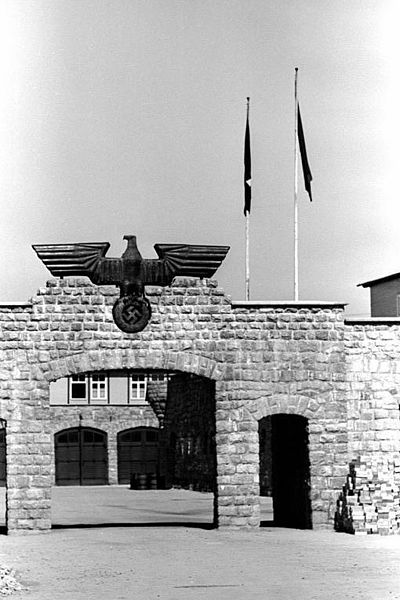
Attribution: Bundesarchiv, Bild 192-334 / CC-BY-SA

Mauthausen                     Attribution: Bundesarchiv, Bild 192-334 / CC-BY-SA

Thanks for joining me on the veranda. If you don’t know what I’m talking about, this post flows from a book review I did on Elie Wiesel’s Night, which can be seen here. But don’t wander off just yet.

I married into a family of holocaust survivors.

Being sufficiently narcissistic, I haven’t been able to avoid thinking of the profound impact this had on my life.  I am married to the most extraordinary woman in the universe [my apologies to all other women, I’m sure you’re someone else’s most extraordinary woman] by virtue of the strength of a man who wrestled his way to the top of a pile of corpses, bleeding profusely from multiple shrapnel wounds, clawing his way out of a pit, and cleaning the gashes with his urine. That man was married to a woman, tiny of body but colossal of mind, who was in the group force marched from Budapest to Mauthausen. After the war, they had a child–my mother-in-law. Yada-yada-yada. I have marital bliss.

Not being completely narcissistic, I’m reminded that every one of our lives have been shaped by strong people who lived through close calls. Each of us comes hither as a gift from men and women who passed through a hail of bullets that bore no name. Some, like my wife’s grandfather, were riddled by bullets bearing their name, and still refused to heed their deadly whisper.  Every holocaust survivor survived by a thin margin. Every battlefield veteran’s life is an execution order rescinded. Every prisoner of war was one germ away from an unmarked grave.

No pressure or anything, but that sounds like a heavy debt we  all bear.

Telling this story in greater detail is one of my bucket list tasks. It’s a project I’ve had on the back burner for far too long. There are several reasons for this. The most feeble of which is a hope to find the right timing. Sadly, there are so many such stories that I fear it will be lost amid a sea of sorrow.  Then there is my need to develop grace with language sufficient to do the story justice. In a way the two novels I have drafted, and whose mess I am now painstakingly trying to dance into shape, are practice exercises.  Wish me luck.

On the plus side, my wife’s uncle had the foresight to have her grandfather speak his story onto about 20 tapes before he died. With today’s technology, there’s no excuse for anyone’s life-altering story to go untold.  So I guess if there is a moral to my rambling post it’s this: don’t let anyone in your life with a spectacular story pass from this world without it being heard.

TODAY’S RANT: Stuck with a Bad Ending

Bonus pages for active readers

Bonus pages for active readers

I miss the days when they put extra blank pages at the end of a book so that you could rewrite an unsatisfactory ending. (Someone once tried to tell me that the extra pages were the result of bulk paper cutting methods. They said it was cheaper to include the blank pages than to remove them. Yeah, I know. How ridiculous, right?) Of course, it wasn’t long before ads began to sully these blank pages, making them less than blank.

I’m not a fan of wastefulness, but if I have to rewrite your ending, why should I incur the cost of paper.

Being lazy, there are not many cases in which I feel compelled to rewrite someone else’s ending. Most books that manage to get published have at least a tolerable ending.

One book always springs to my mind when I think of bad endings. It’s a book called Hostage by a writer named Robert Crais. For those who saw the movie, the movie ending is vastly different–presumably because moviegoers would have insisted on their money back otherwise. While Hostage is not among Bruce Willis’s best, it’s also a prime example of the rare case when the movie is better than the book–for just this reason.

Part of the disappointment stems from the fact that the book has an outstanding premise for a thriller, and in my opinion it was carried off well until the end. (Another reason that I don’t come across too many terrible endings may be that I jettison books that aren’t so good, but this one fooled me.)  Anyway, three delinquent kids rob a house and end up with a  hostage situation with the homeowner’s two kids. The tension is ratcheted up when it turns out that the upscale home where the kids are being held up is owned by a mob accountant. Inside is evidence that could put half the mob away. The mob gets proactive by taking the police chief’s (i.e. the protagonist’s) family (ex and child) hostage and insisting that he get the evidence out before the house is stormed by the sheriff’s department and falls into an evidence locker.

SPOILER ALERT: Ultimately, our hero has no agency in the survival of himself or his family. It’s purely the decision of a mob enforcer that leaves them alive.  I guess it could have been worse. It could have ended with him awaking from a dream.

What book gets your award for “worst-ending-ever”?

How to Kill a Rogue Yard Gnome, Part 3 of 4

Part I can be read here.

Part II can be read here.

[Notes: a.) Sorry, I meant to do this in three installments, but this one was getting long.  

b.) For the best reading experience, assume all of the continuity gaffes in the dream sequence are on purpose and intended to convey the capricious and surreal nature of a dream—most of them are ; ) .]

Attribution: Colibri1968

Attribution: Colibri1968

I cringed when I heard my voice on tape. I always thought I sounded sexier, less like Ferris Bueller’s teacher. But what brought on the nausea was hearing me describing events of which I had no recollection. It was difficult to fathom that such drama could unfold in my dreams without me having any memory of it.

I should take a step back to say that I’d sought therapy immediately after returning home to find the scowling gnome. It was a decision made after a sleepless night. I didn’t dare destroy the scowling gnome for fear I’d end up with a glowering golem in my front yard when I next came home.

Logically, I recognized two possibilities. The first was that someone was playing an elaborate hoax upon me. I couldn’t figure out how, but this was what I wanted to be true. But watching the tape repetitively had given me no clue about how the trick could be perpetrated. The vanishing gnome and the self-propelled gnome were tricks worthy of David Copperfield. The second possibility was that I was out of my mind— but in a manner that was localized to my front yard. That was equally hard to explain. The therapist was my attempt to explore all options, but I didn’t tell her the details.

My therapist said hypnosis would be a good idea, presumably because she’d just gotten her hypnotherapy license and needed the registration fee to pay for itself. As you might suspect, I was skeptical. Lying on a brown leather divan, fingering the brass upholstering rivets along its edge, I listened to fantastic words spew from my own voice as she played the tape back for me.

I’m standing in front of a mammoth mansion made of rough, gray stones. It looks like a castle—like something out of Bram Stoker’s Dracula. It’s dark out, but yet I can see. It’s as if the moon is shining bright, but yet it’s dismally overcast. So much so that I feel like I could jump up and touch the thick, gray clouds. I’m staring at an ornate carving on the door. It’s an elaborate mountain scene. How can I see it? There’s no porch light. Something is wrong here.

I don’t want to go inside, but inexplicably I know I have to. I hear bleating and cowbells. Turning around, I see a herd of goats strolling up the drive. I’m curious about the goats for a moment before a T-rex-like monster darts its head out of the tree line and clenches one of the goats in its jaws. The T-rex’s teeth puncture the goat like a bite into a wonton, and the beast shakes its head from side to side until the goat stops thrashing. I want to save the other goats, but even more so I don’t want to be eaten.

I watch the T-rex; he doesn’t seem to notice me; his chin is covered in crimson. The T-rex looks at the flock of goats like one might look at a box of sampler chocolates, searching out the most desirable morsel. He raises his head, sniffing the air, twisting his thick neck to point his face toward me, and then he begins to run at breakneck speed towards me. I realize that I am the last solid milk chocolate in a field of dark chocolate-covered marzipan.

I spin around and, losing all sight of politeness, begin to twist frantically at the doorknob. The cold, metal knob cuts into my palm, but doesn’t budge. I pound on the door with my fists.

“One moment, Sir.” A voice replies dully from inside. How he knows I am a sir, I don’t know.

“Help me. Please hurry.” I’m too scared to turn and look at the lurching beast, but I hear its footsteps getting closer as the tremors they create run together. I shake the door knob frantically, but the door doesn’t so much as rattle— it’s like a solid piece of wall.

I shut my eyes. I’m sure that the T-rex is now within lunging distance, and in a nanosecond I will feel agony followed by whatever lies beyond agony. I tense up, awaiting my demise. The tremor of a loud thud reverberates up through my feet. I stand there a minute in shock before realizing that all is silent.

I turn around to see the T-rex lying on its side, a gash torn through its throat. There’s a man, a knight, cleaning a large broadsword with a piece of cloth. He discards to cloth and it disappears into thin air. The knight wears chainmail armor under a tunic that has a red and green crest on the chest. I can’t make out the detail in the crest, though I’m looking right at it. It’s as if it has been pixilated, like news stations do to faces when they are talking to an endangered witness or basic cable does with boobies in movies.

“Thank you.” I say, adding, “Who are you?”

“I… I am your protector.” The knight says, looking himself over as though he were surprised to see that he is dressed thusly.

“Do I still need protection?”

“Probably. That remains to be seen.”

The door opens, and I find myself loomed over by a man who is tall, gaunt, and sallow. His black coat has tails like maestros, but there’s a small towel draped over one arm. I conclude that he’s a butler. I turn around to look for my protector, the knight, but he’s not there. Neither is the T-rex.

I turn back, almost surprised to see that the butler hasn’t abandoned me. He speaks, “Right this way, they are waiting for you.” He makes an ushering gesture with his hand as he steps aside inside the foyer.

I eagerly enter, still afraid the wounded T-rex might be around the corner. I start to ask a question, but pause when I realize that the servant’s unusual gait is due to the fact that he is stepping over vipers that are slithering across the rough stone floor. I can hear their hissing, but it doesn’t seem I should be able to.  

I stop, petrified, but the butler turns and waves me forward with what I recognize as uncharacteristic urgency. I walk onward slowly and with great care. I step over the black, shiny snakes, and they seem to take no notice of me. When I finally reach a snake-free patch of floor, I look around. The ceilings are high, and the windows are about two stories up. The moonlight breaking through the windows illuminates a row of gargoyles. I stare at them. I’ve never seen gargoyles on the inside of a building.

As I walk, looking upward, I suddenly feel a panic attack as it occurs to me that I might step on an errant snake. Just as I level my gaze, I run straight into the butler, who has come to a stop. Dust flies off his coat, which had earlier seemed impeccably clean.

“Pardon.” I say.

He glowers at me.

I ask, “Who’s waiting for me?”

He turns and walks silently onward. I can’t tell whether he is hostile or indifferent.

We walk past rusty suits of armor, each with a halberd, pike, or battle-axe positioned beside it as if it were being held upright. It occurs to me that there might be men in those suits, men who could swing those implements of death at will.  I moved closer to the giant butler.

Soon we are at the head of a stone staircase that spirals downward. It’s lit with flickering gas lamps. As we descend, it gets darker and the mustiness becomes more pungent. At the bottom of the staircase, I’m ushered through a large oaken door that is shaped like an inverted heraldic shield, which is to say flat on the bottom and coming to a point at the top. The butler leads me up onto a stage.

I look out into the auditorium and see the room is packed, but every audience member is wearing a goat’s head mask. It’s only then that I feel the cold air on my skin and notice that I’m completely naked. As if that weren’t bad enough, I realize that I have no idea what I’m supposed to speak to the creepy goat-man audience about. It’s like showing up to a test and realizing you forgot to crack the book. There’s no podium to hide behind, just a skinny mike stand center stage and a barstool that’s near the far wing of the stage. I approach the stool and notice that there’s a small remote on it. Turning around, I discover the bright white screen, and notice a harsh light is shining on to it. I consider doing shadow puppets to amuse the audience. They are now grumbling.

Instead I snatch up the remote and advance the slide, figuring that maybe I can wing the talk. Maybe it’s a topic that I know about, such as shadow puppetry. The audience is now laughing, and that doesn’t feel good when one is standing naked at the front of the room.

The first slide reads, “HOW TO GET AWAY WITH MURDER.”

I don’t have any particular expertise on this subject, and am a little dismayed that someone would choose me to deliver such a lecture. I figured there must be a mistake.

The knight strides across the stage, but he is no longer dressed as a knight, now he wears the same tux and tails as the gaunt butler. He extends a large overcoat out in front of him as a gentleman would hold a coat for a lady to slip into. I awkwardly wriggle into the coat and button a few strategic buttons. Now I just look like a flasher, which is—oddly enough— vastly preferable.

I whisper to the knight, “Do you know what I’m doing here? What am I supposed to talk about?”

“Furk wants to plant a murderous seed in your mind, but you should not let him.” The knight-butler says.

The audience stops laughing and grumbling, and makes a bleating sound like “mehhehhehhe!” I assume that this is the sound a goat makes. I consider whether the angry goat sound is preferable to laughter or not.

I turn back to my self-proclaimed protector, but he has once again vanished into thin air. A bell rings and it gets quiet as a grave and I know that I am supposed to start talking.

Keeping in mind the words of the knight-butler, I begin, “Obviously, this is not to be taken literally.” I gesture to the projected slide. “You shouldn’t commit murder, and you can never count on getting away with it.”

The stuttered goat cries become louder and louder. I don’t know how I’ve inherited knowledge of the emotional lives of goats, but somehow I know they’re getting angrier.

I continue, “I mean, imagine that I shoot a person,…”

A chorus of goaty cheers rises up.

“I’ll always be caught and punished.”

The audience turns on me.

Stalling, I advance the slide. In big block letters, it reads, “HOW TO DECIDE WHO YOU SHOULD KILL!” and then a subtitle in smaller letters, “sometimes it’s harder than you think.”

I couldn’t help myself, my notoriously ill-timed sense of humor came through, “Some key questions that you might consider are: Is your potential victim a lawyer, a bureaucrat, or a teenager? Does your victim contribute to society, or is he or she a politician? Would killing that one person lead to the need to kill again, as in the murder of a member of a boy band?” I notice that while I am amusing myself, I am whipping the crowd into a frenzy. The fun dissolves as I see myself as a warmongering dictator, stirring up hatred among a frothy-mouthed constituency.

I say, “I’m kidding, of course, one shouldn’t murder anyone.”

They turn on me once again. This time they’re really raging, as if I had led them on with my little joke. There’s a moment of stillness before the crowd charges the stage. I turn to run, but don’t know where to go. I look over my shoulder, and– as the first few of the audience members leap onto the stage— I can see that they have actual goat heads, not goat masks.

I freeze, but then I’m yanked by the arm. I turn to see the knight-butler, but now he’s dressed in a police uniform. He says, “Come with me; you are in grave danger.”

I’m pulled behind a curtain that skirts the back of the stage, and I see there is another door shaped like an inverted heraldic crest. I move through it. The police officer shoves it closed. A couple hooved appendages get caught in the door, but he slams his body into them and then lets up just enough for the wounded goat-men to retract their injured forelimbs. As they do, he closes and bars the door. There’s clawing, scratching, and knocking from the other side of the door.

The policeman lights one torch off another, and hands one to me. I don’t know how either of the torches materializes. The corridor extends into the distance farther than the torches illuminate. It looks like a sewer tunnel, but the stone floor is only damp, as are the walls. Beyond the torch light lies an inky shadowland that is only held at bay by the precarious, flickering light. We march into that claustrophobic unknown.

“Who is Furk?” I say, remembering the man’s earlier words.

“Furk is the one bringing you this nightmare. He is one of your yard gnomes,” the policeman says.

“Who are you?”

“I’m another gnome.”

“Why is one gnome trying to kill me and another to save me?”

“That’s a long story.”

“Was Furk the gnome by my driveway?”

“No that was me.”

 “Should I wake myself?” It doesn’t come as a surprise to me that I’m dreaming. Maybe I knew it all along.

“Unless you intend to never sleep again, that won’t solve your problem.”

“What if I get rid of the bad gnome?” I ask.

As we quicken our pace, he answers, “You won’t remember to do that when you wake up. We are in the deepest recesses of your subconscious mind. It is a part of your mind that you are not aware of on a conscious level at all.”

I stop. “Wait a minute, if this is a dream, it doesn’t matter what happens—particularly if I’m not even going to remember it.”

“Unfortunately, that’s not so. Future behavior and moods often originate in the subconscious. Haven’t you ever been in a bad mood for no apparent reason, or, alternatively, been happy for no good reason?” he says, stopping for just a moment.

We resume walking, and I say, “I guess I have.”

From behind me, I hear a series of loud thuds. It sounds like they have a battering ram. I turn to look over my shoulder but can’t see the door anymore. We quicken our pace again. Soon I hear splintering. The policeman breaks into a sprint. I follow suit. I soon get winded and can’t figure out why I need air in a dream. More than burning lungs, it feels as if there is a belt tightening around my chest.

The imagined belt tightens further as I hear the echoed clack of hooves on the cobblestones down the corridor.

“You need to try to thin the herd.” The policeman says.

“What?”

“Only one of those goat-men is Furk, the rest are all projections of your mind. Furk may have conjured them, but they are dependent on your mind.” He says without breathing hard in the least.

“Oh, cool.” I say, and I stop and turn toward the onslaught of goatmen pursuing down the pitch black corridor. I concentrate. I will them to disappear. The hooves keep coming, unabated.

When the first faces break into the torch light, I turn and run, screaming, “It didn’t work. It didn’t work.”

“Yeah, I didn’t think it would.” The policeman says, his voice well ahead in the inky distance; he never stopped – some protector.

“What do you mean… you… didn’t think… it would?” I said, gasping as I ran hard to close the gap.

“This part of your mind is like a river that runs underground below your property, just because you own it doesn’t necessarily mean you can stop, or divert, it at will.” The protector says. He is not winded at all.

A door lies ahead. If we can just get through it, I can catch my breath. It occurs to me that I have no idea what will confront us on the other side of the door. Maybe there’s something worse than a flock of goatmen. The hoof clomps sound as though they are closing on us.

The two of us shoot through the door, slamming it shut, putting our backs up to it. Wherever we are, it’s bright. The sunlight assaults my eyes. I squint, trying to glean something about our new environs. The nameless police impersonator produces a heavy wooden beam that fits into metal hardware on the doorframe to form a bar. How he conjures such items, I don’t know. We are supposedly in my mind, and yet I seem impotent.  

“So why did you tell me to try to eliminate them if you didn’t think I could?”

“It was worth a try.”

We are at the base of a hill in grassy prairie lands, the knee high grass is tousled by a breeze. At the top of the hill is a big oak tree, it’s perfectly shaped and stands strong, the iconic tree of life. I turn around and the door from whence we emerged is nowhere to be seen.

“Are we safe here?” I ask.

“It’s your mind.” He responds.

We instinctively walk toward the tree. The ground shakes. The earth splits open. I am falling.

TO BE CONCLUDED (this time for real)