Five Wise Lines from Shakespeare’s Hamlet

We fat all creatures else to fat us and we fat ourselves for maggots… a king may go a progress through the guts of a beggar.”

HamLet to Claudius in Act IV, Sc. 3

One may smile, and smile, and be a villain.

Hamlet to Queen Gertrude in Act I, Sc. 5

I could be bounded in a nutshell and count myself a king of infinite space, were it not that I have bad dreams.

Hamlet to rosencrantz & Guildenstern in Act I, sc. 2

Brevity is the soul of wit.

Polonius to claudius & gertrude in act II, sc. 2

A knavish speech sleeps in a foolish ear.

hamlet to rosencrantz in act IV, Sc. 2

PROMPT: Three Books

Daily writing prompt
List three books that have had an impact on you. Why?
Leaves of Grass by Walt Whitman

This poetry collection teaches that most challenging of human skills: how to be insanely confident that you can do anything without being a jerk about it. (Also, how to see beauty beyond the societal consensus of what’s beautiful.)

Zhuangzi by Zhuangzi

The virtues of a carefree, spontaneous, minimalist, and down-to-earth approach to living explained through tiny stories.

The Tragedies of William Shakespeare by William Shakespeare

A master class in things that can turn a life into a tragedy.

Titus Andronicus: Live by the sword = tragedy (An eye for an eye, and everyone dies.)

Romeo & Juliet: Grudges (+ Lust) = tragedy

Julius Caesar: handing your adversary the mic (/ the fickleness of crowds) = tragedy

Hamlet: indecisiveness = tragedy (i.e. On or off the crazy-bus.)

Othello: jealousy = tragedy

Macbeth: excessive ambition = tragedy

King Lear: needing gratuitous signs of affection = tragedy

Timon of Athens: expectations of reciprocity = tragedy

Anthony & Cleopatra: mixing one’s love and work lives = tragedy

Coriolanus: a crotchety old warrior in peace time = tragedy

Hamlet’s Revenge [Limerick]

A befuddled Prince from Denmark's Elsinore
 was asked by his dad's ghost to even a score:
  "Old Claude poisoned my ear,
   wed (-n- shtupped) my wife, dear.
 So, please ensure that he lives, Nevermore!"

PROMPT: Quote

Do you have a quote you live your life by or think of often?

Four, actually:

Be kind, for everyone you meet is fighting a hard battle.

Plato (attributions vary)

There is nothing either good or bad, but thinking makes it so.

William Shakespeare (in HamLet)

Contentment comes not so much from great wealth as from few wants.

Epictetus

If you reject the food, ignore the customs, fear the religion, and avoid the people, you might better stay home.

James a. Michener

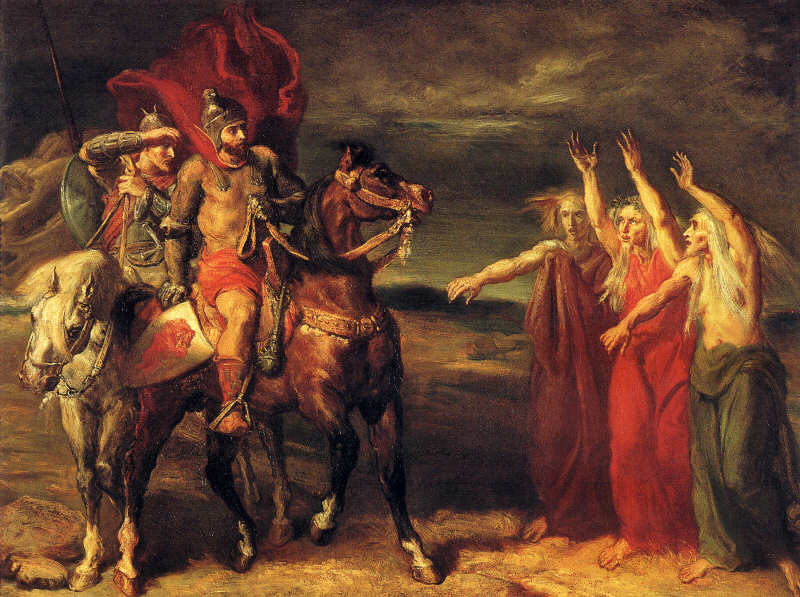
Macbeth Limerick

Macbeth and Banquo Meeting the Witches;
Théodore Chasséria (1855)
There was a great General named Macbeth.
All that kept him from kingship was a death,
but - as with a Pringle -
he couldn't do a single.
So, he showed seven more their last breaths.

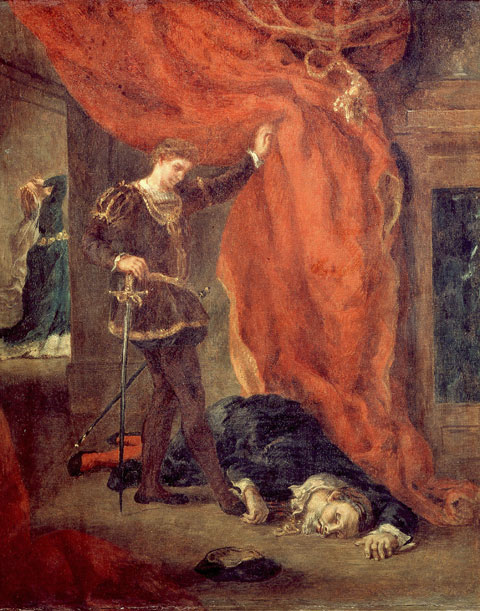
Hamlet Limerick

Hamlet Stands Over Polonius;
Eugène Delacroix (1855)
There once was a wavering Prince of Denmark
whose uncle replaced his dad as monarch.
The ghost of his dad
said, "Kill 'em, my lad!"
Too bad he took that stab in the dark.

A Midsummer Night’s Limerick

Four Athenian youths fled out to the trees,
lacking the love geometry to put hearts at ease.
It might've been tragic,
but Puck worked his magic.
They returned by twos, not ones or threes.

Shakespeare Clerihew

The Bard, the great William Shakespeare,
made stony souls feel love, hate, and fear,
but I'll cease to dote,
in case he never wrote...

Enlightenment in Four Bits of Shakespearean Wisdom

If you’re looking to attain Enlightenment, you may have turned to someone like the Buddha or Epictetus for inspiration. But I’m here to tell you, if you can put these four pieces of Shakespearean wisdom into practice, you’ll have all you need to uplift your mind.

There is nothing either good or bad, but thinking makes it so.

william Shakespeare, Hamlet

Through Yoga, practitioners learn to cultivate their inner “dispassionate witness.” In our daily lives, we’re constantly attaching value judgements and labels to everything with which we come into contact (not to mention the things that we merely imagine.) As a result, we tend to see the world not as it is, but in an illusory form.

The fault, dear Brutus, is not in our stars, but in ourselves.

William shakespeare, julius caesar

In Psychology class, you may remember learning about the self-serving bias, a warped way of seeing the world in which one attributes difficulties and failures to external factors, while attributing successes and other positive outcomes to one’s own winning characteristics. Like Brutus, we need to learn to stop thinking of our experience of life as the sum of external events foisted upon us, and to realize that our experience is rooted in our minds and how we perceive and react to events.

The fool doth think he is wise, but the wise man knows himself to be a fool.

william shakespeare, as you like it

A quote from Hamlet also conveys the idea, “There are more things in heaven and earth, Horatio, than are dreamt of in your philosophy.” If you grasp this idea, you may become both humbler and more readily capable of discarding bad ideas in favor of good. It’s common to want to think of yourself as a master, but this leads only to arrogance and to being overly attached to ineffective ideas. Be like Socrates.

Cowards die many times before their deaths; The valiant never taste of death but once.

william shakespeare, julius caesar

Fears and anxieties lead people into lopsided calculations in which a risky decision is rated all downside. Those who see the world this way may end up living a milquetoast existence that’s loaded with regrets. No one is saying one should ignore all risks and always throw caution to the wind, but our emotions make better servants than masters. One needs to realize that giving into one’s anxieties has a cost, and that that cost should be weighed against what one will get out of an experience.

There it is: Enlightenment in four bits of Shakespearean wisdom.

BOOK REVIEW: Henry VIII by William Shakespeare

King Henry VIIIKing Henry VIII by William Shakespeare
My rating: 5 of 5 stars

Amazon.in Page

This play takes place over a period of time, for want of a better measure, straddling the first two [of six] marriages of Henry VIII. It doesn’t reach the ill-fated end of Anne Boleyn, but rather finishes with the baptism of the girl child she birthed [Elizabeth, who will later be Queen.] [Of course, the failure to produce a male child was the downfall of Katherine of Aragon’s Queenship, so the birth of Elizabeth doesn’t bode well.]

In as much as a history has a theme, this one would be the conflict between the aristocracy and the clergy. This is first, and most extensively, seen through the rise and fall of Cardinal Wolsey, who wins the favor of the King in the Cardinal’s conflict with the Duke of Buckingham, but later Wolsey gets ousted after an aristocratic cabal diverts the Cardinal’s mail to the King. Henry discovers that Wolsey has recommended denial of an annulment of Henry’s marriage to Katherine, despite the fact that Wolsey was telling the King to his face that the marriage’s end had his endorsement. Later, we find aristocrats (the King’s Council) taking on the Archbishop of Canterbury, Cranmer, but Henry sides with the Archbishop as he once had with Wolsey.

The play’s major events are the execution of Buckingham, the divorce from Katherine, the marriage to Anne Boleyn, and the birth of Elizabeth.

This isn’t the most compelling of the Shakespearean histories, but it does have its intrigues. No doubt it would be a bolder play in the absence of the authoritarian nature of monarchy, but it’s still worth reading.

View all my reviews