Second Eyes [Free Verse]

Photograph of the roof of the Cheng Hoon Teng Temple taken from the upper floor of the Xiang Lin Si Temple in the Jonker Walk / Chinatown area of Malacca, Malaysia.
From the dark depths
of a temple,
eyes open & blink
against the sunlight
pouring through
a narrow second set
of eyes.

What shapes form across
the way?

It's the roof of a second --
more ancient -- temple
that stands across
the street.

This monk has opened
eyes on that view a
thousand times before,
and each time has
forgotten the centuries
old neighboring temple
existed.

Superabundance of Buddhas [Free Verse]

Photograph taken inside a Buddhist Temple in Luang Prabang, Laos.
The reclining Buddha oversees
the diligent seated Buddha.

Is this an analogy of the mind,
or just a monk's proclivity
toward a superabundance
of Buddhas?

Iconic [Free Verse]

Bruce Lee statue by Cao Chong-En located on the Avenue of Stars, Tsim Sha Tsui East, Kowloon, Hong Kong.
Everyone gets to be a person,
Few become icons:

What is it to have a lasting
image more well-known
than one's work?

Che Guevara, Bruce Lee,
Heath Ledger's Joker --

Images you can find on
back-alley walls from Lagos
to Prague to Kochi
to Seoul to Santiago
and back again.

Seen day-after-day by people
who never saw Enter the Dragon
or read of the Cuban Revolution,
or saw Nolan's Batman Trilogy,
but they know the faces.

They have thoughts about them
-- and, sometimes, strong feelings --
just like so many people have
thoughts about Alexander the Great
based solely on his name
and a rough impression of history.

What must this be...
blessing or curse ...
if icons had some way to care?

Spring Swerve [Free Verse]

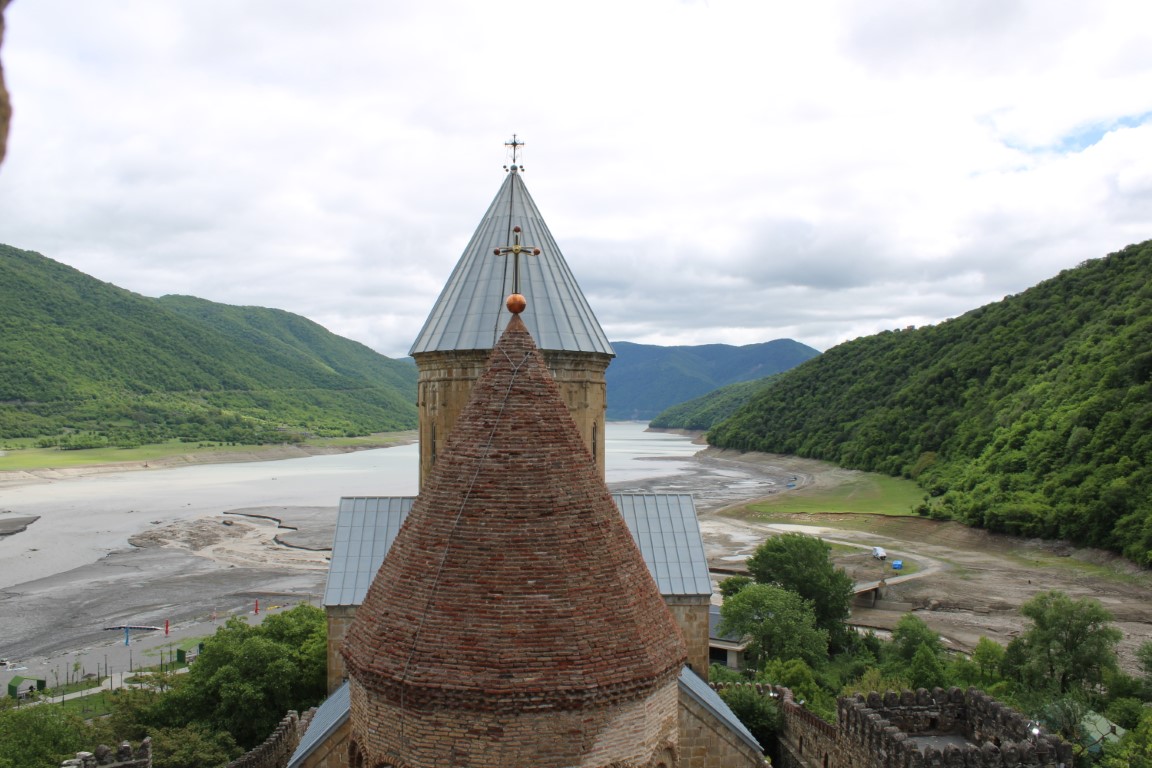
Photograph taken at Jvari Pass in the Republic of Georgia as a rain cloud works up the valley. The previous day, it had snowed.
Spring can swerve.

White patches,
holdouts from yesterday's snow,
are melted by today's rains.

Buds no sooner form
than are encased in ice.

No self-respecting Summer
day could bring snow.

Winter won't hatch
a butterfly.

Autumn can't turn
a red leaf back to green.

But Spring can swerve.

Ivy & Stone [Free Verse]

Taken in the Old City of Baku, Azerbaijan.
There's something relentless
in an old stone wall...
But, also, cold and dead.
One knows it will not stand forever --
that it will go the way of
ruins, rubble, stones, and dust --
but, still, it can outstand any man.
Ivy climbs to camouflage the stone's
cruel deathlessness,
But then the ivy stands on the wall
year after year after year...

Mobile Home [Common Meter]

Turtle exits its hiding place
beneath a rotten log.
Its shell snags on that old, dead wood
he drags the log along.
Does he know that he's double-shelled?
He seems so unaware.
When he breaks free, he gains no speed --
just crawls on like he don't care.

Stumped [Free Verse]

Photo taken on the Butch Kennedy Hiking Trail near Lake Hartwell in South Carolina.
A stump in the forest
is like a gap in a
wedding party photo
where they photoshopped
out a renegade relative,
but forgot to erase
the person's loafers.

Candles [Free Verse]

Ancient cathedral: 
pews & altar
long gone.
Cold air creeps
through cracks
to flicker candles,
Candles lit for
those long dead —
though long remembered —
on a cold, winter day.

BOOKS: “The Suppressed Poems of Ernest Hemingway”

The suppressed poemsThe suppressed poems by Ernest Hemingway
My rating: 4 of 5 stars

Available online – Public Domain

I read this book because my curiosity was piqued by a reference to poems Hemingway published in Der Querschnitt, a reference that was made in a biography of Hemingway I’ve been reading recently (Forty-Three Ways of Looking at Hemingway by Jeffrey Meyers.) Five of the seventeen poems in the book are from Der Querschnitt. (Ten of the poems were published in a book entitled Three Stories and Ten Poems and a couple are odds and ends.)

The Der Quershnitt pieces are bawdy by 1920’s standards, though not particularly for today. The other poems can be a bit intense, dealing in subjects like death in war (Champs D’Honneur,) suicide (Montparnasse, and a curse upon literary critics (Valentine,) but tend to be a bit more refined (excepting Valentine. which may be the least elevated of the collected poems.)

The poems include a mix of lyric, free verse, and prose poem, though all are fairly short (the longest, The Soul of Spain, fits in three pages.)

My favorite was a short lyric poem entitled The Age Demanded, which considers the paradox of the 1920’s as a progressive age, restrained. I also found T. Roosevelt to be fascinating because in the act of critiquing Teddy Roosevelt, Hemingway (wittingly or not) gives us a bit of autobiography. (i.e.“And all the legends that he started in his life // Live on and prosper, // Unhampered now by his existence.”)

I give Hemingway more credit for saying interesting things by virtue of being bold than for saying anything in a particularly interesting way, but it’s enough to make these poems worth reading.

View all my reviews