
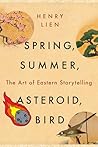
BOOK: “Spring, Summer, Asteroid, Bird” by Henry Lien

Spring, Summer, Asteroid, Bird: The Art of Eastern StorytellingSpring, Summer, Asteroid, Bird: The Art of Eastern Storytelling by Henry Lien
My rating: 4 of 5 stars

Publisher Site

I enjoyed, and was stimulated in thought, by the first half of this book, as well as by sections of the latter half, especially in the fourth chapter. (It’s arranged into four chapters, echoing the book’s central idea of a unique four-act approach to storytelling prevalent in Eastern societies. I’ll get to why I was not so fond of Ch. 3 later.) The book employs exemplary works of literature, film, and even video games to support the claim that there’s not just one approach to sound story crafting — but, rather, that Eastern societies developed distinct modes of storytelling reflecting their values and worldview. (A note on the use of the word “Eastern”: while the book draws heavily on East Asian sources, it tries to make a broader case suggesting not only South Asia but also the Middle East [i.e. everyplace not big-W “Western”] fit this mold. The book might have made a stronger case sticking to East Asia, as – for example – it might be argued that Arabia / Persia of the time of One Thousand and One Nights, being Abrahamic, was closer to Europe than East Asia in values and worldview. To be fair, the author does argue that some parts of that book are believed to have come from farther East (India and, possibly, beyond.))

The book proposes that there are two (arguably three) styles of story construction that are distinctly Eastern. The first is a four-act structure that is far from just a rejiggering of the three and five act forms with which English Literature students will be familiar. Incidentally, the book’s rather unusual title maps to the elements of this four-act structure. The second involves circular and nested story structure. I don’t know that the author succeeds in (or even seeks to) convince the reader that this is a uniquely Eastern approach, but -rather – makes an argument as to why it is prominent in Eastern storytelling.

The author picked an excellent set of works to illustrate his points. Generally, the works are both well-known and well-received among diverse audiences. The films he employs as cases include Parasite, Everything Everywhere All at Once, and Rashomon (the latter also being a literary work.) Lien uses one of my favorite Haruki Murakami novels Hard-Boiled Wonderland and the End of the World as a critical example. I was not at all familiar with the video games he describes (beyond name,) but – given that I’d at least heard of them – I assume they are pretty popular (though I can’t speak to whether they have any discernable stories and will have to take that on faith.) [I’m not sure whether One Thousand and One Nights was a good choice for Eastern literature, though it is an excellent choice as of nested structure.]

As for why I didn’t care for the book’s third part. I should point out that is the most philosophical (and the least explicitly concerned with story) part of the book, and it aims to show how values and worldview vary across cultures such that there are differences in story structure and crafting between different parts of the world. That could be a laudable objective and germane to the book’s point and it’s not why I found this section to be muddled and ineffective. The problem is that the chapter oversimplifies the issue in a way that seems to undercut a broader central argument (that Eastern modes of storytelling are underrepresented outside of the East.) Instead of suggesting that people experience conflicts along continuums (e.g. individual to group identity) and that Easterners tend come to different conclusions than Westerners do based on differing values and cultural perspectives, it engages in an elaboration of the distinctions that seems to suggest there’s some unbridgeable gulf of understanding between cultures (and, quite frankly, kind of feels like it’s shifted from making the aforementioned point to just being a thinly veiled critique of Western culture — which is fine, but probably belongs in a different book — or maybe a manifesto.) But if there were no basis for stories to resonate across this gulf, then not only wouldn’t Parasite and Everything Everywhere All at Once have killed it at both the Oscars and American box office, there’d be no reason for artists to attempt to branch out and tells stories across tribal lines. Without establishing a basis for story resonance, it’s ridiculous to argue that Hollywood should use Eastern modes of storytelling and Eastern worldviews to a greater extent. (A profit pursuing entity is always going to seek the largest possible customer base.) I’m not attempting to negate the argument that there are different approaches to storytelling among different peoples nor that more diversity of approaches shouldn’t be seen across cultures. I’m saying that this chapter doesn’t well support the argument for greater representation of Eastern modes of storytelling outside of Eastern outlets (publishers, film studios, etc.) because it spends so much time arguing the cultural differences that it doesn’t indicate how cross-cultural story resonance is possible.

Overall, I found this to be an interesting and thought-provoking read, though it was – for me – a bit muddled in the middle.

View all my reviews

BOOK REVIEW: The Art of the Tale by Steven James & Tom Morrisey

The Art of the Tale: Engage Your Audience, Elevate Your Organization, and Share Your Message Through StorytellingThe Art of the Tale: Engage Your Audience, Elevate Your Organization, and Share Your Message Through Storytelling by Steven James
My rating: 4 of 5 stars

Amazon.in Page

This is a fine book on storytelling, storytelling with a focus on business presentations and speeches. That said, this is a topic for which the market is glutted. There are many books available about storytelling, and while this one doesn’t distinguish itself by being exceptionally bad, neither does it distinguish itself as exceptionally good. It’s a decent book on storytelling, and if you’re interested in stories for work presentations or speeches and haven’t read other books on the subject, you might as well try this one. However, if you’ve studied up on the subject, I wouldn’t expect to discover anything profound or novel in this book.

The book does focus on some subjects more than do others. One of my favorite parts was chapter 11, “Warts and All…,” because it addresses an issue that books tend to overlook or gloss over, and that’s how to deal with the skeletons in one’s closet (or in the company’s closet.) It offers an intriguing look at the dark side of Henry Ford.

One of the strengths of this book is that it summarizes key lessons and repeatedly revisits core concepts (e.g. the StoryCube, which is these authors’ outline for presenting the fundamental elements of a story.) The book’s greatest weakness is probably oversimplifications and banal statements, particularly given that the authors critique the simplifying statements of others. For example, they offer a criticism of the common distinction between plot- and character-driven literature that misses that there is something fundamentally different between Joyce’s “Ulysses” and “The Hunger Games” that is worth understanding, and – to the degree their criticism is true – much of this book could be similarly criticized as oversimplification or false dichotomization / categorization.

Reading this book helped me think about the subject of storytelling, particularly the non-written variety of story, but I can’t say there was anything groundbreaking or of unmatched profundity.


View all my reviews

BOOK REVIEW: The Storyteller’s Handbook by Elise Hurst

The Storyteller's HandbookThe Storyteller’s Handbook by Elise Hurst
My rating: 5 of 5 stars

Amazon.in Page

Out: June 14, 2022

This is a book, but not one that one reads but rather one that one writes. It contains more than 50 imaginative and fantastical artworks intended to help creative parents build their own stories, while helping their children learn to become storytellers. There is a forward by Neil Gaiman (who has worked with the artist on previous occasions) and an introduction by Hurst, but otherwise there’s almost no text.

The animate subjects of the book are children and animals, but not just any animals. They are mis-sized, misplaced, mythical, imaginary, anthropomorphized, and extinct creatures in search of a clever explanation for their existence and behaviors. The usual suspects of our beloved stories are most well-represented: bears, lions, foxes, rabbits, birds, and fish – for example. But there are also less well-known creatures: mollusks, a mantis, kangaroo, koala, and armadillo. The settings are also designed to fuel the imagination: oceans, hot air balloons, impossibly floating places of all sorts, cities of gothic and fantastical architecture.

If you’re looking for a storybook where you have a graphic prompt to trigger your own story, this is a beautifully illustrated example of such a work.


View all my reviews

BOOK REVIEW: The Science of Storytelling by Will Storr

The Science of StorytellingThe Science of Storytelling by Will Storr
My rating: 5 of 5 stars

Amazon page


Many books have been published on the science of story since the realization that storytelling is as fundamental to humanity as tool-making and bipedalism. The first such book that I reviewed was Lisa Cron’s 2012 “Wired for Story.” So, the question of interest isn’t whether the topic is fascinating (it is) but – instead – whether Storr’s book offers value-added. I believe it does. While Cron and Storr cover some of the same territory, the differences in approach lead to variations in the material covered and the emphasis given. Storr orders his book around his particular method of story building, which he refers to as “the sacred flaw approach.” He proposes that at the heart of a story is an erroneous assumption to which the lead character wishes to cling. This is where he tries to stake his claim among the vast number of books offering advice on story – i.e. by focusing on character flaw, rather than on the sequence of events (i.e. plotting.)

The appeal of this topic will vary according to who’s asking, but for writers there’s certainly a desire to unravel the mystery of story. Every story builder would like to venture into new and uncharted territory, but there seem to be key criteria around which stories live or die. The most glaring illumination of this can be seen when filmmakers spend tens or hundreds of millions on films that utterly flop, and when they spend that much money and flop it’s not because the CGI was hinky. It’s inevitably because the story lacked appeal. At its worst, this has led to strategies such only rebooting films that have worked in the past, and at it’s best it results in following one of the many fixed patterns (e.g. Joseph Campbell’s “the hero’s journey.”) Understanding the science of story offers the hope of being able give one’s audience what they need to find a story fulfilling without following a beat-by-beat sequencing from a manual — in the manner of a pre-flight checklist.

The book is divided into four chapters that are designed to look at story through its various levels, and within each chapter there are many subsections. The chapters are: 1.) creating a world; 2.) the flawed self; 3.) the dramatic question; and 4.) plots, endings, and meaning. Chapter 1 isn’t just advice about how to build the story environment, but rather it looks at how our brains take in and model the world as written so that one can use that knowledge to more smartly approach presenting a world. As one might guess, chapter two is a crucial one because it introduces the study of characters and their flaws, and why said flaws are critical to the appeal of a story. The author also addressed differences between Eastern and Western approaches to story and I found the discussion of culture to be an intriguing inclusion. Chapter three continues the work of the second by focusing on how the interaction of subconscious and conscious minds contribute to a protagonist’s problems. In keeping with the coverage of culture, there’s a section that looks at stories as tribal propaganda that was quite insightful. The final chapter examines how plots and good endings arise as a logical result from setting up the character.

There’s an appendix that lays out Storr’s “Sacred Flaw Approach.” This is the approach that he teaches in his writing course. The book is also annotated, though it is text-centric and doesn’t employ much in the way of graphics.

I found this book fascinating. It does rehash some of the same examples as other books on story (e.g. “The Godfather” movie,) that’s simply because those stories are widely known and thus have broad usefulness. But there were plenty of insights to keep me intrigued, even having read other books on the topic. If you’re interested in the science of storytelling, this book is worth giving a look.

View all my reviews

BOOK REVIEW: TED Talks Storytelling by Akash Karia

TED Talks Storytelling: 23 Storytelling Techniques from the Best TED TalksTED Talks Storytelling: 23 Storytelling Techniques from the Best TED Talks by Akash Karia
My rating: 4 of 5 stars

Amazon page


This is a brief guide to storytelling and story building, particularly as it pertains to public speaking. Its emphasis on TED Talks is just to capitalize on the popularity of that forum as well as to draw widely known examples. There are no novel insights offered in this book. It’s the same information one could find from many other sources. However, it’s concise, well-organized, and uses examples pulled from popular TED Talks, and so readers may get some synergies from familiarity with a given speaker’s delivery.

The book is organized into nine chapters. The first introduces the topic by explaining why stories are so much more effective than other approaches to public speaking. The second chapter is about hooks and conflict. The third chapter is about the twist or element that makes the story interesting—as opposed to a straightforward accounting of events. Chapters four through six are all related in that they deal with providing the sensory and other details necessary to make the story come alive for the audience member. Chapter seven is about the effectiveness of stories with a positive message. Chapter eight steps back and examines the overall flow of the story with key way-points of consideration. Chapter 9 is a summation of key points. It’s mostly a list of the 23 bullet points that were made throughout the book, each of which is also located at the end of its respective chapter.

I’d recommend this book for anyone preparing for a public speaking engagement. However, I should point out that the price seems to be higher at the moment than when I bought it. I wouldn’t recommend spending a lot on the book because the information is so widely available.

View all my reviews