PROMPT: Lesson

Daily writing prompt
Share a lesson you wish you had learned earlier in life.

Few things in life matter as much as they feel they do. Almost nothing is perilous, while many things feel as though they are. Don’t let illusory feelings keep one from living boldly.

Or, as the Epicureans liked to say, “What is painful is easy to endure.”

FIVE WISE LINES [June 2025]

…we should not be too confident in our belief of anything.

cicero; tusculan disputations

No matter what plans you make,
no matter what you acquire,
the thief will enter from the unguarded side.
Be occupied, then, with what you really value
and let the thief take something less.

Rumi; Mathnawi II

Very little is needed to make a happy life;
it is all within yourself, in your way of thinking.

Marcus aurelius; Meditations

I possess, but I am not possessed by her;
since the best thing is to possess pleasures
without being their slave,
not to be devoid of pleasures.

aristippus [according to Diogenes laertius in
lives of the eminent philosophers]

Do not fear the gods.
Do not fear death.
What is good is easy to attain.
What is painful is easy to endure
.

philodemus; Herculaneum papyrus
[Often referred to as the four cures of epicurus]

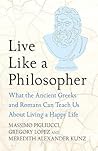
BOOKS: “Live Like a Philosopher” by Massimo Pigliucci, Gregory Lopez, and Meredith Alexander Kunz

Live Like A Philosopher: What the Ancient Greeks and Romans Can Teach Us About Living a Happy LifeLive Like A Philosopher: What the Ancient Greeks and Romans Can Teach Us About Living a Happy Life by Gregory Lopez
My rating: 4 of 5 stars

Publisher Site — Hachette / Headline Press

This book is for a person in the market for a philosophy of life, but who only knows that they want a system rooted in Ancient Greece. While the coauthors are all Stoics, the book explores twelve additional philosophies and gives each roughly equal consideration. In addition to the expected systems, such as Epicureanism, Stoicism, Platonism, and Skepticism, there are also several lesser known or defunct philosophies such as Cyrenaic hedonism, Cynicism, Pyrrhonism, and Megarianism.

The book is organized into four parts. The first examines schools that value pleasure (Cyrenaicism and Epicureanism,) the next investigates schools that focus on virtue and character (Aristotelian Peripatetics, Stoicism, Cynicism, and Political Platonism,) the penultimate focuses on systems encouraging doubt or caution in knowledge (Socratic philosophy, Academic Skepticism, Sophism, and Pyrrhonism,) and the last set are posed as questionable candidates for a life philosophy (i.e. those of the Pythagoreans, Megarians, and Neoplatonists.) The last three schools are questioned on various grounds, including: is enough known about what its practitioners believed, did they live their philosophy or just ruminate on it, and could the system be considered a full-fledged philosophy (as opposed to a stance on a specific issue or issues.)

The book is presented in self-help fashion, with each chapter ending in a set of exercises designed to help the reader build practical understanding of each school. The goal of these exercises (as comes together in an appendix) is to help the reader determine which philosophy is best suited to their disposition and inclinations.

I enjoyed this book. The authors use stories to convey ideas and the book’s readability is kept inviting to general readers. If you’re interested in better understanding Greek schools of philosophy, I’d recommend the book as quick and easy way to get a better grasp.

View all my reviews

“Worldly Place” by Matthew Arnold [w/ Audio]

Even in a palace, life may be led well!
So spake the imperial sage, purest of men,
Marcus Aurelius. But the stifling den
Of common life, where, crowded up pell-mell,

Our freedom for a little bread we sell,
And drudge under some foolish master's
ken
Who rates us if we peer outside our pen --
Match'd with a palace, is not this a hell?

Even in a palace! On his truth sincere,
Who spoke these words, no shadow ever
came;
And when my ill-school'd spirit is aflame

Some nobler, ampler stage of life to win,
I'll stop, and say: "There were no succour
here!
The aids to noble life are all within."

Mountain Envy [Free Verse]

Ah, the mountain!
Old enough to know
When to stay quiet,
And disciplined enough
To stick to it.

BOOKS: Travels with Epicurus by Daniel Klein

Travels with Epicurus: A Journey to a Greek Island in Search of a Fulfilled LifeTravels with Epicurus: A Journey to a Greek Island in Search of a Fulfilled Life by Daniel Klein
My rating: 5 of 5 stars

Amazon.in Page

With the wave of renewed interest in Philosophies of Life lately, it’s nice to see a book that puts Epicurus at the fore. In a number of ways, I believe Epicurus was the most advanced of Ancient Greek philosophers, and yet he doesn’t get much attention compared to Plato, Aristotle, and the Stoics. (In part this is because the vast majority of Epicurus’s writings were lost, and in part it’s because little-“e” epicureanism [i.e. being culinarily hedonistic] has become much more familiar to people than big-“E” Epicureanism [i.e. a materialist philosophy that values pleasure, but not in so hedonistic way as to lose sight of virtue and the countervailing costs of pursing pleasure.] While adjectival forms have done a number on Cynicism and Stoicism as well, the former is – for all intents and purposes – dead and the latter has become much more well-known to present-day people from a pile of podcasts, books, and vlogs.)

I should point out that Klein doesn’t solely focus on the philosophy of Epicurus, he also tells readers what other schools of philosophy teach us about how to age well (and to not turn into a curmudgeon) — most notably: Buddhism, Stoicism, and Existentialism. That said, it’s fair to call Epicureanism the backbone of this book.

One who reads the title might wonder whether this is a pop philosophy book on aging or a travelogue. It’s definitely both, but the philosophy part dominates. I would call it 70/30 pop philosophy to travelogue (maybe 65/35.) The book uses the individuals Klein interacts with on Hydra (and elsewhere in Greece) as examples of how people age well, and in the process shows the reader [textually] a beautiful part of the world. But the core of the book is about philosophy as it pertains to such topics as play, perception of time, idleness, and changing views of spirituality.

I will warn the reader that, while the book offers many great thoughts for a philosophy of aging well, I didn’t agree with everything in the book. Klein contrasts his philosophy for living well into old age and for adapting one’s life to changing roles to the people he calls the “forever young” crowd. I wouldn’t put myself in the “forever young” category as I don’t believe I’m grasping at youth and all its blessings and pains. However, I suspect Klein would put me in that group because I work out intensely, watch what I eat / manage my vices, and am trying to work things so that my heart explodes while I’m still physically and mentally capable — i.e. before I become decrepit or senile. My point is, I’m not sure Klein’s dichotomy is that useful or reflective of reality, and that being health-conscious should necessarily be contrasted with enjoying the pleasures of age. [Truth be told, I’d say the biggest driver for people being more health-conscious into old age is seeing earlier generations live longer, but with a decreased quality of life through that period of increased longevity — See: Being Mortal by Atul Gawande.]

Still, overall, the book is quite readable and offers much excellent food for thought, and I’d recommend it for anyone who is interested in moving into advanced age in a way that isn’t misery filled.

View all my reviews

BOOK REVIEW: Ancient Philosophy: A Very Short Introduction by Julia Annas

Ancient Philosophy: A Very Short IntroductionAncient Philosophy: A Very Short Introduction by Julia Annas
My rating: 4 of 5 stars

Amazon.in Page

Annas’s task of creating a concise guide for such a broad topic is a daunting one. For perspective, I’ve read books in this series [AVSI] on Stoicism, Epicureanism, and Socrates – each of which is a slim subset of the material called “Ancient Philosophy.” Furthermore, it’s not as though there was great homogeneity of ideas among the ancients. And, adding to the challenge, the author attempts to address the full scope of ancient philosophy: i.e. ethics, epistemology, logic, and metaphysics.

The book is forced to both restrict itself to an inch deep (because the subject is a mile wide,) but also to make choices about what schools, philosophers, and sub-topics it will address. History did part of the work – e.g. for many ancients, only fragmentary or secondhand evidence of their positions survived. So, we see a lot about Plato and Aristotle because their words remain. The book also devotes a disproportionate emphasis to what some call “philosophy of life,” i.e. ethics and how / whether to pursue a happy and meaningful life – i.e. how to live. This emphasis is both because that’s what many ancients focused upon, but also because it’s what people find relevant when looking back to them. [As opposed to ancient metaphysics, which science has largely made obsolete, ancient ethics and thoughts on happiness aren’t necessarily outmoded.] The first chapter sets up this focus on philosophy of life in an interesting way by discussing humanity’s mixed motivational system — reason v. emotion.

One question that the book robustly considers is the degree to which ancient philosophy is still relevant. This is taken up most directly in chapter two, but the final chapter (on what constitutes ancient philosophy) also has germane things to say on the subject.

I found in this book a quick guide to comparing schools of the ancient world across the breadth of philosophy, and would recommend the volume – particularly as a starting point prior to delving deeper into sub-topics.


View all my reviews

BOOK REVIEW: Stoicism: A Very Short Introduction by Brad Inwood

Stoicism: A Very Short IntroductionStoicism: A Very Short Introduction by Brad Inwood
My rating: 4 of 5 stars

Amazon.in Page

Inwood provides an overview Stoic philosophy as it’s discussed in a scholarly context. To distinguish Stoicism as scholars see it from how it’s viewed by those who practice it as a lifestyle, the author differentiates “large Stoicism” from “minimal stoicism.” The vast majority of books today deal only with minimal stoicism – in other words; they exclusively explore how to lead a good and virtuous life, i.e. ethics-centric Stoicism. Scholars, however, are also interested in the physics (/ metaphysics) and the logic of Stoicism.


There are several reasons for this difference in scope. First, Stoic ethics has aged much better than its other philosophical branches. Much of Stoic logic has been improved upon or superseded, and Stoic physics is [arguably] obsolete. This means that scholars studying Stoic physics and logic are more interested in those subjects as a stage of development or a piece of philosophical history than they are as contenders for understanding those subjects. Second, prominent Stoic philosophers with surviving writings (i.e. Epictetus, Marcus Aurelius, and Seneca) have inspired many people by discussing Stoicism as a way of life – not so much as a navel-gazing endeavor.


After discussing the origins of Stoicism, the major Stoic authors, and how Stoicism relates to other philosophical schools of the ancient world, the book presents a chapter each on physics, ethics, and logic. The last chapter investigates how Stoicism is viewed today and how it might maintain relevance despite challenges to some of its metaphysical and logical underpinnings.


Having read a number of books on Stoicism, I didn’t know whether this concise book would be of much benefit. However, by describing Stoicism’s broader context and how the deterioration of much of that context influences the philosophy’s relevance, the book offered plenty of food-for-thought. If you’re interested in this broader context, you may want to give this book a look.


View all my reviews

BOOK REVIEW: A Guide to the Good Life by William B. Irvine

A Guide to the Good Life: The Ancient Art of Stoic JoyA Guide to the Good Life: The Ancient Art of Stoic Joy by William B. Irvine
My rating: 5 of 5 stars

Amazon page


This is a great little guide for a person considering the Stoic life. Stoicism was one of more well-known philosophies to come out of the ancient world, though it suffered a setback with changing philosophical trends and the rise of the great monotheistic religions. For those who know the term “stoic” as a small-s adjective, it’s worth noting that its definition (emotionless / impassive) is not the distinguishing trait of this school of philosophy. (Something similar can be said for Cynic v. cynic and Epicurean v. epicurean.) Still, there is a thin connection in that Stoics believed in not being controlled by emotion to one’s detriment, and not becoming emotional over things about which one has no control.

This book offers some historical background, showing how Stoicism evolved as it moved from Greece to Rome (and later how it might continue to evolve to appeal to — and work for — a modern following.) It also gives one some idea of the subtle differences of perspective among the Stoics. Usually when one bones up on Stoicism, one does so through the writings of a particular philosopher, be it Epictetus, Marcus Aurelius, or Seneca, and so it’s interesting to see how these men with varied backgrounds lived and taught Stoicism.

The book is divided into four parts. The first part discusses what a life philosophy is, it gives Stoicism a context within other ancient philosophies, and it compares and contrasts Greek and Roman Stoicism. The second part describes the techniques that Stoics used to achieve their worldview and approach to living. These techniques include negative visualization (mentally rehearsing worst-case scenarios in a way that one becomes desensitized to them), classifying events by whether one can do anything about them or not and adopting a fatalistic acceptance of what one cannot influence, self-denial (i.e. avoiding excessive pursuit of comfort or pleasure), and meditation (being aware of one’s behavior so one can learn to implement Stoic approaches to living.)

Part three describes the advice of Stoics on a range of issues that are confronted in life. These include: duty, social relationships, insults, grief, anger, desire for fame, desire for luxury, exile, old age, dying, and becoming a Stoic. You may note, most of these are as valid today as they were in the day of the great Stoics, if not more so, and even “exile” has modern day analogies.

Part four discusses Stoicism for modern living. Among the issues covered include how a secular humanist might justify the practice of Stoicism. (The historical justifications were couched in theistic assumptions about the world.) It also delves into nuts and bolts considerations for the would-be Stoic. (Specifically, Irvine suggests practicing something he calls “stealth Stoicism,” which involves living in accord with the tenets of the philosophy while avoiding drawing attention to it from friends and family who might think you’ve become a lunatic who will soon be showing up to the 4th of July BBQ in a toga.)

Besides annotations and a works cited section, the back matter also includes a Stoic reading program as an Appendix.

I found this book to be interesting and informative. I’ve read works by Stoics, but it was nice to learn about Stoicism through a broader, overhead lens. If you’re interested in a philosophy of life, in general, or Stoicism in particular, this is a good book to read.

View all my reviews

BOOK REVIEW: The Art of Living by Epictetus; ed. by Sharon Lebell

The Art of Living: The Classical Manual on Virtue, Happiness and EffectivenessThe Art of Living: The Classical Manual on Virtue, Happiness and Effectiveness by Epictetus
My rating: 4 of 5 stars

Amazon page


This thin volume is packed with the wisdom of Epictetus. Epictetus was a freed slave who made a name for himself as a philosopher in Rome about a century after the birth of Christ. While small-s “stoic” conjures an image of a dour automaton, the Stoics were philosophers who believed [he oversimplified] that there’s nothing worth getting broken up about. If you can do something to influence the outcome of an event, you just need to pick the virtuous course. And if you can’t do anything about it, getting mopey is futile. In many ways, Stoicism is the Western philosophy that is most in-line with Eastern philosophies in that it emphasizes that your internal mental state is independent of what is happening outside you; so, if you can rule your mind you can find your bliss. Lebell, the editor of this volume, heavily accentuates that similarity.

When I called this thin, I didn’t mean “thin” as a derogatory comment. That said, this book is even thinner than it’s 113-page count would suggest because (as with most poetry collections) there’s a lot of white space left under a few lines of text. I actually think it’s kind of nice that the publisher didn’t do what is usually done with such short books, which is to pad them out with various unnecessary ancillary material. That said, if you can get the e-book, you’ll save some trees from dying for blank space. If they would have placed more than one maxim per page, it would probably have been cut to about 60pp.

I found this book to be well-written and nicely presented, and would recommend it for someone who wants a simple and concise overview of Stoicism.

View all my reviews