
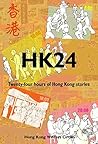
BOOKS: “HK24” by The Hong Kong Writers Circle

HK24: Twenty-Four Hours of Hong Kong Stories (Hong Kong Writers Circle Anthology Book 13)HK24: Twenty-Four Hours of Hong Kong Stories by Stewart McKay
My rating: 4 of 5 stars

Publisher Site – Hong Kong Writers Circle

This collection of twenty short stories is connected by the theme of events taking place in a single day in Hong Kong. Besides this commonality of setting, there is no other connective tissue between the stories. Tonally, the pieces range from hilarious to tragic. There are suspenseful genre fiction stories as well as realist literary fiction (i.e. telling the story of work-a-day characters engaged in events of everyday life.)

I found “Mummy, Daddy, Angry Birds” by Carsten John and “Rent” by Sharon Tang to be the best humor pieces, and “Egrets” (Paul Clinton Corrigan,) “Help Yourself” (Edmund Price,) and “Joss” (Dimple Shah) to be the most thrilling and intriguing dramatic pieces. All the stories were well-crafted, but some did stand out more than others. A few of those realist pieces that explored “mundane” expat life in Hong Kong made for engaging and distinctive reading. And Hong Kong is uniquely situated for tales of an urban shaman or a Triad shooting.

This is the thirteenth volume of a series put out by the Hong Kong Writers Circle. Each volume has a different theme (besides being Hong Kong connected.) Hong Kong is one of those places that is authentically itself, not to be confused with anywhere else, and that offers a great opportunity to build fascinating tales that could only take place there. [I found it interesting that “should I stay or should I go” was a repeated theme across multiple stories.]

I picked this book up as a piece of travel literature for an upcoming visit to Hong Kong (I make sure to read a work of literature from every country I visit — provided I can find anything translated.) I’d highly recommend this book for readers interested in short fiction with that distinctive Hong Kong flavor. I intend to look into other volumes in the series, myself.

View all my reviews

BOOKS: “Sightseeing” by Rattawut Lapcharoensap

SightseeingSightseeing by Rattawut Lapcharoensap
My rating: 5 of 5 stars

Publisher Site – Atlantic

This collection of seven short stories offers insight into Thailand and its culture, but the stories are also gripping and clever. It’s a rare thing for stories to so engage with issues such as poverty, class, the refugee experience, the human experience, and foreignness and to still be highly entertaining.

Farangs is about the interaction of Thais and foreigners in the form of a love triangle featuring a Thai protagonist, a Western girl, and the girl’s erstwhile (also foreign) boyfriend.

At the Cafe Lovely is about two brothers, the older of whom takes the younger brother to a “cafe” that is more of a bar with built-in brothel. The story shows the seedy side of Bangkok, but also the bond between brothers.

Draft Day is about two friends, one from a wealthy family and the other not, who have to go to the draft lottery to determine whether they will have to serve in the military or not. This story is potent observation on social justice.

Sightseeing is about a mother and son’s last trip before the mother loses her vision.

Priscilla and the Cambodians is about a Cambodian girl who, in a rough-and-tumble manner, befriends two geeky Thai boys. The story explores the woes of being poor outsiders in a world that cares neither for the poor, nor for outsiders.

Don’t Let Me Die in this Place is about an old American man who moves in with his son and the son’s Thai wife and their children in Bangkok after the man has suffered a stroke and is in recovery. It’s about the old man’s struggle to adapt to a very different life while at the same time coping with not being able to take care of himself.

Cockfighter is the longest and also probably the most visceral of the stories. It centers on a teenaged girl whose father is the titular “Cockfighter” and whose mother makes hand-sewn bras. It’s an intensely psychological work of fiction with some hilarious moments, as well.

I’d highly recommend this collection for all readers of short fiction. I chose it as my travel literature for Thailand (I read a work [or works] of literature from all countries I visit,) but I don’t think one has to have a particular interest in Thailand to find the stories fascinating and profound.

View all my reviews

BOOKS: “Face Meat” by Bonten Taro

Face MeatFace Meat by Bonten Taro
My rating: 5 of 5 stars

Publisher Site – Living the Line

Release: May 20, 2025

This is a creative collection of fourteen dark and creepy tales. It’s full of monsters, curses, killers, folkloric themes, and death. Many, but not all, of the stories are placed in Japanese settings — e.g. the wild west and 19th century Europe are also featured. (And some of the stories seem to be of ambiguous setting — presumably on purpose.) Most, but not all, of the stories feature supernatural elements.

It’s a translation of a manga, and isn’t reformatted, such that one will need to get comfortable with the “backwards” reading that such books entail. The art is mostly line drawn and lightly shaded black and white, with a few color pages (mostly story covers) in sepia-reminiscent tones.

I found the tales to be taut and disturbing and would recommend the book for readers of horror and dark speculative fiction. It is sexually as well as violently graphic –so, if you’re one of those weirdos who is ok with a severed head but scandalized by an unclad breast, this book isn’t for you.

View all my reviews

BOOKS: “Strange Tales from a Chinese Studio” by Pu Songling [Trans. by John Minford]

Strange Tales from a Chinese StudioStrange Tales from a Chinese Studio by Pu Songling
My rating: 5 of 5 stars

Publisher Site – Penguin

This is a collection of short stories, almost entirely speculative fiction, dating from the Qing Dynasty (specifically, the late 1600’s to early 17oo’s.) Ghosts, folkloric creatures, and Taoist magic all feature prominently in the stories. The stories average about five pages, but with a wide deviation from stories scarcely longer than today’s micro-fiction to extensive pieces. The Penguin edition collects 104 out of a much larger collection of stories.

The best of these stories are clever and highly engaging, and there are many such tales. Being from Qing Dynasty China, the stories offer a perspective different from one’s typical horror and fantasy short stories. Many of the stories prominently feature eroticism, but not graphically so.

As for the weakness of the volume, even though it selects only a portion of Pu Songling’s original, there are many stories that blend together, failing to distinguish themselves. This is most notable among the fox-spirit stories, of which there are just so many. [A number of them are fantastically unique, but others are just variations on the same.] So, the book can seem a bit repetitive in that sense. However, before you get to the point where you feel you can’t read one more fox-spirit story, you’re quite likely to read a tale that blows your mind.

I greatly enjoyed many of the stories herein. Perhaps, the volume could have benefited from further abridgement, but it’s well worth the read.

View all my reviews

BOOKS: “The Sandman, Vol. 3: Dream Country” by Neil Gaiman

The Sandman, Vol. 3: Dream CountryThe Sandman, Vol. 3: Dream Country by Neil Gaiman
My rating: 5 of 5 stars

DC Site

If you love a good story, you really can’t go wrong with Gaiman. This volume consists of four standalone pieces of short fiction set in the Sandman universe.

“Calliope,” like Greek Mythology, envisions an anthropomorphized muse, but takes the idea into a dark and modern twist as said muse is held captive and violated.

“A Dream of a Thousand Cats” imagines dreams do shape the real world and asks what if animals dreamt as big as humans.

“A Midsummer Night’s Dream” is built around the premise that Shakespeare had a patron, none other than Morpheus, a.k.a. Dream, himself.

“Facade” is about a supernatural woman who can only go out in public by taking risky measures to look “normal,” and explores her lonely existence.

All of these stories are clever and compelling, and I’d highly recommend this collection for readers of speculative fiction.

View all my reviews

BOOKS: “Best Literary Translations 2024” ed. by Jane Hirschfield, et. al.

Best Literary Translations 2024Best Literary Translations 2024 by Jane Hirshfield
My rating: 5 of 5 stars

Publisher Site

This “best of” annual celebrates the unsung translator. Many of the original works are recent but some are old or even ancient; it is these translations to English that are in all cases recent. Spanish and Arabic translations are well-represented, but with respect to the twenty or so languages included, almost all are the sole representative for that particular source language. Poetry makes up the bulk of the collection (including prose poems,) but there are several pieces of short fiction and a piece of creative nonfiction or two.

Among my favorites were: “Grazing Land” (Greek,) “The Snail’s Spiral” (Spanish,) “The Lion” (Kurdish,) “Deterioration” (Persian,) “Graceless” (Chinese,) “Our Village” (Tigrinya,) and “The Sea Krait” (Tagalog.) But, as one would expect of a carefully curated “best of” collection, there were no stinkers in the batch.

If you enjoy literature in translation, this book is well worth investigating.

View all my reviews

BOOKS: “Gothic Tales” by Marquis de Sade [Trans. by Margaret Crossland]

Gothic TalesGothic Tales by Marquis de Sade
My rating: 5 of 5 stars

Amazon.in Page

Release Date: September 3, 2024

This collection of short fiction is an excellent entry point for the reader wishing to be introduced to the philosophy and literary stylings of the Marquis de Sade. It is less visceral and explicitly violent than the works for which Sade is most famous (i.e. Justine, 120 Days of Sodom, and Philosophy in the Boudoir.) While it does deal in libidinal issues throughout and has a few stories that are explicitly erotica (notably the last couple pieces,) it never ventures up to or over whatever thin line separates erotica from pornography.

While all the pieces share Sade’s signature philosophy and interests, it is in other ways a quite diverse collection of writings. The first piece, “Eugenie De Franval,” is a novella that takes up about half the book, and it is followed by a piece that, in today’s parlance, might be called flash fiction, “The Horse-Chestnut Flower.” Pieces such as “Eugenie De Franval” and “Florville and Courval” are tragedies while the comedies include: “Emilie De Tourville,”[granted with grim elements] “The Husband Who Played Priest,” “Room for Two,” and “The Self-Made Cuckold.” Those last three – as well as “The Horse-Chestnut Flower”– are comedic in a modern sense, not just the literary sense.

I can’t say how much of the difference in tone and intensity of these pieces from Sade’s other stories is owed to the selected source material and how much is owed to translation and editorial decisions, but it makes for a read that is more intriguing in story and less shocking and disturbing than many other translations of Sade’s work.

I enjoyed these stories. They had many clever twists and turns that I don’t recall experiencing in Sade’s novels. Several stories rely on a great deal of deus ex machina coincidences, but I think that works just fine — particularly in the more humorous stories. I’d highly recommend this for readers looking to ease into the work of the Marquis de Sade.

View all my reviews

BOOKS: MONKEY, Vol. 4: Music ed. by Ted Goossen & Motoyuki Shibata

MONKEY New Writing from Japan: Volume 4: MUSICMONKEY New Writing from Japan: Volume 4: MUSIC by Ted Goossen
My rating: 5 of 5 stars

Amazon.in Page

Release Date: November 14, 2023

This is the fourth volume in a series of translated Japanese short creative writing (mostly poems and short stories.) The series (and this edition, in particular) features some of the best-known Japanese authors (e.g. Haruki Murakami and Meiko Kawakami.) Beyond a few major pieces at the beginning, this edition has a theme of music that runs through it.

Among my favorite pieces were: the novel excerpt Yoshiwara Dreaming about a young girl who is sold into the redlight district and becomes a helper in a brothel; Transformer: Pianos which is a work of surrealist fiction; The Zombie is Haruki Murakami’s fresh take on the zombie story; I also enjoyed many of the inclusions in the section entitled Eight Modern Haiku Poets on Music.

It’s a varied collection of writings. Not only does it include all forms of creative writing — prose and poetic — but the broad selection of writers and translators ensure that there is a diversity of styles and genres. That said, there isn’t a great diversity in quality level. It’s all strong writing, though some works will appeal to any give reader more than others. There’s something for everyone.

I’d highly recommend this volume for readers of literature in translation.

View all my reviews

BOOK REVIEW: Twain Illustrated: Three Stories by Mark Twain by Mark Twain [Ed. by Jerome Tiller]

Twain Illustrated: Three Stories by Mark TwainTwain Illustrated: Three Stories by Mark Twain by Mark Twain
My rating: 4 of 5 stars

Amazon.in Page

This collection gathers three pieces of Twain’s short fiction and presents them in an edited and illustrated volume. The stories are edited from the original published editions. My understanding is that the editing was confined to making the volume more readable to a present-day audience (and probably to younger readers, specifically.) As far as I can tell, that’s the case.

The three stories have in common that Twain, himself, features as a character. [This is less explicit for the second story than for the first and third, it being merely written in first person while the others reference Twain by name.] The first story, “Emerson, Holmes, and Longfellow,” is essentially a roast of those three important 19th century American poets. The story is written as though Twain is traveling on walkabout and happens upon a miner’s household where, as luck would have it, the three titular poets had stopped in previously. Supposedly, this was first a speech given in Boston at a celebration for another poet, John Greenleaf Whittier, and it went down like a lead balloon.

The middle story, “The Facts Concerning the Recent Carnival of Crime in Connecticut,” is about a mysterious visitor who comes calling who seems to know about all the narrator’s misdeeds. It turns out that said visitor is the narrator’s conscience. This personification of conscience is a clever plot device and makes for a hilarious story.

The final story is entitled “Running for Governor,” and it shows that fake news is far from a new phenomenon in American politics. It imagines Twain running for governor of New York and the one news story after the next presenting outlandish, contrived claims that begin to stick as Twain ignores them. This reminded me of the Twain essay that disabused me of the popular notion that we are [at any given time] in uniquely contentiously partisan times for American politics.

I enjoyed this collection. I would probably have preferred an unedited text, but it’s readable, engaging, and humorous as is. The illustrations are line-drawn, and many are cartoonishly jocular while others are more realistic caricatures. It’s certainly an entertaining read.


View all my reviews

BOOK REVIEW: Opium and Other Stories by Géza Csáth

Opium and Other StoriesOpium and Other Stories by Géza Csáth
My rating: 5 of 5 stars

Amazon.in Page

Release Date: December 13, 2022 [For the reviewed edition by Europa and translated by Kessler and Rogers]

Csáth was a Freudian who, in 1919 at the age of 31, murdered his wife before committing suicide. He was a brilliantly imaginative [if macabre-oriented] writer, and — as one might expect — this collection’s two dozen stories are dark, dreamy, and often detached from reality. The collection is full of hazy surreality and bleak obsessions, but it’s an intriguing and engaging read.

The book presents several recurring themes: mothers, murder, the murder of mothers, etc.; as well as repetition of surreal settings involving dreams, drugs, and demented minds. Therefore, I’ll only discuss a handful of my favorite stories in the hope they are a reasonable representation. In “Murder,” a man meets an acquaintance on the train and is told of the murder said acquaintance committed, told in a matter-of-fact tone. This prosaic approach to murder is a recurring element of Csáth’s stories as well, and it lends to both the surreal and eerie nature of the stories. “Little Emma” is about a “play hanging” committed by a group of kids. In “Young Lady,” a patient in an insane asylum tells his friend about his obsession with a young woman. “A Joseph in Egypt” is the story of a dream in which the dreamer engages in a tête-à-tête with a married woman. In “Toad” a man imagines he wakes up to find a monstrous toad in his bedroom, or so he believes. In “Matricide,” brothers attempting to rob their mother end up murdering her when she awakes during the crime. “Father, Son” is the story of a young man going to retrieve his father’s remains from the medical school that had come into possession of the body because his mother didn’t have the funds to afford a proper burial while the son was away overseas.

If you enjoy macabre and surreal stories, this collection is well worth reading. However, it will not be everyone’s cup of tea, owing to the dark tone and themes of the stories.


View all my reviews