5 Untruths Worth Pretending Are True

pretend_play_preschool


William James famously suggested that the path between emotion and expression wasn’t a one-way street. In other words, it’s not just that having an emotion causes us to express it through facial expressions and body language, but also that by assuming a given expressions we create the corresponding emotional state. James might have gone a little far in proposing the emotion can’t exist devoid of its expression, but he came by the belief that you could get to emotion through expression honestly enough.


I read about how James, suffering a bad cases of the blues, asked himself what would happen if he behaved as though he was in a happier state of mind. He decided to carry out this experiment, and he soon found himself in a much better mental state. This got me thinking about what else one might pretend that would yield positive results.


It should be noted, that there’s been a lot of research on this topic, and it’s been dubbed the “as if principle,” though colloquially people talk about it as “faking it till you make it.” Some of you may be familiar with this idea from the study showing that adopting a Wonder Woman stance made subjects feel more confident. If not, Amy Cuddy’s TED Talk can be viewed here.


So, here are five ideas–true or not–that are worth believing:


[Note: You’ve got to pretend as if you were a five-year old. Don’t bring those pathetic and puny adult imaginations.]


5.) I’m happy:  Starting with the self-ruse most widely known and which James brought to our attention. You may have heard the following advice: if you’re ever feeling down, stand up and pump your fists in the air at an upward angle such that one’s body forms a “Y” (or an “X if you want to keep your feet wide.) This is a hardwired victory behavior written into our evolutionary coding, and it’s hard to be depressed while doing it.


4. Oneness / Unity:  Try pretending that you’re connected to everything in the universe. The experience isn’t uncommon with mystics and meditators, as well as those in the Flow. This is an attempt to work it around from the other direction.

Now, some mystic-scientist out there is going to say that this isn’t an untruth because there’s evidence that we are connected to everything, citing quantum entanglement and such like. Maybe so, but as there’s no reason to believe we have a sensitivity to happenings at that quantum state, the pretending is still necessary. (i.e. Even if such entanglement exists, we can no more sense it than we could recognize if a force of 1-trillionth of a gram touched our skin.) Evolution doesn’t grant us capabilities beyond what are needed to survive to procreate, and so I’m doubtful that we have some untapped power to sense quantum entanglement lurking within us.) The oneness we feel has to do with the part of the brain that tracks the “I v.) not-I” divide fading out of operation–rather than an awareness of some web of subatomic entanglement.

This self-subterfuge is a way to simultaneously put one’s worries in perspective while not becoming demoralized about being an insignificant speck in a vast universe. One is an infinitesimal speck in an infinite universe, but one is tied into the universe such that one is simultaneously an infinite universe.


3.) Chi / Prana: I don’t think there’s any reason to believe that the immaterial energies of Eastern traditions (Taoism and Yoga, respectively) exist. However, I wouldn’t argue that there’s no benefit from imagining them to exist.  There seems to be little doubt that visualizing the flow of these energies can have benefits–regardless of whether they’re the traditionally advertised benefits or not. Even if you don’t succeed in pulling energy into one’s body directly, sans the middlemen of food and oxygen (so one can live off the dew on a single ginko leaf–ala “Kung Fu Panda”), visualization is good for the brain and the invigorated feeling one creates in pretending chi exists can’t hurt.



matrix

2.) “There is no spoon:”  This, of course, comes from the movie “The Matrix” in which a young sage / savant attempts to teach the protagonist, Neo, how he can bend a spoon with his mind. The upshot is that one doesn’t try to bend the spoon, one realizes that the spoon is a figment of the imagination.

The idea that we are part of a simulation may turn out to be less far-fetched than it seems. I cite, for example, the TED Talk by physics Nobel Laureate George Smoot.

At any rate, the virtue of the thought exercise of pretending this is true is two-fold. First, one can ask whether one would lead the same life and give events the same weight if one was to discover that one was living out a simulation designed to advance the understanding of some entity (e.g. an alien race, a colossal supercomputer, etc.) Second–and more importantly–one may become more attuned to the fact that one’s own mental / emotional world is full of dream-like simulations. One’s brain is designed to anticipate worst-case scenarios, and it’s exceedingly good at fabricating scenarios that taint our perception of the world with anticipated negative possibilities–most of which will never come to fruition. There are many variants, attributed to various speakers, of the following Mark Twain quote:

“I’ve had a lot of worries in my life, most of which never happened.”


1.) There is no I:  A core tenet of Buddhism is that there is no self. Depending what a self has to be to exist as an independent entity, science may yet converge on a similar conclusion. The self seems, at best, to be an emergent property. In the Anil Ananthaswamy book I recently reviewed, it’s compared to a center of gravity. There’s no molecule that can be called the center of gravity, it’s a property that moves around as the body does. It’s definable, but not in terms of a specific location or physical existence.

Pretending there is no self may help put many worries into perspective. Like #4, it may also help one feel more connected to a larger world. But most importantly, it may help one to turn off those parts of one’s mind that are prone to self-loathing, self-denigration, or just self-consciousness.


Happy pretending.

nightsky

BOOK REVIEW: The Man Who Wasn’t There by Anil Ananthaswamy

The Man Who Wasn't There: Investigations into the Strange New Science of the SelfThe Man Who Wasn’t There: Investigations into the Strange New Science of the Self by Anil Ananthaswamy
My rating: 5 of 5 stars

Amazon page


What is the self, and is the self a distinct entity as we feel it to be? Those are questions that philosophers and theologians have been debating for centuries, and they’re the questions at the heart of this book. Ananthaswamy takes a crack at answering by looking at several of the ailments and mental phenomena that seem to steal or morph what we think of as the self.


While there are many distinct views on the self, the predominant view has always been the one guided by the way it feels. And it feels like there is some non-material entity—call it a soul, a spirit, a consciousness—that resides in the body though is–in certain extraordinary circumstances–detachable from the body (e.g. death.) This gave rise to a widespread belief that while our physical bodies may have a shelf-life, this non-material bit is eternal—or at least not governed by physical laws.


However, as science has illuminated the workings of the brain, it looks more and more as though this “non-material entity” is, in fact, an emergent property or illusion that derives from the activity of our material brain / nervous system. One of the phenomena that a materialist explanation would have once had great difficulty in explaining is the out-of-body experience [OBE.] Historically some may have written these off as fraud, but the cases are common enough and described similarly enough that that strains credulity. However, we now have strong reason to believe that the OBE is a specific kind of hallucination, and that reason is that OBEs can now be consistently induced by neuroscientists applying an electrode to a specific point on the brain. As for the old schools of thought, it seems that the Buddhists were by far the closest when they suggested that there is no self—that it’s illusory.


Ananthaswamy’s book consists of eight chapters. Each of the chapters addresses a particular ailment or phenomena of the mind that has something to tell us about what the self is and what it isn’t. If a specific injury, ailment, or consumption of a chemical cocktail makes one feel as though one has lost part of what it feels like to be a person—then we may get some idea where the self resides or where the series of neural activities that feels like a self resides. (Spoiler: There is no single spot in the brain where the self or sense of self resides.)


The first chapter gets straight to the heart of the matter by describing Cotard’s syndrome, a disease in which a person swears that he or she doesn’t exist or is dead. This affliction seems to attack the most fundamental sense of self—the gut feeling that one is a distinct living being. Another way that we think of ourselves as that distinct living being is through our life story. Chapter two looks at how diseases like Alzheimer’s shatter this sense of self-hood.


Another basic level at which we feel the self is in its correspondence to the confines of our body. However, not even this physically rooted approach to self is unassailable. One may be familiar with cases of phantom limb syndrome in which amputees feel a lost limb. Incidentally, this is another reason people have felt there was a soul—one that didn’t know the body was amputated and kept its original non-material shape, an idea that V.S. Ramachandran’s work showed was likely not the case. Ananthaswamy, however, focuses on an ailment that is the exact opposite of phantom limb syndrome, those who feel that one or more of their limbs are foreign entities. This is where the book’s reporting is at its most intriguing as the author manages to speak with a doctor who does amputations for such people at no small risk to his medical credentials.


In chapter two, the author investigated the self as a collection of memories—in other words, the things one has done. Chapter 4 explores people who don’t feel a connection between the actions they are performing and the self even as they are performing said actions. The cases discussed involve patients with schizophrenia.


Chapter five examines depersonalization syndrome. With this syndrome, there’s an emotional disconnect which people feel as being in a dream, but during the patients waking life. The chapter focuses on two cases which give different means by which this can occur. One was an individual who was abused as a child, and the ailment seems to have been a defense mechanism to disconnect from the trauma. The other was chemically induced—though, disconcertingly, the effects went on long after all of the drugs should have been out of the woman’s system. Chapter six explores another set of afflictions involving stunted emotional response, and those are the autistic syndromes. The principle case involves a high functioning Asperger who was intelligent enough to learn how to respond even though he had no emotional cues. A quote from that individual that sums up his experience of the world nicely is, “I love my sister, but it’s done purely at a cognitive level. I think love for her; I don’t feel love for her.”


The penultimate chapter is where the author describes case of OBE and other hallucinations in which the self seems to migrate, split, or wander. The final chapter continues examining the self free of the body by considering cases of epilepsy. Epilepsy can have many powerful mental effects. One may be familiar with the many cases of “spiritual awakening” that have been attributed to temporal lobe epilepsy. And some have speculated that Joan of Arc, St. Paul of Tarsus, and Mohammed all suffered from epilepsy. Ananthaswamy also presents cases of people on psychedelics—most famously Aldous Huxley.


There’s an epilogue that both tells us what the Buddha had to say about self during his first sermon at Sarnath, and sums up what’s been learned about what the self isn’t and what it seems to be. The book is annotated, but there are no graphics or other ancillary matter. It’s really not needed as the focus throughout is narrative, the telling of fascinating cases that illuminate the experience of the self. I appreciate that the author went out and sought some unique cases. I read a fair number of pop neuroscience books, and there are a few cases that get rehashed ad infinitum (Phineas Gage, H.M. etc.) It’s not that Ananthaswamy doesn’t go retell a few of the classics, but he also does some original investigation. The chapters on depersonalization disorder and amputation show this distinct touch.


I’d highly recommend this book for those who want insight into the nature of the self from a scientific perspective. I’ve read many books that touch upon the subject as part of a broader theme, but this is the first I’ve read that focuses entirely on this subject from a scientific rather than philosophical or spiritual perspective.

View all my reviews

5 Ways to Manage Your Email & Social Media Addiction

Addiction? That seems harsh. It feels like I’m equating a person who has his phone in hand several times every hour with a heroin junky or a nymphomaniac. But, the difference is in the word “Manage.” I wouldn’t write a post entitled “How to Manage your Heroin Addition.” I’d write one called, “Quit that Shit Before it Kills You.”  I’m not suggesting that one needs to do away with checking email and social media. These are great tools that allow us to be much more productive (potentially.)


Still, if we’re honest about it, most of us at some point get caught up in the compulsive checking of emails, social media, internet feeds, click-bait sites, sale pages for online retailers, and stats pages. There’s no denying it. A pile of evidence has accumulated about the extent to which people are dismayed by their own e-world activities. I just started reading Kotler and Wheal’s “Stealing Fire” (out February 21, 2017) and they site a study that found that about 2/3rds of those surveyed admitted checking their status page when they woke up in the middle of the night. It might seem off topic for book about altered states of consciousness to report on such matters, but its not because it’s all about the pursuit of a neurochemical bump. (Also, as I’ll discuss, a major problem of this addiction is in keeping one from slipping into the Flow with one’s work, family, or hobby activities.)


So, below are five methods I’ve found useful in my own on-going struggle with this addiction.


5.) Set a timer:  The problem with this addiction is that when one falls into habitually checking one’s status, one isn’t able to stay on task, and that means that one won’t achieve that elusive state of optimal performance called Flow. One needs time to immerse oneself in a task.


When I’m writing and editing, I set a timer, and until it beeps I do nothing off topic. I don’t make it some Herculean effort. I use 60 and 90 minute intervals. After the alarm rings, I can check email, do Tai Chi, get a cup of coffee, or work on my handstands. A longer time period may be more–or less–beneficial for you. (Isaac Asimov was said to only take a break after 5,000 words, but few writers have that in them.) The point is to make it long enough that one can get into a focused state of mind, but not so long that you become distracted and run down.


4.) Know your high energy period: This point relates to the last because it’s about blocking one’s productive time, and putting the more Flow-demanding activities when one is at one’s best. e.g. Are you a lark or an owl? (i.e. morning person or evening person.)


For example, I’m a morning person. This creates a potential problem. While I find it easy to get up with the sun, I’m at risk of saying, “Oh, I’ll just check emails, Facebook, my blog stats, a couple YouTube channels, and then I’ll get to work.” Then it’s noon, and the hours in which my mind was at its very best are gone. From 7pm until I go to sleep is when I should check these feeds because by that time my mind isn’t good for editing or writing tasks that require a high level of attention to detail.


3.) Go Cold Turkey [for a few days]: Sometimes it’s easier to make changes when one is forced by circumstance to quit. Then one can be more conscientious in resumption of the activity in question. (Moving to India helped me break a lot of bad habits.) If nothing else, this will help to give you confidence that the Earth won’t roll off it’s axis just because you aren’t checking on it twice an hour.


I can offer two examples from my own life. Every year my wife and I go on an extended trek in a place where there are no bars and saving batteries is essential. The past couple years, this has been in the Himalayas because we’ve been living in India, but anywhere remote will work. I also did the Vipassana Meditation Course last year. (If you’re interested in the latter, you can read my account of it here.)

img_1397


2.) Meditate: Why? Because when you start meditating regularly, you tend to do less and less out of mindless habit. You become conscious of what you’re doing, and that’s the first step to making changes. You also start to become attuned to those very subtle dopamine bumps, and in that way you  aren’t fighting it the impulse blindly. The high of the click is infinitesimally more subtle than taking mind altering substances, and so it’s easy for this all to take place below the waterline (analogizing the mind to an iceberg but instead of the majority of the mass of ice below the waterline, it’s the conscious mind above and the subconscious below.)

img_1556


1.) Substitute: In the immortal word of the rock band “The Who.” If your problem is so extensive that it does more than block your attempts to hit the Flow, you may need to find a healthier alternative to wean yourself away.


What does one look for in a substitute? If it’s going to fill the same space, it requires immediate feedback and a mix of “fails” mixed in with “successes.” These are the components that make the e-world so addictive. We know immediately whether we got something or not, and that keeps us clicking–not unlike the famous rats that would keep pressing a button for pleasure even to the point of forgetting to eat.


Some people may work on games that will help build their brain. (Warning: just don’t trade one unproductive addiction for another.) I’m an advocate of working on physical activities (e.g. trying to develop new capabilities in calisthenics or yoga), but these often involve a demoralizing amount of fails to reach the optimal level (the optimal being that one has enough fails to keep it from being boring but not so many that one is brutalized.)

5 Books to Introduce You to Your Subconscious

In a world free of frontiers, the subconscious mind is the final frontier.


Below are a few books that I found useful. The hyperlinks forward to my review on GoodReads or the book’s GoodReads page.


Also, I’ve included three honorable mention books that I haven’t yet reviewed, but which seem both relevant and intriguing.


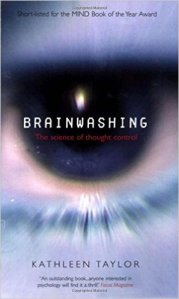
5.) Brainwashing by Kathleen Taylor: What makes some minds more malleable than others and how are minds bent to a given purpose? In learning the answers, one discovers that the bases of our beliefs are often more deep-seated than one might believe.

brainwashing_taylor


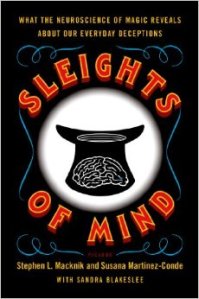
4.) Sleights of Mind by Macknik & Martinez-Conde: Magicians and mentalists are notoriously skilled at exploiting the chinks in the armor of  our minds.

sleights_of_mind


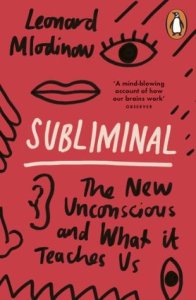
3.) Subliminal by Leonard Mlodinow: Physicist and pop science writer, Leonard Mlodinow, explores the many ways in which our behavior is more influenced from the back of the house than we feel to be the case.

subliminal


2.) The Tibetan Yogas of Dream and Sleep by Tenzin Wangyal Rinpoche: This is my nod to the fact that the Western scientific community isn’t the only entity that has something useful to say on this subject. Tibetan Buddhists have a long tradition (arguably predating Buddhism and into the Bon-era) of dream yoga (lucid dreaming) and our dreams offer the greatest portal to the subconscious.

tibetanyogas


1.) Incognito by David Eagleman: Eagleman tells us that our conscious mind represents the tip of the mental iceberg, and he explores the many ways in which we are subject to the vagaries of what exists below the surface.

incognito_eagleman


Here are a few others.


The Man Who Wasn’t There by Anil Ananthaswamy: I just finished this book. In it, the author investigates whether there really is  such a thing as the self by studying a number of diseases and phenomena of the mind that look like negations of self. (e.g. Cotard’s Syndrome in which people insist they are dead, depersonalization disorder in which life seems a dream in a literal rather than poetic sense, out-of-body-experiences in which there is a hallucination that one is outside one’s body, etc.)


The Attention Merchants  by Tim Wu: I haven’t read this one yet, but it’s said to be good and is about how our programming is exploited to keep us clicking. If you’ve ever wondered why you can’t seem to just drop social media even when it seems like a phenomenal waste of time–why it exerts such a strong pull–this book delves into what proclivities of the mind have been seized upon.


Reality is Broken by Jane McGonigal: I’m about 1/3rd of the way through this one. It has some overlap with the Wu book. In it, McGonigal asks why games have so much appeal–even to the extent of becoming addictive. As with why we keep clicking, the answer has a lot more to do with the primitive parts of our mind than the high tech subject matter might suggest.

BOOK REVIEW: The Geography of Bliss by Eric Weiner

The Geography of Bliss: One Grump's Search for the Happiest Places in the WorldThe Geography of Bliss: One Grump’s Search for the Happiest Places in the World by Eric Weiner
My rating: 5 of 5 stars

Amazon page


This book combines travel writing with pop science discussion of what makes people happy (or unhappy.) Weiner travels to ten countries in pursuit of happiness, and reflects upon the cultural components of bliss.

Some of the countries, like Switzerland and Iceland, rank among the world’s happiest in international surveys. Some of the countries, such as Qatar and America, have every reason to be happy, but aren’t necessarily as blissful as the rest of the world would expect. Some of them, like India and Thailand, have good reason to be unhappy, and yet they manage to be global exemplars of happiness [at least within certain domains.]

Then there are a few nations that have unique relationships to happiness. Bhutan has a national policy on happiness [plus it’s a Buddhist country, and Buddhism probably offers the most skillful explanation of what it takes to be happy of any world religion.] Moldova provides a counterweight as it’s one of the least happy countries in the world. Weiner visits the Netherlands in part because one of the biggest academic centers studying happiness is located in Rotterdam, but it also offers an opportunity to study whether the country’s unbridled hedonism (drugs and prostitution are legal) correlates to happiness. That leaves Great Britain, a country known for wearing the same happy face as its sad, terrified, and enraged faces.

I’ve been to half of the countries on Weiner’s itinerary, and—of the others—I’ve been to countries that share some—though not all—of the cultural constituents of happiness. (e.g. I haven’t been to Qatar, but I’ve been to the UAE. I haven’t been to Moldova, but I’ve seen somewhat less grim Eastern European states. I haven’t been to Switzerland or Iceland but I’ve been to cold countries in Western Europe. I haven’t been to Bhutan, but I’ve been in areas where Tibetan Buddhism was the dominant cultural feature.) This allowed me to compare my experiences with the author’s, as well as to learn about some of the cultural proclivities that I didn’t understand during my travels. And I did find a lot of common ground with the author, as well as learned a lot.

I found this book to be interesting, readable, and funny. Weiner has a wacky sense of humor that contributes to the light-hearted tone of the book—perfect for the subject. That said, some people may be offended because the author doesn’t pull punches in the effort to build a punchline, and this sometimes comes off as mocking cultures. However, in all cases—even that of Moldova—Weiner does try to show the silver lining within each culture.

The paperback edition I read had no graphics or ancillary matter. There are no citations or referred works (except in text), and the chapters are presented as journalistic essays. The chapters largely stand alone, and so one could read just particular countries of interest. He does refer back to events that happened in earlier chapter or research that related to another country’s cultural proclivities, but not often. The first chapter, on the Netherlands, would be a good one to read first because he describes many of the scientific findings on happiness in that one.

I would recommend this book for anyone interested in what makes some places happier (or sadder) than others.

View all my reviews

5 Tips for Introverts

5.) Eye contact: Train yourself to be aware of eye contact. Eye contact doesn’t come naturally for an introvert. It’s common to not only avert one’s gaze, but to zone out in the process because one’s mind is trying to anticipate the direction of the conversation and formulate a replies. There’s not enough consciousness left for monitoring the visual stream. This has a number of side-effects such as:

-missing non-verbal cues

-appearing uninterested

-staring in the wrong direction (crotches, cleavage, Hells Angels, etc.)

Just don’t let the pendulum swing too far such that one stares like a homicidal maniac.


4.) Scheduling: Bracket social and /or noisy events with quiet time. It’s not just social activity that can be draining for the introvert, being in environments with high levels of sensory stimulation will run down one’s energy even if one isn’t interacting socially. Living in India, I find that sometimes just walking down the street and minding my own business wears fairly rapidly. In moderated doses, these sensory-intensive situations are enjoyable and beneficial, but the secret is to avoid redlining. Extended periods of high stimulation may result in you being grumpy and / or dull.


3.) Readings: Come on, you’re an introvert, you know you love reading. There are a number of books that have come out in recent years to help introverts both better understand introversion and to learn to arrange their lives in a manner optimized to it. I’ll mention two of the more well-known ones.

The first is The Introvert Advantage by Marti Olsen Laney. I mention this one first because it was the first book I read on the subject, and it transformed my thinking about what it meant to be introverted. Though I’m an introvert, I didn’t really understand introvertism until I read Laney’s work.

introvertadvantage_laney


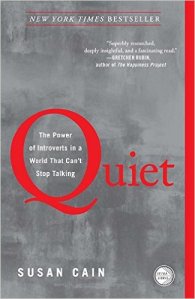
The more well-known and critically acclaimed book, however, is Quiet by Susan Cain.

quiet_cain


2.) Introversion ≠ Shyness: Know the difference between introversion and shyness (social anxiety.) Introversion has long been considered synonymous with shyness. Even many psychologists and mental health professionals seem to believe they are one in the same–or at least they did until the recent spate of books, TED Talks, etc. It’s true that many people are both shy and introverted, but it’s more complicated than that. One can be extroverted and shy. Talk about a raw deal. The shy introvert faces forces pulling them in one direction. The shy extrovert is being pulled in two different directions at once.


1.) Embrace it:  Accept your introverted nature. Given an extrovert bias, there’s a proclivity for introverts to wish they were extroverted or to even try to force themselves to be so. This is a recipe for disaster. I discussed the difference between introversion and shyness above, shyness is something that one can work on reducing through visualization, mindfulness, and–most importantly–practice interacting, but introversion is hardwired.

BOOK REVIEW: The Devils of Loudun by Aldous Huxley

The Devils of LoudunThe Devils of Loudun by Aldous Huxley
My rating: 5 of 5 stars

Amazon page


In 1634, a parish priest named Urbain Grandier was tortured to exact a confession that he’d engaged in sorcery and made a pact with the devil. There was plenty of reason to believe that Grandier was a less than virtuous fellow (e.g. that he knocked up the teenage daughter of his best friend in Loudun), but no evidence of the crimes that he was actually accused of–and that the Church insisted he cop to despite his steadfast denials. However, there was some potent circumstantial evidence in the form of a case of mass hysteria by members of a convent of Ursuline nuns that was attributed to demonic possession at the time.

Huxley tells this fascinating story in great detail. At some points, perhaps too much detail. The writing style can come across as pretentious, needlessly complicated, and slow-moving at times. (For example, there are frequent quotes and snippets of poetry in French–and a few in Latin—and many of these were not translated to English in the edition that I read. Apparently, the assumption was that the reader would have a basic competency in these languages.) However, when it comes to the climax of the story, the book is as gripping as they come. Having been presented with great insight into Father Grandier, we know him to be a deeply flawed man. He’s like the priests and bishops of a Marquis de Sade novel, lecherous and libertine. Yet, he manages to become a sympathetic character as he shows virtue of sticking to his guns in denial of being in league with Satan long after the truth of his vices has been admitted. In essence, when juxtaposed to his inquisitors, he becomes the lesser of two evils.

I also don’t fault that Huxley delves into analysis, because there is a fascinating question at the heart of the event—one that deserves to be batted around. What made this group of nuns behave in such an un-nun-like fashion? There was writhing, foul language, wardrobe malfunctions, etc. Today, it’s impossible for a rational skeptic to write these events off as demonic possession. However, while the Mother Superior, Sister Jeanne of the Angels, clearly had an axe to grind against Grandier (for issues regarding organizational leadership and not so much for womanizing the townies), that also seems unsatisfactory as a cause for these sisters to behave as they did. There have been a number of cases of pretended possession, but generally these were individuals—e.g. Martha Broissier. There seems to be some fascinating psychology at work in this case.

The book is arranged in 11 longish chapters, largely following a chronological progression of events. The edition that I have has some interesting appendices as well as a bibliography. There isn’t much in the way of graphics, but as the book reads like a novel one doesn’t expect there to be.

I’d recommend this book for those who are interested in history or psychology. It’s fascinating in both domains. While I thought the book could have been a little clearer and more concise, it’s still quite readable and the heart of the story is highly engaging. I was also reading the book as a general interest reader. A scholarly reader might appreciate Huxley’s thoroughness more.

View all my reviews

BOOK REVIEW: Siddhartha’s Brain by James Kingsland

Siddhartha's Brain: Unlocking the Ancient Science of EnlightenmentSiddhartha’s Brain: Unlocking the Ancient Science of Enlightenment by James Kingsland
My rating: 5 of 5 stars

Amazon page


Kingsland builds his niche by connecting the dots between the teachings of the Buddha and scientific discoveries about meditation and mindfulness. There are many books that tell the life story of Siddhartha Gautama from various perspectives (e.g. famously the books by Hermann Hesse and Karen Armstrong.) There are also a number of books reporting the science of meditation (e.g. Herbert Benson and Sat Bir Singh Khalsa.) However, it’s not so common for the subjects to be overlapped.

There’s a reason that this middle path hasn’t been more widely studied. While Buddhism is arguably the most science-friendly of the major world religions, there’s always a gulf between spiritual and scientific thinking. The writer has to figure out how to chart a course through rocky waters. Books appealing to spiritual seekers are likely to come across as insubstantial fluff to the scientifically minded reader, and books appealing to skeptics are likely to feel materialistic and cold (and, perhaps, naive) to the spiritualist. The Buddha’s teachings about the need for the practice to be experiential, rather than faith-based, offers a unique opportunity to tread this tightrope. Furthermore, the Dalai Lama’s willingness to facilitate a dialogue between science and Buddhism has been crucial as well. One can easily set aside controversial issues like reincarnation and karmic law as they aren’t essential to the value of mindfulness.

The book consists of twelve chapters. The chapters generally begin with a story or teaching from the life of Buddha, and then go on to investigate the relevant lesson in more detail with particular emphasis on any relevant scientific discoveries that support said teachings.

The story of Buddha begins in a wealthy, high-caste household with young Siddhartha Gautama being kept from seeing the effects of aging, illness, and death. When the young Siddartha, nonetheless, sees these things, it is a powerful introduction to the concepts of impermanence and suffering that will play a central role in his future teachings. Chapter 1 starts this introduction and also offers an overview of the book. Chapter two continues it. In Chapter three, Kingsland describes a little of the known history of meditation, though its origins are lost to time.

Chapter 4 is entitled “The Second Dart” and it discusses the Buddha’s teaching of the same name—the second dart being one’s mental reaction to an event (i.e. the initial dart.) Chapter 5 investigates the question of whether there is a self—and, if so, of what manner. A core idea within Buddhism is that the self is illusory.

Chapter 6 gets to the heart of the matter by explaining the mechanism of mindfulness meditation and what has come to be known as MBCT (Mindfulness Based Cognitive Therapy)—a secular approach to the use of mindfulness to improve well-being. The next chapter tells the story of how a group of fire worshippers came to follow the Buddha after he made clear that everything (their senses, thoughts, and emotions) were aflame with craving, hatred, and delusion, and that springboards into a discussion of how mindfulness is used to reduce craving and addiction.

Chapter 8 tells the story of an attempt to kill the Buddha via an angry, drunk elephant, and the Buddha’s thwarting of the plot by way of calm and compassion. As one might have guessed, the chapter is about moderating emotions, just as the Buddha controlled his fear before the elephant.

Chapter 9 takes a jaunt into evolutionary biology to question how the mismatch between what humans evolved to do and what we do in the modern world causes mental illnesses and how mindfulness can help mitigate the problem. Chapter 10 is about metacognition, or the ability to observe and reflect upon our own mental experience—i.e. thinking about thoughts. Chapter 11 is about cognition and decision-making, and the role that meditation can play in improving our performance in this domain. The last chapter discusses the Buddhist conception of death and enlightenment. It isn’t until this point that there’s a major divergence between the Buddhist and scientific viewpoints. There is a discussion of the Buddha’s teachings emphasizing that belief in ideas from on high is not so important as experience.

Six of the chapters (2, 4, 6, 8, 10, & 11) are concluded with guided meditations to offer the reader an introduction into the basics of mindfulness. These are simple practices that many readers will already be familiar with in some variant or another. (e.g. breath awareness, bodily awareness, and mindful eating.)

There are only a few graphics (e.g. maps and diagrams—mostly of the brain) but there is no need for additional graphics. The book has references annotated.

I found this book interesting and thought-provoking. It uses the stories of Buddha as well as some stories from the present day to make the reading more engaging and approachable. The discussion of scientific research is easy for a neuroscience neophyte to follow.

I’d recommend this book for anyone interested in learning more about the science behind Buddhist practices.

View all my reviews

BOOK REVIEW: Subliminal by Leonard Mlodinow

Subliminal: How Your Unconscious Mind Rules Your BehaviorSubliminal: How Your Unconscious Mind Rules Your Behavior by Leonard Mlodinow
My rating: 4 of 5 stars

Amazon page


If one tries to detect lies using conscious analysis, one stinks—wrong as often as right. However, if one distracts the conscious mind so as to produce what is often called a hunch, one performs much better. This is because not only is there is another mind below one’s conscious mind, but it’s better at many tasks than is our conscious mind. This will be hard news for many readers to take because they are reading and comprehending it with their conscious minds—a conscious mind that thinks it’s better than sliced bread when it comes to things that are awesome. Mlodinow’s book is about the many aspects of this mind that we generally don’t have access to (unless one is skilled in lucid dreaming or is conscientious in the hypnagogic state [on the edge of falling into sleep]—topics the author doesn’t get into.) It’s about why humans evolved to have subliminal mental operations, how they benefit us, and how they sometimes fail us.

Ideas about what the unconscious mind is have varied over the ages, though its existence has long been recognized. Ancient traditions often attributed the unconscious to the supernatural causes like a collective consciousness. Mlodinow begins his book with a chapter entitled “The New Unconscious,” presumably to distinguish it from Freud’s conception and to emphasize the wellspring of results that have come about during the last couple decades of brain research.

The second chapter deals with our sensory experience and the role that unconscious elements play in shaping it. People tend to overestimate the extent to which they experience a high-fidelity and high-resolution display of the world, and underestimate the degree to which the brain fudges to make it seem so. Facial recognition, which is one of the most fundamental of human skills, is a centerpiece of the discussion.

The third chapter discusses memory. Again, the underlying theme is how the brain can make mistakes as it tries to cobble together a story with a combination of information we have, blank spots, and guesses. One may be surprised to discover how poorly one is able to describe the details of things that one sees—if not every day—at least thousands of times in a lifetime.

The next chapter examines how our unconscious plays into our social life. The concept of a “theory of the mind” is at the center of this discussion—and it may not be what you think. Theory of the mind is the ability to figuratively see the world through the eyes of others, to understand justifications for what others have done, and to anticipate what they will do in the future. We also learn about oxytocin and vasopressin, the so-called “love hormones,” whose presence corresponds to our fond feelings for others.

Chapter five continues the discussion of the previous chapter along a specific line of discussion—that of reading people. We are wired to make sense of the facial expressions and non-verbal behavior of other people and this chapter explores that ability as well as its limits. Chapter six describes how we draw quick and unconscious conclusions about people on the basis of how they look, feel, and smell. By way of example, I’ll offer a case from another book I read recently (I don’t believe Mlodinow refers to this particular study, but I may be mistaken) in which a mock interview was set up. Right before their interview meetings, some of the individuals were asked to hold either a hot or cold coffee (or nothing.) It turned out that whether a subject had held a beverage (and what kind) had a profound influence on the interviewers’ feelings about that subject (i.e. the degree to which an interview subject was seen as a cold or warm person had as much to do with an unconscious evaluation of a handshake as it did the conscious interpretation of the individual’s personality.)

The next couple chapters (7 and 8) explain the crucial role of the unconscious mind in categorizing things and people, how that skill has been essential to our survival, and how this sometimes gets us in trouble (e.g. racism.) Chapter 9 delves into the role of emotions, and what the author calls “emotional illusions.” Sometimes we make a decision because we have an emotional experience associated with the decision scenario, but being in an emotional state that is unrelated to the decision still affects the decision.

The last chapter is about how our attachment to self can influence decisions. You’ve probably read about studies showing 90+ percent of the population think they are better than average at something. Also, you may remember from Psychology class a discussion of the self-serving bias (attributing positive outcomes to one’s awesomeness, while blaming external forces for negative outcomes.) This chapter deals in these types of phenomena.

The book has a few relevant black-and-white graphics as well as annotations / citations.

I found this book to be interesting, but not unlike many books that are presently available. I thought it could have ventured into more novel and interesting territory. There are actually a number of books that focus on how we are wired, and the glitches that result. Sometimes our evolutionary programming served us well under hunter-gatherer conditions, and sometimes it still serves us most of the time–but fails us on occasion. There are a number of books that discuss this–often using the same or similar examples as Mlodinow (e.g. consider Eagleman’s “Incognito.”) However, the ways in which the unconscious mind can be interacted with, such as lucid dreaming, are now being scientifically studied, and so there exists a capacity to move beyond the blooper reels of the mind—though that topic is certainly a popular subject, both of scholarly study and pop science books such as this one.

If you are looking for a book on how the unconscious mind both benefits and deceives us, this is a good choice. Mlodinow has a sense of humor and writes complex subjects in an easy to comprehend fashion. However, if you’ve read up on the subject, you might not find much new here.

View all my reviews

BOOK REVIEW: Sleeping, Dreaming, and Dying ed. by Francisco J. Varela

Sleeping, Dreaming, and Dying: An Exploration of ConsciousnessSleeping, Dreaming, and Dying: An Exploration of Consciousness by Dalai Lama XIV
My rating: 4 of 5 stars

Amazon page


This book is a product of the 4th Mind & Life Institute Conference that took place over five days in October of 1992 in Dharamsala, India. It reads as a narrated description / transcription of the event. The Mind & Life Institute was established as a dialogue between science and Tibetan Buddhism, and is actively supported by His Holiness the Dalai Lama—who is an important figure in the book, both asking questions of the presenters and offering clarification on Tibetan Buddhist thinking on various points. The exact subject of each conference is different, but the mind is a recurring theme. Which makes sense as Tibetan Buddhist practices of the mind are as advanced as any, and it would be of great benefit to understand them better from a scientific perspective.

As the title suggests, this conference (and the book) deal with three topics: sleeping, dreaming, and dying. This may seem like a case of “one of these things doesn’t belong,” but from the Buddhist perspective on consciousness it’s a sensible enough grouping. One can think of it this way, sleeping and dying are points at which consciousness goes bye-bye. [Although, lucid dreamers retain consciousness in REM sleep, and there are unsubstantiated claims of the ability to maintain consciousness in sleep by extremely advanced practitioners.]

There is some front matter (a forward by the Dalai Lama and an editor’s Introduction) and then eight chapters. The first chapter discusses both the Western and Tibetan perspectives on “the self,” what it is, and whether it is [real or illusory.] This topic seems unrelated to the book’s theme, but it’s a way to develop a common understanding for the rest of the discussion. If participants have different views on what a person is, mentally speaking, and what consciousness is, then it’s easy to talk past each other without even realizing it. The second chapter is an overview of what was known about sleep, principally from the perspective of neuroscience (it should be noted that neuroscience was a fairly fledgling term at that time.) The next three chapters (ch. 3, 4, and 5) are about dreaming. The third chapter is a bit unique. The general approach throughout the book is to give the understanding of science and then to compare and contrast that with Buddhist thinking. However, chapter three’s discussion is led by a proponent of psychoanalysis (i.e. the Freudian approach,) which isn’t so scientific, but is a Western philosophical approach. [Chapter one is also heavily philosophical.]

Chapters four and five delve into the subject of lucid dreaming, which is referred to as dream yoga in the Tibetan Buddhist tradition. For me this was the meat of the subject, and it was the reason that I bought the book. Tibetan practices on lucid dreaming are incomparable, and at this point science’s understanding was beginning to blossoming as well.

The last three chapters are on death, and each offers a different character. The first two emphasize Western views, but in different ways. Chapter six outlines the Christian position on death—a theological rather than scientific understanding. Chapter seven explains the medical community’s view of death. This sounds straight forward, but it’s a much more technical subject than one might imagine. What organ has to stop functioning and for how long before one is actually dead. Besides all the coma patient stories, one may be aware of cases historically in which people were discovered to have been buried alive accidentally due to bad calls by doctors. The last chapter is about near-death experiences. This is an area in which there is a great potential for differing views. While science doesn’t deny that people have all sorts of fascinating experiences such as seeing bright lights at the end of “tunnels” and out-of-body experiences, scientists tend to attribute such events to material causes. [Neuroscientists can now induce out-of-body experiences by zapping a specific part of the brain.]

There are graphics in the form of diagrams and tables in the chapters that are most technical (e.g. chapter two and chapter seven,) but they are used sparingly. There’s an appendix that describes the Mind & Life Institute, as well as a glossary that explains both Tibetan and scientific terms. There are also a few pages of end notes that will help one find related material.

The weakness of this book is clearly its age. The Buddhism probably hasn’t changed much, but the science has changed a lot. Since 1992 there has been a revolution in understanding of the brain due to advances in functional Magnetic Resonance Imaging (fMRI) and other technologies.

However, despite the book’s age, there’s a lot of thought-provoking discussion, which offers plenty of room for both scientists and Buddhists to gain a better understanding of the mind and consciousness. I’d recommend this book for anyone interested in dream yoga / lucid dreaming, or—for that matter—death.

View all my reviews