BOOK REVIEW: An Introduction to Yoga by Annie Besant

An Introduction to YogaAn Introduction to Yoga by Annie Besant

My rating: 3 of 5 stars

Amazon page

Given what the word “yoga” brings to mind these days, I’ll first note that this isn’t the book for one who’s looking to improve a stiff downward dog, or even an errant kapalbhati breath. There’s no mention of such physical practices. This is a philosophy book–or theosophy if you want to get technical about it. Besant’s definition of yoga makes this clear, “Yoga is the rational application of the laws of the unfolding of consciousness, self-applied in an individual case.” The book is actually a series of lectures by Besant delivered in 1907 at the 32nd anniversary of the Theosophical Society. If it were being released today it might be called “An Introduction to Yogic Philosophy” or “An Introduction to Jnana Yoga” to avoid confusion. Jnana Yoga is the path of knowledge, as opposed to Karma Yoga (the yoga of action) or Bhakti Yoga (the yoga of devotion,) and it’s Jnana Yoga that’s the focus of this work.

I was ignorant of who Annie Besant was when I read this book. I’d heard of the Theosophical Society, but mainly in the context of being an organization that Jiddu Krishnamurti had been a prominent member of, but then had a falling out with. (Given my respect for—and alignment with– the ideas of Krishnamurti, I must admit that this biased me a bit against the Society–perhaps unfairly.) If you’re not familiar with Theosophy, the name probably gave you a big clue about what it’s all about. The “theos” (as in theology) refers to the divine or godly, and “sophia” (as in philosophy) means wisdom or knowledge. So theosophy is knowledge of the divine and it suggests that a mystical path to knowing god can be achieved. I mention all this so that the reader will be aware that this isn’t “what is yoga?” through the eyes of a Hindu or a yogi as much as it is “what is yoga?” framed by a Theosophist. (That’s not to imply any objectionable biases in the book, just in the interest of full disclosure.)

Having clarified what the book isn’t, it’s now time to turn to what the book is. It’s divided into four lectures. The first is entitled “The Nature of Yoga” and revolves around the questions of what is consciousness, what is divine, and how do they interrelate. The second lecture puts yoga into context as one of the six Indian schools of Philosophy, mostly comparing and contrasting yoga to Samkhya and Vedanta—the schools that yoga is most closely linked to. The third lecture considers yoga as an applied science. The final lecture discusses the practice of yoga. Again this is the practice of Jnana Yoga, and not yoga as it’s practiced today. Besides some discussion of diet and vague statements about how to purify the physical body, there’s no discussion of practices other than Dharana (concentration) and Dhyana (meditation.)

In more specific detail, the book addresses the following topics: the 4 states of consciousness, the 3 aspects of consciousness, the 5 stages of the mind, the 3 gunas, the 5 functions of pain, and the 7 obstacles to yogic progress.

I don’t mean to make it sound like the book is entirely a listopia, but the author is very organized—and, to be fair, a lot of these lists are passed on from ancient works. Given this book is the product is 19th century English, its readability is tolerable—especially considering the complex and abstract concepts under consideration. That said, there’s no attempt to put the abstractions in more concrete terms by way of narrative techniques or the like.

I’d recommend this book for those who are interested in Yoga as a philosophy. If you’re interested in the philosophy of the Theosophists, all the better. Again, it’s not of much value for an individual who wants to know about yoga as an approach to fitness, or even someone who wants a balanced view of the eight limbs of yoga. This book skips straight to the last three limbs, i.e. dharana, dhyana, and Samadhi (union with the divine, liberation from the karmic cycle, etc.) In that way it’s an advanced text, and the term “Introduction” in the title may be more deceptive than the word “Yoga.”

Also, it’s free on Kindle.

View all my reviews

BOOK REVIEW: The Golden Sayings of Epictetus by Epictetus

The Golden Sayings of EpictetusThe Golden Sayings of Epictetus by Epictetus

My rating: 4 of 5 stars

Amazon page

Epictetus was a slave-turned-philosopher who was born in Hierapolis and famously lived in Rome until Emperor Domitian banned philosophers from the city. Like Socrates—who Epictetus quotes and refers to frequently—we would know nothing of the thoughts of Epictetus if it were not for one of his enthusiastic students, Arrian, who compiled his mentor’s teachings.

Epictetus was one of the Stoics, philosophers who believed that one should be unmoved by the situations and conditions handed one by the universe—for such things are beyond one’s control. While the word “stoic” has come to mean emotionless in the colloquial, the philosophy might better be summed up by the Serenity Prayer.

God, grant me the serenity to accept the things I cannot change,
The courage to change the things I can,
And the wisdom to know the difference.

In other words, one must not be made unhappy by what one cannot change, and one must strive towards self-improvement (changing the things one can) through intense discipline.

As the title suggests, the book consists of a collection of numbered sayings, some are pithy sentences and others are full paragraphs, but few are as long as a page. After the body of the text there is a collection of fragmentary sayings. Some of these “fragments” pack a whollop in themselves, such as, “Give me by all means the shorter and nobler life, instead of the one that is longer but of less account.” This is a central idea in Stoicism–that fear of death is the cause of many of man’s worst features.

Lest giving up one’s anger and fear of the unknown seem too daunting, Epictetus does advocate a gradual approach to self-improvement. He says that if one can at first say that one went a day without anger, one is on the path. As long as one works in the direction of saying it has been a week and then a month without anger.

As intimated above, Epictetus shows a great admiration for Socrates and applauds the elder philosopher for accepting that which he didn’t know and for his continual struggle to be a better man.

While the Stoics are often perceived as hard people, it should be noted that some of Epictetus’s ideas echo those of Mahatma Gandhi and other pacifist leaders. He praises the ability to forgive, not just letting a transgression go, but not allowing one’s mind to become fixated on perceived slights. Epictetus also echoes the notions read in Indian works such as the Bhagavad-Gita when he says, “Reward! Do you seek any greater reward for a good man than doing what is right and just?”

Epictetus shows his wisdom in suggesting that people lead others by example and not by trying to force them into changing their ways.

I think everyone should read this brief work of wisdom.

View all my reviews

BOOK REVIEW: The Sayings of Confucius by Confucius

The Sayings of ConfuciusThe Sayings of Confucius by Bc- Bc Confucius

My rating: 4 of 5 stars

Amazon page

There’s no one more firmly associated with Eastern wisdom—particularly in the form of aphorisms that fit nicely onto a fortune cookie—than Confucius. This is a book of such aphorisms.

I must admit, I’m not a wholehearted devotee of the Chinese philosopher, and am more likely to side with the Taoist sages who mocked Confucian ideas at every turn. In short, I’m not a big fan of the Confucian idea of societal hierarchies based on some elements of society accepting being infantilized in exchange for the protection and goodwill of others. It’s not just that I’m a youngest child that causes me to ask, what if the younger brother is smarter?

Once one gets beyond what is probably Confucius’s best known teaching—the five relationships—one sees a great deal of solid wisdom that even a Taoist would be hard pressed to refute.

Many of Confucius’s sayings aren’t novel or unique. Like Socrates, Confucius advocates knowing what one doesn’t know—which implies accepting that there are things one doesn’t know and not acting like one knows it all. (A common enough vice in modern times as in ancient.) Like the Indian sages, Confucius emphasized that one shouldn’t chase fame or act out of a desire for the fruits of one’s actions. Like the Stoics, Confucius said, “A gentleman knows neither sorrow nor fear.”

One of the most quoted sayings in this work is, “A gentleman should be slow to speak and quick to do.” This contains two bits of wisdom rolled into one: a.) Think before you say something stupid. b.) and, Get off your ass and do it, already. Of course, Confucius also produced an early (if not the earliest) formulation of what is usually called “The Golden Rule.) Confucius say, “What I do not wish done to me, I likewise wish not to do to others.”

I think everyone should read this short book of even shorter sayings.

View all my reviews

BOOK REVIEW: The Bhagavad-Gita Translated by Barbara Stoler Miller

The Bhagavad GitaThe Bhagavad Gita by Anonymous

My rating: 4 of 5 stars

Amazon page

The Bhagavad-Gita is a philosophical poem, the title of which is translated as “Song of the Lord.” It’s often read as a stand-alone work, but it’s included in the sixth book of longest known epic poem, entitled the Mahabharata.

In The Bhagavad-Gita, Krishna teaches the warrior-prince Arjuna about sacred duty (dharma.) The setting is the battlefield at Kurukshetra as a war is about to get underway. Arjuna asks his charioteer, Krishna, to halt the vehicle between the opposing armies. Arjuna is struck with a crisis of conscience. He doesn’t want to fight and kill the men on the opposing side–some of whom are related to him by blood and others of whom are well-respected elders. Arjuna can see no virtue in the war.

Krishna, after briefly mocking what he describes as Arjuna’s newly developed cowardice, goes on to offer his explanation of why it is that Arjuna should fight. The first argument is that nobody really dies because consciousness is reborn. This makes sense if you believe in reincarnation… otherwise, not so much. A concise restatement of this argument is presented in the 11th teaching: “I am time grown old, creating world destruction, set in motion to annihilate worlds; even without you, all these warriors arrayed in hostile ranks will cease to exist. Therefore, arise and win glory! Conquer your foes and fulfill your kingship! They are already killed by me. Be just my instrument, the archer at my side!”

Another of Krishna’s argument is that if Arjuna fails to fulfill his duty he will be thought less of by others. This is an odd argument to make as Krishna makes a more compelling case for ridding oneself of ego, whereas this seems to be saying that one should put what others think of one above doing what one believes is right. That sounds a lot like succumbing to ego rather than eliminating. In the 12th teaching, in fact, Krishna tells us that the best of men are “Neutral to blame or praise…” This suggests that perhaps one shouldn’t be moved by what others will think of one.

At the core of Krishna’s argument is that one cannot escape the Karmic cycle by engaging any acts but those that are selfless. Like the reincarnation argument. One may find this logic compelling or not depending upon whether one believes in Karmic theory. Karma is the idea of cause and effect. If you do good, you’ll receive good effects and if you do bad you’ll experience bad effects. Ultimately, however, the goal is to break free of the Karmic cycle and, in theory, the only way to do that is to engage in acts that are selfless—hence doing your sacred duty. If your driver isn’t God, it’s not entirely clear how you know what your sacred duty is, at least not by way of this work. (Presumably, God talks to kings and princes, and kings and princes tell the unwashed masses what they are supposed to do. If you happened to have already done away with such a system—as most of the planet has—you may have trouble with this logic.) However, if one takes the lesson to be that one should not be consumed with personal gain when one acts, one has an argument of more general appeal.

Another argument is that devotion to God is all important, not a man’s actions in any absolutist sense. From the 9th teaching, “If he is devoted to me, even a violent criminal must be deemed a man of virtue, for his resolve is right.”

It should be noted that Krishna delivers a number of lessons beyond the need to comply with one’s dharma, and, in my opinion, many of these ancillary lessons are more compelling than Krishna’s explanation of why Arjuna must fight.

One such lesson is to concern oneself with the journey and not the destination. Krishna states it as such, “Be intent on action; not the fruits of action…” Furthermore, there are a great many teachings that will be familiar to Buddhists, such as the need for non-attachment and moderation.

The poem contains lessons of Samkhya (e.g. discussion of the three gunas) and Yoga. It describes concepts from the three original forms of yoga (predating yoga as a fitness activity by centuries): those being of action yoga (karma yoga), knowledge yoga (jnana yoga), and devotional yoga (bhakti yoga.) While The Bhagavad-Gita predates the formulation of eight limbs of yoga as described by Patanjali, it does address certain among them in varying detail. Early on, it speaks about pratyahara—withdrawal from the senses—in considerable detail. There are also references to pranayama (breath/energy control exercises) and most of the yama and niyama are listed among the virtues in the latter part of the teachings. Of course, samadhi (liberation / yoga’s 8th limb) is a central concept in this work.

While The Bhagavad-Gita remains widely cited and relied upon for guidance to this day, it’s not without its controversial elements. In the fourth teaching, Krishna explains how he created the caste system. Of course, Krishna might not have intended it to be the stain it became.

The Miller translation that I read has a few nice ancillary features. There is an introduction that offers background and context for those who have little knowledge of Indian history or mythology. There’s also a glossary that goes into detail about terms that are frequently used in the work. It’s not that there are Sanskrit words mixed into to the text. The glossary explains what the English words should be taken to mean in the context of the Hindu worldview.

What is most intriguing, however, is the afterword which is entitled, “Why Did Henry David Thoreau Take the Bhagavad-Gita to Walden Pond?” Of all the thinkers that have cited The Bhagavad-Gita, the use of Thoreau and Emerson as examples raises intriguing questions. The Thoreau of Civil Disobedience and the Emerson of Self-Reliance would seem to be as far from the message of The Bhagavad-Gita as possible. Krishna is telling Arjuna to ignore his conscience, and just do what God tells him to do—be a selfless instrument of destruction. Thoreau and Emerson both preached that one’s conscience should always be one’s ultimate guide. Thoreau went to jail because he refused to pay taxes that would support the war with Mexico. I suspect Krishna would say to Thoreau, “Hey, I’m throwing this war, and you’d damn well better do your part.” However, there are ideas in The Bhagavad-Gita that work with the American Transcendentalist philosophers. The idea of removing self-interest and egotism as a way to eliminate delusion before one makes one’s own decision is a consistent suggestion.

I have mixed feelings about The Bhagavad-Gita. Like many (most?) sources of religious doctrine, I think the central message of The Bhagavad-Gita is just another means by which to keep the masses under the control of an elite—and, specifically, fighting the wars of the royalty. However, I–like Thoreau and Emerson—also see a great deal of insight into how to be a better person in this poem.

I think The Bhagavad-Gita is worth a read, regardless of how you may ultimately feel about its message. It offers a concise summary of key ideas in Indian philosophy and psychology. It will give one a better understanding of the Indian worldview, and may teach you something about how to live in the process.

View all my reviews

BOOK REVIEW: Yoga Sutras by Patanjali [Trans. Charles Johnston]

Yoga Sutras of PatanjaliYoga Sutras of Patanjali by Charles Johnston

My rating: 4 of 5 stars

Amazon page

There are about a billion editions of Patanjali’s The Yoga Sutras. The one I got was a free or very cheap on Kindle, and is, therefore, probably not the best edition. I don’t know that the Kindle version I got still exists because it included a supplemental essay by Swami Vivekananda that the version I linked to on Amazon doesn’t. However, the translation is the same, and is by Charles Johnston.

For many old works, the edition might not matter too much, but for Patanjali’s Sutras it matters a great deal. First, there’s the issue of the quality of the translation. Beyond that, however, is the question of the analysis. The Yoga Sutras are extremely brief, consisting of only 196 aphorisms. Owing to the terse brevity of the Sanskrit language, many of these aphorisms are only a few words long. That means that there isn’t a high degree of precision in the language of the Sutras, and, consequently, there’s a great deal of room for misunderstanding and misinterpretation. It’s for good reason, therefore, that most editions are 90% or greater commentary on Patanjali’s words.

The Sutras are typically divided into 4 chapters (this convention apparently came well after Patanjali wrote them.) The first section lays out the objective of yoga. The central notion is the need for Chitta Vrtta Nirodha, which basically means to transcend the fluctuations of the mind. Patanjali’s point is that the problem faced by mankind is that people’s minds are run amok. There is a need for some system to facilitate correction of all this monkey-mindedness. That’s where Chapter 2 comes in.

The second chapter lays down an outline of Ashtanga Yoga, which is the eight-fold path of Raja Yoga (i.e. Royal Yoga). While modern-day people tend to think of yoga only as pretzel-like physical postures, that’s just one of the eight limbs of yoga. The eight limbs are: commandments (yama), rules (niyama), postures (asana), control of breath (pranayama), withdrawal of the senses (pratyahara), concentration (dhanara), meditation (dhyana), and liberation (samadhi.)

It’s interesting to note that the limb that many think of as yoga, i.e. the postures, is one of the most briefly covered. Most famously, Patanjali says in Ch.2, Sutra #46, “Sukham Sthiram Asanam” (i.e. postures should be stable and effortless.) The massive body of asana that developed in Hatha Yoga were initially just a means to give one the ability to sit still for a long periods of time comfortably enough to get one’s mind in order.

The third chapter talks a little bit about the last three of the eight limbs (i.e. concentration, meditation, and liberation.) However, the bulk of this chapter is devoted to the supposed magic powers that yogis claimed to have had as a result of their work on improving their minds. For skeptics and scientifically-minded individuals (e.g. yours truly), this is where the Sutras take a silly turn. The translation in question came out in 1912, and it’s clear that rationalism was already gaining hold and magic was getting to be a harder sell. I suspect that was the reason for the inclusion of Swami Vivekananda’s essay entitled “The Powers of the Mind”—to capitalize on the gravitas of the renowned yogi to convince people that chapter 3 isn’t bunk.

The fourth chapter wraps up the book neatly–discussing karma and the liberation of the karmic cycle achieved through the state of higher consciousness called samadhi.

If one has more than a superficial interest in yoga, it’s pretty much obligatory to read some edition of Patanjali’s The Yoga Sutras. I didn’t find this edition to be devastatingly poor, but there seems to be a consensus among reviewers that it’s not among the best translations / commentaries.

I would recommend that one read some version of these sutras, be it BKS Iyengar’s Light on the Yoga Sutras of Patanjali, Swami Vivekananda’s edition, or Swami Satchidananda’s version. I don’t have any experience with these other editions, though I have read works by BKS Iyengar and Swami Vivekananda, and found works by both to be well-written and clear. Notwithstanding the parts about magical superpowers, the book does provide a lot of food for thought, and in nice bite-sized pieces.

View all my reviews

BOOK REVIEW: The Tao of Jeet Kune Do by Bruce Lee

Tao of Jeet Kune DoTao of Jeet Kune Do by Bruce Lee

My rating: 4 of 5 stars

Amazon page

Jeet Kune Dō (henceforth, JKD) is Bruce Lee’s “styleless style” of martial arts. Its literal meaning is “the way of the intercepting fist.” However, Lee cautions one against attaching too much significance to that name (or any name) in the book’s final chapter. Long before “Mixed Martial Arts” became a household word, Lee was constructing this fighting system that borrowed heavily from the Western traditions of boxing, fencing (conceptually speaking), and wrestling as well as from Kung-fu, Savate, and Judō/Jujutsu. While JKD employs techniques and concepts from these systems, Lee remained adamant that no good came of organized styles built on fixed forms. In fact, that might be said to be the central theme of the book. That is, each fighter should begin with sound fundamentals and build an approach that is ultimately his or her own.

The Tao of Jeet Kune Do is an outline of the martial art. In many ways, it looks like and reads like Lee’s personal notebook. It’s illustrated with crude (but effective) hand drawings of the type one would see in a personal journal, and they are annotated with hand-written notes. (My biggest criticism is that on the Kindle version the graphics are largely unreadable. I’d recommend you get the print edition if you can, which is large-format paperback as I recall.) The book combines a philosophy of martial arts with nitty-gritty discussion of the technical aspects of combat. The philosophical chapters bookend the technical ones.

As others have pointed out, there’s not much that is new in either the philosophical discussions or the technical ones. Lee’s value-added is in how he states these concepts, how he selects the concepts of value (informed largely by a love of simplicity and a hatred of dogma), and the weight lent to the lessons by Lee’s great success story—albeit in a life far too short. Lee was a man of charisma, and one who approached endeavors with gravitas.

Now, I can imagine some readers saying, “Why are you recommending a book on real fighting by a movie martial artist? Would you recommend a book on how to conduct gall bladder surgery from someone because they were on the first two seasons of ER? Would you take martial arts lessons from Keanu Reeves because his moves looked pretty nifty in The Matrix?”

I’ll admit that there is nothing about making kung-fu movies that makes one particularly competent to give advice on close-quarters combat. However, as I said, Lee seemed to devote himself entirely to everything he did. Consider the Bruce Lee physique, which seems so common place among actors today (no doubt in part chemical and in part owing to live-in Pilates coaches) was virtually unseen in the 70’s. Yeah, he probably had good genes, but he must have trained like a maniac as well. Lee’s constant mantra of “simplicity” lends him a great deal of credibility. (It should be noted that pragmatism is not a virtue in the movie-making industry.) Lee demonstrates that he’s given a lot of thought to the subject and done the training when he discusses technical concepts. For example, while he gives high praise to Western boxing and emulates boxing moves in some regards, he also notes that boxers are insufficiently cautious owing to the rules/equipment of their sport (a comment—it should be noted–that can be leveled against any sport martial art.)

The technical material is organized in four chapters. The chapter on “tools” deals with the techniques of striking, kicking, and grappling. A chapter on preparations explains Lee’s thoughts on faints, parries and manipulations. There is a chapter on mobility that discusses footwork and various types of evasions. The last technical chapter discusses the approaches to attack, focusing heavily on JKD’s five types of attack.

The Tao of Jeet Kune Do is undeniably repetitive, but that repetition has value in hammering home key concepts. It’s also consistent with the JKD philosophy of not getting into a great deal of complexity, but rather drilling home the basics. There’s an old martial arts adage that says, “One should not fear the man who knows 10,000 techniques as much as the one that has done one technique 10,000 times.” This seems apropos here. Besides, the concepts that are repeated are often worth memorizing. e.g. Simplify. Eliminate ego. Avoid fixed forms. Be natural. Don’t think about building up as much paring away.

I’d recommend this book for martial artists of any style. Non-martial artists may find the philosophical chapters interesting, but may not get much out of the list-intensive technical chapters.

View all my reviews

BOOK REVIEW: The Way of Chuang Tzu by Thomas Merton

The Way of Chuang TzuThe Way of Chuang Tzu by Thomas Merton

My rating: 5 of 5 stars

Amazon page

The Way of Chuang Tzu is Thomas Merton’s take on Chuang Tzu’s lessons of Taoism. One might ask why a person should learn about Taoism from a Trappist monk any more than one would learn the teachings of St. Francis of Assisi from a Zen monk. Maybe you should and maybe you shouldn’t, but I think Merton did a remarkable job in putting this book together and that there’s a lot to be learned from it. Some may find a fresh fusion in Merton’s approach to Chuang Tzu.

What I like most about this version of Chuang Tzu’s teachings is that Merton doesn’t foul it up with a bunch of analysis. Because the lessons are short and—admittedly, in some cases—arcane, there’s a temptation to write in a bunch of explanation and analysis—both to hit a page quota and to prove how smart the translator is. Ironically, some don’t seem to see the irony of rambling on in explication of Taoism—a philosophy that advocates simplicity and rebukes the wordy for their arrogance. Merton doesn’t fall into this trap. He offers a few pages of introduction as context for the reader, and then moves straight into 62 lessons of Chuang Tzu.

I’d say the introduction is useful, particularly for individuals without a great deal of background in Taoism. In it, Merton gives insight into potentially confusing topics like wu-wei (actionlessness), the yin/yang dichotomy, and the divergence of Taoists from Confucian scholars on the four-fold Ju philosophy of virtue. However, the intro can also be skipped if you do know a about Chinese philosophy, and don’t care to read a commentary on Taoism inflected with Trappist worldview. (Taoists may want to skip the intro if they’re prone to becoming infuriated by an outsider proposing that their life philosophy took a wrong turn along the way. Merton suggests that one shouldn’t confuse Chuang Tzu’s Taoism with what the system has become, the implication being that it was a sound philosophy and became voodoo hokum in modern times.) Merton does inevitably project some of his own worldview as a Christian monk into Chuang Tzu’s teachings. Some might find this to make for a refreshing commentary on it, and others may find it a bit off the mark on occasion.

Merton’s poetic background serves him well here as many of the lessons are in poetic form—partially or totally. Translating poetry is one of the most difficult linguistic tasks imaginable. Merton has the added challenge of never having read the original. He doesn’t read any Chinese languages. He did, however, consult four different translations in three different languages (English, French, and German.) This, of course, means that besides Merton being in the text, there’s a further seepage of Western framing into these Eastern teachings. I’ll leave it to the reader to decide whether this is a good or bad thing, and arguments could be made either way.

One of the strengths of Chuang Tzu’s lessons is his use of the narrative form. That is, the Taoist sage liked to use stories to impart his wisdom, like the wheelwright who insults the Emperor but then ends up teaching him a valued lesson. One of my favorites is the story about the Prince of Chu sending out high-ranking emissaries to appoint Chuang Tzu to a ministerial post. Chuang Tzu explains why he is turning down the offer by way of an allegory about a turtle.

Chuang Tzu also uses dialogue to get his point across in a way that is easy to follow and clear. A prime example of this is the discussion between Chuang Tzu and Hui Tzu about the happiness of fishes, which has an almost Socratic ring to it. The combination of story and dialogue makes Chuang Tzu’s lessons sometimes easier to follow than the Tao Te Ching of Lao Tzu. Lao Tzu tends to be more arcane by way of his use of short, declarative statements that are more vague and abstract (that could be a good thing, but given vast loss of cultural context it might be confusing as well.)

I’d recommend this book for anyone interested in Taoism. I enjoyed the Merton’s sparse approach, and think that he does a good job conveying Chuang Tzu’s lessons.

View all my reviews

BOOK REVIEW: The Book of Tea by Kakuzo Okakura

The Book of TeaThe Book of Tea by Kakuzō Okakura

My rating: 4 of 5 stars

Amazon page

This book is neither about tea the drink nor tea the plant; it’s about tea the experience. It’s about what the author refers to as “Teaism,” which is akin to Taoism and Zen and which extols the virtues of simplicity, purity, and humility. Teaism is a philosophy that exists around–and in conjunction with–so many familiar philosophies, but is not subsumed by any of them.

The book is divided into seven parts: I.) The Cup of Humanity; II.) Schools of Tea; III.) Taoism and Zennism; IV.) The Tea Room; V.) The Art of Appreciation; VI.) Flowers; and VII.) Tea Masters.

Part I gives us an overview of what Teaism is. One may get a better feel for the author’s view of Teaism through a few choice quotes than from my rambling description. (I’ll take advantage of the book’s 1906 birth date–and, hence, public domain status–to quote heavily from it.)

“Those who cannot feel the littleness of great things in themselves are apt to overlook the greatness of little things in others.”

“It’s [The Tea cult’s] very spirit of politeness exacts that you say what you are expected to say, and no more.”

“For Teaism is the art of concealing beauty that you may discover it, of suggesting what you dare not reveal.”

“Let us dream evanescence, and linger in the beautiful foolishness of things.”

The first part also devotes considerable space to contrasting East and West. The author defends the Eastern ways, which include an exacting and meticulous approach to tea, as not being backwards–as suggested by some in the West.

It should be noted that her commentary, while sometimes sharp in tone, isn’t an attack on the West so much as a defense of the East. It’s interesting to me that there was such conflict as Teaism sprang from Taoism, which is the individualistic strain of Southern China. There is much in common between the values of Taoism and Western liberal thinking. Both share irreverence for tyranny and authoritarianism, and a dislike of that which is forced on one by dictate.

The second part gives a mini-history of the development of tea, but soon sows more of the philosophy of tea in what becomes a lead-in to the following chapter. A couple more choice quotes:

“Perhaps we reveal ourselves too much in small things because we have so little of the great to conceal.”

“Teaism was Taoism in disguise.”

The third part is the core chapter. It discusses the like mind of Taoism and Zen, and how these systems made fertile soil for the growth of Teaism. It is the heart of the book, as it reveals most vividly what Teaism is by explaining the concepts of nothingness and duality.

“One who could make himself a vacuum into which others might freely enter would become a master of all situations.”

“In jujutsu one seeks to draw out and exhaust the enemy’s strength by non-resistance, while conserving one’s own strength for victory in the final struggle.”

“Truth can be revealed only through the comprehension of opposites.”

“The followers of Zen aimed at direct communion with the inner nature of things, regarding their outward accessories only as impediments to a clear perception of truth.”

Part IV describes the place in which the tea ceremony takes place. The key points are: The tea room should be small and simple, and emulate a Zen monastery. The entryway should be less than three feet high, so that all–Shogun or shepherd alike–can be reminded of the need for humility. The first requisite of being a tea master is the ability to sweep and clean. Earlier, Okakura mentions how the most senior monks in a Zen monastery do the most arduous tasks, rather than the novices. This point translates to Teaism. By becoming a master, one doesn’t escape the requisites of modest tasks, but must carry them out all the more skillfully.

Part V, on the art of appreciation, was summed up for me by the quote, “We classify too much and enjoy too little.”

Part VI is where the author goes a little astray in my opinion. She seeks to address the co-development of flower arranging with tea ceremony. She begins by bemoaning the waste of so many flowers–even more-so in the West than the East. “Why were the flowers born so beautiful and yet so hapless.”

Interestingly, she never bemoans the plucking of tea. She anthropomorphizes flowers–not, apparently, because they are living–but because they are beautiful. She imagines that they must feel the excruciating pain of being wrenched from a stem in a way that a rather lackluster looking tea-bud cannot. It’s her deference to the consensus of beauty as represented by the flower as opposed to the simple tea-bud in which she performs the greatest sin against her own philosophy.

Furthermore, she says, “The man of the pot is far more humane than the man of the scissors.” Failing to recognize that the flower planter and the flower harvester are, in most cases, one in the same person.

She eventually explains how those whose philosophy so despised the destruction of life and beauty came to engage in flower arranging. “We shall atone for the deed by consecrating ourselves to purity and simplicity.”

The final part tells us about the nature of the tea master–a monk of leaf and beverage, if you will.

“The tea-masters held that real appreciation of art is only possible to those who make of it a living influence.”

“He only who has lived with the beautiful can die beautifully.”

I recommend giving this thin book a read. I packs a lot of food for thought into a small package. The language is excellent. (The book was originally written in English, and directed toward a Western audience. Hence the extensive defense of Eastern thinking up front.Therefore, there is no worry about getting a particular translation.)

View all my reviews

BOOK REVIEW: Living Your Yoga by Judith Hanson Lasater

Living Your Yoga: Finding the Spiritual in Everyday LifeLiving Your Yoga: Finding the Spiritual in Everyday Life by Judith Hanson Lasater

My rating: 4 of 5 stars

Amazon page

If you’re the average joe, you probably think of yoga as a series of stretchy postures–many or most of which seem physically impossible for a run-of-the-mill human. If you’re a little more sophisticated on the subject–perhaps you’ve even done a few yoga classes–you realize that breathing exercises (pranayama) and meditation (dhyana) are also an essential part of the practice. However, if you’re hardcore, you realize that there is an entire moral, ethical, spiritual, and philosophical approach to life embodied in yoga.

Lasater’s book is aimed at the latter group or people who plan to one day be in that group. You will not find out how to do a single posture (asana), and you won’t learn how to do breathing exercises or meditation. So, the book might sound like one of those navel-gazing, pie-in-the-sky, philosophical tomes. But it’s not. On the contrary, the chapters are short and readable, and each one ends with exercises to put that chapter’s lesson into practice. Now, it probably sounds more like a how-to workbook. It is, but the exercises can only be carried out in everyday life.

Admittedly, I don’t know that much about yoga, but I suspect such a book is much-needed. I do know that in the martial arts there is also a rich and well-defined moral, philosophical, and–for lack of a better term–spiritual component, and that it gets lost much of the time by a large percentage of students as soon as they step out the door of the dōjō. I suspect this is true of yoga practitioners as well. I imagine that as yoga has spread globally many of the less visible and tangible aspects of the system get left behind. I know this happens in the realm of martial arts–sometimes these elements even get lost in the homeland. It’s a natural side-effect of busy lives; people take on what they can grasp and don’t go looking for the rest.

Living Your Yoga is divided into three parts of seven chapters each (21 chapters in total.) The social circle widens as one goes through the parts. Part I deals with the yoga practitioner as an individual. Part II considers the practitioner’s relationships with others in their immediate domain–family, friends, co-workers, etc. The final part looks at the practitioner in the global context.

Each chapter focuses on a particular virtue or vice and how to cultivate it or mitigate against it, respectively. All of the chapters begin with a quote, most from the Yoga Sutras of Patanjali or the Bhagavad Gita, then there is the body of the chapter, followed by a practice on that particular theme, supplementary practices, and a few mantras.

The chapters in the first part are: spiritual seeking, discipline, letting go, self-judgment, faith, perspective, and courage. The second part deals with compassion, control, fear, patience, attachment / aversion, suffering, and impermanence. And the final part considers greed, service, connection, truth, success, nonviolence, and love.

While I suggested this book is for the hardcore yogi/yogini, it has value for a more general readership than that. It’s really for anybody interested in working on self-improvement on a daily basis, as opposed to those who restrict their development pursuits to inside the yoga studio (or dōjō or ashram.) The advice is sound, regardless of whether one ever practices an asana or not.

View all my reviews

Training the Mind


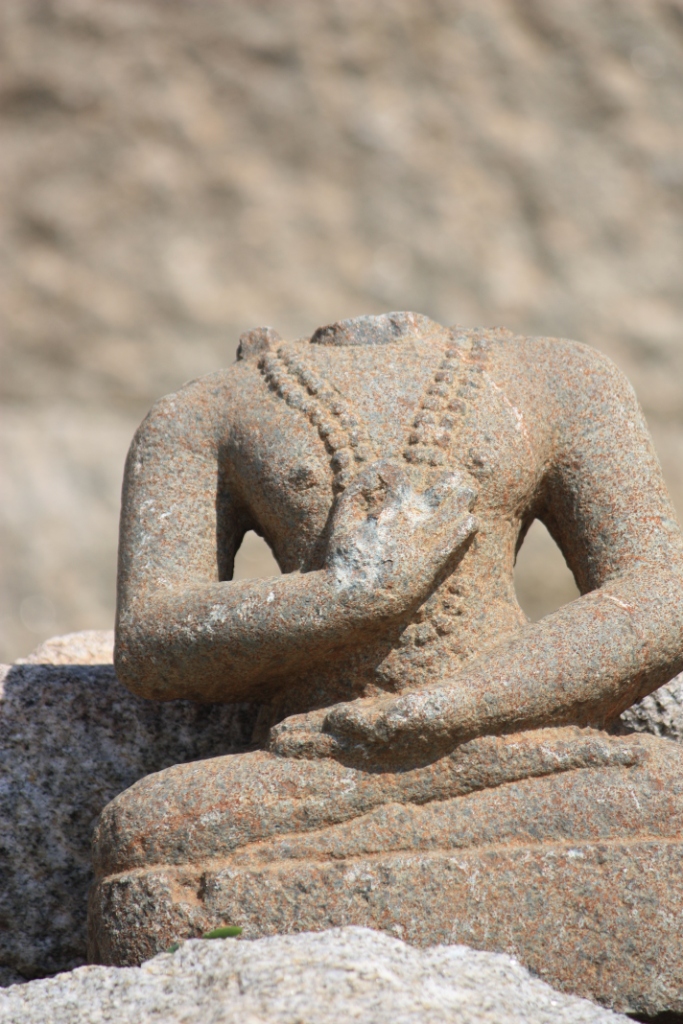
IMG_0520Left to its own devices, the mind is like Indian traffic: chaotic, noisy, slow-moving, relentless, and brimming with latent rage. Meditation is a tool to help unsnarl the traffic jams so that one can observe the mind as something other than indecipherable chaos.


Meditation isn’t the end game. If one goes to the gym daily to lift weights, but one has no interest in–or use for–putting one’s muscles to practical use, one is engaging in an act of vanity more than one of personal development. In the same way, if one builds one’s awareness of the mind, and doesn’t use it for betterment in one’s daily life, what is the point? What do I mean by betterment? I mean defeating the petty elements of one’s nature that cause oneself and others suffering and that keep one living in a world of delusion.


Meditation trains one to take note of the daydreams and obsessive thoughts that run through one’s mind, and to do so progressively sooner—before they can coalesce into a full-blown avalanche of negativity and delusion. In meditation, we observe these errant thoughts and then let them float on down the river. As one lives one’s waking life, however, one may take time to consider what these thoughts and daydreams are doing for one. Often one can remain ignorant of the purposes these thoughts serve, realizing only that they make one feel better temporarily.


A few of the purposes that these errant thoughts may serve are:

martyrdom (i.e. thinking the world is against one so whatever goes wrong is the result of outside forces)

-ego-boosting (imaging one has the confidence to do something one doesn’t in reality)

-empowerment (fantasizing one has power in the face of feelings of powerlessness)

-wishful thinking (imagining a perfect life just a PowerBall ticket away)


So, if these thoughts make one feel better, why shouldn’t one let them fly? For one thing, they keep one from seeing the situation as it is. The fantasy or obsessive thought becomes one’s reality and one remains ignorant of what is real. The problem is that if one wants to fix the problem, one must know what it is (i.e. have a true view of it.) If one imagines that one has no role in the problem, then how can one fix the problem? If the problem is one’s unhappiness, one can always do something—even if one can’t change the external situation.  One’s unhappiness is a function of one’s mind, and is, therefore, under one’s control.


Second, by giving into obsessive thoughts and fantasies, one becomes dependent upon them as crutches, and becomes stuck in a cycle of helplessness.


Third, when one removes oneself from the problem, one denies one’s power to change the situation—or the emotional result. One makes oneself vulnerable to manipulation. If one doesn’t recognize the ability of another person to “make one mad,” one denies them that power. (But this requires accepting that one has a responsibility for one’s emotional state, a sometimes uncomfortable proposition.)


I have a theory that the steadfast pursuit of an enlightened mind will either result in enlightenment or insanity. Why should it result in insanity? Because, the process involves stripping away the coping mechanisms that got one through each day. If one has the internal confidence (i.e. fudōshin, or immovable spirit) to stare in the mirror and see one’s flaws and weaknesses, one may achieve an enlightened state. If one lacks such confidence, seeing those flaws and weaknesses may be depressing. Of course, fudōshin  is just one side of the coin, it also matters whether one has the relative freedom from stress to lead an introspective life or whether one feels the constant pressure that propels most people back into old habits. It’s easier to make positive changes when one’s life radically changes, then the power of routine and habit lose hold.


The challenge is that the pursuit of an enlightened state of mind is a constant job. Some branches of Buddhism and other mystic religions suggest that enlightenment is a tipping point, and that once one achieves that state one is forever enlightened. I’m not in a position to refute such beliefs, but it seems that it’s more like being a sober AA member–there is an ever-present potential to revert to old habits of the mind. So, one must be ever vigilant. There’s no rest until one is dead… as far as I know.