Five Wise Lines (February 2024)

“If one conforms to the world,
He’s bound to suffer.
If he doesn’t,
He’s considered mad.

Kamo no Chōmei, Hōjōki; [Stavros Trans.]

But nothing ever bores me. So much the worse for those who are moulded of boredom.

Salvador Dalí, Hidden Faces

All of humanity’s problems stem from man’s inability to sit quietly in a room alone.

Blaise pascal

I am in no way interested in immortality, but only in the taste of tea.

Lú Tóng (Poet of the Tang Era)

The man who wears the shoe knows best that it pinches and where it pinches, even if the expert shoemaker is the best judge of how the trouble is remedied.

John Dewey

Bonus Quote:

If you have a garden and a library, you have everything you need.

Marcus tullius cicero

PROMPT: Write Space

You get to build your perfect space for reading and writing. What’s it like?

Just a small, quiet room with a window for day and a light for the night. Minimalist. The less to distract, the better.

PROMPT: Ideal Home

Daily writing prompt
What does your ideal home look like?

It should be small enough that I won’t acquire new things without asking whether they are necessary, and whether their value exceeds their spatial cost. [And, also, such that it encourages spending time outside.] Besides that, it should be an environment within which one can live healthily.

PROMPT: Shop

If you were going to open up a shop, what would you sell?

Experiences. There are already too many stores selling geegaws and tchotchkes, and people are too good at buying and collecting them. Experiences! Now there’s a market with plenty of room for growth.

PROMPT: Comfort

What strategies do you use to increase comfort in your daily life?

I don’t, but I have a lot of strategies for being more content in the face of various situations and environments — including uncomfortable ones. These include the yogic practice of dispassionate witnessing, minimalism, travel (and specifically minimalist travel to places – the less familiar the better,) and intense physical activity.

I think comfort as a major objective in life is overrated, and virtually insures a discontented life. A life in which one can be content, whatever may come along, is a happy life.

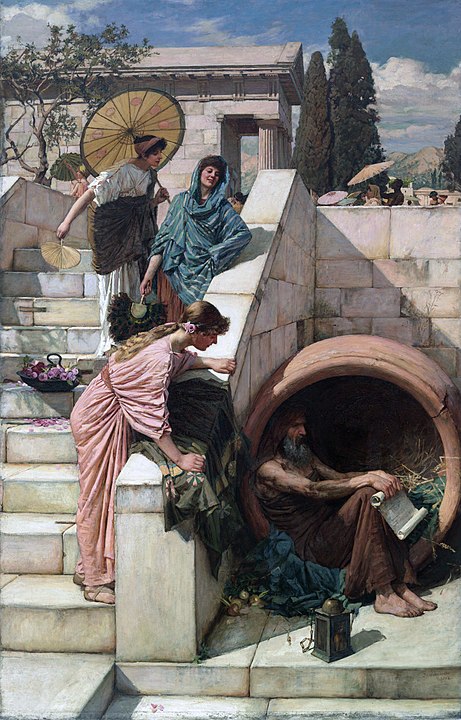
Cynic Limerick

The philosopher named Diogenes
was like a dog... known to have fleas.
-failed to find an honest man.
-didn't let "Greatness" block his tan.
But he lived simply, and as he pleased.

Simplify [Free Verse]

One item per day 
was abandoned
until living got hard.

But like Diogenes -- 
who gave up his cup
upon seeing a boy 
slurping from cupped palms -- 
eventually, it all was gone.

Each item hand-weighed,
its weight against is usefulness,
and all were found expendable.

BOOK REVIEW: Three Japanese Buddhist Monks by Saigyō, Chōmei, and Kenkō

Three Japanese Buddhist MonksThree Japanese Buddhist Monks by Saigyō
My rating: 5 of 5 stars

Amazon.in Page

This book collects three essays composed between the twelfth and fourteenth centuries. They are in chronological order, but also in order of increasing length, i.e. Saigyō’s piece is a short excerpt, while Kenkō’s essay makes up the bulk of the book.


An excerpt from Saigyō’s Senjūshō tells the story of the monk’s meeting with a wise reclusive meditator on Mt. Utsu. Saigyō tries to talk his way into living / meditating with the hermit, but the sage convinces him that that wouldn’t be good for either of them. The monk goes away, planning on visiting the hermit on his return, but he wistfully tells us that he took another route.


“The Ten-Foot Hut” is about the benefits of a simple, minimalist existence. It discusses Impermanence, and takes the view that having more just means one has more to lose. A quote that offers insight into the monk’s thoughts is, “If you live in a cramped city area, you cannot escape disaster when a fire springs up nearby. If you live in some remote place, commuting to and fro is filled with problems, and you are in constant danger from thieves.” The author’s solution? Build a tiny cabin in the woods and – in the unlikely event it burns or gets robbed while one is away – what has one really lost?


The Kenkō essay makes up about eighty percent of the book. Its rambling discussion of life’s impermanence delves into morality, aesthetics, and Buddhist psychology. There are many profound bits of wisdom in this piece. Though it’s also a bit of a mixed bag in that some of the advice feels relevant and insightful, while some of it hasn’t aged / traveled well.


I enjoyed this book and found it thought-provoking. Some may be disappointed by finding how little of Saigyō’s writing is included (he being the author of greatest renown,) but I found each author had something valuable to offer.


View all my reviews

Minimalist [Haiku]

 hand-weigh each thing
as if deciding whether
it's worth packing

BOOK REVIEW: Anecdotes of the Cynics by Various

Anecdotes of the CynicsAnecdotes of the Cynics by Robert F. Dobbin
My rating: 5 of 5 stars

Amazon.in Page

This is a collection of brief stories and sayings from famous Cynic philosophers – notably, Diogenes of Sinope, Crates of Thebes, Hipparchia, and Bion. It opens with the longest piece, a dialogue [allegedly] by Lucian the Cynic advocating the Cynic’s minimalist approach to life. [Cynics were ascetics who shunned customs and cultural conventions and thus often ran afoul of the conservative societal base / rubbed people the wrong way.] The dialogue uses Socratic method, but also contains prolonged exposition. [Not like the Platonic dialogues in which Socrates tends to ask brief questions and attempts to demand brief answers – granted not always successfully.] However, most of the pieces are just a paragraph or two brief excerpts.

Most of the entries report on what various Cynics said or did, though there are a few that are biased commentaries of non-Cynics about these “dog philosophers” – e.g. there is a Catholic tract denouncing the Cynics while talking up Paul. [It reads as though the early Christian church (which was teaching Jesus’s ideas, including: in part, the virtues of poverty, of simplicity, and of a lack of deference to the world of men) might have been concerned about being outcompeted.]

There’s not a tremendous amount that remains of direct Cynic teachings, and so a book like this is a way to get a taste of the highlights. Just as Buddha found that extreme forms of ascetism didn’t yield the optimal result, Cynicism lost ground to the upstart school Stoicism, which borrowed some Cynic ideas while jettisoning the most extreme aspects of the philosophy.

One can find these stories in old public domain sources such as Diogenes Laertius’ (no relation) “Lives of the Eminent Philosophers,” but this is a good way to get the condensed version without too much extraneous information.

View all my reviews