“His steady sails he never furls” by Henry David Thoreau [w/ Audio]

His steady sails he never furls
At any time o' year,
And perching now on Winter's curls,
He whistles in his ear

“Fable” by Ralph Waldo Emerson [w/ Audio]

The mountain and the squirrel  
Had a quarrel;
And the former called the latter ‘Little Prig.’
Bun replied,
‘You are doubtless very big;
But all sorts of things and weather
Must be taken in together,
To make up a year
And a sphere.
And I think it no disgrace
To occupy my place.
If I'm not so large as you,
You are not so small as I,
And not half so spry.
I'll not deny you make
A very pretty squirrel track;
Talents differ; all is well and wisely put;
If I cannot carry forests on my back,
Neither can you crack a nut.’

“Who says my poems are poems” by Ryōkan [w/ Audio]

Who says my poems are poems?
They aren't poems at all.

Only when you understand my poems aren't poems
Can we talk poetry.

This translation by Sam Hamill in The Poetry of Zen (2004) Boston: Shambhala, p. 159

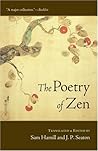
BOOK: “The Poetry of Zen” Ed. / Trans. Sam Hamill & J.P. Seaton

The Poetry of ZenThe Poetry of Zen by Sam Hamill
My rating: 5 of 5 stars

Publisher Site – Shambhala

This poetry anthology consists of translations of Chinese and Japanese poetry that play in the Zen aesthetic. They are not Zen Buddhist poetry in the sense of being sutras or sutra-like expositions on Buddhist philosophy or theology (at least, not mostly.) And while there are many monks and Buddhist layperson poets represented, not all of those included were Buddhists. (In fact, there is even some verse from the Daodejing included, though Taoism is certainly philosophically related to Zen.)

About half the book is Chinese poetry, including pieces from Han Shan, Li Bai, Bai Juyi, Wang Wei, Du Fu, and many other greats of Chinese poetry. (Note: my spellings of author names varies from those used in the book because Hamill and Seaton use Wade-Giles spellings.) The other half of the book consists of works by Japanese poets, including: Saigyo, Dogen, Basho, Ryokan, Buson, Issa, and others. The Japanese part includes a few haibun (prose poems interspersed with haiku,) adaptations of Chinese-style poems, as well as the various Japanese fixed form styles (i.e.. haiku, tanka, etc.)

The two translators, Sam Hamill and J.P. Seaton, initial the poems that each translated (some were dually translated and others singularly.) I enjoyed the translations and felt they were fine reading in their own right. With haiku and tanka, the translators stuck fairly close to the traditional form (in as much as the aesthetic could be maintained doing so,) but with Chinese lyric styles they often took a freer approach to form.

If you’re interested in poetry that conveys Zen sentiment, this book is worth investigating.

View all my reviews

“Indian River” by Wallace Stevens [w/ Audio]

The trade-wind jingles the rings in the nets around the racks
by the docks on Indian River.
It is the same jingle of the water among the roots under the
banks of the palmettoes,
It is the same jingle of the red-bird breasting the orange-trees
out of the cedars
Yet there is no spring in Florida, neither in boskage perdu, nor
on the nunnery beaches.

“Aliens” by Amy Lowell [w/ Audio]

The chatter of little people   
Breaks on my purpose
Like the water-drops which slowly wear the rocks to powder.
And while I laugh
My spirit crumbles at their teasing touch.

“Could that sweet Darkness where they dwell” (1493) by Emily Dickinson [w/ Audio]

Could that sweet Darkness where they dwell
Be once disclosed to us
The clamor for their loveliness
Would burst the Loneliness —

Wen Fu 11 “Banal & Sublime” [文赋十一] by Lu Ji [陆机] [w/ Audio]

Some shoots and stalks stand out --
Taller than the masses.
Their form eludes pursuit,
Sound slips through, like gases.
Great lines are always disjunct:
Don't weave with mid'ling lyrics.
They're pent up and peerless:
Chop them? A win that's pyrrhic.
Jade flecks make mountains shimmer,
Pearly waters enchant.
The thicket mustn't be clipped
If Kingfisher's glory, grant.
Stitched words end under snow,
Work the weft, steady and slow.

The original in Simplified Chinese is:

或苕发颖竖,离众绝致。
形不可逐,响难为系。
块孤立而特峙,非常音之所纬。
心牢落而无偶,意徘徊而不能揥。
石韫玉而山辉,水怀珠而川媚。
彼榛楛之勿翦,亦蒙荣于集翠。
缀下里于白雪,吾亦济夫所伟。

“‘Truth,’ said a traveller” [Poem XXVIII] by Stephen Crane [w/ Audio]

“Truth,” said a traveller, 
“Is a rock, a mighty fortress;
“Often have I been to it,
“Even to its highest tower,
“From whence the world looks black.”


“Truth,” said a traveller,
“Is a breath, a wind,
“A shadow, a phantom;
“Long have I pursued it,
“But never have I touched
“The hem of its garment.”


And I believed the second traveller;
For truth was to me
A breath, a wind,
A shadow, a phantom,
And never had I touched
The hem of its garment.

“Bad Government” by Guan Xiu [贯休] [w/ Audio]

“Venerable Ingatha” by Guan Xiu [One of his 16 Arahat paintings]
Sleet and rain, as if the pot were boiling.
Winds whack like the crack of an axe.
An old man, an old man,
At sunset, crept into my hut.
He sighed. He sighed as if to himself,
"These rulers, so cruel. Why, tell me
Why they must steal till we starve,
Then slice the skin from our bones?

For a song from some beauty,
They'll go back on sworn words;
For a song from some tart,
They'll tear down our huts;
For a sweet song or two,
They'll slaughter ten thousand like me,
Like you. Weep as you will,
Let your hair turn white,
Let your whole clan go hungry...
No good wind will blow,
No gentle breeze
Begin again.

Lord Locust Plague and Baron Bandit Bug,
One east, one west, one north, one south.
We're surrounded.

NOTE: This the J.P. Seaton translation found in The Poetry of Zen (2004); Shambhala Publications: Boston, MA, pp. 67-68. For the author’s name, Seaton uses “Kuan Hsiu,” the Wade-Giles romanization of the name.