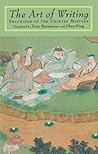
BOOKS: “The Art of Writing” Trans. / Ed. by Tony Barnstone and Chou Ping

The Art of Writing: Teachings of the Chinese MastersThe Art of Writing: Teachings of the Chinese Masters by Tony Barnstone
My rating: 5 of 5 stars

Publisher Website

This thin volume is packed with insights on writing — especially, but not exclusively, poetry. It consists of four chapters. The first two are the ars poetica of Lu Ji and Sikong Tu, respectively (i.e. The Art of Writing and The Twenty-Four Styles of Poetry.) The second half of the book consists of two chapters of collected sayings and poetry commentary excerpts.

I haven’t read a book so dense with quotable lines in a while. Some of the advice offered is universal and timeless (e.g. avoid cliches and read voraciously,) but some of it reflects a uniquely Chinese perspective rooted in Taoist and Zen sentiments (e.g. how to use wu wei [effortlessness] in one’s writing and so forth.)

There is a preface and each of the sections has its own editorial opening, but these never feel like padding (which often happens with books that come out to less than a hundred pages of content.) Instead, this ancillary material is concise and helps to offer historic and cultural context.

I’d highly recommend this book for writers and those interested in Eastern aesthetics and literature. That said, you don’t necessarily have to be interested in both. Any writer could pick up some beneficial tips while reading this book, and it’s compact, highly readable, and even humorous in places.

View all my reviews

BOOKS: “Robert Frost: Sixteen Poems to Learn by Heart” ed. by Jay Parini

Robert Frost: Sixteen Poems to Learn by HeartRobert Frost: Sixteen Poems to Learn by Heart by Robert Frost
My rating: 5 of 5 stars

Amazon.in Page

Release Date: March 12, 2024

This book presents sixteen of Frost’s poems, each with a commentary on the poem, how events in Frost’s life influenced said poem, and assorted background details. It includes the “greatest hits” (e.g. “Mending Wall,” “The Road Not Taken,” “Fire and Ice,” and “Stopping by Woods on a Snowy Evening,”) a few of Frost’s more obscure works, and a number that are in-between in status.

I found the commentaries to be interesting and readable, which is important as Frost’s poems are now in the public domain, and so the value of this volume hinges on Parini’s work. Parini includes some stories that offer insight into Frost’s mindset, as with the story of the lady who approached him after a reading to ask the meaning of “Fire and Ice.” Reading Frost isn’t like reading, say, Allen Ginsberg, the latter being one who put it all out there – unabashedly, Frost’s poetry is more guarded and deals more in nuanced metaphor. This makes a volume like this useful if it can offer any insight into the poet’s mindset, which I think Parini does.

I considered reading this book to be an opportunity to learn more about the poems and poet, and – therefore – did not heavily weight the stated theme of presenting poems that should be rote memorized. I mention this because I suspect Parini had other criteria in mind as well. While the book does include poems that are easily memorized (e.g. “Fire and Ice” and “Stopping by Woods on a Snowy Evening”) as well as poems that have messages worth learning by heart (e.g. “Mending Wall” and “The Road Not Taken,”) it also includes poems that aren’t so memorable because they are long, not especially lyrical, or not particularly filled with stand-out ideas or vivid imagery (e.g. “Directive,” “The Wood Pile,” and “Birches.”) This also begs the question, why one wouldn’t include a poem like “Nothing Gold Can Stay,” which is short, lyrical, and has an easily grasped message (i.e. easily memorized.)

As for ancillary matter, there is an appendix that offers tips for memorizing poems as well as a short “recommended reading” bibliography.

That said, I enjoyed reading this book; I got a lot out of Parini’s commentary, and I would recommend the book for poetry readers.

View all my reviews

BOOKS: Echo & Critique by Florian Gargaillo

Echo and Critique: Poetry and the Clichés of Public SpeechEcho and Critique: Poetry and the Clichés of Public Speech by Florian Gargaillo
My rating: 4 of 5 stars

Amazon.in Page

Out Now (May 10, 2023)

This book examines seven poets’ attempts to halt the proliferation of clichés, euphemisms, doublespeak, etc., words and phrases that not only corrupt the language but are often used to disguise bad behavior or to camouflage dismaying truths. It focuses on a technique, echo and critique, in which the poet employs one or more of these disconcerting words or phrases (or clever variants of them,) but does so in a way that reveals the chicanery within them.

The poets whose work is discussed are: Auden, Randall Jarrell, Langston Hughes, Claude McKay, Robert Lowell, Josephine Miles, and Seamus Heaney. These poets go head-to-head with cliché and doublespeak in the form of bureaucratese, propaganda, political speak, and business talk — with particular emphasis on war, race, and politics.

The book makes some interesting points. There are more readable discussions of the subject of corruption and manipulation of the English language, though none that I’m aware of on this particular approach to combating it. This volume is largely aimed at scholars, and not so much the popular readers. That said, I found it well worth reading.

View all my reviews

BOOK REVIEW: 100 Poems to Break Your Heart ed. Edward Hirsch

100 Poems to Break Your Heart100 Poems to Break Your Heart by Edward Hirsch
My rating: 5 of 5 stars

Amazon.in Page

Release Date: January 31, 2023

This anthology (and the accompanying analytical essays by Hirsch) covers over two-hundred years of poetry and works with a large set of translated languages as well as poems of English language origin. Therefore, the poems include an eclectic set of forms and schools of poetry. There are narrative poems and philosophical poems. There are sparse poems and elaborate poems. Besides the fact that they are all short to intermediate length poems (a few pages, at most,) the only thing the included poems have in common is some serious subject matter at each poem’s core. There are elegies and cathartic poems of illness or ended relationships, as well as tales of various types of tragedy (personal, global, and of scales in between.)

That said, not all of the poems feature a dark and melancholic tone. There are several poems that are humorous — in a gallows humor sort of way. Such poems include: Dunya Mikhail’s “The War Works Hard,” Harryette Mullen’s “We Are Not Responsible,” and Stanley Kunitz’s “Halley’s Comet.”

Of course, there are many poems that are as devastatingly sad as the title leads one to expect. Of these, Eavan Boland’s “Quarantine,” the story of a man carrying his illness-ravaged wife in search of survival during a famine in Ireland in 1847 takes the award for saddest. There are poems in this book that are more brutal, encompass vaster scales of suffering, or combine lyrical skill and emotional experience more artfully. But none of those poems socked me in the chest like Boland’s. One thing that struck me during my reading was what an intense force multiplier story is in creating poignant poems. Several others among my favorites told stories that made for visceral reads. These include: “Song” by Brigit Pageen Kelly, “The Race” by Sharon Olds, “Terminus” by Nicholas Christopher (also among the most savage tear-jerkers,) and “The Gas-Poker” by Thom Gunn.

Other favorites include: Langston Hughes’s “Song for a Dark Girl,” Miklós Radnóti’s “The Fifth Eclogue,” Stevie Smith’s “Not Waving but Drowning,” and “Mendocino Rose” by Garrett Hongo.

I’d highly recommend this book for poetry readers.


View all my reviews

BOOK REVIEW: Rilke: The Last Inward Man by Lesley Chamberlain

Rilke: The Last Inward ManRilke: The Last Inward Man by Lesley Chamberlain
My rating: 5 of 5 stars

Amazon.in Page

This book surveys the influences on Rainer Maria Rilke’s poetry, and makes the argument that Rilke was the last vestige of a mystically spiritual [Romantic or Romantic-esque] poetic line. Poetry was becoming more political and more influenced by nihilistic philosophies that eschewed inward investigations of meaning and self-realization, constructs that were seen as artificial and empty. Rilke bucked the trend, and while he did become an important poet, Chamberlain believes he paid a price.

The book discusses the influence of sexuality, spirituality, and artistic obsessions on Rilke’s poetry in great detail. It also talks about his life as an influence, both his family life (or lack, thereof) and the key years he spent in Paris. The last couple chapters tie the story together by clarifying what Rilke achieved and how it contrasted with prevailing trends.

If you’re interested in understanding more about the philosophical and spiritual forces impacting Rilke’s work, this is an interesting read. It’s not a biography, strictly speaking, but does unavoidably discuss Rilke’s life in some detail (though always through a literary / philosophical lens.)


View all my reviews

BOOK REVIEW: Borges: An Introduction by Julio Premat

Borges: An IntroductionBorges: An Introduction by Julio Premat
My rating: 5 of 5 stars

Amazon.in Page

Jorge Luis Borges was a thinking person’s writer, his works are both global and local (of Argentina or, specifically, of Buenos Aires focus,) are philosophical and literary and cut across scholarly domains, and they can also be arcane and fragmented. It’s because of this — combined with the fact that Borges work remains well worth reading — that a volume like this is beneficial. While the book does -in part – simplify and elucidate Borges’ work, it also expands on the Borges canon as a way to present the reader food-for-thought about ways in which one might approach the thoughts of Borges, oneself. The book is divided into two parts, one on the man and the other on his writings.

While this book is subtitled, “An Introduction,” I would suggest it’d be beneficial if one has read some of Borges’ major works (e.g. A Personal Anthology, “Ficciones,” The Aleph and Other Stories, “Selected Non-fictions,” etc.) Premat does offer some relevant background information when he references texts in order to help clarify his points, but not always enough to get the full understanding and less and less as the book progresses – so as to avoid redundancy. Borges’ work (tending toward short [even micro-] writings across fiction, nonfiction, and poetry) is challenging enough for this kind of study. As opposed to a novelist who would have a few major works to discuss, Borges has a vast body of writings that are no more than a few pages each.

As a reader of Jorge Luis Borges, I found this book to be beneficial and thought-provoking, and would recommend it for others who want to expand the depths of their understanding of this Argentinian writer and his ideas.

View all my reviews

ESSAY REVIEW: Confessions of a Book Reviewer by George Orwell

Confessions of a Book ReviewerConfessions of a Book Reviewer by George Orwell
My rating: 5 of 5 stars

Amazon.in Page

Available free through the Orwell Foundation

An amusing essay that reveals the dirty secrets of book criticism, while proposing that the vast majority of books don’t merit a review. Just a few pages long.

View all my reviews

BOOK REVIEW: Better Living Through Criticism by A.O. Scott

Better Living Through Criticism: How to Think about Art, Pleasure, Beauty and TruthBetter Living Through Criticism: How to Think about Art, Pleasure, Beauty and Truth by A.O. Scott
My rating: 4 of 5 stars

Amazon.in Page

There’s a chasm between title and book. The title, which is clearly meant to play on the Dupont motto turned recreational drug user motto that substitutes the word “chemistry” in place of “criticism,” suggests a book that will be directed toward a reader, teaching said individual how to hone his or her skills of art criticism. This book, on the other hand, reads more like a review of the criticism industry that is meant to be received by an audience. In other words, it feels more like you’re in a Ted Talk than that you’re having a private lesson or conversation. It’s a fine book, witty, thought-provoking, and insightful by turns, but not the book one would expect from the title, subtitle, and blurb.

This essay (or collection of six shorter essays – if you prefer) examines the life and livelihood of art critics and how the endeavor has ebbed and flowed over the years. While the author is a film critic, he adeptly uses examples and stories from across the arts: poetry, paintings, music, theater, etc. In addition to the six chapters, there are three dialogues that are presumably meant to be reminiscent of Oscar Wilde’s essay / dialogue “The Critic as Artist,” a piece that is referenced and quoted in the book.

While the book is generally readable, it would probably benefit from more clarity of message while dialing down attempts to be witty and interesting. It seems like the author may have aimed to do what the films that film critics tend to love do, leave one walking away wondering what it is that one just consumed.

If you want to know more about the criticism “business,” i.e. who does it and how the job has changed (and continues to change,) you’ll enjoy this book. On the other hand, if you’re looking for a book that (as this book’s subtitle suggests) will help you better understand “how to think about art, pleasure, beauty, and truth,” then this might not be the book for which you’re looking.


View all my reviews

BOOK REVIEW: The Spirit of Japanese Poetry by Yoné Noguchi

The Spirit of Japanese PoetryThe Spirit of Japanese Poetry by Yoné Noguchi
My rating: 5 of 5 stars

Amazon.in Page

Free Online at Wikisource

This book-length essay, originally published in 1914, discusses the unique style and aesthetic of Japanese poetry. It’s written for an audience of English language readers and advances its objective not only by presenting illuminating translations of Japanese poetry, but also by comparing Japanese poetry to English language poetry.

Noguchi takes a no-holds-barred approach to literary criticism that is both the strength and weakness of the book, sometimes it feels as though the author’s boldness is granting deep insight into the subject, but other times it reads as though the author is tribally narrow-minded and curmudgeonly. By “tribally narrow-minded,” I mean that he takes the view that the Japanese aesthetic and approach to art is always and in everyway superior to non-Japanese art (in this case, English language poetry.) Interestingly, he frequently compliments specific artists, e.g. Walt Whitman, but doesn’t have anything nice to say about English language poetry in general. By “curmudgeonly,” I mean that he takes the popular — if biased –view that the world is going to shit, and – in the section on modern poetry – it is only after discussing how the art has fallen on hard times that he can discuss a few modern poets who’ve produced some poems worthy of adoration [and some worthy examples of the modern form (Shintaishi.)]

One might think this bigoted view would cripple his book (as bigoted views usually do,) but because what he’s promising is depth of insight into the Japanese poetic aesthetic, he is able to succeed just fine. [Also, to be fair, being highly opinionated and pretentious were hallmarks of critics of his era – just usually not so nationalistically.] Noguchi does a great job of selecting evocative examples, providing powerful translations, and illuminating the Japanese mindset as it pertains to art and poetry.

If you’re interested in Japanese poetry and the psychology that influences Japanese artistic tastes, this short book is highly recommended. [Just be prepared to be offended if you aren’t a hardcore Japanophile.]


View all my reviews

BOOK REVIEW: The Heart of American Poetry by Edward Hirsch

The Heart of American PoetryThe Heart of American Poetry by Edward Hirsch
My rating: 5 of 5 stars

Amazon.in Page

Out: April 19, 2022

This book presents forty poems from prominent American poets, interspersed with essays by Hirsch offering background on the poet, the poem, and how the poem reflects upon America. It’s a fine collection of poems, and a thoughtful discussion of them. There will be something new to most readers. While most of the poets are well-known and while there are a few highly anthologized poems: e.g. Emma Lazarus’s “The New Colossus,” Dickinson’s #479 [Because I Could Not Stop for Death,] and Eliot’s “The Love Song of J. Alfred Prufrock,” there are many more off the beaten path selections to be discovered.

As for whether the selection captures the heart of American poetry, on that wouldn’t necessarily agree. That said, it’s presented as Hirsch’s personal selection; the pieces in it are great poems, and he has as much right to his views as anyone. The anthology does capture many elements of the American poetic voice. It does a fine job of capturing the many strains of dissent, critique, and resistance from the Harlem Renaissance (e.g. Langston Hughes) to that of the indigenous peoples (e.g. Joy Harjo) to the Beats (e.g. Allen Ginsberg.) What Hirsch seems less comfortable with is the Whitmanian voice of affection and admiration for the country. In writing about Whitman and Frost, Hirsch makes comments about their lack of appeal to him, apparently their respective unbridled positivity and folksiness were found unbecoming of a poet. I felt the fact that Hirsch had to search out one of Whitman’s more angsty and dark compositions in order to be happy with Whitman’s inclusion was telling (Hirsch could hardly leave Whitman out and present the book as capturing the essence of American poetry.)

The anthology reflects much of the cultural and artistic diversity seen in America, but it eschews the middle America voice (i.e. 70% of the poems are from New Jersey and northward up the Atlantic coast, and while New York may be the country’s cultural and publishing capital, skilled poets from South of the Mason-Dixon and more than 150 miles from the Atlantic coast aren’t as much rare flukes as this anthology would suggest.)

I enjoyed reading this anthology, and I learned a great deal from the essays that went along with each poem. The book is definitely worth reading. Mopey Plath-loving New Yorkers are more likely to find it representative of the voice of American poetry than sanguine Whitman-loving Hoosiers, but it’s an enlightening read, either way.


View all my reviews