5 Ways the World May Be Weirder Than It Seems

Werner Heisenberg famously said, “Not only is the Universe stranger than we think, it is stranger than we can think.”


5.) Ancestor Simulation: The idea that we could be in a simulation isn’t only a staple of science fiction–e.g. The Matrix. It’s been given serious thought by thinkers who aren’t exactly on the lunatic fringe–most famously inventor /entrepreneur Elon Musk. The core of the argument goes like this. 1.) We are getting better and better at making simulations ourselves. 2.) At some point we will achieve a simulation indistinguishable from reality. 3.) If 2 is true, then it’s vastly more likely that we are already simulations because if it can be done, it probably already has been done many times over. (Thus, we’re more likely to be in one of the simulations than so-called “base reality.”)



4.) Mathematical Universe Hypothesis: Max Tegmark proposes that the universe may be–at its core–a mathematical structure, making us self-aware substructures. This may sound like a different way of stating the preceding hypothesis, but not necessarily. The simulation hypothesis suggests certain motivations of a simulation creator. MUH doesn’t require a creator or an objective. It could be the nature of reality at it’s most basic.


3.) A Holographic Universe: This idea sprang from thinking about what happens to the information when something falls into a black hole. The idea being that the information is trapped on the outside of the event horizon–i.e. information for a three dimensional entity stored in two dimensions. As physicists pondered this, some concluded that it might be that we are a projection of data, or–alternatively–much of what we see when we look out into space is.


2.) One of Myriad Universes: The idea that our universe is one of many (or an infinite number of) universes comes in several flavors and is a prediction of several theories widely given credence. In some versions, all the universes have different sets of laws and constants such that many flash in and out of existence and only a small proportion are capable of hosting life (but the math of infinity is weird and a small proportion of the infinite may also be infinite. I don’t know, I’m not a mathematician and the infinite never mattered in economics because ground zero is that everything is limited but desires.) This answers the Goldilocks zone issue nicely–i.e. we couldn’t exist if the equations and constants that govern our universe were very much different, but if there are many universes with many sets of laws then we just happen to be in one of the ones we can be in–hence, credulity remains unstrained. Other versions propose universes with the same laws such that there could be an infinite number of you living out lives that may be slightly different than yours (or–for that matter–in which you might be the Supreme Galactic Overlord.)


1.) Time is slowing: A couple Spanish physicists have suggested that the universe might not be expanding at an accelerating rate (as is the consensus view in physics,) but rather time may be slowing. This slowing would be anticipated to continue until one final moment is captured frozen in time–note: said point would be long after the Sun swallows the Earth.

5 Bits of Wisdom from The Matrix Movies

5.) Wisdom: Choice is not as it seems.

Quote: No, you’ve already made the choice. Now you have to understand it.
Said by the Oracle to Neo in “The Matrix Reloaded” as they discuss a dream in which he sees Trinity falling.

Interpretation: Studies in neuroscience have repeatedly validated the notion that by the time we think we’re making a decision at a conscious level, we’ve already made it on a subconscious level. While many suggest this means that the verdict is in and free will is completely illusory, another way of looking at it is that one must understand one’s decisions in order to begin to regain the rudder on one’s life.


4.) Wisdom: Courage elevates: or, if you don’t run, he won’t chase you.

Quote: He’s beginning to believe.
Said by Morpheus to Trinity in explanation of why Neo isn’t running from Agent Smith in the subway.

Interpretation: My mother used to say, “If you don’t run, he won’t chase you” with respect to being chased by my older brother. It seemed like insane advice at the time; the alternative to being chased being beaten down. However, now I can see that even taking a butt-whooping elevates one’s spirit over engaging in prey behavior.


3.) Wisdom: Rationality is a thin veneer.

Quotes: Beneath our poised appearance we are completely out of control. & It is remarkable how similar the pattern of love is to the pattern of insanity.
Said by the Merovingian to Morpheus, Trinity, and Neo.

Interpretation: While one might like to dismiss the Merovingian’s comments as the cynicism of a hedonist, the undeniable fact is that we have animal biology and it influences us more than we pretend.


2.) Wisdom: The world contains more Cyphers than not.

Quote: Ignorance is bliss.
Said by Cypher to Agent Smith as he plots his subversion in order to be put back into the Matrix.

Interpretation: Most people are happy with their illusions, rely on them as coping mechanisms, and will respond unfavorably to attempts to strip them way. The illusion in question may not be so much that the world is completely fake as much as biases such as the self-serving bias (i.e. people attribute successes to their inherent awesomeness but blame failures on external sources.)


1.) Wisdom: There are limits to being cerebral.

Quotes: Don’t think you are, know you are. & There’s a difference between knowing the path and walking the path.
Both are said by Morpheus to Neo. The former quote is delivered in the sparring program when Neo isn’t performing up to his potential. The latter is said after Neo & Trinity rescue Morpheus and Neo tries to tell Morpheus what the Oracle revealed, but Morpheus quiets him with said words.

Interpretation: I hope I haven’t muddled this bit of wisdom by choosing quotes in which Morpheus uses the word “know” in two different ways. In the first quote, Morpheus contrasts knowing with thinking, and he means that Neo must not treat it as an intellectual exercise, but rather feel its inherent truth deep down. In the second quote, he contrasts knowing with doing, and in this case “knowing” is the cerebral / thinking activity in comparison to doing (i.e. “walking the path.”) However, the gist is the same, you must approach some things–to use the Oracle’s words–balls to bones.

5 Ways in Which Poets Are Mistaken for the Insane

“He’s right behind me, isn’t he?”


5.) Sound Seeking:
If anything  looks more insane than walking down the street talking to oneself out loud, it’s talking to oneself out loud in rhyme and alliteration in a disjoint fashion while counting off beats on one’s fingers.


4.) Emotion Evocation: If your writing comes across as a cry for help, you may be a deeply troubled individual. Or you may be a poet trying to induce a reader to feel.


3.) Clarity & Codes: Because there may be no literal meaning to your verse, the reader may suspect that you’re writing in code to your imaginary pink bunny rabbit. Faced with the humbling possibility that he or she may “just not get it,” most people prefer the alternative explanation that you’re a rambling lunatic.


2.) Playing the Odds: Let’s be honest, there have been a lot of poets who slipped into the abyss. Poe, Pushkin, Plath, Pound, and several poets whose last names didn’t begin with the letter “P,” were all afflicted by mental illness.


1.) Violent Reactions to being Interrupted:  A poem under development is a house of cards that needs only the subtlest gust of wind to be obliterated. Poems in the works are gauzy and fragile. So, as one is trying to wedge words together into a solid construct, one is occasionally interrupted. When this happens, one may instinctively pimp slap the interrupting individual like a Zen master trying to make the point that there is no point.

5 False Dietary Beliefs that Sabotage Weight Loss


5.) Vegetables are vegetables. If the potato is your go-to vegetable, you’ll probably have trouble shedding the pounds. That’s not to say that there is anything inherently wrong with potatoes. But, because of their high glycemic index value (i.e. they’re quickly digested and cause a sharp blood sugar spike), they should be lumped in with bread or rice when considering portions and meal make up. The same is true for sweet corn. Some people consider carrots (and carrot relatives) to be high glycemic, but one has to eat a pretty massive amount to have a problem. Most vegetables have a relatively low glycemic index score and are great foods to fill up on.


4.) Cola is mostly water, how bad could it be? At the right temperature, one can dissolve 2 kilograms (4.4lb.) of sugar in one liter of water. Wrap your head around that.


3.) I worked up a good sweat; now I can eat whatever I want. If you’re in the process of training for an ultramarathon or the Olympics, this might be true, but an hour in yoga class or run in the park doesn’t float you a free pass to kill it at Häagen-Dazs. There’s no getting around the math, the dietary half of the ledger is the 800 pound gorilla (no pun intended) of weight-loss. [That doesn’t mean that there aren’t many, many benefits to exercise, or that it doesn’t contribute to weight loss in more ways than one.] The Mayo Clinic has an excellent table of calories burned for a wide range of exercises and physical activities. You may be demoralized to note that the calories burned in an hour of Power Yoga are completely replenished by a medium size french fry.


2.) I will treat myself with sweets [or pizza.]  I’m not suggesting there’s anything wrong with treating oneself, but making food the treat sets a bad precedent. For many, this notion of food as reward or comfort source was introduced in one’s youth, and it can be extremely difficult to dislodge it later in life. One might try music or fun activities as alternative sources of reward.


1.) I shouldn’t have eaten that Snickers on Wednesday. This may seem like a contradiction of the previous item, but being doctrinaire about food creates its own problems. Specifically, sustainability may be a challenge–especially if one has had that “food as treat” story inculcated into one’s psyche. It’s not the once and while caloric splurge that kills most people, it’s creeping portion sizes.

Some people swear by a “cheat day.” Others say that that’s a bad approach because one might feel forced to cheat even when you’re really not feeling a desire for junk food. Some advocate an 80/20 rule, whereby 80% of the time one follows a strict dietary regimen, while the other 20% of the time one takes it more free and easy (though not totally insane.) Personally, I think different approaches work for different people, but I do agree that the dietary Nazi approach isn’t the way to go.

5 Thought-Provoking Novels About Mental Illness


5.) Veronika Decides to Die by Paulo Coelho

Premise: A young woman who attempted suicide is told that in the process her heart was damaged and she now has only five days to live. While it might seem that this would be all the same to a suicidal patient, it turns out to matter.


4.) Norwegian Wood by Haruki Murakami

Premise: The lead character, Toru, doesn’t suffer from mental illness, but his life is shaped by those who have. He must decide between two women. One of whom, Naoko, has been institutionalized since her boyfriend, Kizuki, committed suicide. Kizuki had been Toru’s high school best friend, and this weighs heavily in Toru’s feelings of obligation. Add into this Naoko’s roommate–a sage influence in Toru’s life, despite being institutionalized herself.


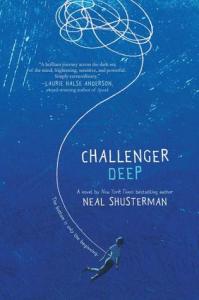
3.) Challenger Deep by Neal Shusterman

Premise: An adolescent boy, Caden Bosch, is transformed from a model student to a paranoid schizophrenic. The title refers to the deepest point on Earth, down in the Marianas Trench, and comes into play because the institutionalized Bosch believes he’s on a ship who’s Captain thinks all the treasure in the oceans got swept to the deepest point.


2.) Fight Club by Chuck Palahniuk

Premise: The unnamed narrator meets the eccentric Tyler Durden and soon Fight Club is born. It’s fueled by a feeling that men have been tamed to be turned into consumers. However, the underground fights are only the beginning, and our lead character is dismayed to discover that from the Club has sprung Project Mayhem with a nefarious terrorist plot.


1.) One Flew Over the Cuckoo’s Nest by Ken Kesey

Premise: Randle McMurphy has convinced authorities that he’s insane for the purpose of getting out of hard labor in prison and into a “cushy” insane asylum. The ward is run by the iron hand of Nurse Ratched. McMurphy on the other hand is rebellious and unruly. The clash is inevitable. McMurphy increasingly disrupts Ratched’s sedate and harmonious ward (re: heavily drugged and cowed into submission.) The story is told from the perspective of a patient named Chief Bromden who has the staff convinced that he’s deaf and mute. Like McMurphy, he’s not what he appears. The book is a scathing indictment of how mental health care was conducted in Kesey’s day.

5 Minds You Meet in Meditation


No matter what style of meditation you practice, you’ve probably heard the following refrain: “And if you find your mind wandering, non-judgmentally make a note of where your mind went, and let that thought drift away as you return your awareness to __________.”


I’ve certainly heard many takes on that teaching, and had plenty of opportunity to implement that advice. In the process, I’ve noted that the places my mind wanders can be classified into several categories.


5.) The Planner: Our conscious mind is first and foremost about answering the question, “What’s the worst that can happen, and how can I make that worst case less bad?” The mind wants to anticipate undesirable events and either make an end run around them or figure out a way to make them less troubling. The Planner wants to rehearse everything from making dinner to being interviewed for a job to having a dreaded conversation.


4.) The Entertainer: This is the mind that sticks songs in your head and replays clips of movies.


3.) The Walter Mitty / The Bolsterer: This is the daydream mind which cooks up scenarios in which you are the hero.


2.) The Subconscious Image Generator: In a relaxed state in which the conscious mind is quieted, one may find oneself seeing images that probably don’t make a lick of sense. The pictures may come and go in a way that make them hard to maintain even a glimpse of. This is the same kind of imagery that one experiences in the hypnagogic state–as one is drifting towards sleep.


1.) The Critic: Saving the most despicable for last; this is your inner critic. The one who thinks that you won’t succeed at any given task.

5 Exercises to Wed Your Yoga and Calisthenic Practices

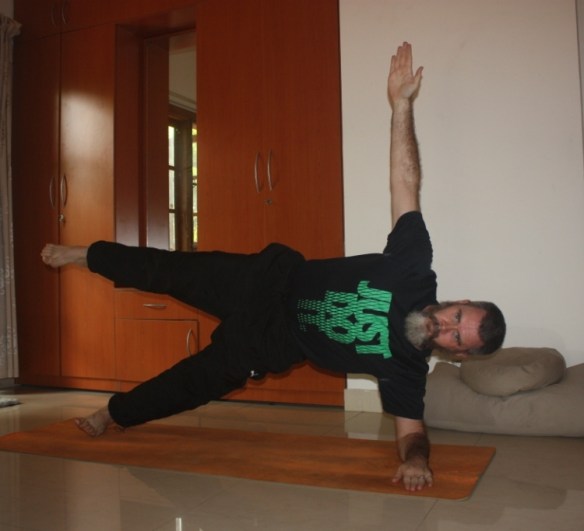
5.) Anything plank (a.k.a. adho mukha dandasana / santolanasana): Who knows how long planks have been a feature of yoga? Plank postures are a fixture in Hatha Yoga, playing a role in most versions of Surya Namaskara (sun salutations), and being used to both to build core strength and to prepare for arm balances.

Planks have also gained immense popularity with calisthenic practitioners. In my gym class days, sit-ups and crunches were the go to ab exercises. No more. Now many bodyweight fitness practitioners are ditching sit-ups and crunches altogether for a number of exercises deemed more effective–include many variations on the plank.

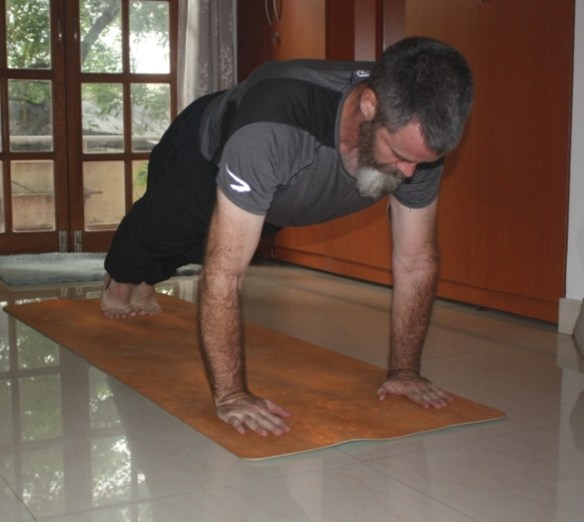
High plank (adho mukha dandasana)


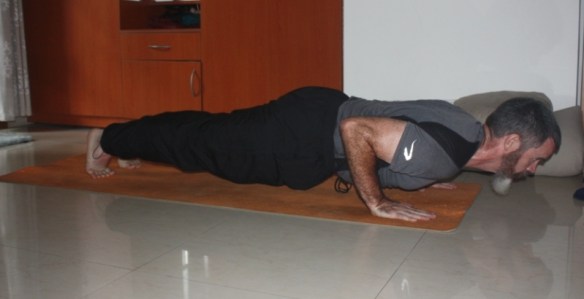
Low plank (chaturanga dandasana)


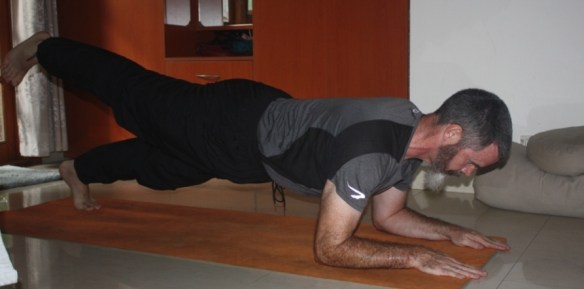
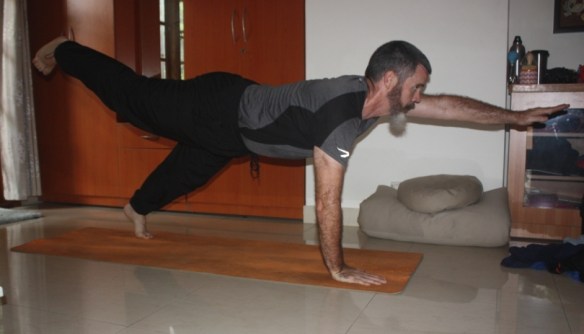
Forearm plank variation with leg up


High plank variation with alternating limbs extended


Side plank (vasisthasana)


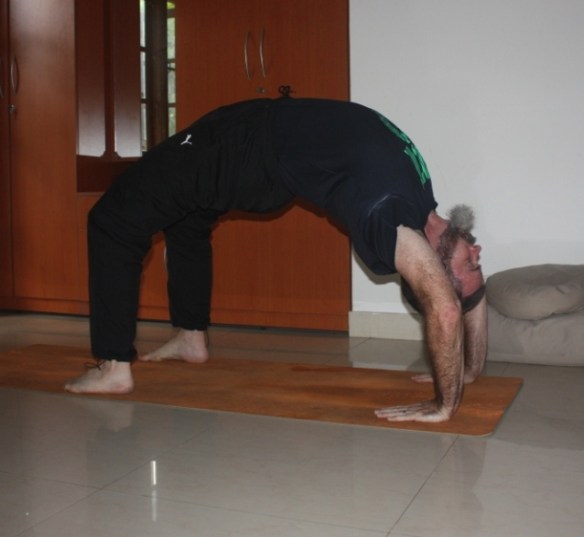
4.) Back bridge (a.k.a. Chakrasana): This is another yoga classic that’s being brought into calisthenics training in a big way. You may note a recurring theme in my selections for this post, exercises and postures (asana) that help to build shoulder joints that are strong, stable, and yet sufficiently flexible. This is a big challenge for bodyweight workout practitioners. One can get stability by bulking the muscles up, but if you don’t have the range of motion to achieve proper alignment, it’s not going to do one a lot of good.

The back bridge (chakrasana, or “wheel pose”)


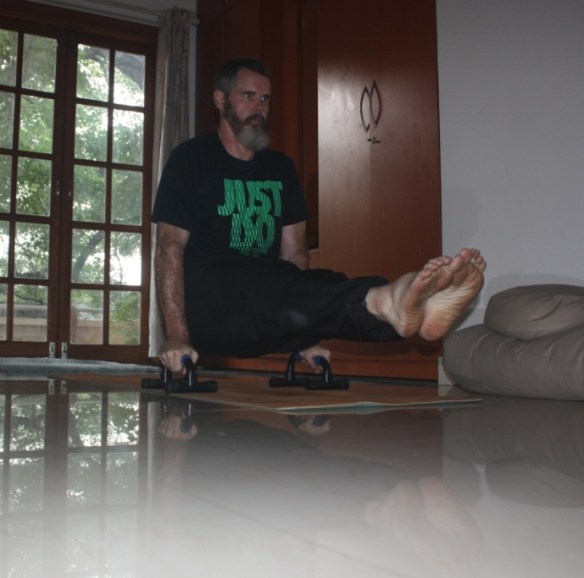
3.) L-sit (a.k.a. Bramcharyasana): Of course, the other recurring theme (besides building shoulder stability) is core strength. This exercise is both a yoga classic and is probably as old as gymnastics itself. Its Sanskrit name, Brahcharyasana, means celibate’s pose–but as far as I’m concerned that’s purely optional.
L-sit (Bramcharyasana)


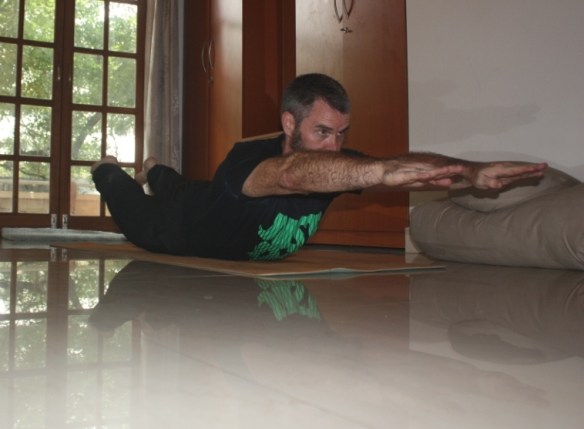
2.) “Supermans” (a.k.a. shalabasana [locust pose]): Another core exercise, but one that strengthens the back muscles.

“Supermans” (shalabasana)


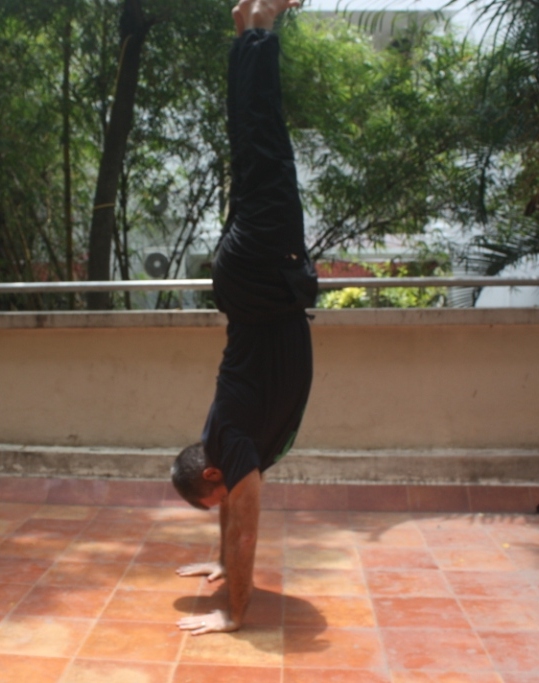
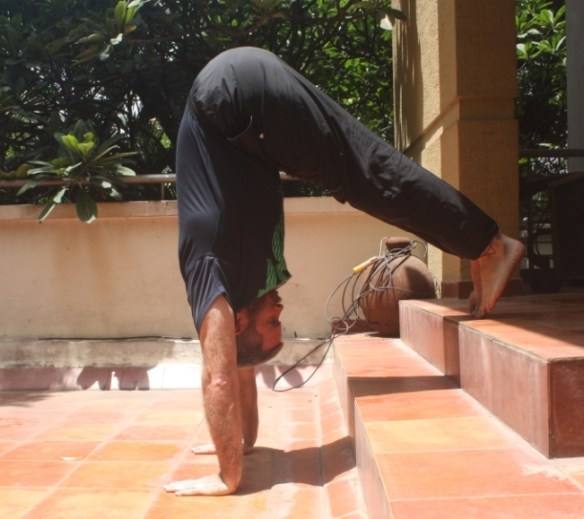
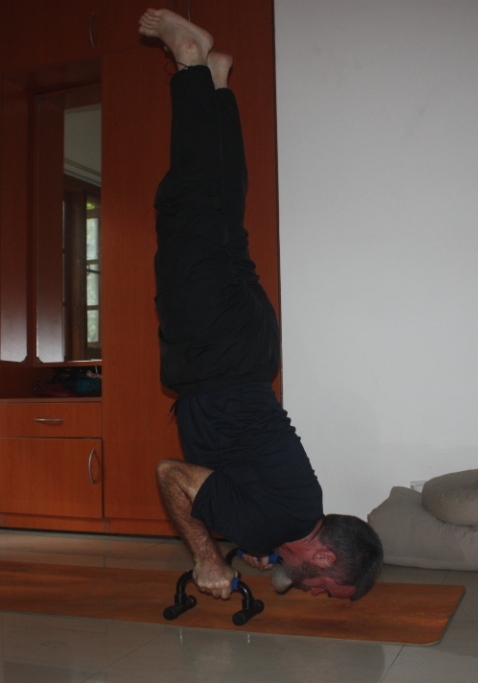
1.) Handstands and Handstand Preppers (a.k.a. adho mukha vrksasana): This practice isn’t just about looking impressive. As mentioned above, it’s hard to build shoulder joints that allow enough stability and range of motion to have the command of one’s body that one would like. Our shoulders are optimized to maximum mobility. That helped our ancestors to be awesome throwers of spears and rocks, but it makes it tough to support our weight in an inverted position. The handstand is a good way to build stability in the shoulders.

Handstand (adho mukha vrksasana)


If it’s too hard, use your legs to stabilize you (but still try to get that straight up-and-down arm position)


If it’s too easy, start doing push-ups

5 Tools to Hulk Your Way Out of Your Comfort Zone


5.) Take a class / Join a group: While I’m partial to yoga and the martial arts, the class could be in any area that presents a challenge.  However, there are a couple of advantages to the aforementioned two (to which I would add dance.)


First, these disciplines train one to be expressive with one’s body and to move more freely. This can do wonders for confidence. People store tension in their bodies without even realizing it. Many have postural problems that effect confidence and self-perception.  A 2014 New Zealand study found that posture can have a strong effect on emotional state.


Second, no matter who one is, one will be challenged by new approaches to movement.  The average person has great difficulty learning to use their body in new ways. One needs to drill in movements conscientiously to achieve competency. Our conscious mind, frequently gets in the way. Even the most athletic and coordinated people will need to work it, failing repeatedly until they succeed.


Why is the challenge so important? Many people go through life afraid to fail, but far too few fear never failing. Sounds idiotic. Nobody wants to fail. I have some hard news. If you’ve never failed, it’s not because you are unmitigatedly awesome in all things. It’s because you’re living in a box and cherry-picking life experiences that feel unthreatening.


If, like me, you’re an introvert, this approach offers the additional benefit of social interaction that is of a predictable / schedulable nature. One needs the interaction, but the problem comes when one has social interactions and / or sensory stimulation that go on too long and in an unpredictable fashion. Therefore, being able to schedule such time is a good way to go about being a more productive introvert.


4.) Writing  / Visualization:  These two approaches to mentally rehearsing allow one to keep one’s inner critic in check. The problem with simply day-dreaming it is that critic can chirp in without being that cognizant of it.

In visualization, one quiets the mind and can then non-judgmentally acknowledge and dismiss the negative thoughts. In writing–be it as a journal entry, poem, or a story–we may not notice the nagging voice of the inner critic on the first draft, but you can take note of it and undo it in rewrites.


3.) Travel / Living abroad: I should point out that not just any old travel will have the desired effect. Many people plan their travel with the objective of being comfortable at the fore.  They eat at places that serve the same kind of food as at home. They stay in hotels with virtually all of the comforts of home, and sometimes many more. This is understandable because the traveler might just be seeking rest.  However, if one is seeking the epiphany or enlightenment experiences talked of by backpackers and ashram-dwellers, that’s not something that comes from staying in resorts or eating at American fast food joint. Those kinds of brain changing experiences come when one is stripped from the familiar and has to surrender one’s attachments to the way one thinks the world should be. One’s perception of culture and worldview changes radically when immersed in a foreign environment.


2.) Game it / Roleplay: There’s a big movement to gamify all manner of everyday activities.  In her book, “Reality is Broken,” scholar of game design Jane McGonigal describes a game called “Chore Wars” that incentivizes the doing of mundane household chores.


What is it about games that help one move beyond one’s limits? First of all, it incentivizes actions. And if you’ve ever noticed people playing games on their phone or FB for hours on end, you’ll note that it doesn’t take much reward to keep people plugging away—as long as the game is structured well.


Second, good games provide a built-in process of “leveling up.” This means that the challenge keeps being intensified as our skill level advances. Those familiar with Csikszentmihalyi’s conception of “Flow” will recognize that matching skill level to challenge level is one of the most crucial elements in facilitating flow-state.


Roleplaying is a bit like the previously mentioned tools of visualization and gaming in that it’s a way to have a low-cost rehearsal. If one has someone with whom one can engage in such a roleplay, than one also has someone to help make you aware of your inner critic and its deleterious effects. And that brings us to the final tool:


1.) Have a spouse, partner, and or confidant: In “Why Zebras Don’t Get Ulcers” Robert Sapolsky tells a story of being interviewed by a magazine. He was asked what the number one thing that they could tell their readers about reducing stress.  To which he replied that the most well-established factor in stress reduction is to have a spouse / life partner with whom to share one’s challenges.  Unfortunately, this was a magazine for women business leaders, a significant portion of whom had given up on permanent relationships and families. They, therefore, asked him what else he had.  Still it’s hard to overlook the anxiety-fighting effects of having someone around with whom to share one’s dread.

5 Ways to Fake It til You Make It

5.) Adopt a power posture: There’s been a lot of research in recent years suggesting that posture isn’t a one-way street–i.e. body doesn’t necessarily have to follow our mental state. One can reverse the flow, improving one’s mental state by adopting a strong  and confident posture.

One of the most thorough discussions of this phenomena is in Amy Cuddy’s book Presencewhich famously mentions the “Wonder Woman” pose. However, another widespread example is using the up-and-outward fist pumping posture that is widely seen among humans and even other primates (i.e. with arms outstretched as Usain Bolt is seen above.)


I got my eye on you

4.) Master eye contact: This is dreadfully difficult for an introverts such as myself. We tend to look anywhere but the eyes.

If one is traveling in risky places, it’s important to have a grasp of the fine art of eye contact. If one doesn’t make any eye contact, then one risks looking zoned out–potentially inviting aggression. If one rapidly  looks away, offering too short an eye contact period, one appears intimidated–potentially inviting aggression. However, if one’s eye contact is too long, it may trigger some primal fight impulse, or–at a minimum–suggest you have taken more interest in the individual–which may invite aggression. This means one has to balance a fine line that says, “I see you, you know I saw you. Now I’m going to do me and let you do you.”


3.) Adopt the opposing viewpoint:  Say you find yourself obsessing about some perceived slight or wrong.  While you want to address this issue, you want to be calm enough to avoid saying or doing something you’ll regret. You want to be seen as a sensible individual while being persuasive. The key is seeing both sides, and taking a moment to realize that your opposition is probably not the black-hearted villain of his own story. He likely has some reason for his behavior. Maybe it’s even a reason you can empathize with, given your own experience–i.e. being overworked and distracted, facing a decision that only allows for a best worst option, etc.


2.) Visualize it: It may seem as though anything that occurs solely in the mind can’t have that much force, but–in fact–it can. Visualizing can help one get over one’s anxieties. By systematically considering how events will unfold, one can break the cycle of worst-case scenario creation that the brain readily falls into. This will make an activity seem less intimidating and more manageable.


1.) Start small: Often when a person would like to be more kind or compassionate, she’s flummoxed or overwhelmed by the scale of the problem. She sees problems that she can’t make a dent in. So schedule one small act of kindness in a week or maybe a bigger one monthly, or as is possible. Do it, see its value, and be content.

One also sees a need for starting small with advanced physical practices. If you can’t do a yogasana or martial arts move, figure out what capacity building or modifications one needs to get to the end goal. Then take it on bit-by-bit. There are many videos on how to systematically build up to challenging maneuvers like the press handstand or planche, moves that almost no one can do with out a great deal of prep work.

5 Neuroscience Fun Facts for Yogis & Yoginis

5.) IDEA: While our conscious mind feels like the sum of our mental world, in fact, it’s the tip of the iceberg of mental processes. Our decisions and actions are guided to a large degree by happenings below the waterline.

INTRIGUING EXAMPLE: In one study, interview subjects were randomly assigned to hold either iced or hot coffee. No attention was drawn to the coffee and it was set up as a mere accident of happenstance (the HR person directing the interviewees had her hands full.) The coffee was retrieved before the subjects made handshakes with interviewers. Unrelated to their verbal responses, those who had held the iced coffee were disproportionately described more in terms suggesting a cold personality (e.g. calculating, devious, etc.) and those who had held hot coffee were credited with a warmer personality.

RELEVANCE: Get your hands warm before you start making corrections.

REFERENCE: The coffee study is discussed by David J. Linden in his book Touch. However, there are many books on this topic, several that I’ve reviewed. In particular, I can recommend Eagleman’s Incognito and Mlodinow’s Subliminal.


4.) IDEA: Emotions play a crucial role in decision-making. We aren’t nearly so rationale and calculating as we think ourselves to be–particularly when there is uncertainty in the mix.

INTRIGUING EXAMPLE: Giovannni Frazzetto’s book describes cases of patients with lesions in their medial prefrontal cortexes who would deliberate ad nauseam and still couldn’t reach a decision.

RELEVANCE: This is why we don’t silence or stamp out emotions, but rather watch them dispassionately while avoiding a mental drift into a frenzy of illusion building.

REFERENCE: The Frazzetto book I referenced is: How We Feel, and it deals with anger, guilt, anxiety / fear, grief, empathy, joy, and love.  However, the patients described in his book were those of Antonio Damasio, and so you may want to check out Descartes’ Errorwhich I’ve heard good things about, but haven’t yet read.


3 .) IDEA: Experiences once thought to be supernatural, mystical, or fraudulent are increasingly being understood in scientific terms.

INTRIGUING EXAMPLE: For some, an Out-of-Body-Experience (OBE) is an impossible flight of fancy, while for others it’s a mystical / transcendent state beyond the physical realm. However, in recent years scientists have not only confirmed that people have these experiences, they’ve come a long way toward understanding such occurrences by actually inducing them via electrodes applied to the right angular gyrus. It seems that area of the brain is responsible for integrating sensory information from various senses, and its disruption creates an illusion of one’s consciousness floating outside the body.

RELEVANCE: As many have wisely advised, don’t spend a lot of time chasing siddhis–not only might it stunt your growth toward the ultimate goal, it might just be running after tricks of the mind.

REFERENCE: I highly recommend Anil Ananthaswamy’s The Man Who Wasn’t There. The book looks at the various ways in which “self” has been defined (one’s memories, one’s body, etc.) and it shows how neuroscience has learned a thing or two about the various dimensions of self, and how none of them fully defines an “I.” (i.e. The Buddhist conception of the self as illusion might turn out to be not far off the mark.)


2.) IDEA: Our brains can be rewired through practice and training. The property is called neuroplasticity, and it’s often described by the verse: “neurons that fire together, wire together.”

INTRIGUING EXAMPLE: You may have heard about  how London taxi cab drivers develop an enlarged hippocampus, which helps them meet the vast spatial memory needs required of the job. However, an even more fascinating example may be how some blind people have developed a capacity for echolocation–i.e. their mind registers changes as sound bounces off walls, curbs, and other obstacles.

RELEVANCE: One takes advantage of neuroplasticity when one works to be more kind and compassionate by recognizing and changing one’s behavior patterns.

REFERENCE: Fascinating reading on the topic can be gleaned from Kathleen Taylor’s book Brainwashing, but the most widely-cited book on the topic may be Norman Doidge’s The Brain That Changes Itself.


1.) IDEA: We have neural circuitry that predisposes us to spiritual belief and inclinations toward the sacred.

INTRIGUING EXAMPLE: The evidence suggests that it’s not so important who or what you believe in, but the more positive the message the better. People of religion have demonstrated both better and worse health outcomes–all else equal–and it seems linked to whether you have one of those smiting gods or a more compassionate one.

RELEVANCE: Belief and surrender–religious or secular–can play an important role in one’s personal development.

REFERENCE: Newberg and Waldman’s How Enlightenment Changes Your Brain deals with these issues in detail.