DAILY PHOTO: Crossing the Street in Bangalore

Taken in September of 2013

IMG_0270

When I first moved to Bangalore, I would have thought the street above couldn’t be crossed. However, I’ve now learned that one has to take advantage of the speed differential between the bikes and livestock on one hand and the motorized vehicles on the other to get one’s foot in the door. Then one has to cross in stages, with vehicles whipping passed to fore and to the back. It’s like getting vaccinations with the cattle gun in the military, you take a step forward and stop precisely. Except, instead of getting a gash in one’s arm, the penalty is being pelted with a rear-view mirror. It’s the only way, really.

BOOK REVIEW: Pocket Guide to Hatha Yoga by Michele Picozzi

Pocket Guide to Hatha Yoga (The Crossing Press Pocket Series) (The Crossing Press Pocket Series)Pocket Guide to Hatha Yoga (The Crossing Press Pocket Series) by Michele Picozzi

My rating: 4 of 5 stars

Amazon page

Having moved to India, I’ve been wanting to take advantage of the wealth of expertise in yoga. However, part of the problem is that there is such a wealth of knowledge. There are many different schools, each with different approaches and focal points, and each of those with separate branches. So I began, as I often do, among the shelves of one of my local bookstores. (Yes, here in India, we still have local bookstores [plural emphasis intended.])

That is where I picked up Michele Picozzi’s Pocket Guide to Hatha Yoga. A slight book of only about 100 pages, this guide serves as a sort of “Yoga for Dummies.” (I’m aware that there is a book by that title, but it’s probably not as concise.) Despite a mild bias against learning about yoga from Westerners (what’s the point of being in India–yes, I realize it’s irrational), I picked up this thin guide because it was only 70 rupees (less than $1 US), and I like the way it was organized.

It begins with a quick overview of the many schools of yoga. Next, it does the same for the many branches of Hatha yoga–which by all accounts seems to be the most popular school. I found this very helpful. The book doesn’t get bogged down in the minutiae, but rather presents a short paragraph hitting the highlights that differentiate one sect from another.

Then the book gets to the meat of the subject (my apologies to vegetarians for that analogy.) It gives helpful tips for one who has never been in a yoga studio before. Then it has chapters on postures (asana), breathing exercises (pranayama), and meditation (dhyana.)We learn that these are but three of yoga’s 8-fold path (not to be confused with Buddhism’s 8-fold path.) For the neophyte, it may be news to learn that there is more to yoga than just bendy poses.

The last chapter deals with basics of a yogic/ayurvedic diet. Here I learned that the Dalai Lama isn’t a vegetarian, among many more important advice about how and what yogis and yoginis should eat.

There are appendices containing line drawings of about 45 of the most fundamental asanas (all of the graphics in the book are line drawings), a glossary, and a list of references.

If you are brand new to yoga, I would recommend this book. You can get it through Amazon for only a little more that 70 Rupees.

View all my reviews

DAILY PHOTO: Bangalore Overlook

Looking to the east from Barton Centre's 13th floor.

Looking to the east from Barton Centre’s 13th floor.

Visvesvaraya Industrial and Technological Museum

The plane is the HF-24, India's first indigenous figher jet (circa 1960's)

The plane is the HF-24, India’s first indigenous fighter jet (circa 1960’s)

I visited the Visvesvaraya Industrial and Technological Museum last week. I wasn’t sure what to expect. The admission fee is only 30 rupees (less than 50 cents in USD terms.) I ended up being pleasantly surprised. It took me back to childhood visits to Chicago’s Museum of Science and Industry. Granted it’s neither on the scale of the windy city’s museum nor as well-maintained, but it’s largely interactive and has some fascinating–if often retro–displays. It’s great for kids or adults who’d like to revisit the science that they’re forgetting, and to do so in a way that’s entertaining.

The museum consists of five exhibit halls and a few other stand-alone displays both inside and outside the building. Outside one will see an old locomotive, a copy of India’s first indigenously-built fighter jet, an Archimedes water drill, and a big steam turbine. One’s visit inside, unfortunately, begins inauspiciously with a solitary animatronic T-rex that looks a bit dog-eared.

Also on the ground floor, the first exhibit hall one visits is the Hall of Engines. This covers steam power, gasoline engines, turbines of various forms, as well as displays of human and animal powered technology. There are hand-crankable cut-away scale models that allow one to see how the various engine designs work. There are also cut-aways of some full-sized engines. Overhead there are a series of wire tunnels through which billiard-size balls circulate, having been hand-cranked up into the track by various mechanisms. This, I believe is intended to demonstrate gravity power, which it does in a whimsical Rube Goldberg-esque sort of way. There’s also a video on simple machines that looks like it was initially made for 1950’s school children in America.

There are two exhibit halls on the first floor (that’s the second floor to Americans), one that deals with electricity and another called “Fun with Science” that’s all hands-on exhibits intended to spark the interest of school-aged children. The former covers the basic science of electricity as well as looking at the various generation methods, including nuclear, wind, solar, hydroelectric, and fossil fuels.  The latter has interactive exhibits of the kind found in many a science or children’s museum. I would say the exhibits here are largely geared toward middle school and high school students. There is a small exhibit on the top floor that is aimed at young elementary school age students.

The second floor has a biotechnology exhibit hall as well as one that deals with space. The biotech hall covers basic biology, agriculture, and even beer brewing. The space hall discusses the history of space technology and particularly focuses on India’s Chandrayaan-1 moon-orbiting mission. (If you didn’t know that India had orbited the moon and delivered an impactor to the lunar surface, you are in good company. I had no idea either. But this was back in 2008-2009.)  Anyway, it was good to see some Indian focus. As I was traveling through the exhibit halls up to this point, it occurred to me that there wasn’t a great deal for the school children passing through this museum to take national pride in. There was a lot of material about discoveries made in places like Germany, America, and Japan, but not a lot of segments on contributions of national scientific heroes as one would expect at such a museum.

The third floor has a full-sized exhibit hall dedicated to electronics and computer technology, and part of one hall that is split between a small “Science for Children” exhibit geared toward young children (pre-school and the younger elementary grades) and a temporary exhibit on chemistry. The chemistry exhibit is the most reading-oriented exhibit, except for a couple of models and a touch screen interactive periodic table, it’s pretty much a poster exhibition. The hall of computers and electronics has many interesting exhibits, such as a cylinder supposedly containing the 42 million transistors that it takes to make up one Pentium 4 processor.

There’s a nice poster exhibit about the 2012 Nobel Prize Winners. I assume this will be updated sometime next month after the new winners have been announced.

All and all, I’d say this museum is a bargain at several times the price.

IMG_0189

DAILY PHOTO: Ramakrishna Math

Taken September 30, 2013 in Bangalore

Taken September 30, 2013 in Bangalore

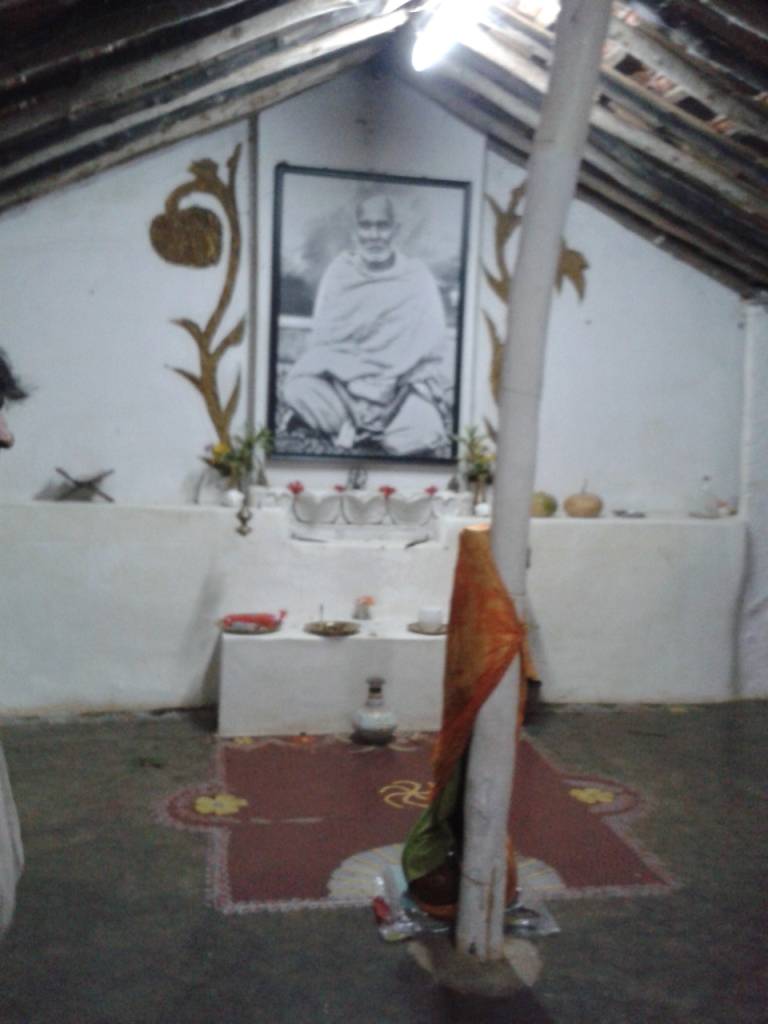
This small campus of buildings in the Halasuru neighborhood of Bangalore is dedicated to the teachings of Sri Ramakrishna. Ramakrishna was a holy man from Bengal who lived from 1836 to 1886. The Bangalore chapter is one of several associated with this non-secular monastic order. The order was actually begun by Ramakrishna’s lead disciple, Swami Vivekanada. Vivekanada is most well-known as the individual who introduced Yoga to the West, and particularly the US, back in the 19th century.

With a motto of “Liberation of oneself and service to mankind,” the order both facilitates personal growth through yoga classes and meditation sessions, and also has a major philanthropic thrust.

DAILY PHOTO: Trio of Street Dogs

Taken in September of 2013 in Nandi Hills, India.

Taken in September of 2013 in Nandi Hills, India.

India has a lot of street dogs. While there are many that are in a tragic state, others look like they’re someone’s pet. They tend to cluster together in places like parks where they have prospects for both food and to not be run over by rampaging autorickshaw drivers.

My First Tibetan Buddhist Meditation & Lecture

Having settled into life in India over the past month, I’m now getting around to some of the self-enrichment activities I’ve planned on taking advantage of here in Bangalore. Today I attended a meditation session and discussion/lecture at the Thubten Lekshey Ling Tibetan Buddhist Meditation Center. I’ve read a few books on Buddhism and even one or two specific to Tibetan Buddhism, but this was my first time attending such a session. Also, while I’ve done several kinds of secular meditation, both in a group and individually, this was my first exposure to guided meditation in the Tibetan Buddhist tradition.

The title of the session was As the Clouds Drift by… The first hour was the meditation portion and the following two hours were the lecture / discussion portion. The session opened with a few prayers that were chanted in what I believe was Sanskrit, but there was an English translation for newbies such as myself to follow along with the meaning. Then we did a few short meditations that were much like others that I’ve done: meditation on breath and meditation on bodily awareness. Then there was a visualization as we read a sutra in English.

Transitioning into the discussion and lecture portion, we first discussed the meaning of life. No, I’m not making that up. While it might seem like a hackneyed question, some intriguing points were raised. We were directed to think of the question as having two alternative meanings. First, why am I here? Second, what is my purpose? The conversation gravitated to the latter topic. I’m not sure if this was because there was a consensus that the question “why am I here?” is meaningless, or if the question of purpose was just more intriguing. There were various opinions about whether there was a purpose, and–if so–whether it is universal or individual-specific.

After a brief tea break, the remainder of the session involved readings from The Way of Bodhisattva followed by analysis and prompted discussion. Much of the discussion revolved around the issue of how compassion is expressed and the difficulty (or ease) of being a Bodhisattva. (A Bodhisattva is one who seeks enlightenment out of compassion for all sentient beings.)

I found the session to be thought-provoking and beneficial, and thought the atmosphere was conducive to growth. Emphasis was placed on discussion rather than straight lecturing. I will no doubt be back to visit in the future.

I did learn something interesting about myself through the process of the class, and that’s that I need to learn to be still for more than two hours. While there was no prohibition on moving around–particularly beyond the meditation portion– in an effort to not be a distraction, I tried to keep fairly still. I practically ran home afterwords. I had all this pent-up energy. I would have thought myself better than average at sitting in a contemplative state. I’m a writer for goodness sake. I spend entire days at my computer. However, in truth, I rarely sit more than an hour without getting up and stretching or doing some sort of movement to limber up my body and get the blood flowing. I was raised Catholic, and so I’m not new to sitting quietly for long periods of time. Though that was a long time ago. I also have three college degrees and have spent more than my fair share of time in classrooms, but the wandering mind is not discouraged in that environment–in a way it’s encouraged.

DAILY PHOTO: MG Road at Barton Center

Taken in September of 2013 in Bangalore

Taken in September of 2013 in Bangalore

MG Road (short for Mahatma Gandhi Rd.) is the main drag in Bangalore. It’s lined with shops, malls, and office buildings.

DAILY PHOTO: Bangalore Literature Festival

Taken September 27, 2013

Taken September 27, 2013

I spent Friday September 27th at the Bangalore Literature Festival. This was the second year of the event, and the first day of this year’s festival. Pictured onstage here is Sri Sri Ravi Shankar, a world-famous guru and charitable foundation leader who is headquartered in Bangalore. He drew the biggest crowd that I saw, although the rest of the talks I went to were on a secondary stage called Lawn Bagh. (“Mysore Park” was the name of the main stage.)

I went to a panel entitled “Vision for India” that featured a politician, a retired General, and a well-known pundit. The panel solicited the three men’s opinions on the future of India. It was fascinating to the international affairs / economist trained part of me. There were some political and economic reforms all of them seemed to agree on, but, great for this type of panel, there was some controversy as well.

I also went to panels on crime fiction, geographic-centric poetry, and the coexistence of literary and commercial fiction in the publishing space.

I was impressed with the festival. The caliber of speakers and authors was high. They had to contend with something that no other literary festival that I’ve been to had to, and that is that there are many written languages  in India–and at least one French and  German writer each that I saw. While English was the lingua franca of the festival, I heard poetry in Tamil, French, and other languages as well.

The campus it was held on, Velankani Park, was sparkling clean held a lot of interesting plant life.  This was my first trip out to Electronic City. It seemed odd that they held the festival so far from the city center, but I can see why in a way. As one of the speakers said during the “Visions” panel, it’s a first world oasis in a third world country. The little I saw, verified that. That said, if they wish to grow, they may need to put it closer to the city center. (Of course, as the metro comes on-line and people start using it, this may become a moot point.)

They did have trouble controlling the schedule. By the end of the day they were about 45 minutes behind. This is something that they’ll have to control if they wish the festival to grow beyond three stages. In terms of quality, this was very much like a scaled down version of my previous home city’s literary festival, the Decatur Book Festival. However, DBF has about 20 stages and a much bigger vendor space. This means the DBF has to have “stage Nazi’s” that will crack the whip. Even with a compact three-stage campus, they probably need to build defined break space into the schedule.

DAILY PHOTO: Bangalore Palace

Taken in September of 2013

Taken in September of 2013