DAILY PHOTO: How Many People Fit in an Auto-Rickshaw?

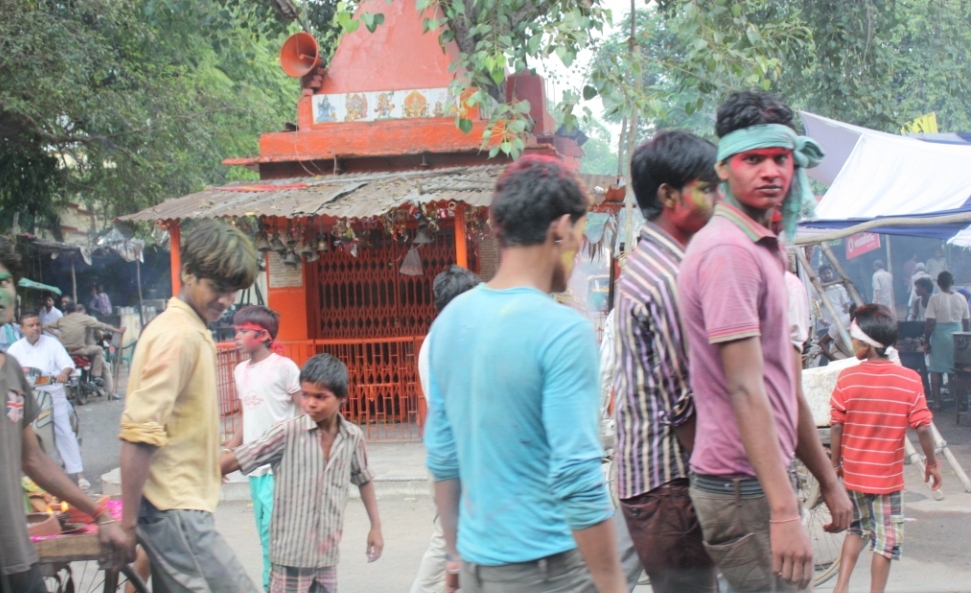
Taken October 12, 2013 in Agra, India

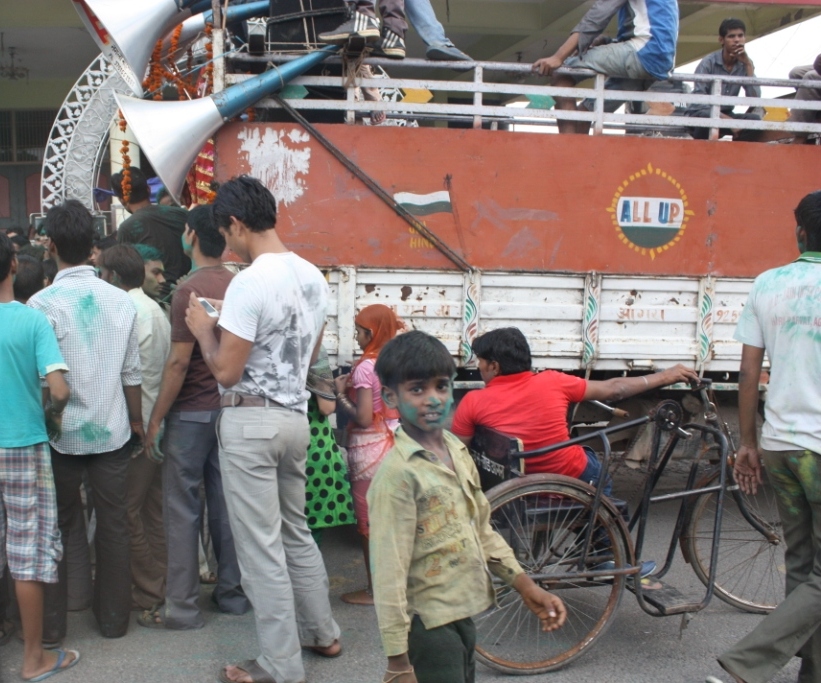
Taken October 12, 2013 in Agra, India

It’s a question that has been debated since the dawn of the Tuk-tuk. Like the question of how many licks it takes to get to the center of a Tootsie-Roll Tootsie-Pop, attempts to definitively answer the question have resulted only in controversy. The question?

HOW MANY PEOPLE FIT IN AN AUTORICKSHAW?

In the highfalutin cities, people think that nobody is supposed to ride upfront with the driver, but elsewhere they’ve figured out that you can put at least one man on either side of the driver (as long as the weight of each man is fairly evenly matched–there’s only one tiny front wheel after all.) How many one can fit in the back is influenced by the average yoga skill level of the riders and whether one has any Twister (TM) grand-champions on board. 

There are myths of tuk-tuks containing entire villages tooling down the back-roads. Theoretical physicists tell us that you can pack them in until their density forms a self-sustaining black-hole, and then everybody out to the event horizon is drawn in… ya-da-ya-da-ya-da.

The answer is: “a lot.”


POEM: Scared Little Chipmunk

Taken at Fatehpur Sikri

Taken at Fatehpur Sikri

Poor little rodent, run up a door.

Chattering and chattering, frantic, he swore.

Babel Fish Rodentia translated his words:

“It’s not bad enough, the cats and the birds,

hectic humans and their frantic pace,

always running about like they’re in a race.

Stuck on this peg for nigh half a day.

‘A break in the traffic’, I fervently pray.

Pfff! Bipedal humans with their gigantic feet

designed to crush chipmunks right in the street.”

DAILY PHOTO: Herd of Elephants

Taken November 10, 2013 at Bannerghatta

Taken November 10, 2013 at Bannerghatta

Elephants are paradoxes. They seem like gentle giants–making an end-run around tiny mice. Then you realize that humans are the only animal idiotic enough to screw with one in its natural habitat. OK, if an entire pride of lions can separate one injured elephant from its herd, they might go for it. But, generally, the most fearsome predators in the world look at an elephant and say, “Oh, that would not end well for me.” And, of course, one has to consider that they never forget. If you do piss one off, you have to worry about it coming at you all Tony Soprano-style a decade later. 

I’ve ridden an elephant in Thailand near the Mae Wang River. It was pleasant. It’s a little terrifying when it goes up or down a steep grade. You have a moment where you think, if this thing topples over, I’m a goner. (You’d have a moment where you hit the ground and said, “I’m alive, I made it.” And then you’d be like, “I didn’t know there was a solar eclipse today” and then” SPLAT!”) At one point, our driver jetted, but–it didn’t matter–the  elephant knew where it was going and how to get there. As long as you don’t run out of bananas, the elephant will get you where you’re going. Of course, you will run out of bananas. Fun fact: a person can’t carry enough bananas to satiate an elephant. Then your elephant will get all morose and brooding. 

DAILY PHOTO: Gazing Tiger, Drinking Tiger

Taken November 10, 2013 at Bannerghatta.

Taken November 10, 2013 at Bannerghatta.

White Tiger drinking

White Tiger drinking

Bannerghatta has several tigers, two of which are white tigers, that can be seen on the “safari.” It’s not a safari in the usual sense, as the cats are in fenced off containment zones and segregated from their food. One rides in buses or jeeps in through a double-fenced gate, and then through the area.

At some point it occurs to you that they are in the larger area, with greater freedom of movement, and so in some sense one is on exhibit for the animals. The vehicle even has steel mesh over the windows to make the caging experience complete.  There are periodical camera portals to give one the illusion that it’s all for the humans’ entertainment. 

There are several enclosures to keep lions, tigers, and bears separated.

I saw tigers looking, drinking, walking, stalking, and sniffing–but not crouching. I didn’t see a dragon, and so I must assume that it was hidden.

DAILY PHOTO: Hanuman

Taken November 2, 2013 at Hampi.

Taken November 2, 2013 at Hampi.

Among the many devotees of this Hindu deity are wrestlers, who admire the monkey-god for his reputed strength. In Rama’s war against Ravana, he was said to have picked up a mountain and carried it a great distance, which is pretty strong.

He’s not whimsical and mischievous like Sun Wukong, the Taoist monkey-king (who also has god-like powers), but some believe that Sun Wukong’s myth was partially influenced by Hanuman’s myth. (Of course, the more irreverent and anti-authoritarian Taoists had a different take than the caste-conscious Hindus. (Whimsicality and mischievousness are considered more virtuous among the former than the latter.)

This Hanuman temple is a small, stone-block affair abutting a giant boulder on the trail from Hampi Bazaar to Achyutaraya temple. As you can see, it still has local devotees.

DAILY PHOTO: Tiny Temple and Wind-blown Trees

Taken November 3, 2013 at Hampi.

Taken November 3, 2013 at Hampi.

These trees, raising like hands out of fresh, graveyard soil in front of this tiny temple really captured my imagination. It would probably be a better picture in low light, when the creepiness of the scene could really root around in your brain–but I took what I could get.  There were a couple of places around Hampi that I thought would make the perfect setting for horror, and this was one. Another was the banyan tree that had many-colored satchets of rock tied to hang from the tree’s drooping roots.

This picture is taken on top of the hill that overlooks Virupaksha temple, not far from the Ganesh temple.

DAILY PHOTO: Gray Langur Watchmonkey

Taken Nov 3, 2013 at Hampi

Taken Nov 3, 2013 at Hampi

Gazing into the distance

he renders his assistance

to the mischievous monkeys–

making him a monkey flunky

A watchman of the langur pranks

yet not a part of their prankish ranks

He screeches warnings now and then

on sight of broom-wielding women

He neither seeks nor needs praise

just the occasional banana raise

He does it not for power or glory

just the occasional funny story

DAILY PHOTO: Lotus Mahal

Taken November 2, 2013 at Hampi

Taken November 2, 2013 at Hampi

The Lotus Mahal is one of the most popular attractions at Hampi. It’s atypical in that it’s built, in part, in the Indo-Islamic style (note: the arches.) (Hampi [Vijayanagar] was the capital of a Hindu kingdom that was defeated by a confederation of Islamic states. ) While this pavilion is often referred to as the “Lotus Temple,” it was believed to be either a rest-house for visiting royalty or the queen’s recreational building–but not a religious building of any sort. 

We got there with good timing. The beige-pink lime mortar seems to glow in the low, afternoon sunlight.  

The Lotus Mahal is located in the Zenana Enclosure with the Elephant Stables. 

DAILY PHOTO: Black Marble Pillars of Hazara Rama Temple

Taken November 2, 2013 at Hampi.

Taken November 2, 2013 at Hampi.

There’s a good chance that Hazara Rama temple isn’t even mentioned in your guidebook. It’s on the loop that includes the Queen’s Bath, the Mahanavami Dibba, the Lotus temple, and the Elephant Stables, but it would be easy to dismiss as lesser ruins if you’re traveling by yourself. This would be a mistake. This small temple has some of the most impressive friezes and carvings at Hampi. This was the King’s own personal temple.

The centerpiece of the temple are four black marble pillars. While black marble can be seen commonly enough at sites in other parts of India (e.g. Agra), it’s a rare building material here. In fact, these pillars were the only use of black marble that I remember seeing at Hampi.  The marble holds the carved images better than the sedimentary stone that is most common at Hampi.

Experts say the most prized sight at Hazara Rama are the friezes of Vishnu as Buddha, which are apparently quite rare.

Out front.

Out front.

DAILY PHOTO: Mahanavami Dibba

Taken November 3, 2013 at Hampi

Taken November 2, 2013 at Hampi

The Mahanavami Dibba was a monument built to honor Emperor Krishnadevaraya’s win over the state of Kalinga. (I believe he had it built himself. The arrogance of emperors knows no bounds.) At a little over 20 foot tall, it’s the highest structure in the Royal Enclosure, and offers a nice view of the palace ruins as well as  the boulder mountains of the surrounding countryside. The sides of the platform are covered in friezes in which elephants play heavily, but also dancing-girls and hunting scenes.  We had great skies for our visit.

The Royal Center is part of Hampi that one will need to have transportation to get around because it’s quite far from the Hampi Bazaar (where the guest houses are) and the key sites (e.g. Queens Bath, Hazara Rama Temple, the Lotus Mahal, and the Royal Elephant Stables) are spread out over a large area. However, willing auto-rickshaw (tuk-tuk) drivers abound.