This dog followed us around during our tea plantation walk in Munnar. It was a fine-looking dog with a warm disposition. It seemed quite healthy, except for the fact that it was missing its left eye.
This made me think. If you take in a blind dog, does that make you its seeing eye human?
Gandhi is credited with saying, “Be the change you wish to see in the world.”
That’s powerful phrasing. It’s much more effective than, say: “Nag your friends until they’re the change you desire.” It’s also far more potent than: “Write your legislator to draft a new bill so that we all have to be the change you wish to see.”
It’s powerful because it acknowledges that–whatever else you do–you have to set a good example by doing what you think is right. Even if that”s painful and lonely. It’s powerful because it’s bold.
That’s why it sticks in the mind. I once read an entire book by a well-known billionaire who made his fortune in foreign currency arbitrage. I was underwhelmed by the book and the character of the author, and don’t even remember the title because I remember thinking the title should have been: “Why It Should Be Illegal to do What I Did.” This individual came to believe it was morally repugnant to upset the economies of entire nations to make a quick buck, but the lure of making that buck was too great for him to stop without the threat that someone would put him in jail for it. In other words, instead of living by the motto of “be the change,” he lived by the motto of “If I don’t do it, someone else will.”
I learned the terms “hot media” and “cool media” during my weekend reading. These terms were coined by Marshall McLuhan, and don’t seem to have caught on outside of academia.
Hot media are information sources that are packed with data (often simultaneously transmitted to multiple sensory organs at once), and that require little or no interpretation or analysis on the part of the recipient. Television and movies are prime examples.
Cool media are those information sources that offer relatively little data, but which require the receiver to interpret, interpolate, analyse, and draw conclusions about the information they receive. Books are the prime example of cool media.
There are people who proudly say, “I don’t have the time to read, but I only watch the Discovery Channel and Public Broadcasting.” If you think you’re getting smarter just like readers, you’re not. You’re still mainlining information, and the parts of your brain that have to exercise when you read (or otherwise take in information in an abstract form) are shut down.
I’m not suggesting one shouldn’t watch television, or that you can’t learn something from it. I’m just saying that if you don’t read, but try to educate yourself via TV, you are the intellectual version of this guy…
Statue of Kusunoki Masashige, famous Royalist supporter, taken outside the Imperial Palace in Tokyo in 2008.
The defining characteristic of a warrior isn’t the ability to fight. Thugs and mercenaries fight. It’s subordinating one’s most base instinct to survive to virtuous behavior. It’s not being ruled by fear, anger, or pride, but consciously opting to do the right thing.
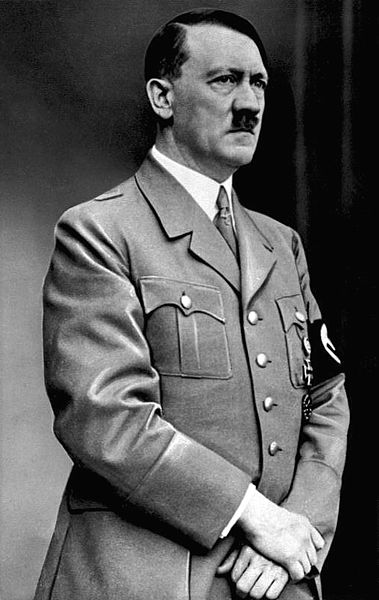
Hitler killed the short-stache (a.k.a. the “toothbrush mustache.”) Imagine that, almost 70 years after his death, he still holds power over people’s decisions about facial hair.
This is a misplaced take-away lesson. It’s the unbridled narcissism, the icy hatred, and the irrational exuberance in the power of evil of Hitler that should be abandoned (yet, somehow, those intangibles still quietly exist.) It’s not the superficial aspects of Hitler that should be shunned, but the ones at the bastard’s core.
I’m not saying the toothbrush-stache was a good look. On the contrary–as one who has had a mustache his entire adult life and has worn a beard now for several years–I’m a little offended by the lack of commitment to one’s choice of facial hair that the toothbrush-stache represents. (Incidentally, I feel the same about the sole patch and mutton chops.) In my mind, one should go full-stache or go home to shave.
Still, there being no accounting for taste, I think those individuals who would otherwise find the short-stache appealing (i.e. you know, indecisive types who wear culottes and eat with sporks) should revive the toothbrush mustache as a big fuck-you to Hitler–don’t let tyrants boss you around from the grave.
Toothbrush mustache admirers of world, unite! (No, I won’t be joining you.)
I don’t think Death should be depicted as a cowled, faceless Grim Reaper.
Instead, I think Death should be the wise drinking buddy who can hold his liquor. Not the one who acts like an idiot an encourages friends to do the same. Rather, the one who spurs you to ask out a girl who’s way out of your league, and keeps you classy if (when) she declines.
Kleon’s work began as a series of index cards and expanded into a short book. As the subtitle implies, the book is built around ten pieces of advice on creativity, each of which has short sub-chapters.
The ten chapters / advice offerings are:
-Steal like an artist.
-Don’t wait until you know who you are to get started.
-Write the book you want to read.
-Use your hands.
-Side projects and hobbies are important.
-The secret: do good work and share it with people.
-Geography is no longer our master.
-Be nice.
-Be boring.
-Creativity is subtraction.
Much of the advice offered in this book is common wisdom. This is exemplified by the title chapter, “Steal like an artist.” That chapter suggests that one must learn to borrow from past artists in a way that creates an end product uniquely one’s own. It’s good advice. Frequently, artists become paralyzed by a desire to create a work that is unlike any in the annals of humanity. At some level of granularity, this is an impossibility, and each artist has to come to grips with that. I once read a book entitled Write Like the Masters which offered this exact same advice in a less pithy form but which elaborated more on how to go about this process.
It’s possible to drill down much deeper into on the subject. Some art is much more thievable than others. I once wrote a short story set in a dystopian far future in which animals of several species had evolved intelligence and other adaptations and were challenging humanity. This was panned by a few on a critique group on the grounds that it was too much like Planet of the Apes. In truth, it did have some things in common with that story (though also much that was quite different.) However, I realized that where there is only one iconic storyline that’s similar, it’s much harder to avoid being compared than when there is a wide body of work. (As opposed to say the billions of vampire stories constantly coming out that usually escape comparison to Bram Stoker’s.)
However, Kleon’s book does offer some advice that isn’t as often addressed in creativity self-help guides. For example, the advice “Marry well” that forms a sub-chapter is critically important but is usually outside the scope of this type of book (and forms its own self-help genre.)This is certainly a good piece of advice not just for life, but specifically for creativity or other personal development. A bad relationship can kill personal growth faster than almost anything else, and a good relationship certainly facilitates one becoming a better person.
Besides being concise, where the book excels is putting advice on creativity in a modern context. This is most prominent in the chapter about the changing role of geography, but it’s also seen in discussions of how to share one’s work in the world of social media and blogging. There’s a lot of advice out there about how to deal with social media. Some will tell you to avoid it like the plague because it cripples productivity. Others will say that you can’t get far in this world without having mastered social media. This book addresses the balance, which is to say being able to use social media to one’s benefit while not letting it consume one’s time and energy.
Some of the advice conflicts, such as “validation is for parking” and “keep a praise file.”
One of the most interesting parts of the book is an appendix that consists of many index card notations–a number of which are clever and thought-provoking. These include one that says merely “quilting vs. weaving” and another that has a drawing of a pitcher and one of a skeleton that says “containers vs. skeletons.”
This book is highly readable, brief, and offers cleverness sprinkled throughout. It’s worth a read if you are interested in how to spur creativity. Don’t expect revelations, but rather inspiration.
America is the product of a set of exceptional human beings. Some may wish to humanize the founding fathers and to deflate the mythology that has grown up around them, but deflate the myth and one still has impressive facts. Who turns down a salary for the most sleepless and thankless job in the universe? George Washington, that’s who. Who writes a political document so artfully that its turns of phrase still chime poetically in the ear 237 years after the fact? Thomas Jefferson, that’s who? Who can invent the lightening rod and bifocals, convince the French to move toward the sound of the guns (just kidding, France), and get the chicks despite the most hideous comb-over ever? Benjamin Franklin, that’s who.
Now this may be Golden Age fallacy talking, but today’s ruling elite seem a bit… well let’s just say “pathetic” by comparison. Sure modern-day rulers still have charisma out the wazoo, but Franklin had charisma plus a world-class intellect. Jefferson had charisma, and he didn’t need a speech-writing team and focus groups to craft his words for him. Washington had charisma, and–quite frankly–he could scare the shit out of a grizzly bear. It’s the rare modern-day leader who is qualified for any alternative career besides ambulance chasing.
Still, I will remain optimistic about the fate of the nation as long as great ideas prevail. Checks and balances is a great idea. The compromise to appease both populous and small states is a great idea. The Bill of Rights is a set of great ideas. I’m a little amused whenever I hear people say that America needs to revise its Constitution if it wants to keep up in the modern world. I heard this most recently from a scholar who said that because it was relatively difficult to make laws and spend money, America was going to fall ever behind the likes of Scandinavian countries? What? Really? Seriously?