POEMS: Dreary Day Haiku

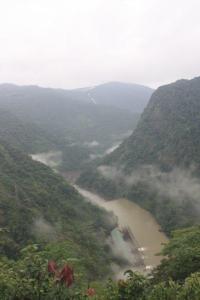
IMG_2123Clouds chugged landward
Smothering a festive town
In a dense, gray cloak


Dreary days have come
Reminding me of Britain,
the long nightless nights


Drizzle piddles down
Dimpling the sidewalk sheen
With random ripples


READING REPORT: April 10, 2015

Ikkyu_Berg

I finished four books this week. That makes it sound like a big reading week, but two of the books were tiny and I was well into the other two at the start of the week. I will present them in the order in which I enjoyed them because they hit the great, the middling, and the awful. The best was Ikkyu: Crow With No Mouth, which is a poetry collection by an irreverent 15th century Zen monk. Given that this is a collection of Japanese short form poetry, you may have guessed that it’s one of the short books (as opposed to one that was half read.) [Full disclosure: some will find a few of the poems vulgar, and it’s probably not a collection you want your kids reading until they are of suitable age for graphic sexual description.] Among my favorite verses are:

you can’t make cherry blossoms by tearing off petals

to plant only spring does that


and

it’s logical: if you’re not going anywhere

any road is the right one

and

I live in a shack on the edge of whorehouse row

me autumn a single candle

or

the edges of the sword are life and death

no one knows which is which


HaikuHandbook

(Yes, I’m on a bit of a haiku kick lately. With my RCYT training in progress, I haven’t had a lot of time for more extensive reading or writing lately.) Unlike the previous book, this book on Haiku isn’t a poetry collection–though it does assemble a lot of great haiku, tanka, renga, and haibun as examples. However, this book is–as its subtitle suggests–about writing, sharing, and teaching haiku and related poetic forms. The book teaches one that five-seven-five syllable organization isn’t an essential element haiku,  but rather it should be considered the most readily abandoned and superficial aspect of this form. However, beyond teaching one what one really needs to know to construct haiku, the book offers a lesson plan for teaching haiku to school children and tells us how this Japanese poetry form went global.


Elements of fiction writing conflict & suspenseElements of Fiction Writing: Conflict & Suspense is my second read by Bell on writing. The first one was on plotting and structure. That first book must have been useful enough to get me to read a second. This book is divided in two parts, the first one on conflict and the second on suspense. (The first is much longer.)  In both cases, the chapters examine how the various elements of fiction (i.e. setting, plot, character, dialogue, etc.) can contribute to creating the much-needed characteristics of conflict and suspense. Bell uses a lot of example text to illustrate his points (mostly–but not exclusively–from commercial fiction), and this is a valuable feature of his guides.


wit&wisdom_yoda

This book was a stinker, and I can’t recommend it for anyone–though its saving grace is that it’s slim and thus only wastes a tiny bit of one’s time. What the author apparently did was to watch a Star Wars movie marathon and pull every Yoda line out and collect them together. This is a sad effort in two ways. First, while Yoda isn’t a lead in the movies (and, therefore, has a limited number of lines), there’s a vast canon of Star Wars books, and it doesn’t look like the author trolled any of them for quotes. Second, some of the lines are neither witty nor wise. Occasionally, Yoda has a line equivalent to, “take a left at the second light,” and the author includes such banal quotes. Furthermore, some of the quotes appear a second time in either reduced or extended form. Beyond all these complaints, the author doesn’t even take the time to put together meaningful front matter to tell the reader something interesting that they don’t already know, and thus doesn’t establish his worth in producing such a book. (Also, he doesn’t seem to know accepted protocol for writing quotes inside quotes–i.e. use of single quotes. Which I guess means he probably didn’t just cut and paste all the quotes because then they would have been grammatically correct.) He also could have at least provided told us which movie each quote was from. It’s a lazy effort. It succeeds spectacularly in being lazy.  If you’ve seen the movies (or have basic cable so that you can readily do so by way of one of the frequent Star Wars marathons) you’ll gain nothing from this book.


I bought three books during this week, but one of them was the aforementioned Yoda crapfest. On the other hand, one of these books I have high hopes for being both fascinated and educated by, and that’s Wired for Story. This book is about how our brains are evolutionarily optimized to the narrative form, and how one can use this fact to one’s advantage as a constructor of stories.

Wired for Story

The second book was a poetry collection that is on sale on Amazon entitled Love Alone. I must admit that I picked this book to meet one of my remaining requirements in the 2015 Book Riot Read Harder Challenge–nevertheless I have high hopes for this work.

LoveAlone


HAIKU: Notes From an Evening Walk

Bat black skies above
Jinking, rolling, and dipping
Dog-fighting for food


The Morning Glory
After dark is monotone
But remains shapely


A pack of street dogs
Bursts into barking, relief
Their mark? Lunchbox man,


Shadow silliness
Man flails his arms overhead
Walking behind me

POEM: Three Tanka City

Stiff iron trusses
skeletonize a building
outlining order
wind whistles over I-beams
flexing,  moaning, and rising


Steel lugged upward
welded into false order
chaotic city
don’t pretend order reigns here
litter skitters on the wind


From: the Butterfly
To: the city residents
Sorry my flapping
caused the storm that destroyed your
lovely burgh. I didn’t know.

TANKA: Crows

a murder of crows
call from trees in unison
hidden amid leaves
invisible but noisy
what secret taunts curse us

Haiku from my daily walk

Hazy hilltop morn,
a resting hiker looks like
a granite Buddha

Chicks chirp noisily
each tremor anticipates
mamma coming home

BOOK REVIEW: The Classic Tradition of Haiku Edited by Faubion Bowers

The Classic Tradition of Haiku: An AnthologyThe Classic Tradition of Haiku: An Anthology by Faubion Bowers

My rating: 4 of 5 stars

Amazon page

The other haiku anthology I reviewed is Classic Haiku, located here.

This is the second haiku anthology that I’ve reviewed on my site. While they’re both thin volumes of traditional haiku, each has its distinct flavor. The previous volume was organized by season. This one is organized by author. The two books share several authors (e.g. the greats Bashō, Issa, and Buson), but diverge on many of the lesser known poets.

One nice feature of this book is that it offers multiple translations of many of the haiku. Poetry is notoriously tricky to translate as literal translations can be meaningless. Multiple translations can give one a better opportunity to hone in on what the author meant to convey. This volume does give the original Japanese poem in romanized transcription (for those who enjoy the sound the author conveyed as well as meaning), but–unlike the other volume–it does not include the kanji. (This doesn’t matter for me, as I don’t read Japanese, but I’m sure the kanji is a nice feature for readers of Japanese.)

Some favorites are:

clouds occasionally
make a fellow relax
moon-viewing

Matsuo Bashō

islands
shattered into a thousand pieces
in the summer sea

Matsuo Bashō

you’re the butterfly
and I the dreaming heart
of Sōshi

Matsuo Bashō

[Note: Sōshi is the Japanese name of the Taoist thinker Chuang Tze, and this references his famous statement about having dreamt he was a butterfly.]

that dream I had
of being stabbed–was true
bitten by a flea

Takarai Kikaku

oh, won’t some orphaned sparrow
come
and play with me

Kobayashi Issa

View all my reviews

Early Spring Haiku

IMG_5325

stalwart Beech tree
still gathering sunlight
on last year’s leaf

IMG_5315

dandelion
arrives to party first
eager flower

IMG_5346

a bud breaks open
its tiny leaf waves hello
welcoming the spring

IMG_5350

spring’s urgent leisure
flowers drop a fine pollen
to ride listless winds

Haiku no Gyokko-ryū Jōryaku no Maki

throw open the gate
mindless herds will charge headlong
into the stockyard


prolong each journey
show the Emperor the sights
drop his palanquin


the guitarist’s hand
bounds chord to chord on the dot
no beat is missed


the slug ricochets
yet always finds its mark
burrowing deeply


waves washing ashore
within a rocky inlet
turn about strongly


gulls flap into flight
slowly lifting skyward in
an unrushed climb


sparks pop from the fire
with impeccable timing
uncapturable


topple the gatepost
with a splintering impact
but start with a sting


the pinky finger
of a raging wild-eyed brute
snaps like a pea-pod


once the snake constricts
all is hopelessly lost
sting first and sting deep


bears don’t crush stout trees
stout trees sometimes crush a bear
falling in tree’s time


the bull’s hoof clomps down
a statement made decisive
not to be wrangled

BOOK REVIEW: Classic Haiku ed. by Yuzuru Miura

Classic Haiku: A Master's SelectionClassic Haiku: A Master’s Selection by Yuzuru Miura

My rating: 5 of 5 stars

Classic Haiku is a collection of 106 poems by masters such as Matsuo Bashō, Kobayashi Issa, and Yosa Buson. It’s logically arranged into five sections: Spring, Summer, Autumn, Winter, and New Year’s Day. While haiku has come to be thought of as any poem in a 5-7-5 syllable arrangement, those familiar with traditional haiku know that there are other requirements that are at least as fundamental as the syllabic arrangement. One of these is that the poem be pure observation devoid of exposition. Another criteria is that it be rooted in nature. A final criteria, historically, has been that the poem indicate the season, if not giving an explicit seasonal word or phrase. This makes the season an optimal organizational unit for the book.

One nice feature of this book is that it includes the English translation, the Japanese romaji version (i.e. the way it would be spoken in Japanese but using roman alphabet characters), and the version using the Japanese system of writing. Granted, for those who aren’t fluent in Japanese, these features might not seem to add much. However, sound can be evocative itself in poetry, and so it can be interesting to read the Japanese for that reason. Furthermore, there are those who argue that 5-7-5 syllables is not the closest facsimile to Japanese haiku for haiku written in English. Because of the average length of syllables, some say that a 2-3-2 accented syllable pattern for English haiku is closer to the original Japanese form. Reading the Japanese, gives one an idea of the sound characteristics of Japanese haiku.

[Furthermore, if one loves a haiku enough to want to get it tattooed in Japanese on one’s body, one can double-check the characters before one gets it done at a Chinatown tattoo parlor only to find that what one really has tattooed on one’s butt is, “Syphilitic nightmare – Ketchup bottle mayhem day – Rides the goat to school”]

Here’s a sampling my favorites:


the raftsman’s straw cape
brocaded with
the storm-strewn cherry blossoms
– Yosa Buson

calm and serene
the sound of cicada
penetrates the rock
– Matsuo Bashō

in summer grasses
are now buried
glorious dreams of ancient warriors
– Matsuo Bashō

oh, cricket
act as grave keeper
after I’m gone
– Kobayashi Issa

View all my reviews