
"the fish's world
 is always in drift,"
  thinks I, from the bank.

"the fish's world is always in drift," thinks I, from the bank.

This machine can flow,
     moving over, around,
     & through.

Skin conforms to the contours
     of musculature.

Muscle binds to bone,
     muscle that thickens
     and lengthens and ripples
     and pulses.

Bones that flex and recoil.

But that machine can flow --
     over, around, and through.

It can cause air to pop
     and water to slosh
     and earth to tremor.

It crawls through liquid,
    slices through gases,
    and slams the solids,

but can move over, around,
    and through.

roots drape over rock,
 a blind search for soil:
  flowing & rigid.

If you can follow rivers to the sea
by drifting without thrashing or grasping --
just let the flow take you upon a spree,
a spree of dunk and breathe, without gasping,

then you will witness all there is to know.
You'll see shaky shanties and vast estates,
the birds in flight and creatures: fast and slow,
the weeping willows, and fish tempting Fates.

If you can roll around the rocks -- always --
and never crack your head and silence all
the voices saying you've reached your end-days,
and never rush and never, ever stall...

If you can do all this and keep the flow,
it won't matter you don't know which way you go.

monks of the temple
that stands beside the river
receive flow teachings
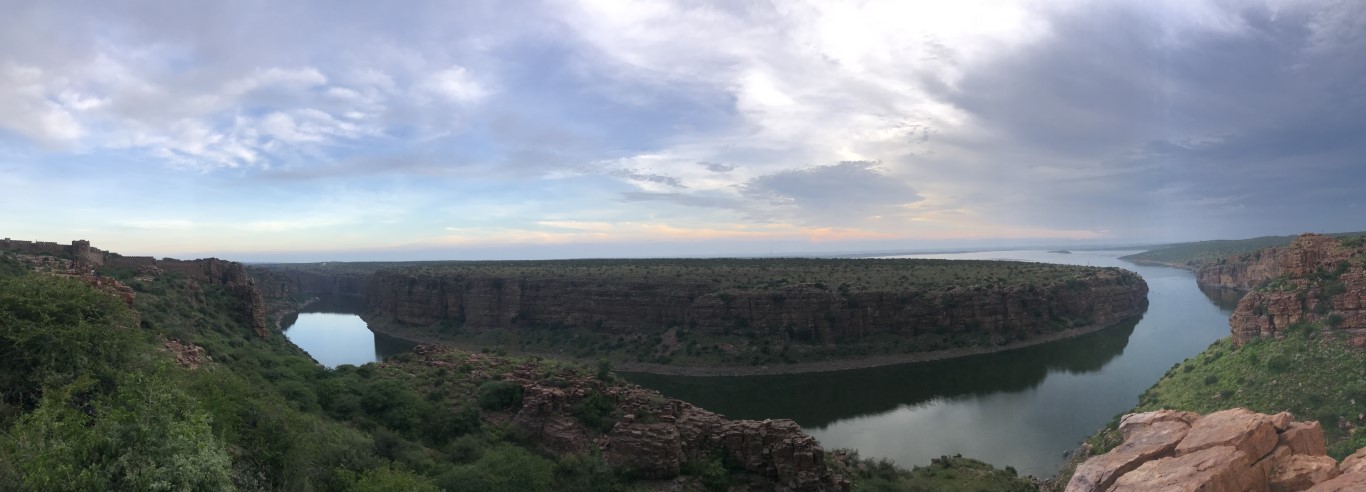
I stand before a horseshoe canyon,
and it feels like the world
has folded back upon itself.

And I sort of like that idea.

There's too much emphasis on progress,
so maybe we need pockets of regress.

Not a full fusion blast of regression.
No one's calling for being battered back
to the stone age.

Maybe, it'd just be nice to escape
the clarity of the watercourse way.

To be in the kind of place
where one has to drop a leaf
to know which way the waters flow.
 The Art of Impossible: A Peak Performance Primer by Steven Kotler
My rating: 5 of 5 stars
Out: January 19, 2021
Steven Kotler’s new book, “The Art of Impossible,” shares territory with two of his previous books [“The Rise of Superman” and “Stealing Fire” (the latter co-authored with Jamie Wheal,)] but it also takes a step back to reveal a broader landscape than those previous books. Whereas the earlier books focused on how to achieve a high-performance state of mind called “flow” (or “peak performance,”) this one looks at the bigger picture of how to achieve success with daunting projects. So, while the fourth / final section of the book presents information that will be familiar to past readers, the first three sections – on motivation, learning, and creativity, respectively – are not addressed in the earlier works. [It’s worth pointing out that even section four (Ch. 19 – 23) presents some new information and organizational schemes because this is a fast-moving research domain of late.]
The book’s first six chapters (i.e. Part I) are about achieving and maintaining motivation. This starts from the logical bedrock of finding an “impossible” task for which one is likely to have sufficient passion and interest to follow through. The reader learns how to formulate goals that are challenging enough and clear enough to facilitate sustained interest, effort, and productivity. The importance of autonomy is discussed at length, and the reader learns what companies like Google, 3M, and Patagonia have done to make gains via employees energized by increased autonomy. The kind of motivation that allows one to knuckle-down under adversity, grit, is given its own chapter, and the author discusses six variations that are important to success.
Part II (Ch. 7 – 14) is about the learning process and how one can organize one’s pursuits to get the most learning per effort. Chapter ten is the heart of this section, offering a detailed approach to organizing one’s learning activities. Chapter fourteen offers yet another critique of the 10,000-hour rule that was popularized by (and oversimplified in) the Malcolm Gladwell book, “Outliers.” [This “rule,” developed by Swedish psychologist Anders Ericsson, has come under intense criticism in large part because every time the explanation shifted downstream it became less of an approximate rule of thumb that was applicable to some specific domains and more of an iron-clad rule deemed applicable to every activity that benefits from practice, resulting in insane behavior such as parents who pick their child’s sport in the womb so that the kid can get the requisite number of practice hours before the college recruiters come to see him or her play.]
The third part (Ch. 15 – 18) is about fostering creativity. Here, Kotler takes the reader on a tour of changing thought about creativity, ranging from the ancient stories of muses to today’s state-of-the-art neuroscience. Like the section on Flow, there is an elaboration of where the neuroscientific understanding of creativity sits at the moment. Having read a range of books discussing such descriptions, this approach is falling out of favor with me. First, whenever I’ve read a book by an actual neuroscientist, I’ve learned that these simple attributions of activities to certain brain regions are either vastly oversimplified, more tentatively agreed upon than suggested, or both of the above. Second, I have realized that learning a name like Anterior Cingulate Cortex (ACC) and an oversimplified explanation of what it does doesn’t really help me. That said, I understand there is interest in these descriptions that drive their inclusion in such books. (I, too, have been interested in reading about it, but less and less so.)
The final part is about Flow, and this is where readers of “Rise of Superman” will be well-primed for the information that is covered. Chapter 21, which elucidates the twenty-two “Flow Triggers,” is the heart of this section. As I mentioned, Kotler has changed the way he organizes this discussion since his earlier book, but the material is still largely from Mihaly Csikszentmihalyi’s work on the subject. In addition to explanation of what it means to get into the state of Flow and of how to improve one’s chances of getting there, there is a discussion of “Flow Blockers” – four mind states that hinder Flow. The last chapter lays out a plan consisting of daily and weekly activities, and – as such – it serves as both a summary and an outline for moving forward.
Writers may find this book particularly beneficial because Kotler relies heavily on anecdotes from his own work to clarify and explain the points under discussion. By contrast, “Rise of Superman” relied almost exclusively on stories from extreme sports athletes, and “Stealing Fire” drew on silicone valley and the special forces heavily for examples. I actually enjoyed that Kotler spoke from his own experience. As someone who has read a fair number of books on peak performance, I’ve seen a lot of the same stories repeated within popular books. That said, readers who haven’t read much on the topic may wish the book had a broader set of narrative examples and less definitional / conceptual discussion. The author may be aware that many of his readers will have fatigue from reading the same stories and examples. When Kotler does mention such widely-discussed examples (e.g. Steve Jobs putting bathrooms in the Pixar building in a central location that created cross-pollination of people on different projects) he does so briefly and without preaching to the choir.
I found this book to be an interesting overview of how to approach a large-scale life mission. It’s well-organized and readable (though it might benefit from less vocabulary-based neuroscience discussion.) If you are feeling a bit rudderless, this is a good book to look into.
 I stare into a rushing stream.
For me, time flows as in a dream.
But the stream knows only one flow —
its tune an endless allegro.
Lord willing -n- the creek don’t run dry.
[A pantoum is a Malay form built in quatrains, and which uses repetition of lines. The second and fourth lines of one stanza become the first and third of the next. The final stanza can, but doesn’t necessarily, revisit lines from the first stanza.]
 She bends a moment writ in iron time,
while concentrating on a hov’ring bee.
Its undulation hushes a turbid mind.
Entranced, there’s nothing else to feel or see.
She concentrates on the hov’ring bee.
It becomes the sum of all things in her world.
There’s nothing else to feel or hear or see.
Only the bee alighting, body curled.
The bee is all that resides in this world.
Its undulation lulls her into trance.
She sees it flit and hover, its body curled.
The moment slows to show her its wee dance.
 Thru-hiking a sheep-cropped pasture,
I spied a shepherd in repose,
in the shadow of a boulder.
I asked, “Do you know which way it flows?”
“It flows? What flows? the creek below?”
“I know the creek must flow downhill.
I mean how I flow through the world,
or it through me — by force or will?”
“I know when I lie here it slows,
between the bleats and blowing winds,
and I wonder through shaded eyes
whether the world is still in spin?”
I nodded, wandering on, wondering whether the world would stop for the likes of me.


 Tiger Riding for Beginners