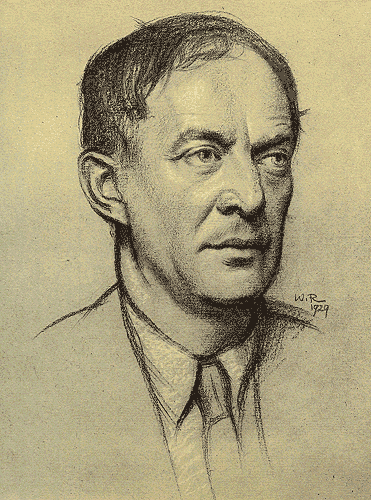
Clear eyes, beneath clear brows, gaze out at me,
 Clear, true and lovely things therein I see;
 Yet mystery, past ev'n naming, takes their place
 As mine stay pondering on that much-loved face.
I take it you already know
  Of tough and bough and cough and dough.
 Others may stumble, but not you,
  On hiccough, thorough, lough and through.
 Well done! And now you wish, perhaps,
  To learn of less familiar traps.

Beware of heard, a dreadful word
  That looks like beard and sounds like bird.
 And dead -- it's said like bed, not bead.
  For goodness sake, don't call it deed!
 Watch out for meat and great and threat.
  They rhyme with suite and straight and debt.

A moth is not a moth in mother,
  Nor both in bother, broth in brother,
 And here is not a match for there,
  Nor dear and fear for pear and bear.
 And then there's dose and rose and lose
  Just look them up -- and goose and choose.

And cork and work and card and ward.
  And font and front and word and sword.
 And do and go, then thwart and cart.
  Come, come I've hardly made a start.

A dreadful language? Man alive,
 I'd mastered it when I was five!
* This poem has come to be attributed to a T.S. Watt with a date of 1954. However, the broad divergence of titles and lack of other publication information suggest the alternate possibility that attribution was invented after the fact and has just been mindlessly copied across the internet. I don’t wish to cheat T.S. Watt, if he or she was an actual person who wrote this clever poem, but I also don’t wish to contribute to the spread of false information that happens regularly across the internet. Hence, this note.
If thou must love me, let it be for nought
  Except for love's sake only. Do not say,
  "I love her for her smile -- her look -- her way
  Of speaking gently, -- for a trick of thought
  That falls in well with mine, and certes brought
  A sense of pleasant ease on such a day" --
 For these things in themselves, Beloved, may
  Be changed, or change for thee -- and love, so wrought,
  May be unwrought so. Neither love me for
  Thine own dear pity's wiping my cheeks dry:
  A creature might forget to weep, who bore
  Thy comfort long, and lose thy love thereby!
 But love me for love's sake, that evermore
 Thou mayst love on, through love's eternity.
Scorn not the Sonnet; Critic, you have frowned,
  Mindless of its just honours; with this key
  Shakespeare unlocked his heart; the melody
  Of this small lute gave ease to Petrarch's wound;
 A thousand times this pipe did Tasso sound;
  With it Camöens soothed an exile's grief;
  The Sonnet glittered a gay myrtle leaf
  Amid the cypress with which Dante crowned
 His visionary brow: a glow-worm lamp,
  It cheered mild Spenser, called from Faery-land
  To struggle through dark ways, and, when a damp
  Fell round the path of Milton, in his hand
 The thing became a trumpet; whence he blew
 Soul-animating strains -- alas, too few!
The fountains mingle with the river
   And the rivers with the ocean,
 The winds of heaven mix forever
   With a sweet emotion;
 Nothing in the world is single;
   All things by a law divine
 In one spirit meet and mingle.
      Why not I with thine? --

See the mountains kiss high heaven
   And the waves clasp one another;
 No sister-flower would be forgiven
   If it disdained its brother;
 And the sunlight clasps the earth
   And the moonbeams kiss the sea:
 What is all this sweet work worth
   If thou kiss not me?














 Tiger Riding for Beginners