Five Wise Lines from The Importance of Being Earnest by Oscar Wilde

The truth is rarely pure and never simple. Modern life would be very tedious if it were either, and modern literature, a complete impossibility!

Algernon

Oh! it is absurd to have a hard and fast rule about what one should read and what one shouldn’t. More than half of modern culture depends upon what one shouldn’t read.

ALgernon

It is awfully hard work doing nothing. However, I don’t mind hard work where there is no definite object of any kind.

Algernon

One has a right to Bunbury anywhere one chooses. Every serious Bunburyist knows that.

Algernon; [fyi: “Bunburying” is the use of appointments with ficticious individuals to get out of one’s duties and obligations.]

One should always eat muffins quite calmly.

Algernon

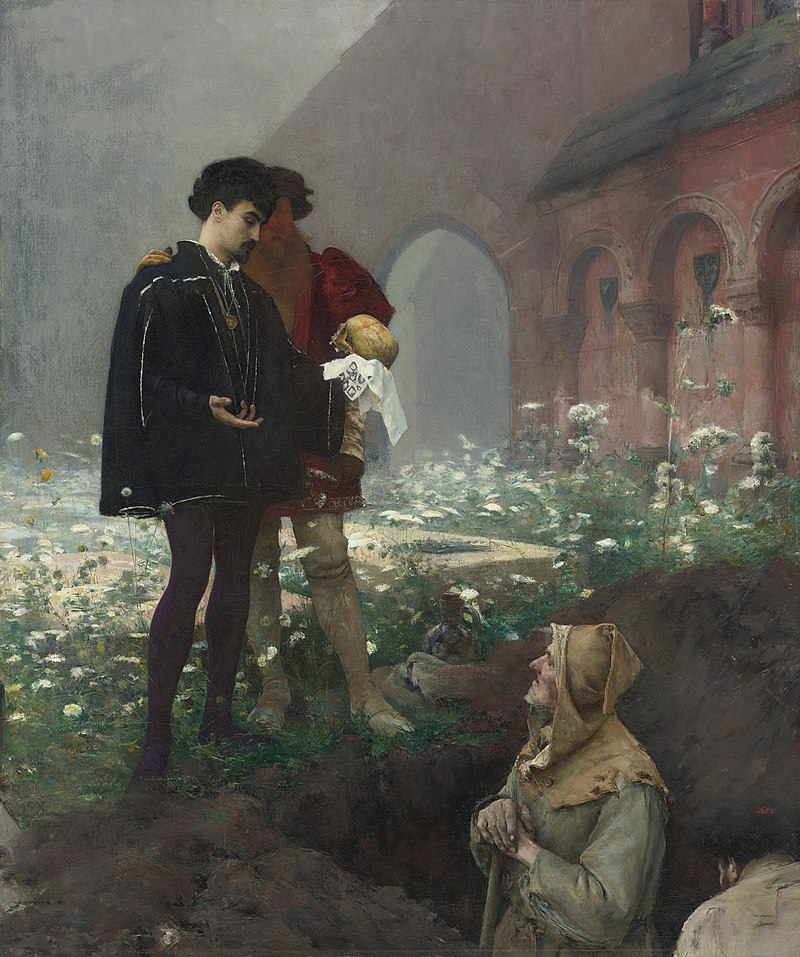
Five Wise Lines from Shakespeare’s Hamlet

We fat all creatures else to fat us and we fat ourselves for maggots… a king may go a progress through the guts of a beggar.”

HamLet to Claudius in Act IV, Sc. 3

One may smile, and smile, and be a villain.

Hamlet to Queen Gertrude in Act I, Sc. 5

I could be bounded in a nutshell and count myself a king of infinite space, were it not that I have bad dreams.

Hamlet to rosencrantz & Guildenstern in Act I, sc. 2

Brevity is the soul of wit.

Polonius to claudius & gertrude in act II, sc. 2

A knavish speech sleeps in a foolish ear.

hamlet to rosencrantz in act IV, Sc. 2

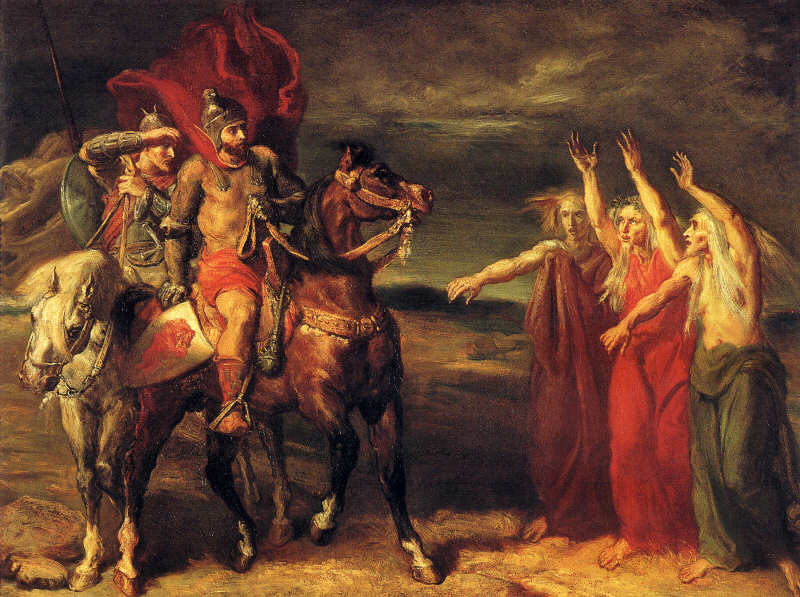
Macbeth Limerick

Macbeth and Banquo Meeting the Witches;
Théodore Chasséria (1855)
There was a great General named Macbeth.
All that kept him from kingship was a death,
but - as with a Pringle -
he couldn't do a single.
So, he showed seven more their last breaths.

BOOK REVIEW: Supernatural Shakespeare by J. Snodgrass

Supernatural Shakespeare: Magic and Ritual in Merry Old EnglandSupernatural Shakespeare: Magic and Ritual in Merry Old England by J. Snodgrass
My rating: 4 of 5 stars

Amazon.in Page

Like – I suspect – most of humanity, I’m a big fan of Shakespeare’s work, but I’m also not alone in feeling that I’ve missed a some of the depth and texture of his plays. Both language and the body of common / popular knowledge have evolved and migrated tremendously since the Elizabethan era. This makes a market for books that offer insight into the age and the role that the beliefs, norms, and daily life played in Shakespeare’s theatrical works. This book is one such work. It focuses on the role supernatural beings and various festivals play in the Shakespearean canon and why they do so.

Conceptions of the supernatural may be one of the areas in which human beliefs have changed most severely since Shakespeare’s day. The book has chapters on witches, ghosts, fairies, and enchanted forests that are interspersed among chapters that deal with various seasonal festivals of Pagan origin. I did find this leapfrogging around a bit odd, but I would speculate two possible reasons for it. First, the author may have wanted to build cyclicality into the overall organization, and thus put beings and creatures that seemed thematically related to a season near its festivals. Second, it may have seemed like a good idea to break up the festivals because that discussion could have felt tedious to a general reader if it’d been clumped together (as opposed to the “sexier” topics of witches and ghosts and the like.) This organization didn’t bother me; it just seemed a bit strange, but I could imagine it being for the best.

I learned a great deal from this book, and my newly gained knowledge wasn’t all about the supernatural elements of Shakespeare. The author dropped some fascinating facts regarding other domains as well – such as Elizabethan sexuality and lifestyles as well as biographical facts about Shakespeare. If you’re looking to expand your understanding of background information relevant to Shakespeare’s plays, this book is worth looking into.

View all my reviews

BOOK REVIEW: Iphigenia in Aulis Adapted by Edward Einhorn [from Euripides]

Iphigenia in Aulis: The Age of Bronze EditionIphigenia in Aulis: The Age of Bronze Edition by Edward Einhorn
My rating: 5 of 5 stars

Amazon.in Page

This illustrated play is an adaptation of Euripides’ drama of the same name. The title character, Iphigenia, is the daughter of King Agememnon and she’s lured to Aulis by her father to be a human sacrifice, but under the fraudulent claim that she’s to be married to Achilles. [Because, you know, people tend to not show up if you invite them to be murdered, but they’re much more amenable if you invite them to marry a hunky half-god.]

It’s a simple and straightforward story, but one that is never-the-less evocative and dramatic. Agememnon’s will to kill his daughter falters for a time and when his wife, Klytemnestra, scores Achilles’ support for the cause of saving her daughter, it’s unclear how things will unfold. It’s a story that encourages one to reflect upon fate and the virtue of sacrifice, while showing that different chains of causality applied to the same event can radically alter the perception of justness. When Iphigenia’s death is seen as the means to get back Helen (who eloped with Paris to Troy,) it’s vile and despicable. However, when it is viewed as the means to get the fleet moving in order to restore the honor of those assembled nations pledged to fight, that’s a different matter.

I found this play to be compelling and well worth reading.


View all my reviews

BOOK REVIEW: The Medea by Euripides [Trans. Gilbert Murray]

The Medea of EuripidesThe Medea of Euripides by Gilbert Murray
My rating: 5 of 5 stars

Amazon.in Page

Project Gutenberg

This tragedy follows up the myth of “The Golden Fleece.” That hero’s journey culminated in three trials which Jason (of Jason and the Argonauts) must complete in order to acquire the golden MacGuffin. Jason succeeds in large part because (arguably, entirely because) Medea, daughter of the fleece’s owner, i.e. King Aeetes, gives Jason some potions to make the trials a cinch. She does this in exchange for Jason’s everlasting love.

And, herein, lies the heart of this play’s conflict. Jason – like many heroes of Greek Mythology – is kind of a jerk. In flashing forward to the beginning of this play, we find Jason has traded Medea in for a younger and higher stature wife (i.e. a princess whose father doesn’t despise and disown her). [Note: Technically, Medea may not be married to Jason because of legalities, but she did bear him two boys.] To add insult to injury, Jason’s new father-in-law (King Creon) insists that Medea and her two boys be exiled, effective immediately.

What makes this play so fascinating is that we have sympathy for Medea’s plight, but then her inner monologue turns to the nuclear option she will employ – killing Jason’s new princess-wife and, more disconcertingly, her own children. Medea goes back and forth about her plan, showing reluctance to kill her boys, at least. So, the reader (viewer) ends up finding Jason loathsome because he steadfastly refuses to accept any blame for how poorly things have gone, but – on the other hand – he’s being more reasonable. (i.e. He talks kindly and isn’t murdering anyone.) It’s a fascinating reflection on the battle between rationality and passion.

I’d highly recommend this play. It’s a short and straightforward story, but it does present a great deal of food-for-thought.


View all my reviews

BOOK REVIEW: Henry VIII by William Shakespeare

King Henry VIIIKing Henry VIII by William Shakespeare
My rating: 5 of 5 stars

Amazon.in Page

This play takes place over a period of time, for want of a better measure, straddling the first two [of six] marriages of Henry VIII. It doesn’t reach the ill-fated end of Anne Boleyn, but rather finishes with the baptism of the girl child she birthed [Elizabeth, who will later be Queen.] [Of course, the failure to produce a male child was the downfall of Katherine of Aragon’s Queenship, so the birth of Elizabeth doesn’t bode well.]

In as much as a history has a theme, this one would be the conflict between the aristocracy and the clergy. This is first, and most extensively, seen through the rise and fall of Cardinal Wolsey, who wins the favor of the King in the Cardinal’s conflict with the Duke of Buckingham, but later Wolsey gets ousted after an aristocratic cabal diverts the Cardinal’s mail to the King. Henry discovers that Wolsey has recommended denial of an annulment of Henry’s marriage to Katherine, despite the fact that Wolsey was telling the King to his face that the marriage’s end had his endorsement. Later, we find aristocrats (the King’s Council) taking on the Archbishop of Canterbury, Cranmer, but Henry sides with the Archbishop as he once had with Wolsey.

The play’s major events are the execution of Buckingham, the divorce from Katherine, the marriage to Anne Boleyn, and the birth of Elizabeth.

This isn’t the most compelling of the Shakespearean histories, but it does have its intrigues. No doubt it would be a bolder play in the absence of the authoritarian nature of monarchy, but it’s still worth reading.

View all my reviews

BOOK REVIEW: Richard III by William Shakespeare

King Richard IIIKing Richard III by William Shakespeare
My rating: 5 of 5 stars

Amazon.in Page

Like Macbeth, this is the story of one man’s unchecked ambition bringing about his ruin. Richard wants to be king. The problem is that his eldest brother (Edward) is already king. The good news for Richard is that Edward is sick. The bad news is that Edward has two sons (and a daughter,) and there’s another elder brother (i.e. Clarence.) While Richard is willing to let nature take its course with Edward, he’ll have to get rid of everyone else between himself and the Crown.

Richard is different from Macbeth in that Richard’s psychopathy is more like that of Iago from “Othello.” Macbeth is conflicted and, though he keeps digging himself deeper, the burden of guilt leads to a descent into madness. Richard is anxious, but it’s not clear that he feels bad about what he’s done (i.e. having his brother’s boys killed, as well as his own brother, his wife, and a number of aristocrats.) When his own mother tells him she wishes she’d strangled him to death with his umbilical cord it rolls off him with the cool detachment one expects of a psychopath. That said, in the last act, he is visited by a series of ghosts. These visitations and his subsequent monologue might give indication that he’s realized how awful he is, but one could also argue that he’s just worried about the precarious state of his kingship.

The hammer drops when Richmond, a nephew of Henry VI, leads forces against Richard. In part, the aforementioned ghosts (which could be interpreted as bad dreams) psychologically do in Richard. (Though the ghosts also visit Richmond with the opposite message, a positive one.) But also, Richmond has proven his leadership skill by forging alliances with the French and the Scots, and turning Lord Stanley (despite Stanley having a son held hostage by Richard.)

While this play not only lacks the character nuance of Macbeth as well as The Scottish Play’s brilliant poetic language, it does have more great lines than the other “War of the Roses” plays (i.e. Henry VI, Pt. I – III.) [e.g. It opens with “Now is the winter of our discontent” and, of course, there’s “A horse! A horse! My kingdom for a horse!”]

This conclusion to the War of the Roses story is well worth reading.

View all my reviews

BOOK REVIEW: The Clouds by Aristophanes

The CloudsThe Clouds by Aristophanes
My rating: 5 of 5 stars

Amazon.in Page

This play scoffs at philosophers and sophists (in general) and Socrates, in particular. An old man, Strepsiades, is beleaguered by creditors, having purchased a horse and chariot for his son, Pheidippides. Strepsiades tries to get Pheidippides to study philosophy because the old man believes it will allow his son to argue away the debt. Pheidippides refuses, and so Strepsiades takes it upon himself to enroll as Socrates’ student. After some strained conversations and ill-timed masturbation, all parties conclude that the old dog can’t learn new tricks, and so Stresiades again tries to recruit his son. This time Pheidippides does join Socrates’ “think-shop” (called “the Thinkery” in some translations.)

Socrates’ characterization isn’t fair to the philosopher in some regards. If the works of Plato and Xenophon hold water, Socrates was neither a know-it-all nor was he obsessed with grandiose topics – rather, he claimed to know little and was said to have been only concerned with questions of how to live a better life (as opposed to lordly enigmas like the origin of the universe or the nature of reality.) However, this isn’t to say that Aristophanes has no valid point. That intense and abstract philosophical debate doesn’t change the hard facts of the world is a legitimate point. Debts aren’t erased by the creditor’s inability to successfully argue niggling points of grammar. Being stabbed by a jilted lover is no less painful if love is an illusion than if it equates to beauty or is a fundamental truth.
Much of the play’s humor is weakened (if not killed) by a lack of common context, but that’s not to say there aren’t jokes that still fly in the 21st century.

This short play is worth reading, as it presents a beneficial counterpoint to the Socratic dialogues.

View all my reviews

BOOK REVIEW: Henry VI, Part 3 by William Shakespeare

King Henry VI, Part 3King Henry VI, Part 3 by William Shakespeare
My rating: 5 of 5 stars

Amazon.in Page

Here we witness a tug-of-war for the British monarchy that plays out to a decisive conclusion (eventually.) It begins with Henry VI as king, but the Duke of York has gained the upper-hand. Henry makes a deal that, upon his death, succession will pass back to the Duke’s line, but not before. The Duke reluctantly agrees, but the deal makes everyone else furious. Margaret (Henry’s Queen) is upset because her son has lost his right to succession. The Duke’s sons are also displeased because they think their father should strike while the iron is hot, rather than risking that Henry’s strength and popularity will rise.

The Queen’s displeasure leads her and Clifford (enemy to the Duke, who killed Clifford’s father) to go on the offensive to reacquire the line of succession. They kill the Duke’s youngest son, a child, and then the Duke, himself. This would strengthen Henry’s position, but fortune doesn’t shine for long on anyone in this play, and soon the Duke’s sons capture Henry and Edward (the Duke’s eldest son) is crowned. But then Edward lusts after the first woman he meets as King, the widow Lady Grey, and being rebuffed in his plan to make Grey his “side piece,” he proposes to her. Unfortunately, Edward has already dispatched the Earl of Warwick to propose to the sister of the French King. This leads to the humiliation of Warwick (not to mention the French King’s sister,) and Warwick (with French troops) goes back and dethrones Edward. This, too, is short-lived. Edward consolidates support, captures Henry, and defeats Warwick. As the play ends it might seem stability has been achieved, but we know Edward’s brother, Richard, has ambitions.

While this one of Shakespeare’s earliest plays and it’s constrained by events, it’s worth a read. It has a lot to say about how arrogance, lust, and timidness can all precede a downfall.

View all my reviews