FIVE WISE LINES [November 2025]

Taken at Fo Guang Shan, near Kaohsiung in Southern Taiwan.

A thing is mighty big when time
and distance cannot shrink it.

Zora Neale hurston; Tell my horse

…if you want to be elected, it is better
to be Mean than to be Funny.

hunter s. thompson; Better than sex

And whosoever shall compel thee to go a mile,
go with him twain.

jesus; Matthew 5:38-40

The only gamblers who will talk openly
are the ones who don’t make money.
The successful ones keep their mouths shut.

Kit chellel; lucky devils

To live a creative life,
we must lose our fear of being wrong.

joseph chilton pearce

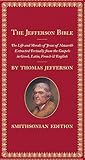
BOOK: “The Jefferson Bible” by Thomas Jefferson

The Jefferson Bible: The Life and Morals of Jesus of NazarethThe Jefferson Bible: The Life and Morals of Jesus of Nazareth by Thomas Jefferson
My rating: 5 of 5 stars

PDF available online [Public Domain]

Thomas Jefferson (yes, the same one who wrote the Declaration of Independence) produced this book by cutting and pasting excerpts from the Gospels so as to produce a distillation of who he believed Jesus was and what Jesus’s essential teachings were. It mixes parables and other New Testament teachings with biographical description.

There is an introduction which offers the reader more specific insight into Jefferson’s thinking than can be gleaned merely from what he includes and what he trims. The Introduction also discusses the similarities and differences between Christian philosophy and that of the Jews, the Greeks, and the Romans.

If you’re looking for a condensed version of the New Testament, I’d highly recommend this book. Jefferson was obviously a sharp guy who looked at the Bible from the perspective of Enlightenment-era thinking.

View all my reviews

“To Tirzah” by William Blake [w/ Audio]

Whate'er is Born of Mortal Birth
Must be consumed with the Earth
To rise from Generation free:
Then what have I to do with thee?

The Sexes sprung from Shame & Pride,
Blow'd in the morn; in evening died;
But Mercy chang'd Death to Sleep;
The Sexes rose to work & weep.

Thou, Mother of my Mortal part,
With cruelty didst mould my Heart,
And with false self-deceiving tears
Didst bind my Nostrils, Eyes, & Ears:

Didst close my Tongue in senseless clay,
And me to Mortal Life betray.
The Death of Jesus set me free:
Then what have I to do with thee?

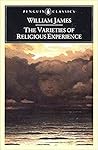
BOOKS: “The Varieties of Religious Experience” by William James

The Varieties of Religious Experience: A Study in Human NatureThe Varieties of Religious Experience: A Study in Human Nature by Dr. William James
My rating: 5 of 5 stars

Project Gutenberg — Free Online

This book is now more than 120 years old and yet is still widely read and is still provoking thought about the nature of religious experiences and how they should be considered by academia. The book is a write-up of a series of twenty lectures that the famous American Philosopher-Psychologist, William James, delivered at the University of Edinburgh in 1901-02.

There are a few things that impressed me about this book. First, James was skilled with language and clever in conveying ideas, resulting in a good bit of quotable material and stimulating ideas.

Second, James’s writings about Eastern practices and philosophies were impressively clear and faithful. In those days, there wasn’t a lot translated from Sanskrit, Pali, etc. and what had been translated was frequently done by outside academicians with no firsthand experience with Eastern systems — e.g. Hinduism or Buddhism. This meant that the writings about Eastern Philosophy and practices from those days were often contorted by a Western / Abrahamic frame in a way that distorted the true nature of those traditions. James seems to have gained at least some of his understanding from someone with enough practical experience to produce accurate descriptions. Furthermore, James avoids spewing myths and misapprehensions by being humble in stating what is merely his understanding. It should be noted that James does write much more about Abrahamic traditions (as one would expect given his direct experience,) but it’s hard to plumb the depths of mysticism without looking to the East where such practices reached such advanced states.

Finally, I was impressed with James’s ability to walk the line of believer and scholar in a way that was fair both to religion and the religious but also to the scientifically-minded rational sceptic. So much of what I read on the subject takes a vitriolic tone of strict opposition and often unfairly depicts the positions of the other side (to be fair, usually this seems to be because the critic doesn’t understand the views of the other side and so produces an interpretation of the opposing ideas conforming to their own worldview, rather than just lying to win.) [As was attributed to James as well as others, “…people think they are thinking when they are merely rearranging their prejudices.”]

I’d highly recommend this book for readers interested in philosophy of religion and the psychology of religious experience.

View all my reviews

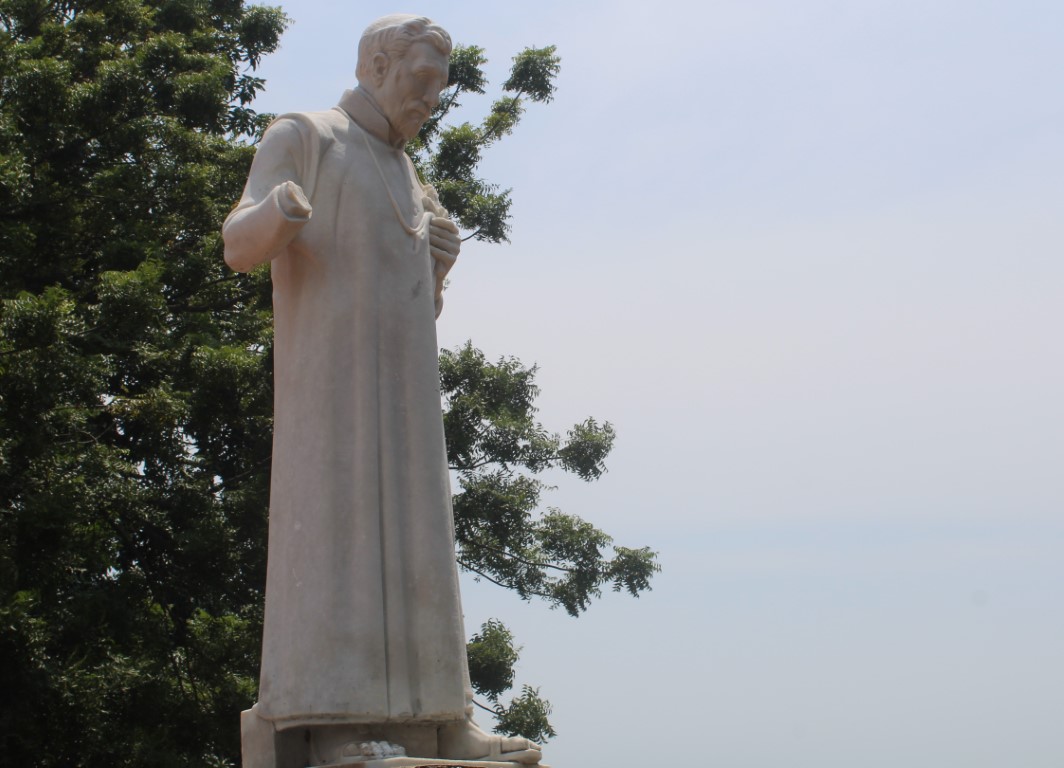
DAILY PHOTO: Church of St. Paul, Malacca

Said to be the oldest European building east of India, these hollowed out ruins represent one of the oldest Christian Churches in Southeast Asia.
This statue of St. Francis Xavier stands in front of St. Paul’s Church. Francis Xavier did have his right hand amputated posthumously, and many like to tell the story that the statue’s hand was sheared off by lightning in an act of divine reckoning (though more likely the movers dropped the statue and the hand broke off. At any rate, that’s why they never got around to having it fixed.)

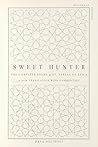
BOOKS: “Sweet Hunter” by Teresa of Avila; Trans. by Dana Delibovi

Sweet Hunter: The Complete Poems of St. Teresa of Ávila (Bilingual Edition)Sweet Hunter: The Complete Poems of St. Teresa of Ávila by St. Teresa
My rating: 4 of 5 stars

Publisher Website

This is a bilingual collection of the poems of Teresa of Avila, one of history’s most influential Christian mystics, newly translated by Dana Delibovi. The collection contains about thirty poems, some ecstatic and some philosophic, in both English the original Spanish.

The book also offers an overall introduction and commentaries on each of the five sections by which the poems are grouped. This provides the reader, particularly a neophyte to the history and theology that inform these poems — such as myself — with background useful to better experiencing the poems. I do enjoy bilingual editions even when they are in a source language that I don’t read because they do allow some insight into rhyme, metering, and other considerations of sound. One can observe to what degree the translator emulates form, even if one remains ignorant of the degree to which meaning is captured.

I enjoyed this collection. If you are interested in the poetry of Christian mystics, I’d recommend you give it a read.

View all my reviews

“The Lamb” by William Blake [w/ Audio]

Little Lamb who made thee
Dost thou know who made thee
Gave thee life & bid thee feed.
By the stream & o'er the mead;
Gave thee clothing of delight,
Softest clothing wooly bright;
Gave thee such a tender voice,
Making all the vales rejoice!
Little Lamb who made thee
Dost thou know who made thee

Little Lamb I'll tell thee,
Little Lamb I'll tell thee!
He is called by thy name,
For he calls himself a Lamb:
He is meek & he is mild,
He became a little child:
I a child & thou a lamb,
We are called by his name.
Little Lamb God bless thee.

BOOKS: “Christianity: A Very Short Introduction” by Linda Woodhead

Christianity: A Very Short IntroductionChristianity: A Very Short Introduction by Linda Woodhead
My rating: 5 of 5 stars

Publisher’s Page OUP

The central idea of this book is that (despite all the complexity of schisms, sects, and subsects) the various entities that call themselves Christian can be put into one of three categories: church, biblical, or mystical. These groups reflect where the adherents see the ultimate source of authority. Church Christians, exemplified by Roman Catholics, view the hierarchy of clergy as the ultimate authority. Biblical Christians, e.g. Baptists, see the Bible as the highest authority. Finally, mystics see the individual’s relationship with (or connection to or oneness with) God to be what matters.

Bookending elaboration upon those three forms of Christianity, there is an opening that discusses early development of the Christian religion and the dividing lines that characterized it (e.g. whether Jesus was man, god, or a bit of both,) and there is a closing chapter about modern Christianity that explores various modern movements, such as: liberal Christianity, Evangelicalism, Fundamentalism, and charismatic Christianity.

If you’re interested in understanding the various permutations of Christianity (past and present,) and how they developed and differentiated themselves, this is a fine introduction to the subject.

View all my reviews

BOOKS: “Teachings of the Christian Mystics” ed. by Andrew Harvey

Teachings of the Christian Mystics (Shambhala Pocket Library)Teachings of the Christian Mystics by Andrew Harvey
My rating: 5 of 5 stars

Acquired at Blossom Bookhouse

This book gathers a collection of short writings (mostly paragraph to a few page excerpts as well as a few poems) on mystic Christianity from the time of the Gospels through the twentieth century. While the bulk of the pieces are (if not from scriptures) the work of clergymen and / or theologians, there are some by individuals known elsewise (e.g. poets William Blake and Gerard Manley Hopkins.) The book is arranged somewhat, but not perfectly, chronologically — enough that all the Biblical excerpts are lumped together at the beginning to form about the first quarter of the selections. While there are a number of one-off contributors, there are several pieces from each of: Gregory of Nyssa, the Desert Fathers, Saint Symeon the New Theologian, Saint Bernard of Clairvaux, Saint Teresa of Avila, and Eckhart von Hochheim.

One nice feature of this book is that it does include selections from a wide range of sources (Roman Catholic, Orthodox Catholic, and Protestant) over a range of time periods, and from scriptures both canonical and “apocryphal.” So, there are many varied ideas of the mystical experience and the path thereto. The flipside of this fact is that there doesn’t seem to be a lot of cohesiveness to the collection. It isn’t always clear why Harvey (the editor) thought a given excerpt was representative of mystic teachings versus of mainstream Christianity. There is a substantial introduction, but otherwise the selections are left to speak for themselves.

Still, it was a quick read, dense with insights, and I found — particularly some of the scriptural selections — to be among the most profound statements of Christian philosophy that I’ve seen.

View all my reviews

The Second Coming by W. B. Yeats [w/ Audio]

Turning and turning in the widening gyre
   The falcon cannot hear the falconer;
 Things fall apart; the centre cannot hold;
   Mere anarchy is loosed upon the world,
 The blood-dimmed tide is loosed, and everywhere
   The ceremony of innocence is drowned;
 The best lack all conviction, while the worst
   Are full of passionate intensity.

Surely some revelation is at hand;
   Surely the Second Coming is at hand.
 The Second Coming! Hardly are those words out
   When a vast image out of Spiritus Mundi
 Troubles my sight: somewhere in sands of the desert
   A shape with lion body and the head of a man,
 A gaze blank and pitiless as the sun,
   Is moving its slow thighs, while all about it
 Reel shadows of the indignant desert birds.
   The darkness drops again; but now I know
 That twenty centuries of stony sleep
   Were vexed to nightmare by a rocking cradle,
 And what rough beast, its hour come round at last,
   Slouches toward Bethlehem to be born?