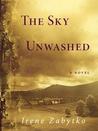
BOOK REVIEW: The Sky Unwashed by Irene Zabytko

The Sky UnwashedThe Sky Unwashed by Irene Zabytko

My rating: 4 of 5 stars

Amazon page

The Sky Unwashed is a character-driven novel, telling the story of an elderly pensioner residing a few miles from the ill-fated Chernobyl nuclear plant. The protagonist’s name is Marusia, and she lives with her beaten-down son Yurko, his cheating wife Zosia, and the dysfunctional couple’s children (her grandchildren.)

The first part of the novel is a bit of a slog, though the character portraits of the adult family members may be enough to keep one intrigued if one enjoys being pulled into a dysfunctional Ukrainian village household. (The first part is a bit like “Jerry Springer—Ukraine Edition.”) Zosia’s unfaithfulness provides the main source of tension, but that tension is a quiet one between Marusia and Zosia. Yurko knows about his wife’s infidelity, but doesn’t seem to care–or doesn’t seem to be able to muster the energy to make the appearance of caring. Marusia, on the other hand, is the doting mother who feels that her doofus son could do better, but she bites her lip as she doesn’t feel it’s her place.

It’s the Chernobyl meltdown that kicks the novel into interesting territory. One is shown how tragedy can bring out the best and worst in people. Both Yurko and Zosia have jobs at the plant, but it’s Yurko who’s working when the incident occurs, and it’s he who gets a dose of radiation that will prove lingeringly fatal. Interestingly, the reader isn’t taken into the plant often. We don’t see Yurko fighting the fires, but rather we see the family in the village Starylis. We experience the family first noticing Yurko’s failure to return and then becoming increasingly concerned. We see the family noticing the subtle signs of something gone awry—like air that tastes of pennies.

Starylis’s occupants—including Marusia’s family–are eventually evacuated to Kiev. It’s here that we see how events press the once hostile family together before ultimately tearing them apart. The Zosia we found unpalatable in the first part is now seen in more sympathetic terms. We see her at her best and her worst, and we see that in sum she is a survivor. Her behavior, good and bad, is committed saving the remainder of her family—which is her children.

The truly visceral part of the novel is reached when Marusia opts to move back to Starylis, despite the fact that it’s abandoned. At first, the elderly woman is completely alone. It’s the eerie loneliness of an abandoned place that one once knew as a thriving community. Even the livestock Marusia left behind is long gone. Her daily ritual includes ringing the church bells to let any other stragglers know they aren’t alone. Eventually, she befriends a cat gone feral, and shortly thereafter others begin to trickle back to the village—virtually all of them women.

In retrospect it seems the author might not have been comfortable writing male characters. The only male character of note is Yurko, and he’s by far the most flat of the major characters—that’s probably on purpose and it feels true enough. The only other male character we get to know in any detail is quickly killed off. Given all the male-dominated works of literature, this isn’t necessarily a complaint or a problem—just an observation.

I’d recommend this book for the patient. If you need a hard and fast hook to keep you engaged, you’ll have trouble with this book. However, once one gets into the parts set in Kiev and the abandoned Starylis, you’ll find the book intensely engaging.

View all my reviews

BOOK REVIEW: Faster, Higher, Stronger by Mark McClusky

Faster, Higher, Stronger: How Sports Science Is Creating a New Generation of Superathletes—and What We Can Learn from ThemFaster, Higher, Stronger: How Sports Science Is Creating a New Generation of Superathletes—and What We Can Learn from Them by Mark McClusky

My rating: 4 of 5 stars

Amazon page

McClusky’s book tells us how advances in sports science and technology are producing a new class of elite athlete. More usefully, it discusses which practices of high-level athletes can reasonably be emulated by amateurs. One may think that what’s good for the goose is good for the gander. In this case, not so much. If shaving a hundredth of a second off your time isn’t going to affect your life’s course, there are many activities of elite athletes that simply aren’t worth the cost (in whatever terms.) For example, the loss of friendships due to rampant flatulence resulting from consuming large quantities of baking soda isn’t worth it if you just want a little bit stronger Sunday cycling ride. (Baking soda [sodium bicarbonate] counteracts blood and muscle acidification during exercise and makes it possible to keep moving strongly when fatigued would normally degrade performance. Incidentally, this practice has been shown to be effective only for events that last between one and seven minutes.) On the other hand, some of the lessons of sports science are relatively low-cost and high benefit, and might be just what one is looking for to improve one’s performance. (e.g. Replacing a pre-workout stretching routine with one of rolling out the muscles.)

Faster, Higher, Stronger consists of twelve chapters, each addressing a different aspect of the application of science and technology to sport, including: training methods, genetics, nutrition, recruitment, practice, performance enhancing substances (legal and illegal), elevation training, and the limits of performance.

One question that has always been of great interest is how much of a top athlete comes from his or her genes? In other words, can anyone can do it–given a willingness to work like a maniac of course. As with many other questions about heredity, it was once thought that there would be a precise answer to this question in the wake of the decoding of the human genome. However, the success of the human genome project showed only that the situation was vastly more complex than we’d imagined. It turns out that having certain genes isn’t the end of the story because there are many factors that influence which genes are expressed. Attempts have been made to put numbers to the influence of genetics. For example, one scientist is quoted as claiming that 50% of oxygen processing capability (i.e. VO2 max) is heritable. This translates to the fact that, while the average Joe has a reasonable chance of engaging in athletics at some level, only a 0.1 to 0.3 % can summit the pinnacle of elite level athletics.

In many ways, science has encouraged coaches, trainers, and recruiters to think outside the box—and to look beyond the traditionally engrained approaches. One fascinating story was that of how the British national rowing team held tryouts based only on height, with experience with the sport being not required. They ended up with a champion rower who’d first entered a boat only four years before. This is part of the evidence that controverts the once popular 10,000 hour rule that was popularized by Malcolm Gladwell–though Anders Ericsson is more properly considered the father of the idea. It turns out that 10,000 hours of practice aren’t required for most activities if one goes about it right.

McClusky spends a considerable amount of space on the questions of what athletes should and shouldn’t consume. In emulating elite athletes many amateurs are working at cross purposes. This is readily seen with the issue of sports drinks. If you’re guzzling down a Gatorade or snacking on Cliff Bars after your run, you may only be ensuring that you continue to gain weight despite working out. On the other hand, you may decide that chocolate milk or beet juice are good choices for you.

I’d recommend this book for those interested in the heights of human performance.

View all my reviews

BOOK REVIEW: What If? by Randall Munroe

What If?: Serious Scientific Answers to Absurd Hypothetical QuestionsWhat If?: Serious Scientific Answers to Absurd Hypothetical Questions by Randall Munroe

My rating: 5 of 5 stars

Amazon page

If you like the tv show Mythbusters and snarky and / or silly humor, you’ll love Randall Munroe’s What If?: Serious Scientific Answers to Absurd Hypothetical Questions. Munroe gained internet fame (still not the same as real fame) drawing the popular webcomic xkcd. The book’s subtitle says it all. Munroe solicited questions from his web-legion (not the same as a real legion) of fans, selected a collection that he found intriguing, and answers them with a mix of science and humor. Munroe’s bona fides to answer questions of a technical nature include a degree in physics from Christopher Newport University and a brief career as a roboticist for NASA—though he’s fond of pointing out that he’s just a web-cartoonist whenever his answers might be wrong.

Each chapter presents a detailed answer to one of the absurd hypothetical questions. Most of the chapters are just a few pages long and feature the same variety of stick-figure cartoon that grace the xkcd website. He covers 60-ish questions in the book. Scattered throughout the book are sections called “Weird (and Worrying) Questions” which usually don’t receive answers but merely cartoons that mock the demented mind that came up with said question. (If that seems harsh, keep in mind that many of the questions he does answer are pretty warped (e.g. setting off a nuke in a hurricane or whether steady rising would result in death by freezing or suffocation).)

Like the Mythbusters, Munroe does an excellent job of selecting questions that have unexpected answers. For example, the author addresses the question of what would happen if one went swimming in a spent fuel pool (nuclear fuel rods are stored underwater for a long time after they come out of the reactor before they can go to dry storage.) The answer: Nothing if one swam near the surface, but if you swam down and touched the casks, you’d die in minutes. Munroe also takes liberty to find the more interesting unintended consequences embedded in some of the questions. For example, he dismissively answers the old question about whether every human on the planet standing as close together as possible and jumping so as to land simultaneously would have any effect on the planet. Instead, he takes on the questions of the logistics of getting everyone to one place, how much space humanity would take up, and how / whether people could get out of this state of shoulder-to-shoulder proximity alive.

Some of the questions are impossible to answer with certainty but Munroe takes them on when he can offer reasonable, scientifically-based speculation. For example, what will the area that is currently New York City look like in a million years? His answer is more or less: Who cares? Humans will be long gone and veins of plastic in past landfills will be the only evidence that we ever existed. Another such question is how much power can Yoda achieve through application of the Force?

Besides the many physics question (e.g. What’s the fastest speed at which one can hit a speed bump and live?), there are others that involve mathematics, chemistry, and biology. Mathematics questions include calculations of the likelihood that one would find his or her soulmate if each person really only had one soul mate. (My Indian friends might be pleased to know that we’d all be screwed if that were the case.) There are actually many questions that hinge on mathematical calculations.

One of my favorite chapters is in the domain of chemistry, and it answers what would happen if one tried to make a wall by collecting together blocks of all of the elements in the periodic table in the relative position in which they exist on the table? Answer: Nothing good. There are a few biologically centered questions as well. Munroe takes on the question of how much computing power human brains collectively have—and the more interesting unasked question of how human “computing” is different from that of machines.

I’d highly recommend this book for science lovers. In fact, even people who don’t care for science may find this book palatable because of its humor and the fascinating questions it addresses.

View all my reviews

BOOK REVIEW: A Tale for the Time Being by Ruth Ozeki

A Tale for the Time BeingA Tale for the Time Being by Ruth Ozeki

My rating: 5 of 5 stars

Amazon page

A struggling novelist named Ruth finds a watertight package containing a Hello Kitty lunchbox washed ashore on an island off the coast of British Columbia. Ruth’s initial assumption is that it’s debris from the March 11, 2011 tsunami that scoured a large swath of coastal eastern Japan out to sea. However, her husband, Oliver, who has more expertise in these matters, tells her that it’s unlikely that the box could cross the Pacific so quickly and that it would be jettisoned out of the currents that consolidate plastic rubbish into large debris fields like the Great Pacific Garbage Patch. When the lunch box’s contents turn out to include a teenage girl’s journal and a number of letters, it seems as though the mystery might be solvable.

The journal is written by a Japanese girl in turmoil named Nao. Nao grew up in American, her father working for a Silicon Valley computer firm until he lost his job. A major factor in Nao’s depression is that she has to return to her ethnic homeland of Japan as a stranger. Her formative years were spent in America, and she is out-of-place in Japan and—as a result—she falls victim to vicious bullying. Furthermore, her father is unable to find a job in Japan and becomes suicidal. The household has to tighten its proverbial belt because Nao’s father, Haruki #2, isn’t working and Nao’s mother has limited earning potential. (FYI: the “#2” refers to the fact that Nao’s father had an uncle for whom he was named who’d been a scholar forced to serve in a kami kaze squad during the war.)

Nao also becomes suicidal, but she is firm in her conviction that she will not fail like her father has done on two occasions. There’s one thing that she must do first and that’s to pen the story of her great-grandmother Jiko. Jiko is a centenarian Buddhist nun and the family matriarch on Nao’s father’s side of the family. Nao stays a summer with Jiko, and the old nun in all her wisdom becomes an anchor in the girl’s tumultuous life. With a level of narcissism appropriate to a teenager, Nao ends up telling us a story that’s more autobiographical than an account of Old Jiko.

A Tale for the Time Being interweaves two storylines. One line is Nao’s journal entries and letters from the lunchbox. The other line is Ruth’s journey as she reads the journal and becomes obsessed with discovering more about Nao and her family members. Eventually, Ruth’s investigation turns up information about Haruki #1 and Haruki #2 that Nao apparently didn’t know, and that both Ruth and the reader hope the girl will learn. Nao comes to idolize Haruki #1 in part because he was committed to his fate as a kami kaze. It’s not that she believed in the kami kaze objective (she identifies more as American than Japanese), but she sees Haruki #1’s commitment in contrast to her father’s behavior. Nao’s myth about her great-uncle turns him into a counterpoint to the father that she loves but thinks a pathetic loser. In a way, this novel is a cautionary tale about drawing conclusions about the virtues and vices of others without knowing their whole story.

Ozeki does a great job of creating characters multi-dimensional enough for us to become intrigued by. Just as Ozeki has her same-named secondary protagonist, Ruth, sitting on the edge of the seat wanting to find out what happened to Nao and her family, we—too–are pulled into that mystery. The challenging approach of weaving Ruth’s story into the journal’s contents works well.

Ozeki hints that there may be something supernatural about the world in which her characters inhabit. There’s a member of a species of crow that shouldn’t be on the American side of the Pacific who shows up at about the same time as the lunch box. Also, we can’t tell whether some of Nao’s stories are the wishful delusions of a tormented girl or whether they reflect some kind of subtle magic. It’s a similar approach to that of other literary fiction authors such as Haruki Murakami.

I’d recommend this novel. It’s gripping and readable.

View all my reviews

BOOK REVIEW: After Dark by Haruki Murakami

After DarkAfter Dark by Haruki Murakami

My rating: 5 of 5 stars

Amazon page

[Note to readers unfamiliar with Tokyo: There are a couple of facts about the city that one must understand for this book to make sense. First, while Tokyo is a city that’s always moving, the trains don’t run between roughly midnight and five am (your results may vary by station.) Second, because many people live far out in the suburbs and the cost of living is high, taxis aren’t an option for much of the population. These two facts add up to a slew of business for those industries that cater to the population caught out “after dark” (i.e. after the trains stop running–not after sundown) including: all-night diners, love hotels, c-stores, bars, pachinko parlors, bowling alleys, and manga bookstores.]

This novel takes place in Tokyo during the wee hours of a single night. Murakami satisfies a form of voyeuristic impulse by giving us a peek into the lives of a few of the people out and about while the masses are home slumbering, or—at least–whiling away insomnia-ridden hours in the privacy of their own homes.

The protagonist is a young college student named Mari. As she sits in a 24-hour Denny’s reading, Mari immediately triggers curiosity. She isn’t typical of the disheveled, boozy, or garish crowd out “after dark.” In a post-witching hour world of drunken salaryman, micro-miniskirted hostesses, tattooed yakuza gangsters, and nightlife-savvy travelers, the bookish young woman stands out. We soon learn that Mari didn’t miss the last train on accident, but rather is staying out all night on purpose to be out of the house. This further raises the level of intrigue.

In the Denny’s, Mari is approached by a gregarious young man named Takahashi who is grabbing a quick snack before going back to his nighttime hobby of jamming in a jazz band. Takahashi introduces himself as someone who already knows Mari from a party. He’s a couple years older than the young woman, and was a classmate of Mari’s sister, Eri. The party at which he met Mari was mostly attended by kids the age of Eri and himself, and Mari was just along for the ride with her more popular sister.

Eri is another major character in the book, although her mysterious presence is mostly in a sleeping state. Eri, unlike the plain Mari, is drop dead gorgeous, and has been doing modeling jobs since she was a child. Takahashi is but one of the young men infatuated with Eri—though we get the feeling that Takahashi realizes that Eri isn’t in his league. He’s a pragmatist—if begrudgingly so. The rest of the book hinges on this chance encounter between Mari and Takahashi.

Suspicions that the grim hours of circadian disruption are the domain of crime and vice are confirmed when a bulky former female wrestler turned love hotel manager, named Kaoru, rushes into the Denny’s seeking Mari. Kaoru is an acquaintance of Takahashi (who has since left the diner to play jazz) and she is seeking Mari because Takahashi told her that Mari spoke fluent Chinese. A Chinese prostitute was beaten up at the love hotel, the Alphaville, and Kaoru needs to talk to the foreign woman to get to the bottom of the matter. Kaoru’s investigation is in part driven by the fact that the Chinese hooker’s John dashed on the hotel bill, but the former wrestler also has a soft spot for the beaten girl and wants to do the right thing by her—though Kaoru knows the police can’t be involved because the Chinese working girl will, at a minimum, be deported by the authorities, or, worse, be punished by the Chinese mafia who pimp her.

As with a few of Murakami’s other books, this book might be labeled “slipstream.” Slipstream is a genre that blends mainstream literary fiction with supernatural elements / speculative fiction. However, the scenes that aren’t realist generally involve the sleeping Eri in her room by herself. So, it may be that Murakami is just conveying the hazy and illusory world of sleep and life at the edge of sleep. I’ll leave it to the reader to make their own interpretations of this. There are also coincidences that could strain credulity, but this may just be an attempt to convey that the world of Tokyo “after dark” is a small pond.

I’d highly recommend this novel. Murakami gives us likable characters and one can see why said characters are draw to each other despite their very different existences. Then he puts them into situations that demand resolution. It’s a short, readable, and interesting novel.

View all my reviews

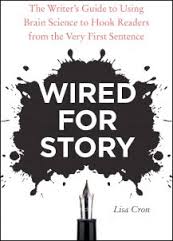
BOOK REVIEW: Wired for Story by Lisa Cron

Wired for Story: The Writer's Guide to Using Brain Science to Hook Readers from the Very First SentenceWired for Story: The Writer’s Guide to Using Brain Science to Hook Readers from the Very First Sentence by Lisa Cron

My rating: 5 of 5 stars

Amazon page

There are countless books offering advice to writers. Some are good. Some are not. Good, bad, or ugly, few of these books offer anything new beyond particularly artful (e.g. humorous or poetic) explanations or superior examples. In other words, if you’ve read five writer’s guides you’ve read five thousand. Cron’s book is the rare guide worth a read even if you’ve read a hundred other such books. It’s not that Wired for Story offers radical or novel advice on story building (its writer’s tips are orthodox.) It’s the way this book couches the arguments for what can admittedly be hackneyed advice. As the title suggests, Cron’s book is about how our brains are wired to love stories–as long as said stories contain certain attributes that the brain finds appealing. (Conversely, there’s a reason why books that go wildly off the reservation with “experimentalism” are doomed.)

While I’ve read many a book on writing, I picked up Wired for Story more out of an interest in the subject of the neuroscience of story. The book doesn’t delve deeply into the science, but it does cite leading thinkers in the field as well as providing a good layman’s overview of the neuroscientific principles that inform the book’s tips. Cron’s background is in publishing and her bona fides to write this book are as someone who came from a career reading and rejecting / accepting manuscripts. However, I believe she did a good job of laying out science.

The central idea is that humans love stories because the narrative structure allows people to simulate a nasty chain of problems without suffering the real world consequences. The brain loathes uncertainty and randomness, and loves whenever it can learn about how to face a problem or make sense of the world. This is why we love conflict, tension, and an unrelenting unfolding of worst case scenarios in our stories even though we tend to hate those characteristics in our own lives. This results in both the tried advice to keep putting the protagonist through the wringer, and the qualifications that a writer should do so in a way that is believable (our brain’s BS-detector is ever on) and which will eventually force the protagonist to change. Cron offers a definition of story that has the usual elements: “A story is how what happens affects someone who is trying to achieve what turns out to be a difficult goal, and how he or she changes as a result.” As with many guides, the definitions of plot, the protagonist’s issue / goal, theme, and tone are elaborated at length—as well as being differentiated because these topics tend to be confused by neophytes—often resulting in a failure to clarify one or more of them.

Stories also give us an opportunity to anticipate what others will do, and forecasting the behavior of others gives one a nice little dopamine dump. The ability to foresee what others will do has always been a powerful evolutionary advantage, and those who did it better passed on their genes more than their oblivious counterparts. Owing to this idea, there is a great deal of advice about what should be in the book (only what is relevant), and how it should be revealed (in a way that eschews attempts to play “gotcha” with your readers.)

One may wonder why I’m so pleased with a writer’s guide that gives common advice about writing–just because it explains said tips in terms of evolutionary biology. The answer is that it’s far easier to keep these lessons in mind when they’re held together by a logic rooted in what all readers have in common (e.g. conscious and unconscious minds, emotions, instinctual drives, etc.) For example, knowing why readers hate an overly simple resolution for a problem that’s presented as insoluble (i.e. robbing them of dopamine reward for figuring it out) helps one better recognize this pitfall in all its forms and to avoid it. Such an approach allows for a deductive approach and is far more useful than having memorized “avoid deus ex machina” as a disparate tip that’s attached to a specific example. In short, it’s both easier to remember and broadly implement these ideas when one understands the rationale from the ground up.

Beyond the reason in the last paragraph, I enjoyed this book for reasons that have little to do with its advice to writers. While I now know that there are other books on the evolutionary biology of story that deal with the subject more from a scientific perspective (while I haven’t read it yet, you might try this book), this was the first book that I stumbled across on that topic. And, it’s a topic that’s well worth understanding whether you’re a writer or not. No matter what one does, understanding the universal appeal of a story can be beneficial, whether it’s in the context of teaching, parenting, or business.

I’d recommend this book for writers—particularly those who think about the world in scientific terms. Beyond writers, if you have cause to construct or use stories in your life—or suspect you should—you can benefit from this book.

View all my reviews

BOOK REVIEW: Crow with No Mouth: Ikkyu Translated by Stephen Berg

Crow With No Mouth : Ikkyu : Fifteenth Century Zen MasterCrow With No Mouth : Ikkyu : Fifteenth Century Zen Master by Ikkyu

My rating: 5 of 5 stars

Amazon page

Ikkyū Sōjun was the Howard Stern of Zen masters. Born in 1394, he lived through most of the 15th century. Ikkyū served as a temple’s abbot for less than two weeks before he quit in disgust, vowing to move into a red-light district—apparently he wanted to live among people he found more honest and less hypocritical. The Zen master despised the corruption and snobbery of monastic politics.

Crow with no Mouth is a collection of Ikkyū’s verse, which is largely in the Zen tradition–featuring natural subjects and simple wisdom in a sparse style. Of course, as per my comments in the preceding paragraph, there are a few poems on topics such as cunnilingus and debauchery—so it’s not what one would call a child-friendly collection (unless one enjoys explaining the sexual exploits of a lecherous monk to one’s child.) The more explicit poems may seem like a diversion from the Zen path, but perhaps not. Maybe Ikkyū offered them as a way to train the mind, to observe one’s reaction to shocking commentary as a means of changing one’s way of thinking.

A few of my favorite lines of a more traditional nature include:

-“you can’t make cherry blossoms by tearing off petals to plant; only spring does that”

-“sometimes all I am is dark emptiness; I can’t hide in the sleeves of my own robes”

-“it’s logical: if you’re not going anywhere any road is the right one”

-“the edges of the sword are life and death; no one knows which is which”

-“even in its scabbard my sword sees you”

-“a flower held up twirled between human fingers; a smile barely visible”

-“in war there’s no time to teach or learn Zen; carry a strong stick; bash your attackers”

Here are a few of those jarring lines that I mentioned above:

-“that stone Buddha deserves all the bird shit it gets”

-“all koans just lead you on but not the delicious pussy of the young girls I go down on”

-“ten fussy days running this temple all red tape; look me up if you want o in the bar whorehouse fish market”

-“my dying teacher could not wipe himself; unlike you disciples who use bamboo; I cleaned his lovely ass with my bare hands”

-“don’t hesitate get laid that’s wisdom; sitting around chanting, what crap”

-“who teaches truth? good/bad the wrong way; Crazy Cloud knows the taste of his own shit” [Crazy Cloud was Ikkyū’s name for himself.]

When he left the monastery, Ikkyū shredded the certificate that served as his monastic credential. Some of his students found it, and pieced it back together. That led to the following verse:

-“one of you saved my satori paper I know it piece by piece; you pasted it back together; now watch me burn it once and for all”

Ikkyū’s verse asks us to reevaluate what it means to be sacred or profane. The orthodox view would be that Ikkyū fell from the sacred life of a monk. However, Ikkyū tells us that one can degrade what is important by raising the wrong things to sacred status. Conversely, some of what we believe to be profane is just rooted in habitual and ill-reasoned ways of thinking.

I’d recommend this work for those who love the spare form of Japanese poetry, and who don’t mind a hard jolt to their psyche occasionally.

View all my reviews

BOOK REVIEW: Becoming Batman by E. Paul Zehr

Becoming Batman: The Possibility of a SuperheroBecoming Batman: The Possibility of a Superhero by E. Paul Zehr

My rating: 5 of 5 stars

Amazon page

[Note: This book is about sport and exercise science, particularly as they pertain to the martial arts. If you’re a martial artist or are interested in fitness and movement arts at the extremes of human capacity, you’re in the right place. If you’re interested in the comics and an overview of topics including how many billions Bruce Wayne needs and what technologies Batman must master, those aren’t questions addressed in this book. Such readers may find the book delving into depths they aren’t interested in on biological science. There are articles on the web that deal with topics like the “Cost of being Batman.”]

Next summer an eagerly awaited movie entitled Batman v Superman: Dawn of Justice hits theaters. Who knows how much screen time will involve the fight between the titular characters, but the same battle has played out a number of times in the comics, and its appeal is clear. What are the limits of human capability given training, technology, and sufficient smarts? Can a man really defeat an alien that’s faster than a bullet and more powerful than a locomotive? A popular fanboy mantra is, “I like Batman, because I could be Batman. Batman has no superpowers.” So, yes, if you were a billionaire, genius, with the physique of a Greek god, and knew 127 martial arts, you too could be Batman. Or could you? That question is at the heart of Zehr’s book.

Becoming Batman is arranged into sixteen chapters divided among five parts. It begins logically with the question of whether Bruce Wayne needs to begin at any particular point to achieve success in transforming himself into Batman? (At the extreme, one probably can’t imagine Bruce Wayne becoming Batman if he was born with one leg a foot longer than the other and with a Quasimodo hump, but given a Bruce who is starting out “average,” what are his limitations.) In other words, how much does genetics come into play. In the first part, Zehr introduces a character, Bob Wayne, who doesn’t appear in the comics. Bob is Bruce’s twin, and is used throughout the book for comparison purposes, i.e. to convey what Bruce Wayne would look like if he didn’t train fanatically to be Batman. The question of how much of Batman is innate and how much is painstaking built by exercise and training is critical to determining how many of those fanboys really could be Batman.

There a series of chapters explaining the mechanism by which stressors result in a stronger, faster, more powerful, and more resilient Batman. The idea is that Mother Nature doesn’t over-engineer. The only way one gets stronger muscles is by overloading them, which triggers a process of rebuilding them bigger and better than before. Wolff’s Law defines the same concept for bones, i.e. bone density increases in response to increased loading. (Incidentally, the same is true of the mind. A more agile mind is achieved only by working it, and zoning out in front of the television results in a dumbening.)

The next section shifts from generic exercise science to questions of Batman’s martial arts training. What kind of martial arts (or arts) would Batman practice? There is an often quoted statement in the comics to the effect that Batman had mastered 127 martial arts. (This is ridiculous, but it does spur the intriguing question of how many systems does Batman need to learn to have a well-rounded skill-base without being a dabbler? Many will say one art—the right one–is enough, others will say that–given the varied cast of villains he must defeat–Batman needs a broader skill-set than any existing art provides.) More to the point, how many hours does one need to practice a technique to ingrain the movements into one (e.g. neurologically it takes repetition to optimize efficiency.) This is among the questions discussed in this book.

The fourth section deals with the ravages of being Batman, and how much any human could be expected to endure. In this section, one will learn about the cumulative toll of concussions, the likelihood of Batman avoiding broken bones and other injuries that would necessarily sideline his crime fighting, and the effect that working the night shift would have. (The latter might seem trivial in comparison to the former two topics, but—in fact—it’s not. It’s well established that night workers have higher incidence of some cancers and other ailments. Furthermore, as Bruce Wayne has to keep appearances up, it means not only fighting circadian rhythm issues, but also frequent sleep deprivation—the hazards of which are even clearer and occur in short order.)

There are a number of interesting topic that aren’t don’t pertain to the core question per se, but which are interesting for fans of the Batman canon and the character’s mythos. Famously, Batman doesn’t use guns or lethal force. This raises the question of how realistic it is to regularly fight hardened knaves and miscreants without killing them. One can only knock out so many of Gotham’s baddies before one doesn’t get up.

There’s a chapter about what a fight between Batman and Batgirl would be like. While strength would definitely be to Batman’s advantage, there are advantages that an equally skilled female fighter might bring to the fight? How would Batgirl (or Catwoman) need to fight to put those advantages to use? Finally, for those of us who are no longer spring chicks, there are chapters about how Batman could expect to age, and how long he could keep performing at a level at which he could defeat his enemies.

I enjoyed this book and found it both educational and interesting. It should be clear that Batman is just a teaching tool used to explore the limitations of the human body and its ability to endure a life of fighting. That said, references to the Batman comic books and movies makes for a readable text. Perhaps what I like most about this book is that most of the books that address these subjects are textbooks that are sold on the textbook pricing model (i.e. we have a limited but captive audience so let’s make them pay top dollar.) This is one of the few books that takes on these topics at the readability and pricing model of a popular science book.

I recommend it for those interested in the science of performance, martial arts, and injury.

View all my reviews

READING REVIEW: April 24, 2015

I completed three books this week. The first was Richard Wiseman’s Night School. I wrote a lot about this book in my last Reading Report. Night School examines what happens when we sleep, what happens when we don’t, and a host of events that happen in and around our sleeping life (i.e. nightmares, night terrors, sleep walking, etc.)  The notion that dreams and nightmares are our subconscious working out waking life problems is well established, but there was some interesting discussion of how to change one’s dreamscape (i.e. lucid dreaming) that was fascinating.

NightSchool


The second book I finished was Sam Harris’s Free Will. I had high hopes for this book, but they didn’t pan out.   It’s a very short book (less than 100 pages) on the subject of free will–or the lack thereof. There’s a well-established scientific literature supporting the notion that free will is an illusion. This conclusion was reached by observing that subconscious parts of the brain involved with decision-making light up well in advance of the conscious parts of the brain. The most illuminating example offered is an experiment in which participants were asked to press a button to select a letter or number of their choosing from among a string of rotating letters / numbers. Some subjects became convinced that the scientists had mastered precognition (a class III impossibility according to physicists–i.e. impossible according to the laws of physics as we know them.)  What was really happening was an exploitation of the lag between when the individual’s subconscious decided and when they became aware of their decision.

While I’m normally a big fan of brevity, Harris could have put some more pages to good use. First, he barely mentions a couple of the neuroscience experiments, and expects that the reader will treat this all as law. That is, we are to accept that always and everywhere people’s subconscious minds decide some measure before their conscious minds. Harris also scoffs at the suggestion that perhaps the conscious can overrule the subconscious. He seems to deem this as not worthy of study because it would just be the subconscious making a second decision. So we learn about a couple of studies in which a.) the decision-maker has no stake in the decision (is it possible the mind treats decisions about picking a spouse or a house differently than picking a letter or number in which there is no more costly outcome?) b.) those studied are a random sample of individuals who have no particular expertise with their minds. (If I drew a random sample of people and asked each to lift 300 lbs over his or her head. If no one could do it, would I be safe in concluding that lifting 300 lbs was something forever beyond the capacity of every member of the human race? In other words, what if exercising conscious control over decision-making requires training and expertise with the mind.) Maybe all of this has been studied (e.g. high stakes cases and cases with monks and meditators), and we can safely conclude that free will is always and everywhere an illusion–but Harris didn’t make this point. He concludes we will take it as a given just as he has. (Much like he suggests that anyone who truly studied their mind would understand this point already. Would it surprise Mr. Harris to learn that there are people who have spent far longer alone with their minds than he, who have concluded quite the opposite?)

Second, if the conscious mind is just a Matrix Revolutions-style (and Rube Goldberg-style) machine for tricking us into thinking we have choice and control over the direction of our lives (what happened to evolution not over-engineering?), what guides all of these “decisions?” Given that they produce, I might point out, a fairly orderly world. Harris doesn’t answer this. One might guess that he would point to Dawkinesque suggestion that it’s all about genes advancing their own agenda. (A proposition that seems to me has trouble explaining a corporeal who throws himself on a grenade to save his comrades.) I shouldn’t put words in the author’s mouth. Quite frankly, I have no idea whether he believes there are rules or some guide to these subconscious decisions, because he doesn’t tell us. (Maybe he thinks they are random neuronal firings, but I doubt it.) From what I’ve heard of his other books, he doesn’t think it’s a god making these decisions–a sentiment I share. However, there must be something underlying these decisions, and an author writing about this topic should at least make some effort to address it. Black boxes aren’t persuasive.

FreeWill


The final book I finished this week is entitled The Sensual Body. This is a book that discusses a number of systems of movement and bodily activity as means to increase bodily awareness. Among the systems included are Tai chi, Eutony, Kum Nye, running, Aikido, and massage. It’s an interesting overview, but without sufficient detail of anything in particular to be of practical value. It’s the kind of book one might read to see what kind of classes one should take or what more focused books would be of benefit.


Besides the aforementioned books, I spent most of my reading time on two books that look at two very different subjects from the viewpoint of neuroscience. The first is Wired for Story, and it’s a how-to book for writers that sets itself apart by explaining how humans are hardwired by evolution to love stories. Just as a few notes produce an infinite variety of music. There is an inherent limiting / shaping structure to stories that is ignored at the writer’s peril. Much of the advice offered isn’t that different from other books on writing or storytelling, but one gets insight into which advice one should really treat as inviolable because it touches upon something fundamental to our human nature.


Wired for Story


The other book is the only book I purchased this week. It’s entitled Brainwashing: The Science of Thought Control and is by Kathleen Taylor. So far the book is intriguing. The chapters I’ve read so far provide an overview of brainwashing and cults. The middle section of the book delves into the neuroscience behind brainwashing, and the final section gets into practical matters such as how one can make oneself resistant to thought control techniques.


Brainwashing_Taylor


BOOK REVIEW: The Memorable Thoughts of Socrates by Xenophon

The Memorable Thoughts of SocratesThe Memorable Thoughts of Socrates by Xenophon

My rating: 4 of 5 stars

Amazon page


Xenophon gives us an alternative to Plato’s accounts of the lessons of Socrates. As you probably know if you are reading this, Socrates left nothing behind by way of written teachings. All we know of the great philosopher’s teachings come from the accounts of his students. Xenophon’s version (Memorabilia of Socrates) is stylistically different from Plato’s dialogues(e.g. Euthyphro, Apology, Crito, and Phaedo), though Socrates’ wisdom and method (questioning) remain consistent.

I enjoyed Plato’s dialogues on the last days of Socrates more than Xenophon’s Memorabilia. This owes to Plato’s narrative approach, which tells us the story of Socrates’ trial, conviction, and execution. Philosophy is more palatable embedded in a story. However, all of these works (Xenophon’s and Plato’s) are short, readable translations, and so it is worth reading all of them to get a broader access to the thoughts of Socrates.

As with Apology, Xenophon conveys Socrates thoughts on piety and corruption of the youth (these were the charges raised against Socrates that resulted in his hemlock sentence.) Socrates maintained that he was pious, but he did think it a weakness to trouble the gods with questions that men should be able to solve for themselves. His emphasis on self-reliance and fortitude is part of why we so respect Socrates. One sees the imprint of Socrates on the school of Stoicism that would come later. In Memorabilia, Socrates openly mocks those men who cannot bear adversity as well as their slaves. (Yes, Socrates wasn’t so infallibly wise as to see the folly of slavery. I no more advocate paleomania [irrational exuberance for old thinkers / ideas] than I do neomania [irrational exuberance for new ideas.] Still, people live in the context of their times, and if one expects a person to be ahead of their time in all aspects, one will be disappointed.)

Socrates discusses governance and politics frequently in this volume. To a large extent, this is by way of trying to convince men that he believed would be good for governance to participate, and convincing those who he believed wouldn’t be effective leaders (e.g. Euthydemus) not to participate. Toward the end of book (part IV) he talks about the various forms of government (e.g. Monarchy, Aristocracy, Plutocracy, Tyranny, and Democracy.) These ideas no doubt informed Plato’s illumination of eight forms of government in The Republic.

What I appreciate most about Socrates was his groundedness and appreciation of the importance of the body. One can read a lot of philosophy without hearing mention of the body (beyond the thought that it might be an illusion created by the program that runs our brain-in-a-vat system.) One gets the idea that proponents of this discipline largely think of the body as a cart that drags around their great, big, lovely brains. Not so with Socrates. In fact, he rebukes philosophers for not taking care of themselves. He mentions the importance of nutrition, exercise, and sleep [this is where he’s ahead of his time.] Also, Socrates recognizes the damage done by having too great an attachment to comfort. (Here one sees an interest point of overlap with Eastern philosophies that derive from yoga–with its niyama of tapas [austerity and self-discipline.] By the way, that isn’t the only correlation between the Eastern and Western mindset we see in Socrates. e.g. At one point, a wealthy man complains about the poor behavior of his servant, to which Socrates asks upon whom this condition should reflect poorly—the master not the servant. Confucius made a similar statement to this one.)

I think this classic is well worth reading. It’s short, readable, and offers a great deal of food for thought. If you don’t have time for multiple accounts of Socrates’ teachings, you might be kept more enthralled by the Platonic dialogues, but surely you can make time for Socrates.

View all my reviews