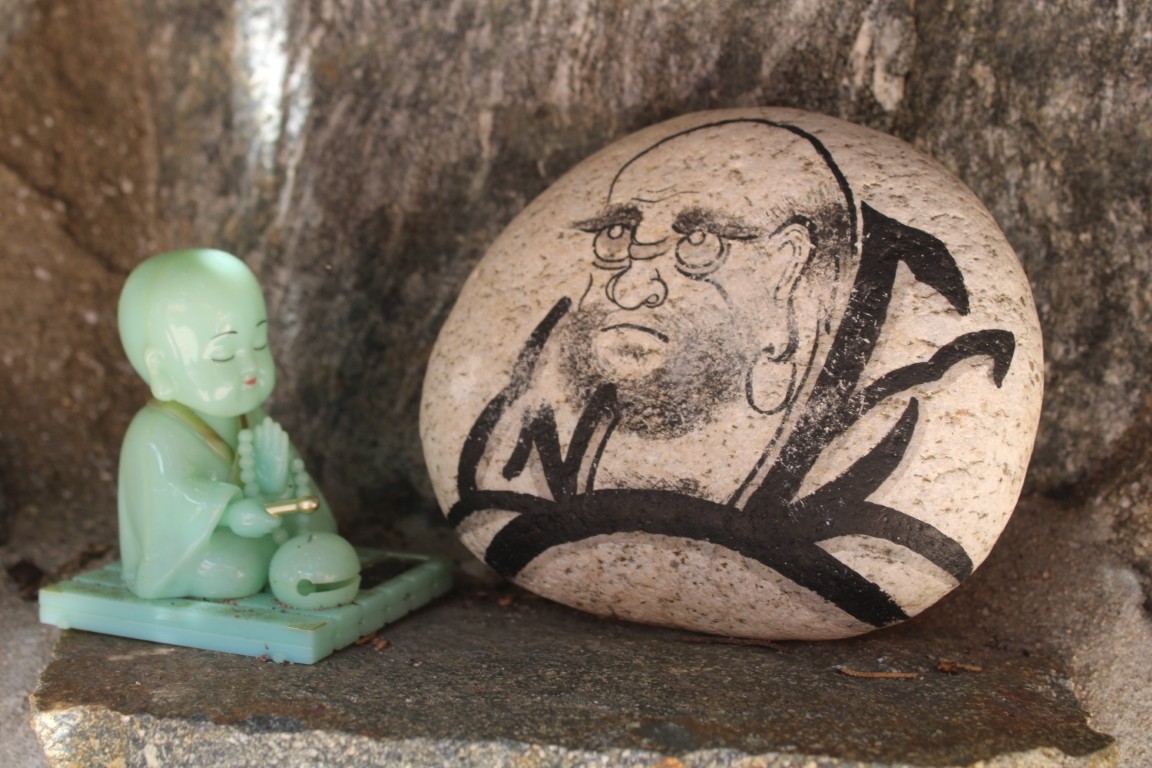

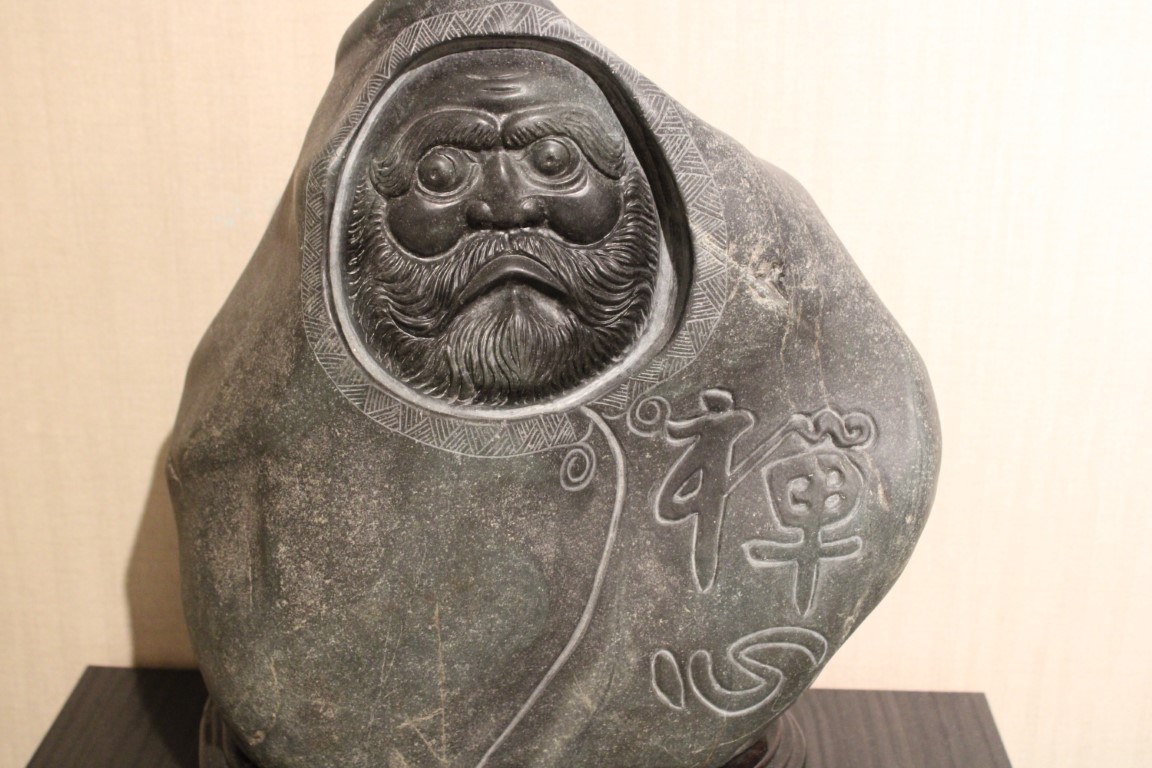
He is carved as an
   amorphous stone,
 Suggesting he stared
   into the rock until
   any distinction between
   himself and the rock
   vanished. . .

But the sculptor couldn't
   help but add a face.
Today as in ancient times
Mei Yaochen in Poets’ Jade Splinters
it’s hard to write a simple poem.
To be undefeated lies with oneself;
Sunzi in The ART of War (孙子兵法)
to be victorious lies with the enemy.
A buddha is an idle person.
Bodhidharma; Bloodstream Sermon
He doesn’t run around after fortune and fame.
What good are such things in the end?
Not what we have, but what we enjoy, constitutes our abundance.
Epicurus
Take more time, cover less ground.
Thomas Merton
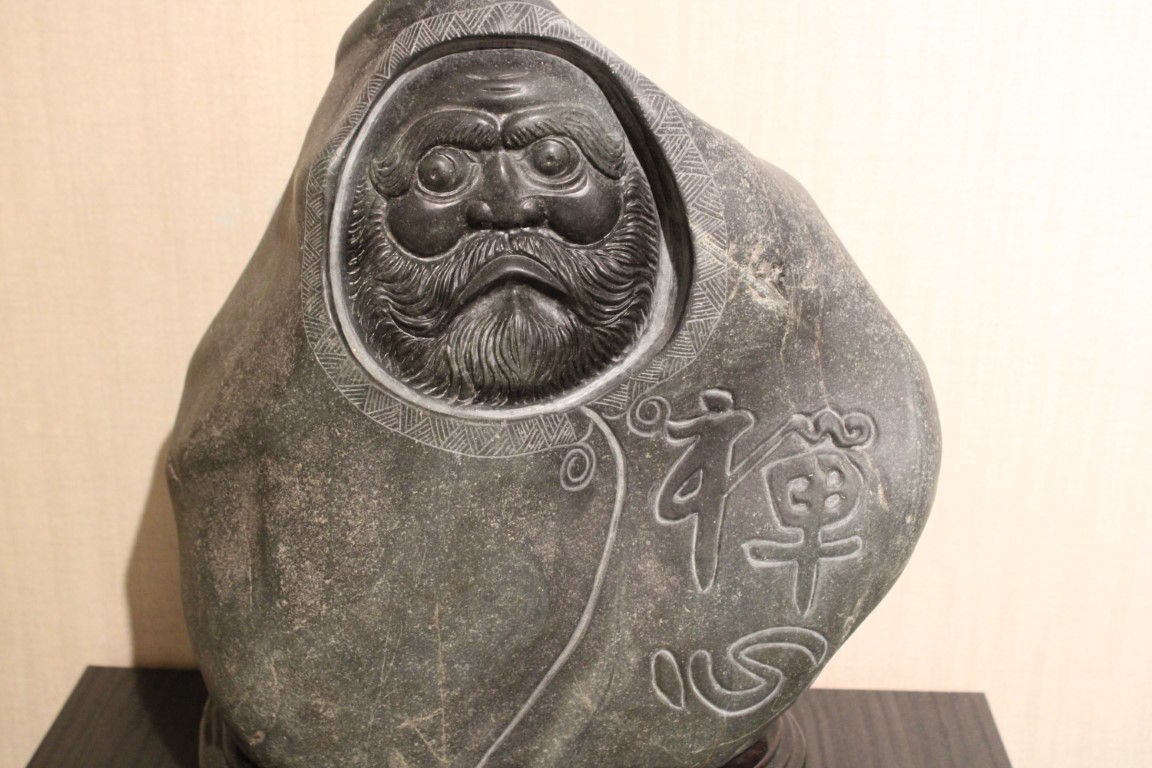
The stone Bodhidharma,
   Meant as more than likeness.
 It tries to copy Damo's
   Stillness & uprightness.
 The Zen Teaching of Bodhidharma by Bodhidharma
 Zen Buddhism and Its Relation to Art by Arthur Waley
I just began my study of Kalaripayattu this morning. Kalaripayattu is an Indian martial art that is named for the training space (kalari) in which it is conducted. It’s a very different martial art from others I’ve studied, and is a great learning experience—as well as an excellent workout. Kalaripayattu is said to be one of the oldest formal martial arts that has survived into the modern era. I have no reason doubt this. The art is documented in the 11th century by a historian who attributes its development to wars between the Chola and Chera kingdoms.
However, there’s another common claim that is much more controversial, and that’s that Kalaripayattu is the “mother of all [Asian] martial arts.” With all due respect, I’m skeptical of this claim—even if we don’t take it in the literal sense (i.e. Asia is a big place and there are almost certainly places where martial arts were established before contact with the Buddhist diaspora.) I obviously don’t base my skepticism on what I have been taught—as that is, at this point, a miniscule portion of the most basic of basics.
While I can offer no definitive proof to discredit the claim, I do have specific reasons to be skeptical. The theory of Kalaripayattu as the origin of martial arts is based on the legend of Bodhidharma. The legend says that the famous monk shared martial arts with the monks of Shaolin in conjunction with the Zen (Cha’an) form of Buddhism, and from Shaolin as Buddhism spread so did the martial arts. I’ve read myths about the origins of the Japanese martial arts that I’ve studied that place the beginnings of their ancestor arts with Chinese Buddhists fleeing persecution during the T’ang Dynasty (as well as later periods.)
The first problem with this theory is that historians have found it to be unsubstantiated and dubious. While the belief that Bodhidharma introduced the Chinese to martial arts is one of the most widely believed and cited pieces of martial arts lore, Meir Shahar in his book The Shaolin Monastery [http://www.amazon.com/The-Shaolin-Monastery-History-Religion/dp/082483349X] states that the evidence doesn’t support this popular belief. Specifically, the only historical documentation of this theory is a document that was written in the 1600’s that the author claimed was “discovered” from an earlier time—the problem is that the language usage isn’t consistent with the claim that the document was from a much earlier period, and there are many verified mistakes in the document.
Even if Shahar and other historians are wrong, the evidence that Bodhidharma came from southern India and that he studied Kalaripayattu specifically seems to be non-existent. There is at least one popular theory of Bodhidharma that puts the origin of this famous spiritual leader outside of India altogether. If the aforementioned Indian historian was right and Kalari developed during 11th century wars, then it’s late for the life of Bodhidharma by some 500 years.
The challenge is that it’s difficult to compare the modern martial arts and see definitive evidence of historic connections. Some will say, “But Kalaripayattu doesn’t look like Shaolin Kung fu (or any other subsequent arts) at all.” While it’s not true that they don’t look anything alike, it’s true that they look very different. However, what one has to keep in mind is not only did Kung fu continue to evolve in order to optimize to its circumstance, its predecessor system (whether Kalaripayattu or otherwise) would have continued to evolve as well. The Kalaripayattu of today most likely looks quite different from 11th century Kalaripayattu, but we can’t know how so in any detail. This could make for some pretty rapid divergence. Others may say, “But, hey, I do see the similarities in kicks and postures and so forth.” This may be true as well, but can one be sure that one of those commonalities is causal of the other? What if it’s just the constraints of the human body that make all martial arts similar at some level of granularity?
My intent is neither to destroy origin stories nor to discredit any martial art. Obviously, Kalaripayattu has a long history, and the fact that it survived to modern times is a testament to its value over that time. Combat is a harsh evolutionary environment, and things that don’t work for the situations they face are likely to die with the people who practice those systems. However, I think it’s important for warriors to not succumb to false fables because they must see the world as it is and not as they wish it to be.


 Tiger Riding for Beginners