PROMPT: Favorite Artists

Daily writing prompt
Who are your favorite artists?

Those who cross boundaries. William Blake with painting and poetry. Yue Fei with martial and poetic arts. Rabindranath Tagore with music and poetry. Da Vinci with painting and sculpture. Weird Al with accordion music and comedy.

Aesthete Levels [Free Verse]

       Anyone
can see beauty
in the flawless.

Artists
can see beauty
in the flawed.

Sages
can see beauty
in chaos.

BOOKS: “Bohemian Manifesto” by Laren Stover, Paul Himmelein, and Patrisha Robertson

Bohemian Manifesto: A Field Guide to Living on the Edge (Kindle Edition)Bohemian Manifesto: A Field Guide to Living on the Edge by Laren Stover
My rating: 5 of 5 stars

Amazon.in Page

The central premise of this book is that not only does the Bohemian artist live on, but she does so in five distinct varieties: the Beat, the Zen Bohemian, the Dandy, the Folkloric Bohemian, and the Nouveau Bohemian. While the title calls this book a “manifesto,” the term used in the subtitle, i.e. “field guide,” is far more apropos. Like a field guide to birds or mushrooms, it lays out
characteristics and distinctions, the characteristics of Bohemians, generally, and the five flavors thereof, more specifically, and it does so in a way that separates them from the other varieties of human.

One might be wondering, why are these varied categories classed as Bohemian, as it seems they are their own distinct class. One way to understand this is to consider the “Zen Bohemian,” who often bears little resemblance to the “Zen Buddhist” for which one might mistake him. The Zen Buddhist has both a strong connection to and a depth of knowledge of Zen Buddhism, but the Zen Bohemian often rather has a strong connection to a broad hodge-podge of Eastern philosophies and spiritual traditions that he may or may not properly understand the distinctions between.

This book is quite readable, and informative in an easy-going way, but it’s also perplexing. It’s informative in that it clarifies the characteristics of Bohemians across many criteria (e.g. food, clothing, tastes in literature, art, movies, and music, interest in boxing, etc.) It’s perplexing in that it starts with the premise that Bohemians are, at their core, free spirits who refuse to be hemmed in by convention, but then the bulk of the book is about the various tribe-signaling boxes that the Bohemian puts himself within to conform to the norms of the group. It seems that the authors are aware of this and actually produce humor through oddly specific statements such as, “They [Bohemians] still adore Laurie Anderson even though their yuppie brother went to see her.” It feels like they are aware that, to the extent Bohemians are truly free spirits, any description the authors give will be wrong at some level of granularity, and so they lean into it with great (sometimes comedic) specificity.

I enjoyed reading this book and picked up a number of interesting references to other books and whatnot. (I’m currently reading Kliph Nesteroff’s “The Comedians” because of a reference to it in this book.) I did find bits on subjects like wardrobes and astrology to be a bit tedious, but just skimmed through them.

View all my reviews

BOOKS: Bohemians: A Very Short Introduction by David Weir

Bohemians: A Very Short Introduction (VERY SHORT INTRODUCTIONS)Bohemians: A Very Short Introduction by David Weir
My rating: 5 of 5 stars

Amazon.in Page

This book examines the brief life of the Bohemian artistic lifestyle, exploring how it came about, what it looked like in its heyday, what led to its demise, and by what / whom it was replaced (e.g. the Beats.) It is an intriguing examination of the subject. I will say, there were points that I felt the book had become lost in the weeds, but at other points I found it fascinating. I concluded that my own calculus was to find it interesting when it discussed the lives and works of artists who are still deemed to have relevance and influence today (e.g. Baudelaire, Picasso, and Whitman,) and not so much when it was elaborating on artists and works that have fallen into obscurity among the general populace (e.g. Henry Murger’s Scenes of Bohemian Life.) So, that may be more a reflection on me than on the book.

The author touches upon the fictional influences that inspired Bohemianism, the places where the lifestyle thrived (e.g. Paris and New York,) the philosophy and – particularly – the political philosophy of the Bohemians (e.g. often Anarchists or – at least – anti-government.) One of the topics that most interested me is how the successor artistic communities differed from the Bohemians.

If you’re interested in who the Bohemians were and how they differ from other artistic communities (before and after,) this book is well worth the brief read required.

View all my reviews

Green Fairy [Free Verse]

Bohemians
   gathered around 
   the absinthe bottles,
  the light hitting 
   the bottles shone
   a radioactive shade
   of green.

That green light
   threw blotches
  against walls &
 floors & people &
  anything else there
  was to illuminate.

The more they drank,
 the less green the mottling --
  not because the empty glass 
   was clear, &
 didn't refract, or spray green,
   but because the splotches
  turned every color --
   every color there is --
  and the colors danced
   around the increasingly 
  amorphous surfaces.

 Until, at last,
  everyone was asleep,
 and visions of Green Fairies
  danced in their dreams. 

PROMPT: Favorite Artists

Daily writing prompt
Who are your favorite artists?

If one means “arts” in the broadest sense of the word, I’d have to say William Blake, because I like both his poetry and his graphic artistry, as well as his particular brand of madness.

If you mean visual artistry (which people often do when they use the term without a qualifier,) I generally enjoy fantastical and imaginative art, but not so fantastical or imaginative that it requires / shows no skill. So, artists like Vincent Van Gogh, Francisco Goya, Hieronymus Bosch, and M.C. Escher top the list.

BOOK REVIEW: Public Domain, Vol. 1 by Chip Zdarsky

Public Domain Vol. 1Public Domain Vol. 1 by Chip Zdarsky
My rating: 4 of 5 stars

Amazon.in Page

This isn’t a superhero comic, but a meta-superhero comic. The central premise is similar to that of the popular novel “The Amazing Adventures of Kavalier & Clay,” by Michael Chabon, which is to say it’s about how comic book artists historically made work-a-day salaries while others (actors, executives, producers, etc.) became astoundingly rich off the creations of those artists. In this case, it’s the father of two middle-aged sons, one of whom has a gambling problem.

It’s a fine story, and the character development is well done. Of the two sons, there’s one that’s incredibly likable and the other makes you want to punch him in his stupid face, and – as a twist – the likable one is the man-child and the straightlaced one is the jerk.

If you’re interested in a story about comic book justice, you should check it out.


View all my reviews

BOOK REVIEW: Genius: A Very Short Introduction by Andrew Robinson

Genius: A Very Short IntroductionGenius: A Very Short Introduction by Andrew Robinson
My rating: 4 of 5 stars

Amazon.in Page

This book examines the myths and realities of that state of capability we call genius. It’s not about “geniuses” as individuals who test well on IQ exams, or who are eligible for Mensa membership, but rather about those luminaries who’ve made breakthroughs that changed the course of their discipline. It considers artistic and literary type geniuses (Shakespeare and Picasso) as well as scientific geniuses (e.g. Einstein and Darwin,) as well as discussing the differences (perceived and real) between these groups and the intriguing rarity of crosscutting figures (e.g. Da Vinci.)

The bulk of the book evaluates characteristics that are (rightly or wrongly) commonly associated with genius, including: heredity, education, intelligence, creativity, madness, personality traits, and discipline. Don’t expect clear and straightforward connections. That’s not the author’s fault. There just aren’t any traits unambiguously linked to genius in an uncomplicated way. One might expect education would be an unequivocal boon to genius, but it can be a hindrance to genius in its training of conformity. There may be a disproportionate number of geniuses with mental health issues, but there are even more without them. Hard work maybe a necessary condition, but it’s clearly not a sufficient one.

The book addresses a few other related subjects, beyond the traits associated with geniuses. For example, the degree to which genius can be defined and what it means if we can (or can’t) do so. Few individuals would be unanimously judged geniuses, and to the degree some are, mightn’t that say more about the public’s role in bestowing genius rather than the individual’s earning the designation. There is also discussion about eureka moments versus slow-builds.

This book is thought-provoking and raises intriguing and counter-intuitive debates. If you’re interested in the perception, the reality, and the interplay between the two with regard to genius, check it out.

View all my reviews

POEM: All Hail, Warhol! [Day 17 NaPoMo: Doggerel]

[With doggerel the only way to be “good” is to be ironically bad.]


Being a true genius must be hard work.
Is there a less laborious path to the perks?

I’m so glad you asked:
Just convince the right person you’re a genius,
and you’ll be in like porn star penis.

Just stack some boxes of Brillo pads,
reprint some old burger joint ads,
slather color on portraits — Tammy Faye Bakker-style —
(just make sure to showcase the subject’s creepiest smile.)

Lest you think I’m just being snarky,
I say this without a trace of malarkey,
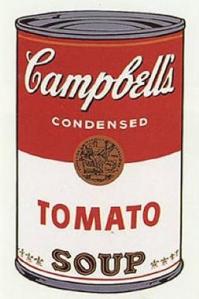
if you can buy mansions off a soup can label you didn’t design,
genius is too meek of a word, you stink of the divine.
[Like Odysseus being dropped in the lap of goddesses
who were ready & eager to pop open their bodices.]
Do you think the Campbell’s marketing artist has a mansion?
He probably retired with a meager pansion.

I say this without derision,
to be great artist you don’t need to show in galleries, Parisian
you simply need to showcase your vision
of some poor shmuck’s labors
to the person who can get you a better class of neighbors.