They in their cruel traps, and we in ours,
 Survey each other's rage, and pass the hours
 Commiserating each the other's woe,
 To mitigate his own pain's fiery glow.
 Man could but little proffer in exchange
 Save that his cages have a larger range.
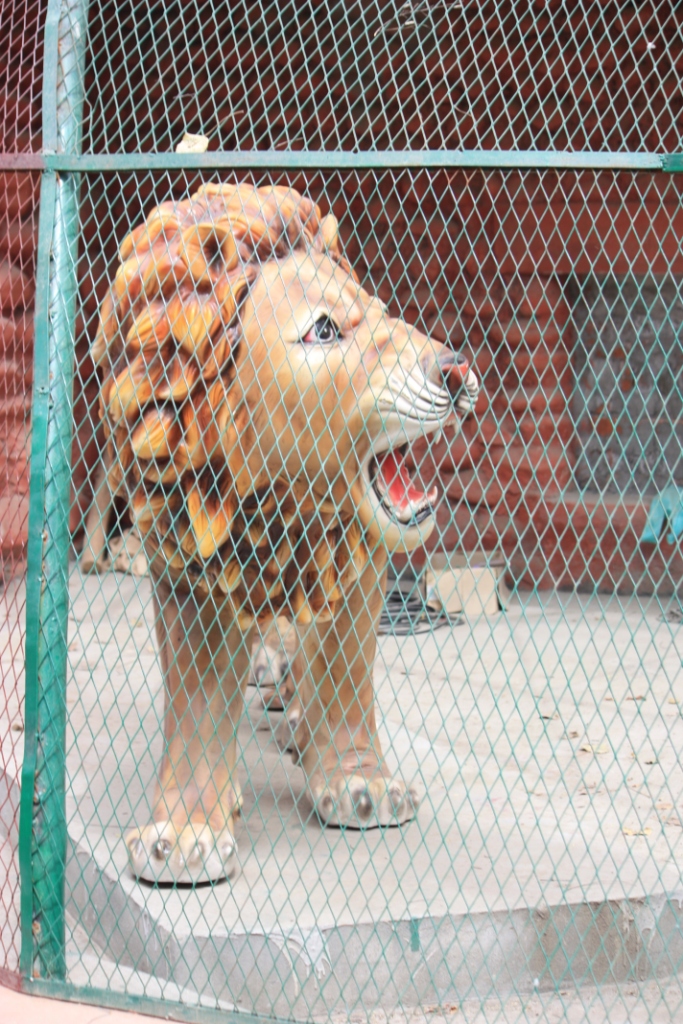
 That lion with his lordly, untamed heart
 Has in some man his human counterpart,
 Some lofty soul in dreams and visions wrapped,
 But in the stifling flesh securely trapped.
 Guant eagle whose raw pinions stain the bars
 That prison you, so men cry for the stars!
 Some delve down like the mole far underground,
 (Their nature is to burrow, not to bound),
 Some, like the snake, with changeless slothful eye,
 Stir not, but sleep and smoulder where they lie.
 Who is most wretched, these caged ones, or we,
 Caught in a vastness beyond our sight to see?
Before me lies a mass of shapeless days,
 Unseparated atoms, and I must
 Sort them apart and live them. Sifted dust
 Covers the formless heap. Reprieves, delays,
 There are none, ever. As a monk who prays
 The sliding beads asunder, so I thrust
 Each tasteless particle aside, and just
 Begin again the task which never stays.
 And I have known a glory of great suns.
 When days flashed by, pulsing with joy and fire!
 Drunk bubbled wine in goblets of desire,
 And felt the whipped blood laughing as it runs!
 Split is that liquor, my too hasty hand
 Threw down the cup, and did not understand.
There is no Frigate like a Book
   To take us Lands away
 Nor any Coursers like a Page
   Of prancing Poetry --
 This Traverse may the poorest take
   Without oppress of Toll --
 How frugal is the Chariot
   That bears the Human Soul --
When I heard the learn'd astronomer,
 When the proofs, the figures, were ranged in columns before me,
 When I was shown the charts and diagrams, to add, divide, and measure them,
 When I sitting heard the astronomer where he lectured with much applause in the lecture-room,
 How soon unaccountable I became tired and sick,
 Till rising and gliding out I wander'd off by myself,
 In the mystical moist night-air, and from time to time,
 Look'd up in perfect silence at the stars.
Twelve o'clock. Along the reaches of the street Held in a lunar synthesis, Whispering lunar incantations Dissolve the floors of memory And all its clear relations, Its divisions and precisions, Every street lamp that I pass Beats like a fatalistic drum, And through the spaces of the dark Midnight shakes the memory As a madman shakes a dead geranium.
Half-past one, The street lamp sputtered, The street lamp muttered, The street lamp said, 'Regard that woman Who hesitates towards you in the light of the door Which opens on her like a grin. You see the border of her dress Is torn and stained with sand, And you see the corner of her eye Twists like a crooked pin.'
The memory throws up high and dry A crowd of twisted things; A twisted branch upon the beach Eaten smooth, and polished As if the world gave up The secret of its skeleton, Stiff and white. A broken spring in a factory yard, Rust that clings to the form that the strength has left Hard and curled and ready to snap.
Half-past two, The street lamp said, 'Remark the cat which flattens itself in the gutter, Slips out its tongue And devours a morsel of rancid butter.' So the hand of a child, automatic, Slipped out and pocketed a toy that was running along the quay. I could see nothing behind that child's eye. I have seen eyes in the street Trying to peer through lighted shutters, And a crab one afternoon in a pool, An old crab with barnacles on his back, Gripped the end of a stick which I held him.
Half-past three, The lamp sputtered, The lamp muttered in the dark. The lamp hummed: 'Regard the moon, La lune ne garde aucune rancune, She winks a feeble eye, She smiles into corners. She smoothes the hair of the grass. The moon has lost her memory. A washed-out smallpox cracks her face, Her hand twists a paper rose, That smells of dust and old Cologne, She is alone With all the old nocturnal smells That cross and cross across her brain.' The reminiscence comes Of sunless dry geraniums And dust in crevices, Smells of chestnuts in the streets, And female smells in shuttered rooms, And cigarettes in corridors And cocktail smells in bars.
The lamp said, 'Four o'clock, Here is the number on the door. Memory! You have the key, The little lamp spreads a ring on the stair; Mount. The bed is open; the tooth-brush hangs on the wall, Put your shoes at the door, sleep, prepare for life.'











 Tiger Riding for Beginners