BOOKS: “Funny Stuff” ed. by Laura LaPlaca and Ryan Lintelman

Funny Stuff: How Comedy Shaped American HistoryFunny Stuff: How Comedy Shaped American History by Laura LaPlaca
My rating: 4 of 5 stars

Publisher Site — Rutgers University Press

Release Date: May 12, 2026

As the subtitle suggests, this book explores the nexus between American History and comedy across many, varied media (i.e. writing, theater, standup, improv, radio, television, movies, etc.) It’s an interesting book, but I don’t know that it has the right title. Considering the title, a reader might expect a fuller coverage of American History, drawing on whatever humorous outlets existed at the time (e.g. op-eds and satirical articles.) This book is more of a history of comedic content in the US with a substantial discussion of how comedy addressed / participated in changing views on sex, race, and sexuality and with occasional mention of how comedy was involved in other social issues, such as changing views on free speech and expression. You’re not going to learn how comedic writers addressed Smoot-Hawley or the Sinking of the Maine. (i.e. The book leads with comedic content and leans the discussion toward societal influence [rarely toward policy influence.] It does not lead with historical events and draw on appropriate comedic content.)

The book covers a lot of the same ground as Kliph Nesteroff’s The Comedians, though with quite different emphases. Nesteroff focuses on the gritty underside of comedy and the oft unseen dark side of comedians, while this book focuses on comedy as a factor in changing views on race and sex [as well as on the changing technological outlets for comedy.] Funny Stuff does spend a little more time on pre-20th century America than does Nesteroff, but not much more. Both books are heavily weighted toward the late 20th century to present. To be fair, there is much more volume of comedic output in this period. (That said, there were artists I expected coverage of, e.g. Josh Billings, that weren’t included. That’s where the book seems more like a history of comedy and its varied outlets.)

If you’re interested in the development of comedy in America, and its influence on social issues — most extensively attitudes towards race — I’d recommend this book.

View all my reviews

BOOKS: “John Brown” by W.E.B. Du Bois

John BrownJohn Brown by W.E.B. Du Bois
My rating: 5 of 5 stars

Available free online at Project Gutenberg

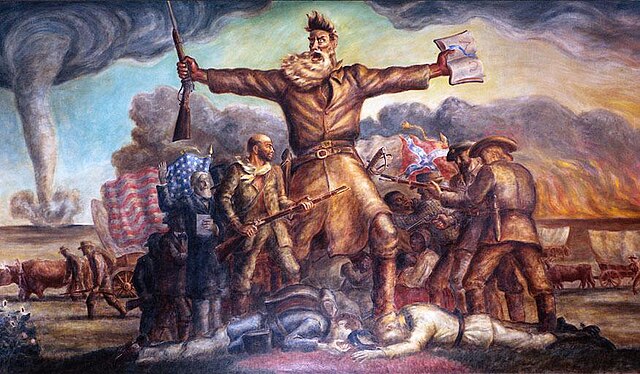
“John Brown’s Raid on Harpers Ferry” is one of those historic events like the “Teapot Dome Scandal” that American kids have to memorize a rote fact about to regurgitate on an American History test a couple times during their scholastic lives, never to be thought of much again, forever a familiar name lacking all depth of understanding. (At least that’s how it was in my day.) Unlike the Teapot Dome Scandal, which I suspect is not learned about in detail because it was somewhat complex and boring, I think the minimalist coverage of John Brown might reflect a bit of national embarrassment. For Brown’s tale is not complicated, and it’s certainly not boring. Brown thought slavery was an abomination, and he devoted his life to freeing slaves by whatever means he could, which culminated in a raid on an arsenal at Harper’s Ferry, West Virgina, at the convergence of the Potomac and Shenandoah Rivers, a raid intended to liberate weapons to the cause of arming freed slaves and other abolitionist fighters.

It’s a shame that more is not learned about John Brown because he was such a fascinating and principled individual, and in a sense his story isn’t just an embarrassing tale of a sparse few virtuous people against a mainstream that was — at best — indifferent to slavery. But there is a potential for pride in the fact that Brown and those who fought with him were able to see slavery for what it was and to stand strong against that mainstream, to make the fight of the oppressed their fight and — in the case of Brown and others — to pay the ultimate price in the conduct of that fight.

W.E.B. Du Bois’ biography of John Brown came out in 1909 and may not be written in the novel-esque style that a writer today would write it, but it is well-written and readable. Du Bois’ book is a full biography of Brown, if focused on his abolitionist aspect. Du Bois tells a little of Brown’s backstory and of his work life and then explores his experiences fighting in Kansas. However, this book does really shine in its account of the Harpers Ferry Raid and its aftermath.

Readers interested in American History or the biographies of virtuous individuals are urged to read this account of the life of John Brown.

View all my reviews

“The Portent” by Herman Melville [w/ Audio]

Hanging from the beam,
Slowly swaying (such the law),
Gaunt the shadow on your green,
Shenandoah!
The cut is on the crown
(Lo, John Brown),
And the stabs shall heal no more.

Hidden in the cap
Is the anguish none can draw;
So your future veils its face,
Shenandoah!
But the streaming beard is shown
(Weird John Brown),
The meteor of the war.

BOOKS: “American Intellectual History: A Very Short Introduction” by Jennifer Ratner-Rosenhagen

American Intellectual History: A Very Short Introduction (Very Short Introductions)American Intellectual History: A Very Short Introduction by Jennifer Ratner-Rosenhagen


Publisher Site – OUP

This is a brief guide to the philosophies and major developments in United States’ academia from pre-colonial times to the 1990’s. But both of those end points require a bit of clarification. The discussion of pre-colonial scholarly history is largely a mea culpa for beginning with colonial history because Native American tribes weren’t big on recording their philosophical and other scholastic ideas in writing. There is an appendix that discusses America scholarship in the era of globalization (and beyond.) My point is that if you’re hoping for discussion of what’s happened in the last couple decades, you won’t find it herein. (There are a few bibliographic references from the 2010’s, but that’s it.) It is a history book, but some readers may be curious because there’s been a lot of talk of late about issues related to scholarship in America.

Overall, I believe the book covered the topic solidly. There is considerable discussion of the debates triggered by the ideas of Charles Darwin arriving on American shores. As one would expect, there is also quite a bit of discussion of Transcendentalism and Pragmatism, two philosophies closely associated with America. The author covered a wide swath of ground including both progressive and conservative thinkers and viewpoints. One conspicuous absence was any mention of Objectivism / Ayn Rand. I know that isn’t a popular topic in academic circles and is widely dismissed with contempt, but on the grounds of: a.) Objectivism’s considerable influence (e.g. we had a Federal Reserve Chairman – Alan Greenspan – who served almost 20 years under both Republican and Democratic Presidents who was from that school of thought,) b.) its distinctive Americanness, I’m shocked that it didn’t merit at least a sentence or any mention of a book in the bibliography.

All in all, it’s an interesting book that offers unique insight into the history of the United States.

View all my reviews