BOOK REVIEW: Perv by Jesse Bering

Perv: The Sexual Deviant in All of UsPerv: The Sexual Deviant in All of Us by Jesse Bering
My rating: 4 of 5 stars

Amazon page


“Perv” is an examination of human sexuality outside the norm. As one might expect from the back blurb mention of a woman who was aroused by the Eiffel Tower, the book provides many a revelatory “things-that-make-one-go-HUH?” moment. The author’s humor–and willingness to offer cringe-worthy personal confessions–makes the book all the more readable. (e.g. As an example of the author’s humor: “As an adolescent male, you’re basically an ambulant sperm factory with an incompetent foreman…”) The book is in the vein of Mary Roach’s “Bonk” (something about sexuality triggers the urge to go monosyllabic), but Bering carves out his niche in deviant territory, while Roach’s book provides a more balanced look at the subject (although both books exploit anomalies to make for interesting reading.)

There are two ways in which this book wasn’t the one I expected, one of which is entirely my fault for reading too much into some words in the book blurb while ignoring others. I think the author and/or publisher must take some responsibility for the other as the subtitle itself leads one to expect a different emphasis in the book beyond the first chapter. First, I expected more insight into why people engage in these behaviors. Are there explanations rooted in our evolution? Does a given act result from some cross-wiring in the brain? There’s a cursory mention of science in the book’s description which led me to expect it to go much further beyond a cataloging of anomalous sexual behavior. To be fair, the author does back load an interesting discussion on the role of theory of the mind into the last chapter and there is some of this discussion throughout. However, the book spends much more time on history and semantics than I expected. Semantics sounds boring, but there are some fascinating insights into how words came to be used, and how usages have changed over time. (Also, the reader may be surprised at the huge vocabulary of “-philias” [objects of love / attraction] that’s not unlike the more well-known one for “-phobias” [fears.])

The second way this wasn’t the book I expected was that—owing to the subtitle “the sexual deviant in all of us”—I expected much more discussion of widespread but unconventional sexual proclivities (e.g. exhibitionism, voyeurism, dominance / submission, role-play.) Instead, Bering spends a lot of time discussing rare fetishes for materials, animals, objects, etc, and also extremely high-profile (but also rare) proclivities such as pedophilia and vovarephilia (cannibalistic arousal.) One can see the appeal from the book selling perspective. Said emphasis provides a lot of WTF and giggle-inducing moments to keep up the reader’s interest. However, if you’re expecting drilling down into [no double entendre intended] why people engage in these activities, mostly you’ll get playful variants on “the heart wants what the heart wants” and not so much insight into whether there are unseen Darwinian mechanisms at work or whether there’s some synaptic cross-wiring. I doubt this is a conscious attempt to avoid dealing with the un-PC ramifications of finding some deviant behaviors to be explicable in terms of brains that are operating within expected parameters while others may only be explained in terms of something not working as usual. I doubt this because Bering seems quite willing to take the book in uncomfortable directions. I’m not certain that there’s not an unconscious bias away from considering the “why” questions because it risks putting one in the cross-hairs even if one reports in an objective and non-judgmental way. (Perhaps there’s a lack of scientific findings to report for the same reason.)

Still, while I didn’t get the book that I expected, there were some surprising bonuses to weigh into the mix. Bering provides interesting food-for-thought on a few topics. One of these is what he calls the “naturalistic fallacy,” which is the idea that whether an activity can be considered acceptable depends upon whether one sees it elsewhere in nature (i.e. besides humanity.) This has been used over the years to divide acceptable from unacceptable “perversions”—often by people who had little to no idea what activities are or aren’t seen across the animal kingdom. (We do, after all, see monkeys literally throwing their poop.) Another challenging area of consideration is whether society’s extreme distaste for pedophilia leads us to write laws that actually exacerbate child abuse and exploitation (e.g. completely CGI [computer generated imagery] pornographic material is illegal, and—according to the author—there is reason to believe that–were it not—exploitation of children would decline.)

The book consists of seven chapters. An introductory chapter sets up the idea of sexual deviance and its changing definitions. Chapter 2 is about the many ways in which people manage to overcome their instincts toward disgust in order to engage in sexual activities. Chapter 3 looks at various forms of hypersexuality (e.g. nymphomania) and the changing definitions over time—and the biases contained therein (i.e. it was once thought to be a condition only females could experience.) Chapter 4 considers various paraphilias—i.e. unconventional sources of arousal. Chapter 5 deals with the subjective experience of many of these sexual behaviors and how that brushes up against societal norms. Chapter 6 delves into the topic of age and attraction discussing pedophilia, hebephilia, ephebophilia, teleiophilia, and gerontophilia. Of these, the vast majority of people are teleiophilics (attracted to full-grown adults) with hebephilic and ephebophilic tendencies not being uncommon (i.e. attraction to pubescent or post-pubescent youths.) Much of the discussion is about pedophilia and the legal entanglement of pedophilia and ephebophilia. Chapter 7 delves into the science and psychology in a way that I wished the rest of the book had.

There are no graphics in the book. It does have both chapter end-notes and bibliographic notes (the former being more foot-note like elaborations and the latter being mostly sources.)

I found this book interesting. It was more historical and semantic (dealing in the terminology of deviant sexuality and its changing nature over time) and less scientific and psychological than I expected, but it was still loaded with interesting information and insights. I’d recommend this book with the provisos mentioned, i.e. that it might not be the book you expect and may deal much more in rare proclivities than one expects.

View all my reviews

BOOK REVIEW: Tales of the Taoist Immortals by Eva Wong

Tales of the Taoist ImmortalsTales of the Taoist Immortals by Eva Wong
My rating: 3 of 5 stars

Amazon page


This book tells of the key events in the lives of forty Taoist immortals. While the title (specifically the word “tales”) might lead one to think that this is a book of stories, it is only so in the most general sense of the word “story.” Satisfying stories show a character confronted by barriers to obtaining some desired goal. That isn’t the case in the overwhelming majority of the “tales” in this book, and the few in which the individual is confronted with a challenge she usually uses her superpowers to magic the problem away. (To be fair, Taoist sages aren’t known for being ambitious and thus have few goals to chase after. There are more examples of individuals turning down high offices in these character sketches than there are characters attempting to obtain some objective.)

If you are looking to learn more about key figures in Chinese history and mythology, this book will serve your purpose through brief (2-3 page) character sketches that hit the highlights. However, if you are looking for something like the “Book of Chuang Tzu” with clever morality tales, that’s not at all what you’ll find in this book. There are a couple of exceptions, but they are rare nuggets.

Each of the 40 chapters provides one character sketch of life events with a brief bio at the end. The 40 chapters are divided into five parts by the class of individual being mentioned (i.e. the eight immortals, sages, magicians, diviners, and alchemists.) There is a line drawing (reminiscent of block print) for each of the chapters that depicts the immortal in action. The only ancillary matter is a brief introduction.

As I suggested, if one is looking for information about the lives of Taoist immortals, one may find this to be a good source—particularly if one doesn’t want to get bogged down in minutiae. The entire book is less than 200 pages. On the other hand, if one is looking for stories or morality tales, one will likely find this book leaves one wanting.

View all my reviews

BOOK REVIEW: An Introduction to Indian Philosophy Chatterjee & Datta

An Introduction to Indian PhilosophyAn Introduction to Indian Philosophy by Satischandra Chatterjee
My rating: 4 of 5 stars

Amazon page


India has spawned a number of philosophical systems over the centuries. Chatterjee and Datta provide an overview of Indian philosophy by comparing and contrasting nine major schools of Indian philosophy—the six orthodox schools plus three well-known heterodox schools. The dividing line between orthodox and unorthodox hinges upon whether a philosophy accepts the Vedas as sources of authority.

After an introductory chapter that lays out the concepts that will be needed throughout the remainder of the book as well as providing brief sketches of nine philosophical schools, the remainder of the book is a one chapter per school examination of metaphysics, ethics, theology, epistemology, etc. The authors first consider the heterodox schools: i.e. Carvaka (a materialist /atheist approach), Jain (one of the major Indian religions), and Buddhist. After examining the heterodox approaches, Chatterjee and Datta take on the orthodox schools in the following order: Nyaya, Vaisesika, Sankhya, Yoga (which you may not have realized was a philosophical system), Mimamsa, and Vedanta.

There are a number of questions that recur as the authors compare these schools to each other. A major point of consideration is presence or absence of belief in a god, and—for those systems that believe in a God or gods—what is the role of said deity. It might seem that all the orthodox systems would be theistic, but this isn’t the case (e.g. Sankhya.) Another key question is how one can know something, i.e. what is acceptable authority—can one only trust one’s own senses or can one trust everything but one’s own senses? Then there is the matter of ethics and how each system regards ethical behavior. Of course, there are some elements that are unique to a given system, and so it’s not entirely a matter of comparison and contrast.

There are no graphics in the book and the ancillary material is limited to footnotes, a select bibliography, and prefaces to the various editions of the book. Note: I read the 2007 / 7th Edition of the book.

I won’t say this book isn’t dry. It’s a philosophy textbook, after all. However, it does provide a solid overview of the topic and seems to take great efforts to be unbiased (to the extent of sometimes not challenging philosophical ideas that are patently unsound in favor of reporting what advocates of the tradition propose.)

I’d recommend this book for anyone who’s looking for an overview of Indian philosophy.

View all my reviews

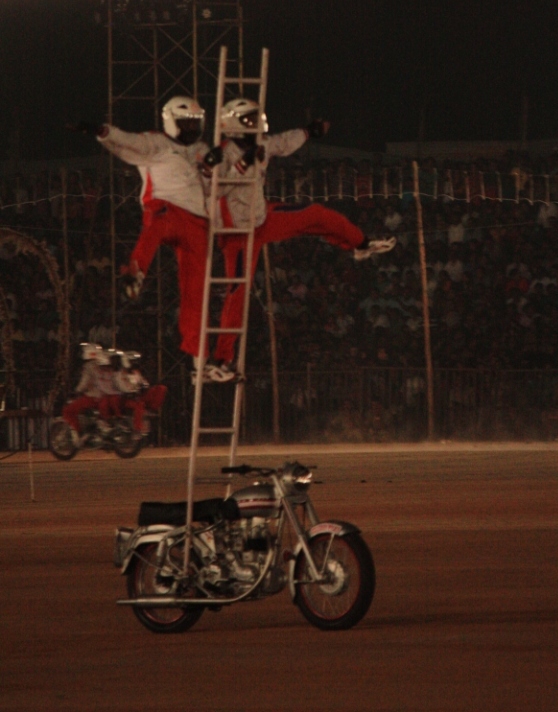
DAILY PHOTO: Indian Military Police Stunt Riding Team


Taken in October of 2014 in Mysore

POEM: Under the Rug

a vessel cracked

an act of ransack

a pile of shards

one can’t discard

but swept aside

never to be eyed

under the rug

like Kafka’s bug

DAILY PHOTO: Pink Lotus


Taken in May of 2017 in Assam

DAILY PHOTO: Heroes’ Square in Monochrome

Taken in December of 2016 in Budapest

DAILY PHOTO: Khonoma Homestead

Taken in May of 2017 in Khonoma

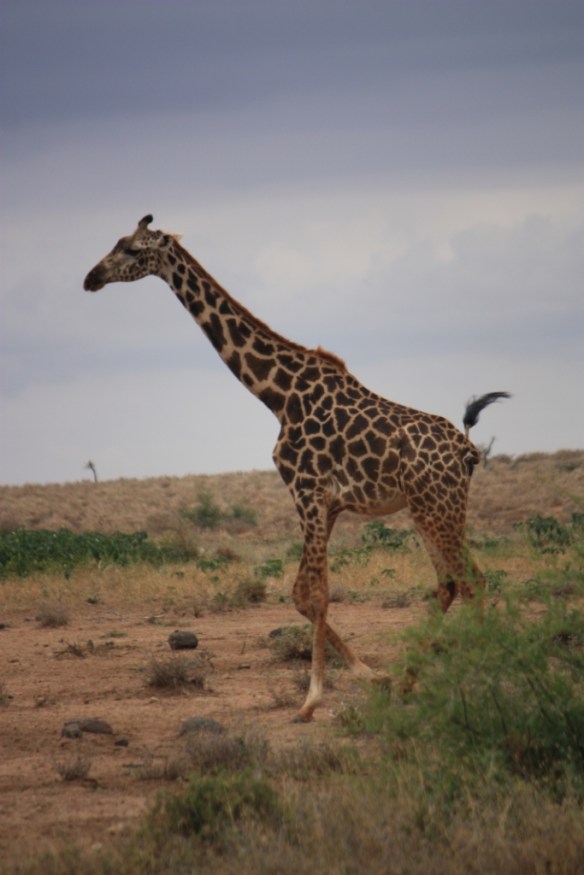
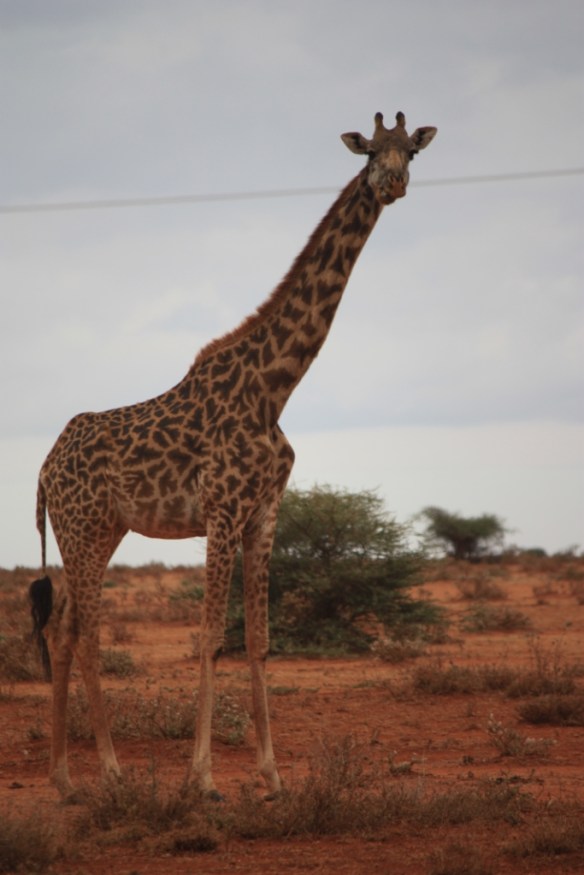
DAILY PHOTO: Masai Giraffe

Taken in June of 2017 near Amboseli National Park


5 Exercises to Wed Your Yoga and Calisthenic Practices

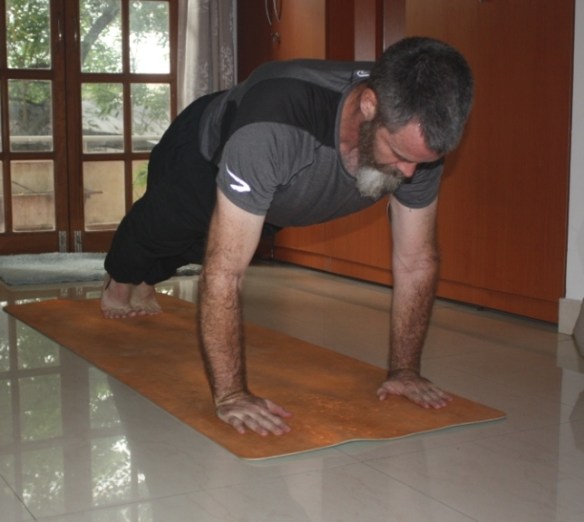
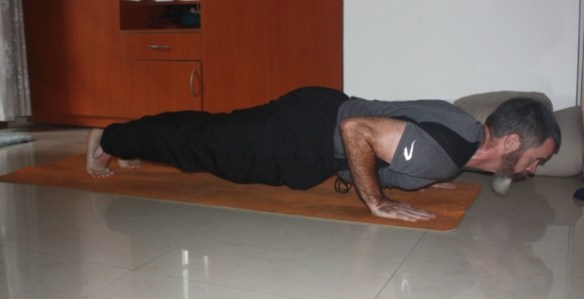
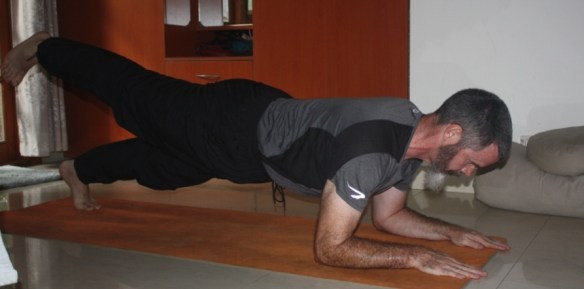
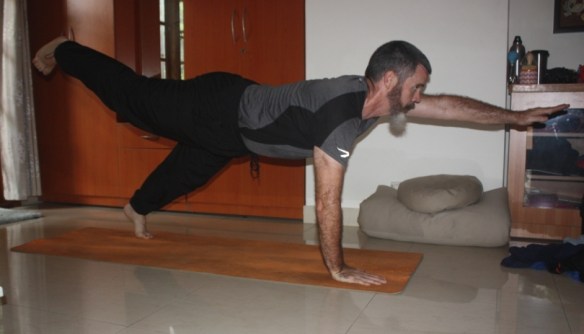
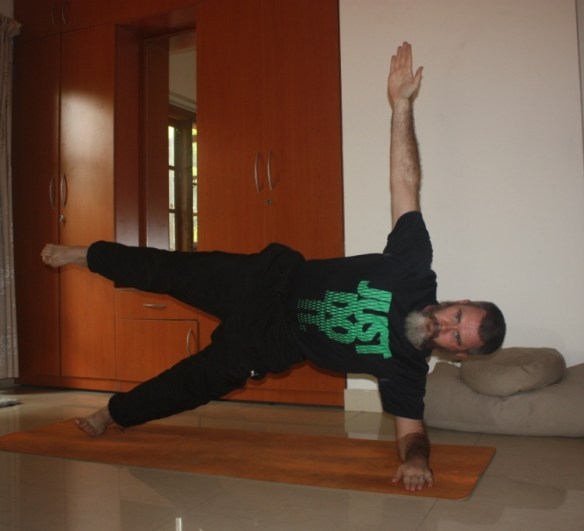
5.) Anything plank (a.k.a. adho mukha dandasana / santolanasana): Who knows how long planks have been a feature of yoga? Plank postures are a fixture in Hatha Yoga, playing a role in most versions of Surya Namaskara (sun salutations), and being used to both to build core strength and to prepare for arm balances.

Planks have also gained immense popularity with calisthenic practitioners. In my gym class days, sit-ups and crunches were the go to ab exercises. No more. Now many bodyweight fitness practitioners are ditching sit-ups and crunches altogether for a number of exercises deemed more effective–include many variations on the plank.

High plank (adho mukha dandasana)


Low plank (chaturanga dandasana)


Forearm plank variation with leg up


High plank variation with alternating limbs extended


Side plank (vasisthasana)


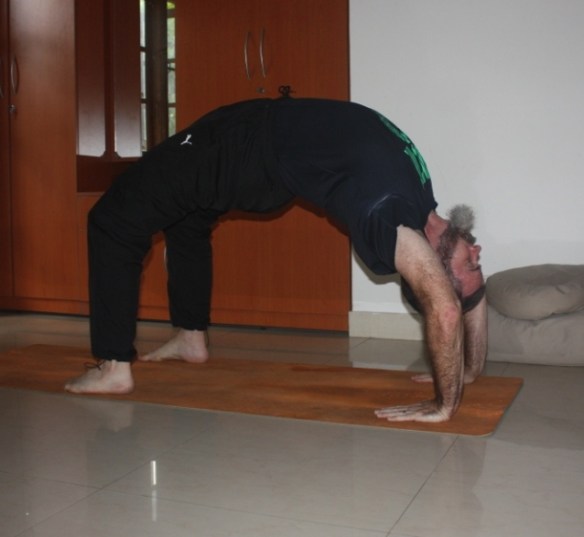
4.) Back bridge (a.k.a. Chakrasana): This is another yoga classic that’s being brought into calisthenics training in a big way. You may note a recurring theme in my selections for this post, exercises and postures (asana) that help to build shoulder joints that are strong, stable, and yet sufficiently flexible. This is a big challenge for bodyweight workout practitioners. One can get stability by bulking the muscles up, but if you don’t have the range of motion to achieve proper alignment, it’s not going to do one a lot of good.

The back bridge (chakrasana, or “wheel pose”)


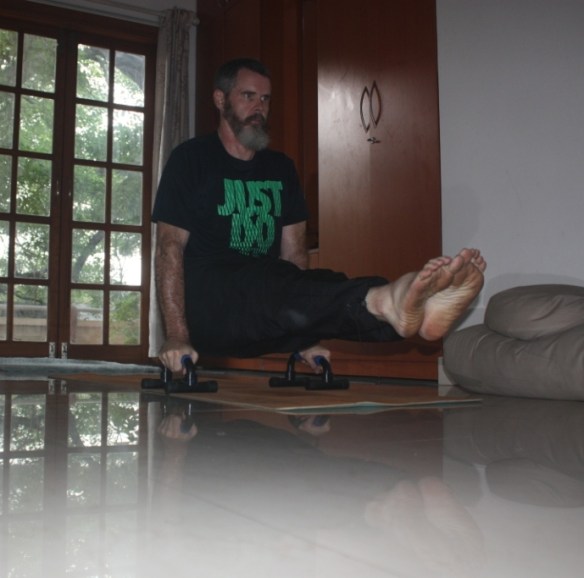
3.) L-sit (a.k.a. Bramcharyasana): Of course, the other recurring theme (besides building shoulder stability) is core strength. This exercise is both a yoga classic and is probably as old as gymnastics itself. Its Sanskrit name, Brahcharyasana, means celibate’s pose–but as far as I’m concerned that’s purely optional.

L-sit (Bramcharyasana)


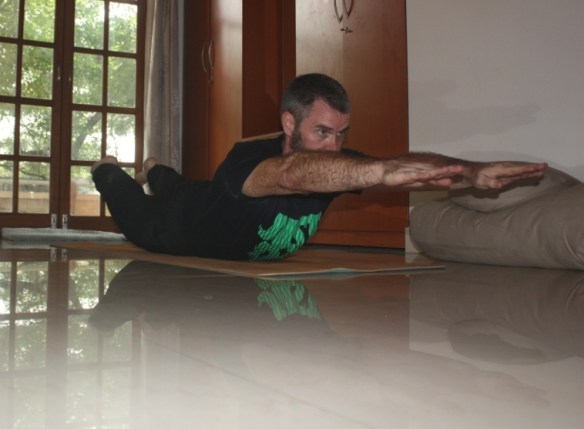
2.) “Supermans” (a.k.a. shalabasana [locust pose]): Another core exercise, but one that strengthens the back muscles.

“Supermans” (shalabasana)


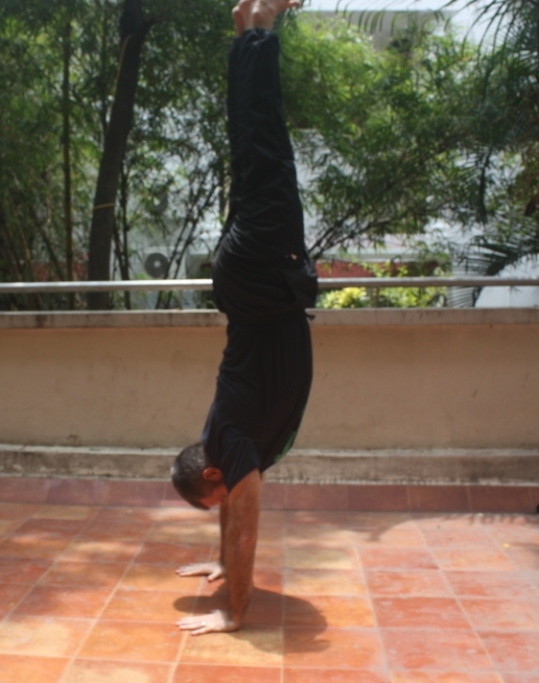
1.) Handstands and Handstand Preppers (a.k.a. adho mukha vrksasana): This practice isn’t just about looking impressive. As mentioned above, it’s hard to build shoulder joints that allow enough stability and range of motion to have the command of one’s body that one would like. Our shoulders are optimized to maximum mobility. That helped our ancestors to be awesome throwers of spears and rocks, but it makes it tough to support our weight in an inverted position. The handstand is a good way to build stability in the shoulders.

Handstand (adho mukha vrksasana)


If it’s too hard, use your legs to stabilize you (but still try to get that straight up-and-down arm position)


If it’s too easy, start doing push-ups