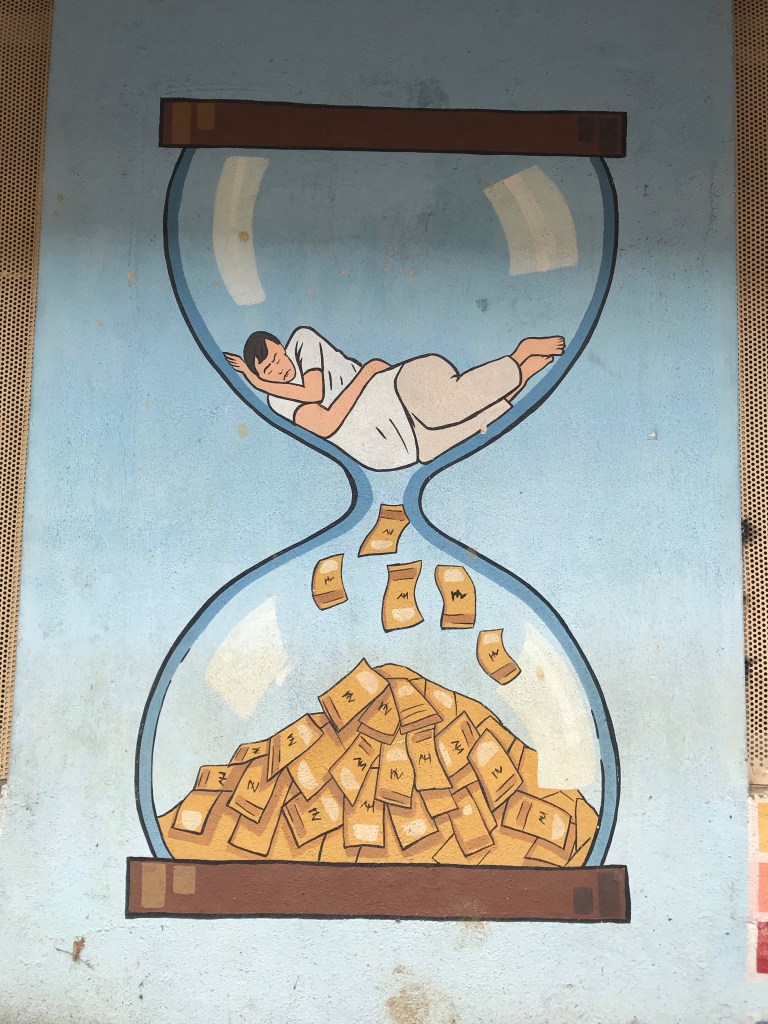
POEM: Mental Weather

My mind experiences unforecastable weather.

Adrift in horse latitudes
Tortured by a polar vortex

Low pressure systems
to
High pressure systems

Storm fronts & storm surges

Partly sunny / partly cloudy
or
Partly cloudy / partly sunny
[Depending upon whether I’m in a glass-half-full or glass-half-empty kind of mood.]

Lightening strikes
Wind shear / wind chill / wind chimes
Squalls
Droughts, often followed by flash flooding
Breezes, blizzards, and breezy blizzards
Microbursts
Flood crests
Nor’easters

Due points and do points [if not a dew point]
Topical depression — though no tropical depressions

Hail storms

Sun Dogs & rainbows

BOOK REVIEW: Functional Training Anatomy by Kevin Carr & Mary Kate Feit

Functional Training AnatomyFunctional Training Anatomy by Kevin Carr
My rating: 4 of 5 stars

Amazon.in page


Exercise regimens that improve the body’s ability to coordinate movements in order to carry out particular actions relevant to the exerciser’s life have increasingly come to be valued in recent years. (Traditionally, fitness regimens often focused on one muscle / body part at a time without an eye toward whether the strengthened muscles worked well together when applied to the required motion – or sometimes regimens focused entirely on how the muscles look.) This book is designed to show muscle activation for a wide range of functional fitness training exercises. It is one volume in a series of anatomy for sports / exercise books put out by the publisher, Human Kinetics.

Each exercise under discussion features an anatomical cut-away drawing showing the muscles that are working, as well as a list of the primary and secondary muscles, a diagram showing which planes are being worked in during the exercise, a step-by-step description of how each exercise is performed, and a brief discussion of what functionality is improved by doing the exercise in question — always with a supporting drawing of a relevant action / motion. Some of the exercises offer a variation.

The book consists of nine chapters. The first chapter gives an overview of what functional training is (and how it contrasts with other approaches,) and provides the necessary background to understand the exercises explanations (e.g. the planes of the body,) the rationale for what exercises are included, and what must be kept in mind with this approach to exercise. Chapters two through five look at various types of exercise, besides strengthening exercises. These include: mobility / flexibility exercises (ch. 2,) motor control / movement preparation exercises (ch. 3,) plyometric exercises and kettle-ball (ch. 4,) and power exercises using heavy weights (ch 5.) Chapters six through eight focus on strength exercises by body part: upper body (ch. 6,) lower body (ch. 7,) and core / rotational strength (ch. 8.) The last chapter provides advice on how to put a program of functional training together.

The book doesn’t include much ancillary matter. The front matter consists of a brief preface, and the back matter provides an “exercise finder,” a detailed index to find the desired exercise rapidly. [The latter has a nice feature. It includes a drawing of the exercise. That’s useful because exercise names, while prosaically descriptive, can often be confusing (e.g. what two trainers call a “hip extension” may vary, though they will both no doubt feature extension of the hip joint in some way.)] There is a page for those who are using the book for Continuing Education (CE) credit that explains what resources are available.

I found this book to be beneficial and educational. I learned a few new exercises, and was provided with some interesting food for thought. The drawings are clear, both in their representation of the exercise and the anatomical cutaways. If you are looking for information on functional training, particularly which discusses muscle activation, I’d recommend you give this book a look.

View all my reviews

DAILY PHOTO: Machu Picchu from a Distance

Taken in the summer of 2010 from the trail to Inti Punku (The Sun Gate.)

BOOK REVIEW: Introducing Ethics: A Graphic Guide by Dave Robinson [Ill. by Chris Garratt]

Introducing Ethics: A Graphic Guide (Introducing...)Introducing Ethics: A Graphic Guide by Dave Robinson
My rating: 4 of 5 stars

Amazon.in page


This is one title in the “A Graphic Guide” series of books, many of which (including this one) are available on Amazon Prime. The books in the series explain fundamentals for a wide range of academic subjects, using simple descriptions supported by graphics. This particular book examines the philosophy of ethics and morality.

The book consists of a large number (almost 130) short topical sections, each with supporting graphics. Each section is just a page or two in length. The book has a chronological flow, moving from Socrates through the Postmodern philosophers. The nature of the topics varies, sometimes it is the view of a particular philosopher or school of philosophy, sometimes it’s a fundamental question or point of contention, and sometimes it’s a specific ethical issue. The last twenty-ish statements elaborate on two specific cases that the book addresses in detail: animal rights and euthanasia.

I felt the author did a good job of laying out a number of fault lines, controversies at the heart of differing views of ethics. The controversy that gets the most attention is that between absolutists and relativists. (Absolutists claim there are a set of core moral rules that are universally applicable, while relativists say one can’t make such rules because the morality of every action is relative, be it: situationally, culturally, or individually. An extreme view from either perspective is inconsistent with what one tends to sees in the real world.) A second point of contention regards whether ethical constraints are determined at the individual level or the societal / tribal / group level? A third controversy consists of a subjectivity versus objectivity divide – i.e. is morality just about what feels right or is there an objective way of defining moral knowledge? A significant portion of the book deals with the rivalries about these points, and – to a lesser degree – others (e.g. is biology the root of ethics or is it a domain devoid of ethics?)

There are cartoon drawings with most of the sections that illustrate key points, and / or depict interactions between rival philosophers. There is a “further reading” section in the back that suggests books to expand one’s grasp of the subject beyond the bare fundamentals that are addressed in this book.

I thought this book did a good job of laying out the issues. The cases (animal rights and euthanasia) helped show how different schools of thought apply their ideas to specific questions. I particularly enjoyed how the book clarified the subject through discussion of key questions of contention. If you have Amazon Prime, it’s definitely worth checking this one out. If not, you may want to see how it compares to the “A Very Short Introduction” guide for Oxford University Press, which is a similar series that explains the basics of a subject in a concise fashion.

View all my reviews

POEM: Leprechaun

I think I saw a Leprechaun,

but it could’ve been a deer.

It seemed quite mean, and was a bit green,

but I’d had a keg of beer.

DAILY PHOTO: Chocolate Hills [Not at Their Most Chocolaty]

Taken in December of 2017 on Bohol in the Philippines

POEM: Agents of Change

They took the Moral High Ground,
commanding its lofty heights.

And never bombed trespassers,
but let them fail on their own.

Some wanted to let their anger show,
to know that they’d struck back.
Those few tumbled from the high ground,
landing in the scree of despot lackeys.

In the end, the powerless, that Juggernaut,
could not be defeated.

For every step usurpers made
shone a harsh light on their souls,

and all the world saw the gruesome image
that was reflected back.

BOOK REVIEW: Civil Disobedience by Henry David Thoreau

Civil DisobedienceCivil Disobedience by Henry David Thoreau
My rating: 5 of 5 stars

Amazon.in page


This 30+ page political philosophy essay argues that it is one’s responsibility to avoid letting the government make one complicit in its unjust activities. The major points of contention for Thoreau were two-fold: state facilitation of the institution of slavery and the Mexican-American War (which Thoreau – like many – saw as a shameless land grab.) Thoreau put his money where his mouth was, and was briefly jailed for failure to pay taxes. [This brief stay might have been much longer had not someone paid the tax bill without Thoreau’s knowledge. While Thoreau doesn’t name said individual (if he ever knew who it was,) he treats that person as someone who did a bad deed in his name rather than someone to be thanked.] The discussion focuses heavily on tax-paying (or, rather, non-payment) as opposed to other acts of civil disobedience / passive resistance / non-violence such as breaking unjust laws.

This essay has been cited as an influence by Mahatma Gandhi, Martin Luther King, Jr., Leo Tolstoy, and many who are less well-known as proponents of non-violent resistance against oppressive or unjust governance. While the meeting of unjust governance with passive resistance has shown itself to be a powerful strategy in the intervening years, Thoreau was at the vanguard of thinking on this issue. Later activists would expand the domain of civil disobedience greatly, and it would become more explicitly associated with non-violent opposition. [Thoreau doesn’t talk up the virtue of avoiding violence like Gandhi does, but he also doesn’t mention violence as an alternative to his approach — and it seems he would find violent acts as morally reprehensible as supporting the government in its acts of aggressive violence.] I would be interested to know the following of this essay by different elements of the political spectrum today, and how that following was influenced by those who took up its banner. [It has a libertarian “the government is fundamentally untrustworthy” vibe going, but I suspect it is probably popular with elements the left who generally view the government as a savior against corporations, given the essay’s past proponents. Though I could be wrong.]

Thoreau doesn’t focus on his own case, which he only gets to well into the essay and which he addresses in quick manner. Rather, he spends most of the essay discussing the justification for breaking the law (i.e. not paying taxes) and what is moral and proper and what is not. [e.g. He says that he pays the highway tax because his desire to be a good neighbor matches his desire to be a poor subject. [paraphrased.]] Obviously, it’s a nuanced issue. If no one paid their taxes who had a gripe with the government, it might just result in everyone finding a gripe with the government – in perpetuity. Thoreau, himself, has quite a negative view of government’s ability to be just. While his focus is on abolition of slavery and the war with Mexico, it’s not as though he proposes that these are exceptional and uncharacteristic cases.

Though it is short, this essay can be obtained as a standalone work (as it’s reviewed here,) but it’s also included in many Thoreau collections and political philosophy anthologies. Like it or lump it, it’s definitely worth reading because it addresses some pretty fundamental questions about what an individual’s responsibilities are to the government as well as what are one’s responsibilities to resist the government’s activities.

View all my reviews

DAILY PHOTO: Tarsier Naptime

BOOK REVIEW: Dark One, Vol. 1 by Brandon Sanderson

Dark One Vol. 1Dark One Vol. 1 by Brandon Sanderson
My rating: 5 of 5 stars

Amazon.in page

Out: May 5, 2021


This Fantasy graphic novel tells the story of a young man, Paul, who is in therapy for mental health issues, in our world (or an indistinguishable facsimile of it,) that is. However, it seems that the most pressing of Paul’s symptoms, hallucinations, result from bleed over from an alternate reality, a world called Mirandus. Mirandus is a quintessential Fantasy genre world with kings and castles, magic and monsters, and feudalism and fierce warriors. While the artists and writer take efforts to present a unique rendering of a Fantasy realm, in a way it’s a clear-cut and emblematic example, with – literally – forces of light arrayed against forces of darkness.

Mirandus is governed by something called “The Narrative.” I couldn’t decide whether that was too on-the-nose for a storybook world, or whether it was a clever way of hinting at the true nature of this alternate reality. (There are a number of other elements that make blatant the storybook qualities of Mirandus.) Whether it’s too on-the-nose or not depends on how one sees what is going on in the story. I mentioned the straightforward interpretation of the story – i.e. Paul thinks he’s mentally ill but then he’s drawn into another realm, one in which his symptoms are shown to have been a ghostly other-realm visitor, as well as repressed memories and general confusion. That’s the interpretation of the story that seems to be meant to achieve traction with readers, at least there are a lot of little pieces of supporting evidence for it. There are other ways of interpreting this scripted storybook world.

An alternative that one might consider is that Paul has had a full-blown psychotic breakdown and the events in Mirandus are a much more intense kind of hallucination as Paul works through the throes of flipping out. This interpretation doesn’t work as smoothly [but, it shouldn’t.] It leaves many questions unanswered while those of the main interpretation are reconciled by the narrative as we see it. Paul’s mind would definitely be working overtime to do things like build a backstory for the sister he’s been hallucinating. However, the explicitly storybook quality of Mirandus makes it feel more likely that it would be made up by a Fantasy reader than that it’s a real world that is the quintessence of a gritty fairy tale. [It’s worth noting that the [unlikely] psychotic break interpretation would be necessarily messier as the narration becomes unreliable and all clarity is lost.]

The story has a lot to say about fate and destiny, and the degree to which those concepts reflect reality.

I found the art to be easy to follow and nice looking. As I said, it walks a line between the novel and the familiar quite well. The “hallucinations” are very clearly differentiated from the real-world action. The sibling dynamic between Paul and his ethereal sister is nicely portrayed – even though he has no childhood memories of her through most of the story.

There is a sub-plot involving the main character’s mother, a lawyer who is defending a serial killer, a man who is not what he seems. However, this subplot is meant to set up continued action through the subsequent volumes. While the subplot generates some intense moments and intrigue, it does not pay off in this volume as a story (i.e. having a climax and resolution.) That said, I liked that the main plot does pay off. We know from the “Volume 1” subtitle that this will be a serialized story, and so it’s certainly necessary to have some continuing intrigue. However, too often, serialization means that one is given a tiny speedbump or a big cliffhanger in lieu of a proper resolution. This book did resolve the main storyline. [Thus, avoiding running afoul of my firm policy about never continuing a series – multi-volume book or multi-season tv – that doesn’t resolve in the volume (or season) under review – if they don’t do it in a given volume / season, how likely are they to do so in the end? Not very, I feel.]

I enjoyed this story. If the set-up intrigues you, it’s definitely worth giving a read.

View all my reviews