Crab [Lyric Poem]

Not sure whether to call the crab "monstrous," 
Or, rather, to class it "preposterous?"
Claw outsized, staggering like drunken ants,
If I saw one dog-sized, I'd crap my pants.

“The Bridge” by Henry Wadsworth Longfellow [w/ Audio]

I stood on the bridge at midnight,
As the clocks were striking the hour,
And the moon rose o’er the city,
Behind the dark church-tower.

I saw her bright reflection
In the waters under me,
Like a golden goblet filling
And sinking into the sea.

And far in the hazy distance
Of that lovely night in June,
The blaze of the flaming furnace
Gleamed redder than the moon.

Among the long, black rafters
The wavering shadows lay,
And the current that came from the ocean
Seemed to lift and bear them away;

As, sweeping and eddying through them,
Rose the belated tide,
And, streaming into the moonlight,
The seaweed floated wide.

And like those waters rushing
Among the wooden piers,
A flood of thoughts came o'er me
That filled my eyes with tears.

How often, O, how often,
In the days that had gone by,
I had stood on that bridge at midnight
And gazed on that wave and sky!

How often, O, how often,
I had wished that the ebbing tide
Would bear me away on its bosom
O'er the ocean wild and wide!

For my heart was hot and restless,
And my life was full of care,
And the burden laid upon me
Seemed greater than I could bear.

But now it has fallen from me,
It is buried in the sea;
And only the sorrow of others
Throws its shadow over me.

Yet whenever I cross the river
On its bridge with wooden piers,
Like the odor of brine from the ocean
Comes the thought of other years.

And I think how many thousands
Of care-encumbered men,
Each bearing his burden of sorrow,
Have crossed the bridge since then.

I see the long procession
Still passing to and fro,
The young heart hot and restless,
And the old subdued and slow!

And forever and forever,
As long as the river flows,
As long as the heart has passions,
As long as life has woes;

The moon and its broken reflection
And its shadows shall appear,
As the symbol of love in heaven,
And its wavering image here.

Giraffe Headbutts [Lyric Poem]

I was warned giraffes like to give headbutts.
I told the man, "You must be nuts!
Even if true, my head 's far too low."

"That's why we built a tower, now up you go!"
Tower built at the Giraffe Centre to put humans at headbutt level.

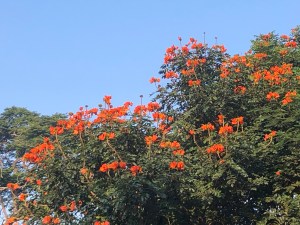
DAILY PHOTO: A Strange Plant Stumbled Upon in the Savanna

Image

Warthog [Lyric Poem]

Given that "warts" and "hogs" are both unloved,
Why not prybar letters, together shoved?
A well-placed dash might do the trick,
Would "War-Thog" sound too sci-fi bombastic?

BOOKS: “Taoism: An Essential Guide” by Eva Wong

Taoism: An Essential GuideTaoism: An Essential Guide by Eva Wong
My rating: 4 of 5 stars

Publisher Site

This book offers the reader clarity about the scope of Taoism, a daunting challenge given Taoism’s long history and how it overlaps with other schools of philosophy as well as with Traditional Chinese Religion, more broadly. The book is divided into three parts: history, specialties (magic, divination, ceremony, inward training, and karma yoga,) and practices (meditation, somatic practices [e.g. qi gong and taijiquan,] and rituals and ceremonies.) The history section covers a period from pre-Taoist shamanic practices of 5,000 years ago, practices that would inform early Taoism, to a period during which Taoism became entwined with Buddhism and Confucianism. The specialties and practices sections attempt to give the reader a broad overview while avoiding discussion of “how-to.”

I found this book to be informative and interesting. It did feel more effectively geared toward someone with an interest in Taoism as religion rather than Taoism as a philosophy. The discussion does sometimes get into the weeds on issues like ceremonies and talismans (again, not in a how-to fashion, but with some arcane detail nevertheless,) but — at the same time — besides some discussion of the teachings of the Tao Te Jing and some exploration of Taoist metaphysics in the Divinational Taoism chapter, there’s not a lot of insight into Taoism as philosophy. That said, it does end each chapter with a “Further Reading” section that can point readers interested in a specific topic elsewhere.

If you’ve ever been overwhelmed at one of those bright and complicated Chinese temples and would like some insight into what Taoists do and how it’s different (or not different) from what Confucianists, Traditional Chinese Religion practitioners, and Zen Buddhists do, this is a good book to check out. If you’re solely interested in Taoism as a school of philosophy or otherwise have a specific focus such as qi gong and breathwork practices, you can probably find books that are better tailored to your needs.

View all my reviews

“They shut me up in Prose–” (445) by Emily Dickinson [w/ Audio]

They shut me up in Prose --
As when a little Girl
They put me in the Closet --
Because they liked me "still" --

Still! Could themself have peeped --
And seen my Brain -- go round --
They might as wise have lodged a Bird
For Treason -- in the Pound --

Himself has but to will
And easy as a Star
Look down opon Captivity --
And laugh -- No more have I --

Marmot [Lyric Poem]

I came across a chubby marmot
In some puffed up outer garment.
A fur coat over its furry coat?
Or mainlining from the gravy boat?

DAILY PHOTO: Drum Tower [鼓楼] of Beijing

BOOKS: “Language” by Xiaolu Guo

LanguageLanguage by Xiaolu Guo
My rating: 5 of 5 stars

Publisher Site

This book is excerpted from a full-length novel entitled, A Concise Chinese-English Dictionary for Lovers, and it conveys what it’s like to be a stranger in a strange land — particularly when one has only a rudimentary grasp of the local language. Specifically, the story revolves around a young Chinese woman who moves to London to pursue her studies. In London, the young woman becomes involved with an older man, and much of the story looks at how culture — and particularly language — impacts the nature of the relationship. (And, also, how being in a relationship with a native of her new home impacts her language learning.)

Perhaps the most important factor influencing whether a reader will like or loath this book is how one feels about reading broken English. Like the dialectic poetry of Paul Laurence Dunbar, this book isn’t written in grammatically correct standard English. The broken – “learner’s” – English is quite effective at conveying the struggle of language learning and how culture and language are intertwined. But if reading grammatically incorrect writing gives you a headache, then this book is not for you.

As for why this book consists of excerpts, it’s part of a series called “Vintage Minis” that consists of short (or excerpted) works from prominent authors from around the globe, generally with a straightforward unifying theme. [Vintage Classics is an imprint of Penguin Random House.] The fact that the book was an excerpt didn’t create a problem for me. The origin material is a literary fiction novel and doesn’t seem to be significantly plot-driven. It’s much more character-driven, and thus getting a limited picture doesn’t open up a lot of unanswered questions about what will come next. In other words, it felt like it could have been a full piece of short, character-driven literary fiction.

I enjoyed reading this slim volume. I think it offers interesting insight into being a language learner abroad. If you’re interested in the challenges of language and culture in an unfamiliar place, this thin book is well worth reading.

View all my reviews