TODAY’S RANT: Viral Video Advertising

I recently saw this posted on Facebook. I, being a doofus, believed I had stumbled upon the black box recording that would show archaeologists the moment it all went sour for the human race– the dawn of the rise of the apes. As soon as our self-aware brethren learn to take our technology and use it against us, we are surely doomed. Being damned dirty, the apes will own humans. [Participle dangle intended.]

Of course, I felt compelled to do a Snopes check because– believe it or not– sometimes people put things on the internet which are fake. I know, I know, hard to believe.

It turns out the video is a piece of viral advertising for the next Planet of the Apes movie. “Lesser” primate use of technology is still about right here:

Viral advertising is the latest craze. One leaks intriguing footage onto YouTube and doesn’t label it or say what it is.  Then you hope a bunch of schmucks fall for it, and they will– because that’s the defining characteristic of we schmucks. It’s tautological.  This kind of video will stick in one’s mind and get more media attention than would a regular trailer.

The problem is that movie-makers have the ability to make really convincing fakes. (That’s what they do.) My well-read reader will certainly have heard of the Orson Welles War of the Worlds incident. People who didn’t hear the beginning of the broadcast, which was formatted like a news bulletin, freaked out about the alien invasion. Some people jumped out windows (why, I have no idea. I don’t think they thought the value of that through.) Some people fled to Canada (assuming, of course, that the aliens wouldn’t be interested in that icy wasteland.)

My problem with all this isn’t that people are duped; it’s the “boy who cried wolf” effect. One day when we’re under attack by aliens, apes, or artificial intelligence, people are going to be like, “Dude, that’s a really convincing looking ray-gun… NOT!”

BOOK REVIEW: Cat’s Cradle by Kurt Vonnegut

Cat's CradleCat’s Cradle by Kurt Vonnegut

My rating: 5 of 5 stars

Cat’s Cradle is Vonnegut at his most brilliant and witty.

The book follows a writer, John/Jonah, as he does research for a book on the Hiroshima A-bomb. To learn about the (fictitious) inventor of the bomb, the deceased Felix Hoenikker, he interviews  Hoenikker’s children and former supervisor. In the process he becomes entangled in global catastrophe in a way he couldn’t have imagined.

As it turns out, Hoenikker had invented another weapon of mass destruction, one that would make the H-bomb look like a firecracker. However, ice-9, as the weapon was designated, wasn’t intended as a weapon at all. Ice-9 turns all water into ice at temperatures below 114 degrees Fahrenheit. The idea was to make marshes crossable by Marine Corps units. It’s the failure to anticipate the ramifications of using such a chemical, i.e. the hydrologic cycle, that’s the central premise of this book.

A lot of the book deals with a fictitious religion called Bokononism. Bokononism is the cynical faith of the Island of San Lorenzo, and it perfectly reflects Vonnegut’s mildly misanthropic attitudes. The first sentence of the Book of Bokonon says it all, “All of the true things I am about to tell you are shameless lies.”

At the beginning of Cat’s Cradle we find out that John is a Bokononist, but that he’d grown up a Christian. Bokononism is prohibited on the island by the dictator, Papa Manzano. The reader comes to discover that not only is the prohibition a fraud designed to give the religion more sex appeal, but also that Manzano is a practitioner himself. This is just one of the quirky oddities that defines life on San Lorenzo.

It’s when John and all the Hoenikker children are assembled in San Lorenzo that the action really unfolds. Manzano is dying and turns the presidency over to Franklin Hoenikker (the non-midget son of the father of the bomb); Manzano later commits suicide in the oddest imaginable way. Franklin convinces John to take the presidency, but it becomes moot as the book approaches climax.

I’ll leave you with my favorite piece of Bokononist wisdom, “Peculiar travel suggestions are dancing lessons from God.” By the way, you should go to San Felix island off the coast of Chile. [Picked via a spinning globe.]

View all my reviews

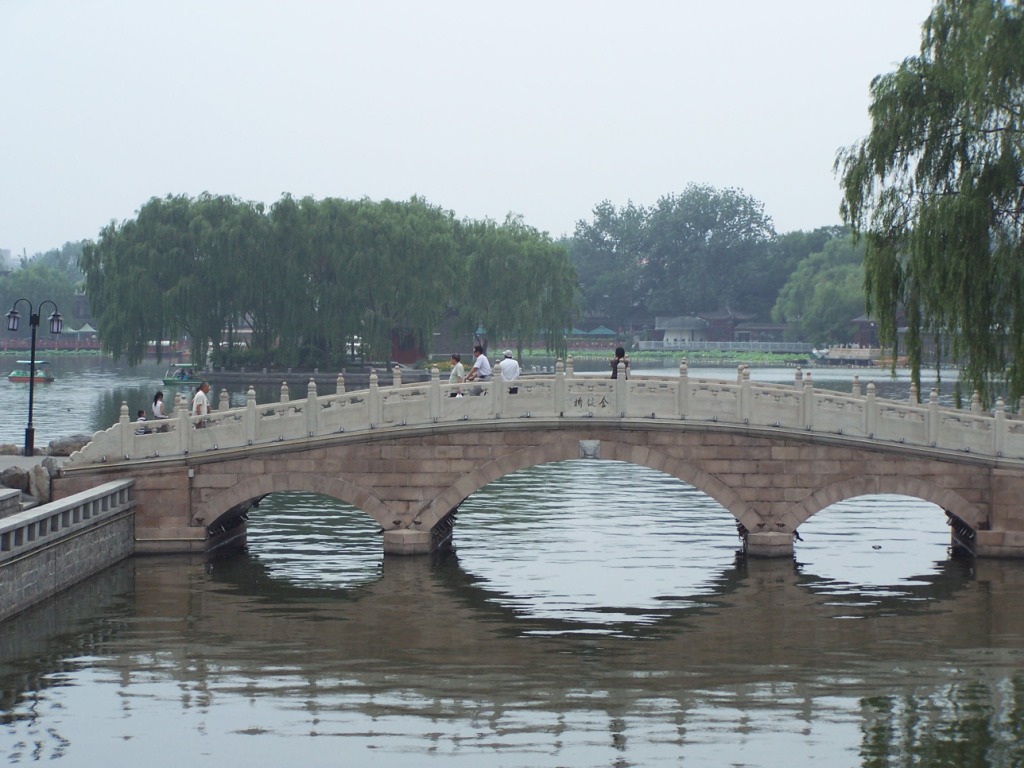
DAILY PHOTO: Back Lake Bridge in Beijing, China

Back Lake in Beijing

Back Lake in Beijing

This was taken in 2008. Beijing is such a pretty city… when the smog lifts and one can see it.

BOOK REVIEW: Ishmael by Daniel Quinn

Ishmael: An Adventure of the Mind and SpiritIshmael: An Adventure of the Mind and Spirit by Daniel Quinn

My rating: 4 of 5 stars

A man answers an ad that says, “Teacher seeks pupil. Must have an earnest desire to save the world. Apply in person.” Expecting to find a charlatan, the man is surprised to find his new teacher is, in fact, a gorilla.

Like Socrates, this gorilla, Ishmael, uses questions to guide his pupil toward crucial knowledge. Ismael teaches his student to challenge some of his most deep-seated beliefs such as, the world was made for humans, humans are the ultimate culmination of biology, humans are inherently separate from (and above) nature, and that humans are fundamentally flawed in such a way as to make ruination of the planet inevitable.

The core of the book differentiates two human cultures. The author calls them the “takers” and the “leavers,” but they correspond to what we might call “us” and the “aboriginal peoples.” Takers are specialized, agricultural, and technologically advanced (if you’re reading this review on a computer and not chiseled on a cave wall, you, my friend, are a taker.)

The lives of “Leavers” aren’t that different from those of humans 10,000 years ago. They are tribal as opposed to (to borrow Desmond Morris’s term) super-tribal. [In a tribe everyone knows everyone else. Morris suggests that things go to shit –re: war, crime, and deviant behavior– in super-tribal societies.] Leavers live like animals in that they tend towards equilibrium within their ecosystem. Takers do not.

If you long for thrillers or potboilers, this isn’t the book for you. It’s a thinking person’s book. The nice thing about Ishmael’s use of the Socratic method is that one can think through the questions in parallel to the narrator’s discovery. In this way, the reader can install himself or herself into the conversation.

At the most generic level, the book’s value is in showing one how much one takes for granted. We can’t see forests for trees.

One may agree or disagree with the author, but either way one will be subjected to powerful food for thought. Some of the discussion may evoke a visceral emotional reaction that one may have trouble reconciling with logic, such as the discussion of the morality of feeding the starving.

The downside of the book is that the dialogue can be strained in places and it can get a bit repetitive. The latter serves to reinforce key concepts, but some of them feel as though they are reinforced inordinately. In making the narrating protagonist struggle, Quinn creates a lead who seems a bit dense sometimes. Also, as I indicated, the journey is by-and-large in the mind, and so the tension is limited. There is some drama when the narrator shows up one day to find that Ishmael has been evicted. However, this is resolved without too great a difficulty and they resume lessons with  Ishmael’s irritability being the only change to be seen. There is drama at the end that will remain unspoiled herein.

I’d recommend this book as a thought-provoking exercise for the mind.

View all my reviews

DAILY PHOTO: Grand Plaza, Tikal, Guatemala

Taken from Temple II

Taken from Temple II

The Grand Plaza comprises two temples towers that face each other, Temples I and II, the manicured courtyard between them, and these buildings off to the side. This photo is taken from atop Temple II.

I like to visit Mayan sites. As with Angkor, I feel that this is a good way to mentally prepare myself for the day our own civilization collapses.

Tikal was one of my favorite Mayan sites, mostly because it was the only large-scale site we could visit in peace. When we were at Chichen Itza, the hawkers were ubiquitous and weren’t above following one around. I don’t recall being bothered at Tikal at all.  Of course, it’s been a many years since I visited.

TODAY’S RANT: Stupid is as Cupid Does

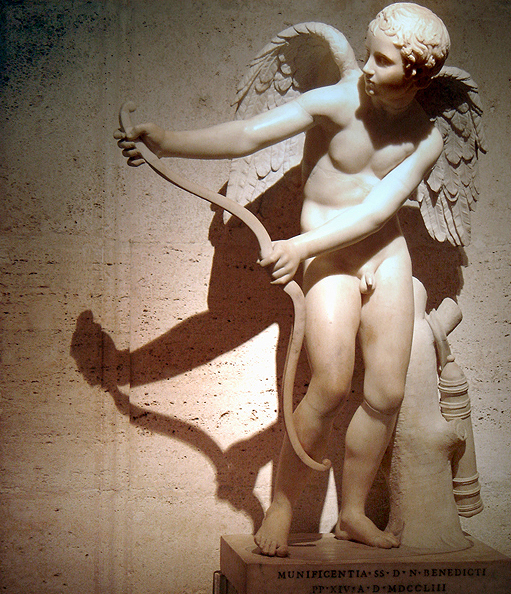
Attribution: Ricardo André Frantz Nothing says lovin' like  a prepubescent archer.

Attribution: Ricardo André Frantz
Nothing says lovin’ like a prepubescent archer.

This isn’t a generic rant about Valentine’s Day. I am not the curmudgeon of ardor or the Grinch of St. Valentine’s Day. All I’m saying is that nothing is less sexy than a naked baby archer.

I guarantee that if you polled paramedics who’ve responded to bow-hunting accidents, none would say that their patients reported sexual arousal as a symptom of arrows sticking out of thighs. How being impaled with a razor-sharp implement came to be associated with the transmission of love, I’ll never know. Yes, little boys have been known to sock a girl they like in the deltoid, but breaking out the device single-handedly responsible for Mongol hordes sweeping across Eurasia is taking that dysfunction up a notch.

I have no problem with nudity. Nudity and erotic love is like getting your chocolate in her peanut butter– so to speak. My problem is with prepubescent nudity. All that does is remind one of the end product of amour, and that’s terrifying, not arousing. No one needs that kind of pressure in a budding relationship.

I know I said this wasn’t a blanket condemnation of the holiday, but I’ve got one more sub-rant. What is with flowers and chocolate as the iconic gifts of the holiday? Is it that nothing says everlasting love like a bouquet that will be shedding wilted petals by day’s end. And chocolate says, “I love you so much that I’ll even love you if you get fat. Furthermore, I’m willing to prove it by doing my damnedest to make you fat.”

I won’t even get into the jewelry ads. “Show her you love her by implying that you think she’s in it just for the swag.”

TODAY’S RANT: Continuity Gaffes

For those unfamiliar, a continuity gaffe is a mistake in a movie in which something that shouldn’t change from one instant to the next does. They result from movies being shot over many days in an order unrelated to how the film unfurls before the viewer. Take an example, say a brawler is wearing a green shirt, they cut away to the other fighter, but when they flash back he’s an orangutan in a bikini. If it’s still not clear what I’m talking about, the YouTube clip below shows a horde of gaffes from the first Star Wars trilogy.

Now, from the title of this post, you probably think that I’m some sort of obsessive-compulsive nerd who catches every little niggling mistake in a movie. To this I say, I wish! I’m a not-the-least-bit-compulsive nerd. I don’t catch any movie continuity gaffes– not a single one. Sure, I can see them when they’re circled and the film is run in slow motion, but otherwise I’m clueless. This has made me wonder if there isn’t something defective with my brain. When they are pointed out they seem pretty glaring.

What really bothers me is not that I never catch a continuity gaffe in a movie, but rather that I catch them in my real life all the time. I’ll distinctly remember setting my keys down on the valet, but after a thorough search I’ll find them in the freezer. I’ll remember having written a paragraph, but when I come back to my laptop I find nothing but the cryptic message, “xzsawrwddd&&ppPPP.” I’ll put down Shakespeare’s Sonnets and when I pick the book back up, it’s a James Patterson novel.

I’ve developed two competing hypotheses to explain these gaffes. First, I’m in the Matrix, and Mr. Smith is corrupting the code. Second, my secretly super-intelligent cat is fucking with me.

BOOK REVIEW: The Sun Also Rises by Hemingway

The Sun Also RisesThe Sun Also Rises by Ernest Hemingway

My rating: 4 of 5 stars

Get Speechify to make any book an audiobook

Whatever the blurbs or critics might say, this book is about the raft of men left in the friend-zone after brief dalliances with Lady Brett Ashley. One may have been led to believe it’s about the life of Jake Barnes. Barnes is the lead character, but he’s not the most influential character.

Besides Barnes, the list of men who fall hard for Lady Brett Ashley include, boxer Robert Cohn, the bankrupt Michael Campbell, and the bullfighter Pedro Romero. Oddly enough, the physically toughest, Cohn, is the one who falls the hardest. Barnes may be the strongest in this sense; perhaps because his relationship with Ashley is over before the novel begins. Barnes comes off as likable with a pragmatic “live and let live” nature. (He can maintain a friendship with a woman that he loves, a feat that seems beyond Cohn’s ability. Campbell is used to having lost everything, and so seems to bob comfortably in Ashley’s wake. We don’t reliably learn about how Romero takes it.)

As the blurb says, The Sun Also Rises is about a journey from Paris to Pamplona. In Paris, the cast of Lost Generation friends hang out in cafés. In Pamplona they attend bullfights. In between, Barnes goes fishing with friends.

In a broader sense, the book is about dissatisfaction and restlessness, and not only within Ashley. This is summed up nicely by Cohn’s words to Jake, “Don’t you ever get the feeling that all your life is going by and you’re not taking advantage of it?”

Of course, the book shines in its language. Hemingway’s lean buy meaty prose is readable and engrossing. The minimalist dialogue beautifully conveys the interaction of a group of intimate friends.

Here’s a great line that captures the character of Hemingway’s writing in this book, “The beer was not good and I had a worse cognac to take the taste out of my mouth.”

The book rises to crescendo with the Pamplona bullfights and Hemingway adeptly ends on a sad note apropos of the morning after a great party.

View all my reviews

DAILY PHOTO: Downtown Debrecen

Aranybika Hotel

The Aranybika (Golden Bull) Hotel is one of the most prominent landmarks of Debrecen, Hungary. The Golden Bull is alternatively an important edict of 1222 or a soccer team. The hotel was built in 1915 in the secessionist style.

Debrecen is the second largest Hungarian city at 200,000+ residents. In 2002, I attended an intensive language course affiliated with the University of Debrecen. The building in which I was taught was  near this square, across and down the street.

If you are interested in learning Hungarian, I’d highly recommend the school I attended, the Debreceni Nyári Egyetemen.

A Dude’s Attempt to Master Pad Thai

On a trip to Thailand last fall, my wife and I did a one-day cooking class in Chiang Mai. That day I made the perfect batch of pad thai. (For the uninitiated, Pad Thai is “noodles Thai-style.” It’s one of the more popular dishes at your local Thai restaurant. If you don’t believe me, go check. I’ll wait.)

Anyway, I preceded at home to make 35 batches of pad thai that bore little resemblance to food. That’s not true. Only the first five dishes were fundamentally inedible, the next thirty were tasty enough– they just didn’t taste like pad Thai. A poor cook might blame the difference on the variation in ingredients between Thailand and home. However, I have a sneaking suspicion the cooking school staff was slipping good cooking into my dish while I wasn’t looking. They’d say, “Godzilla” and point, and I’d turn (because one can’t take a chance that close to the Pacific), and when I turned back around the contents of my wok would look and/or smell better.

If making mac-n-cheese from a box, microwaving a HotPocket, or grilling a burger aren’t counted as cooking, then you might say that my experience with cooking was nothing. However through an extensive process of error and error, I arrived at delectable pad thai.

Below is what you’ll need.

Ingredients

Ingredients

First, for the anal retentive types who’ve noticed that I took this picture on top of the washing machine, that was solely for lighting purposes. This process in no way involves use of the washing machine. It’s not one of those clever recipes like cooking fish in the dishwasher. I’m serious, under no circumstances are you to attempt to use your washer in the making of pad thai.

In list form, what you’ll need is:
– 2 Tablespoons of oil (anything but olive)
– 4-ish cloves of garlic (more if you have a vampire-infestation problem)
– shrimp (several to many)
– chicken (one to two tenders’s worth; like the size of tender they give you at Applebees or Chilis– NOT McDonalds, i.e. a swanky tender)
(substitute tofu if you’re one of those quasi-vegetarians who count chicken as animal but don’t count shrimp/fish.)
– egg (1)
– 2 Tablespoons fish sauce
– 1-1/2 teaspoons sugar
– rice noodles (about 2 ramen packets worth, not that you should buy it that way)
– crushed peanuts (3 heaping Tablespoons)
– spouts (1 cup-ish. Normally this is soy or mung bean sprouts, but I’ve substituted Alfalfa sprouts because they work fine and last longer in the fridge.)
– spring onions or chives or something green and oniony (1-cup-ish)
– 1/2 a lime

Step 1: Heat your oil in a wok. Get it hot enough so that when you throw the garlic in, it’ll sizzle. This will make you feel more chef-like.

Sizzling garlic

sizzling garlic

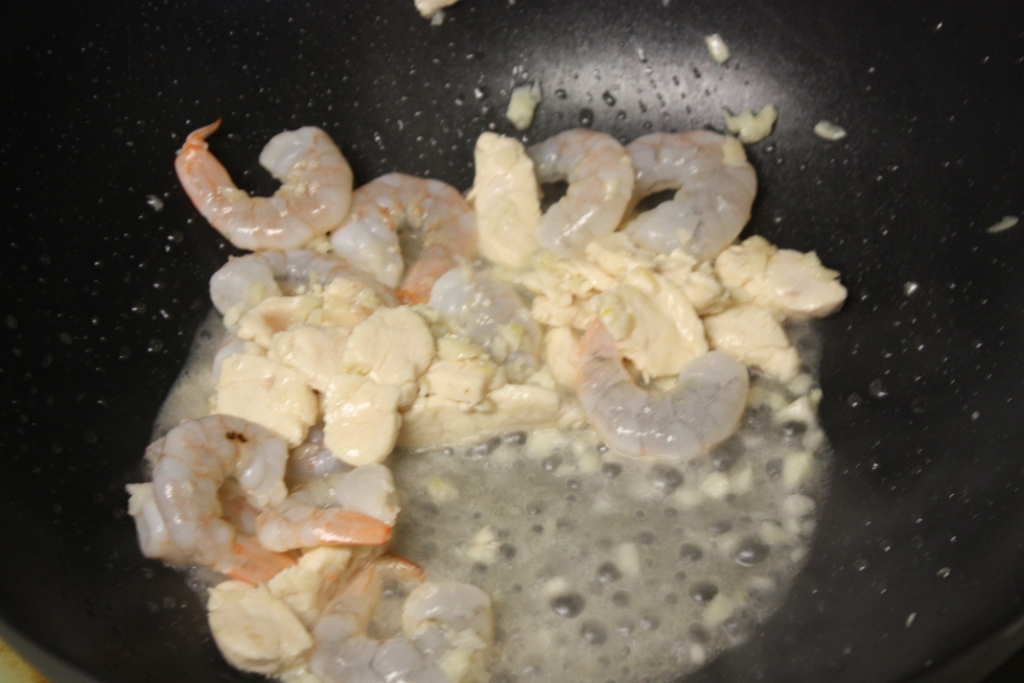
Step 2: Add the animal stuff. Put the chicken in first, it takes longer than the prawns.  If you’re using tofu, put it in after the shrimp (tofu won’t cause you severe debilitating diarrhea if it’s under-cooked. [I don’t think, but I have no idea what I’m talking about. Although I do suspect one shouldn’t refer to diarrhea at any point in a food blog post.])

chicken and shrimp (lamest superhero duo ever.)

chicken and shrimp (lamest superhero duo ever.)

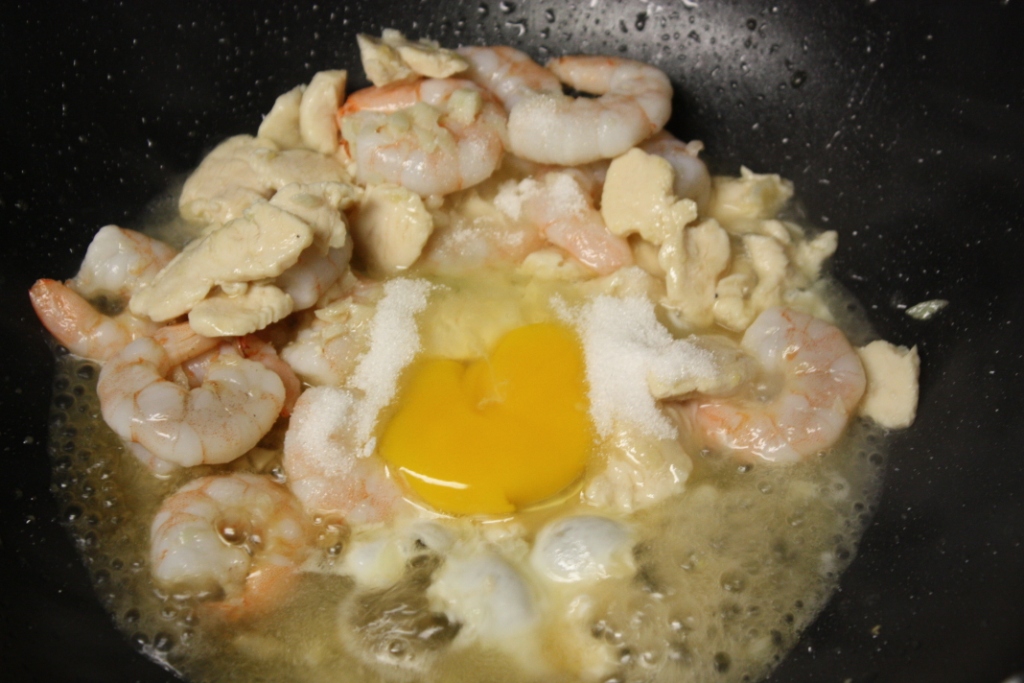
Step 3: Add the egg, fish sauce, and sugar. Scramble the egg up good, and mix everything together.

Egg, fish sauce, and sugar

egg, fish sauce, and sugar

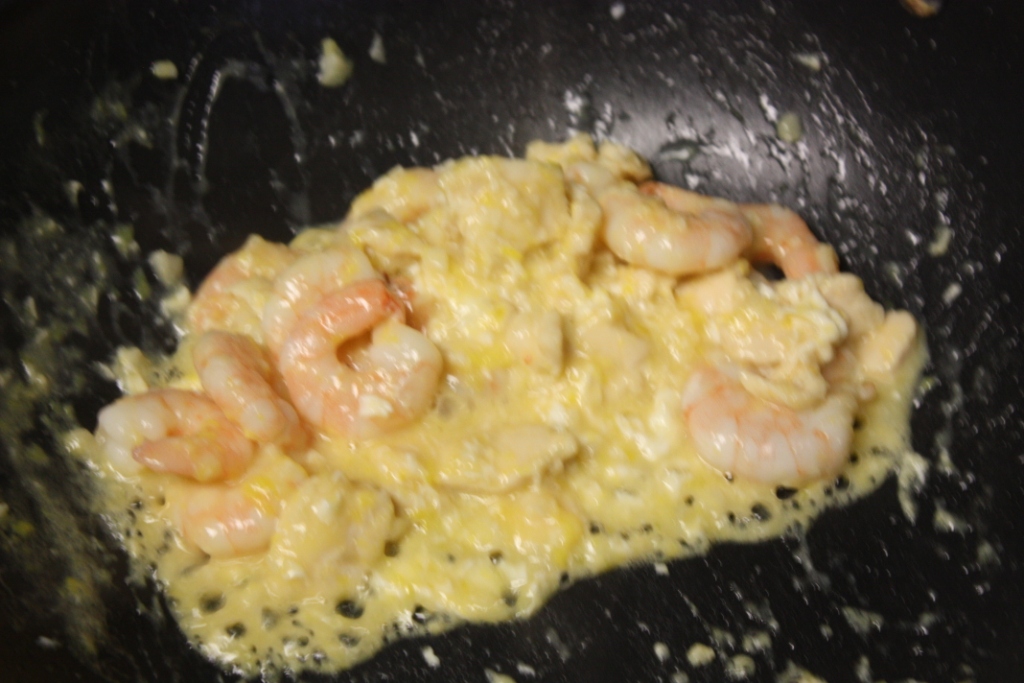
prawn scramble

prawn scramble

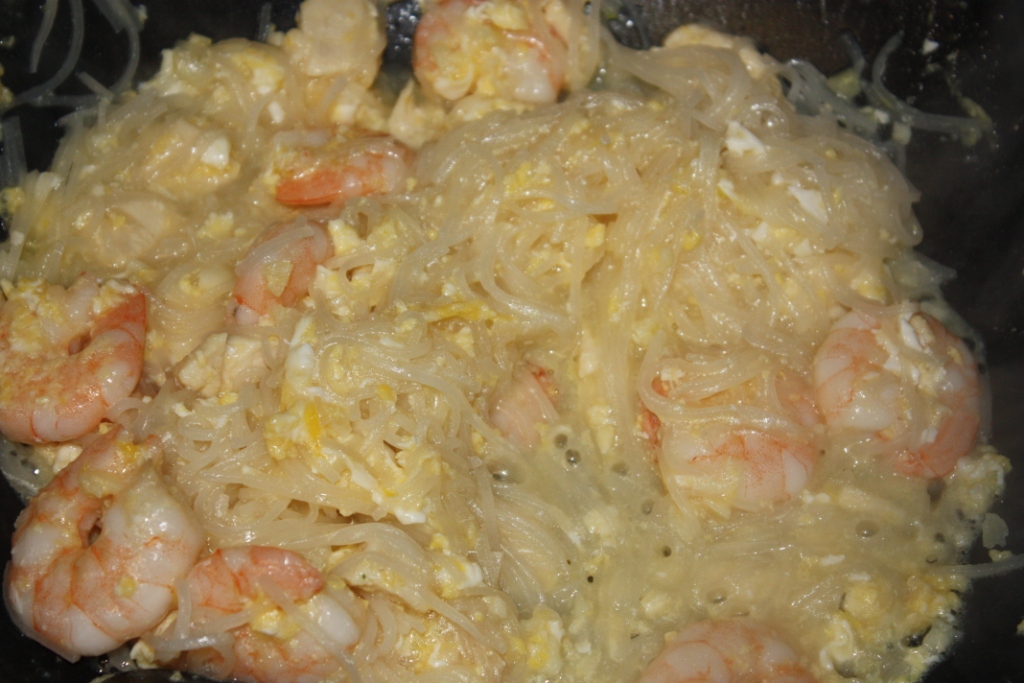
Step 4: Add the noodles. This is the trickiest part of all. First, they make a lot of different types of rice noodles in different dimensions and colors, and they all cook differently. I prefer thin noodles. I must admit the noodles are the weak part of my game. In the batch I’m showing, the noodles are overcooked, but I have done them just right. (You’ll have to take my word.) It’s preferable to have them slightly under-cooked when they’re mixed with the prawn scramble (There’s usually enough moisture that they’ll continue cooking.)

At the cooking school, we put pushed the prawn scramble up to the top of the wok and tilted the wok over and put dry noodles and a cup of water in the bottom of the wok. We then cooked the noodles, and then mixed them with the prawn scramble.  If you’re an octopus or a ninja, that method works great. I, however, pour boiling water over bowled noodles when I’m putting the chicken in the wok, then I tong them into the wok and mix them right together with the prawn scramble.

overcooked noodles this time

overcooked noodles this time, so sad

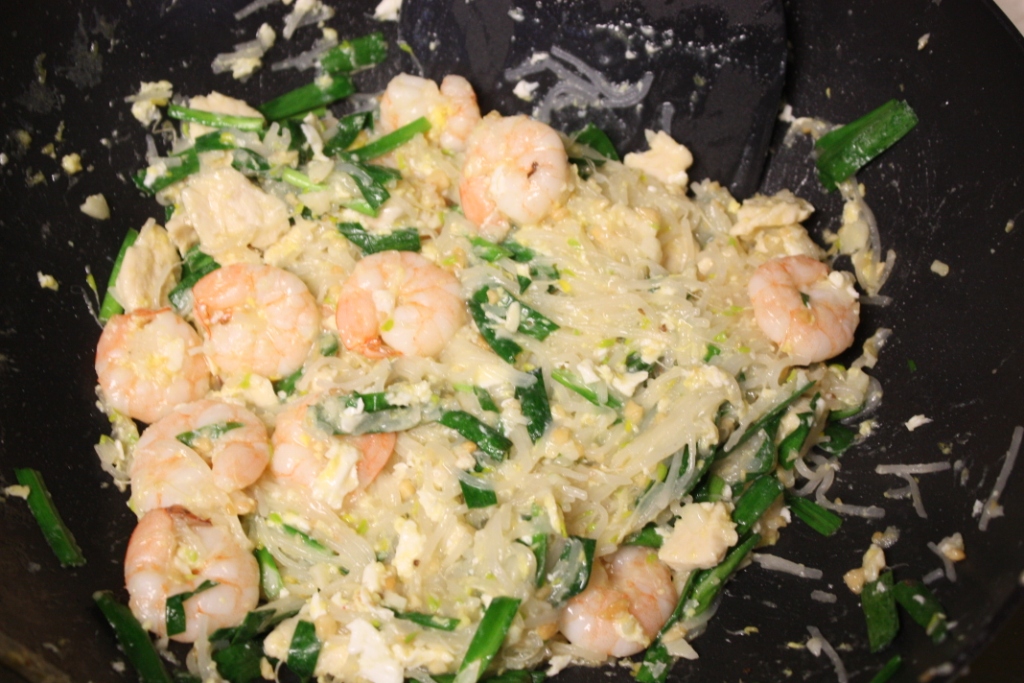
Step 5: Add the vegetable stuff. First, throw in the crushed peanuts. Then stir in the sprouts and the spring onion. (These are all done last, because you want them to provide a bit of crunch. i.e. You don’t want them thoroughly cooked.)

with the veges in

with the veges in

The penultimate step is to squeeze on the lime. This can be done into the wok after it’s removed from the heat or directly on top of one’s bowl.

Step 6: Eat. I’ve included the following picture as proof that this was, in fact, edible.
last few bites

last few bites