POEM: Deceit Days

What an apple!
–spoiled and rotten
The weave of lies
is soon forgotten.
Cast and reel,
no hook is set.
Which lie is true?
He soon forgets.

He says,
Just let me be, and I won’t lie.
But ask me now and it’s fib or die.

The lying life is tenuous.
Backpeddling? Strenuous

POEM: Overcast Day

Clouds tugged themselves over the city like a thick quilt
adding to the gritty gray inner-city nightmare.
I rode through this monochrome madness
without seeing a person on the sidewalks.
I felt their eyes peer down through ash-covered windows,
like a hand running over the tips of tiny hairs on my back
A high-pitched tone sounded in my ears
filling the void of chirpless birds and dumbstruck relicts

It can’t be long now.

MASTER WORKS: Apology by Plato

ApologyApology by Plato

My rating: 5 of 5 stars

Amazon page

Apology is Plato’s account of the trial of Socrates. This brief work presents Socrates’ defense of himself as well as his reaction to the death sentence verdict against him. Of course, it is all through the lens of Plato, as Socrates left us no written works.

Socrates was charged with impiety and corruption of the youth. He acknowledged both that he was eloquent and that he was a gadfly of Athens (the latter being a role for which Socrates believes he should be valued.) However, he denied both of the formal charges.

Socrates refuted the charge of corrupting the youth first by denying that he had taken money in exchange for teaching. Taking money was a component of this charge. Socrates’ claim is supported later when Socrates tells the court that he can only afford a very small fine, even in the face of the alternative–a death sentence.

Socrates says that he sees nothing wrong with taking money for teaching–if one has wisdom to share. Socrates says that he has no such wisdom, and suggests the philosopher/teachers that are taking money aren’t in error for taking money, but rather because they really don’t have wisdom themselves.

This is summed up nicely by this pair of sentences, “Well, although I do not suppose either of us knows anything really beautiful and good, I am better off than he is–for he knows nothing and thinks he knows. I neither know nor think I know.”

While Socrates raised the ire of the Athenian leaders with what they no doubt believed to be his arrogance, in fact it wasn’t that he thought himself wiser than they, but that he thought they were deluded in thinking themselves wise.

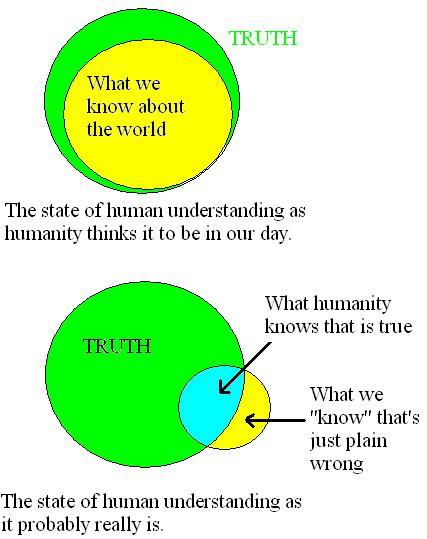
Socrates’ lesson remains valid today. It is the scourge of all ages to think that have finally attained true understanding of the world. Our posterity may know more, but we know all of the essentials and are rapidly converging on a complete picture of our world. We think our generation to be humanity’s sage elders, when, in fact, we are the impetuous teen whose growth spurt has made him cocky. I would propose to you that in all likelihood, even today, the sets of “that which is true” and “that which humanity ‘knows'” form a classic interlinking Venn Diagram. That is, some of the body of knowledge that we take to be proven true is, in fact, false. This occurs because we cannot accept that there are things we are not yet prepared to know, so we use sloppy methodology to “prove” or “disprove.” This one reason we have all these conflicting reports. E.g. coffee is good for you one week, and carcinogenic the next.

VennDiagram_WhatWeKnow

Socrates uses the method that today bears his name, i.e. the Socratic method, to challenge the arguments of Meletus, the prosecutor. The Socratic method uses questions as a device to lead the opposition to a conclusion based on premises they themselves state in the form of their answers. Socrates proposes that if it is he alone who is intentionally corrupting the youth, they would not come around–for no one prefers to be subjected to evil rather than good.

Socrates denies the suggestion that he does not believe in the gods, and in fact indicates that the very suggestion by virtue of the charges against him is a contradiction. What Socrates is guilty of is encouraging those who come around him to develop their own thoughts on god, and not to subordinate their thought to anyone–an idea the leaders found disconcerting.

Socrates goes on to say why he is unmoved by the death sentence. He wonders why it is thought he should beg and wail, when he doesn’t know for sure that an evil is being done against him.

The moral of the story is that those in power fear and will attempt to destroy advocates of free thinking.

This book should be read in conjunction with a couple other Platonic Dialogues, Crito and Phaedo.

View all my reviews

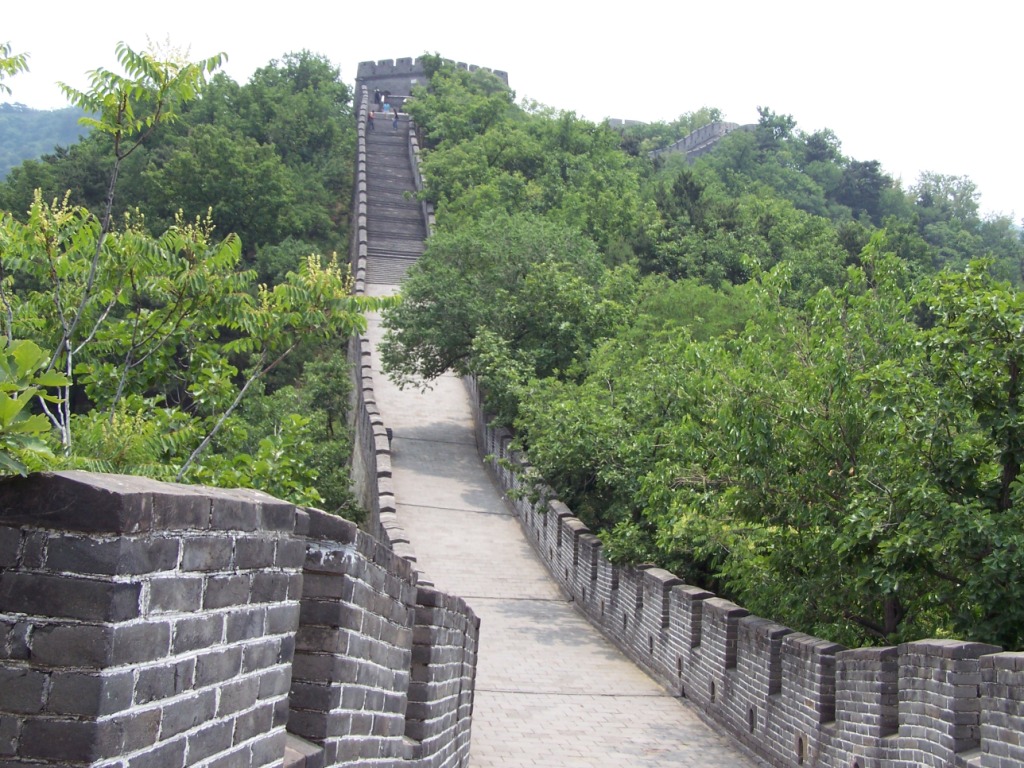
DAILY PHOTO: The Great Wall of China

A nicely restored section of the Wall

A nicely restored section of the Wall

POEM: Chirpy Bird in a Cedar Tree

Hey, little chirpy bird,
who rambles on without a word,
does your measure and your meter
tell of life in yonder cedar?

TODAY’S RANT: How’d I Get So Much Stuff?

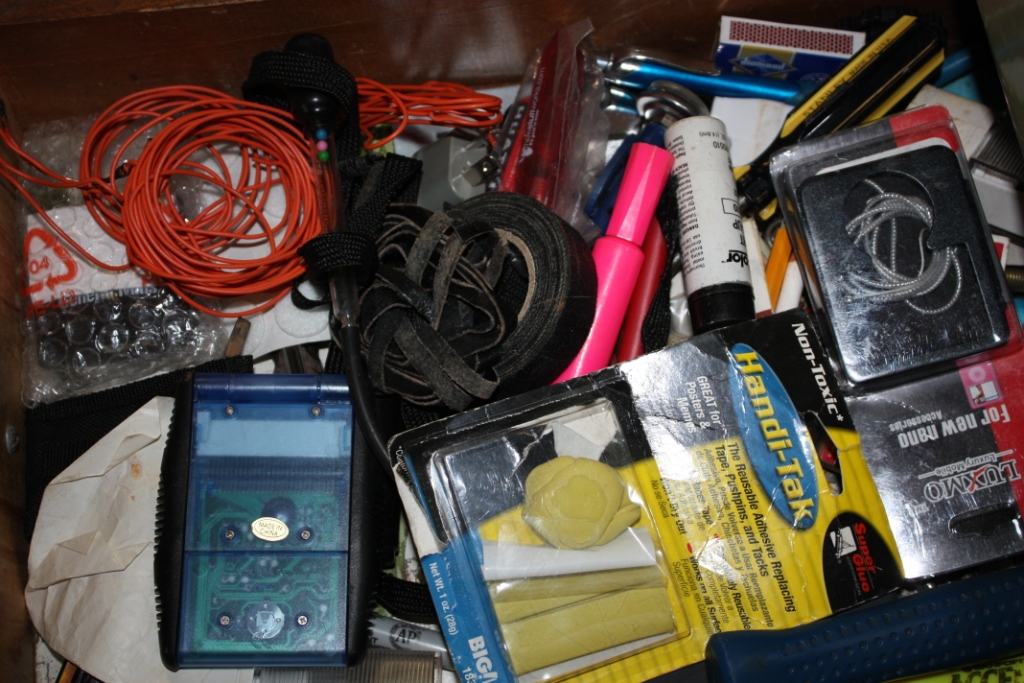
IMG_5194I don’t  like to use words like “stuff”, “things”, or the vague but picturesque “crap.”  Such words have low information content and are thus semantic lightweights. However, there are few words for the random compilation of tchotchkes, trinkets, baubles, gewgaws, kit, tools, devices, objects, gadgets, contraptions, contrivances, gizmos, widgets, thingamajigs, and doohickeys that line the drawers, shelves, and closets of my house.

You may think I’m some sort of packrat, but the sad fact is– I’m not. I’d say our household buys  less than average for homeowners. For one thing, we have no children. For another thing, both my wife and I might be classified as, for lack of a more eloquent term, cheapskates. (She’s an accountant and I’m trained as an economist, what do you expect?)  Of course, many people, perhaps most people, organize their junk better than I.

I do have one consumption fetish, and that is books. If you live in a very small town (or a large city with many small, local libraries) I may have more volumes in my house than does your local library. However, two things have slowed me down in collecting [physical] books. First, I buy most of my books on my Kindle these days. Second, I’ve come to realize that the reason I’ve bought so many books is the hope that one of them would provide some impetus for me to say something interesting, insightful, and valuable, and the entire English language canon has failed me utterly in this regard.

Still, I have a lot of miscellaneous detritus floating around in my home. You’ve heard of the 500-year flood? I have 500-year tools; that is, tools that are specifically for some task that only comes up once every few lifetimes or so. In a reasonable world, one would rent such tools. However, most tool rental places are also tool sellers. Such businesses have learned that if the tool sells new for $60, they can rent it for $50. Most people will buy it on the principle of the matter, and if they don’t… CHA-Ching. Who would rent a tool that costs almost as much to rent as it does to buy? I’ll tell you who (you thought that was rhetorical, didn’t you?), people who have the good sense to think of every object that comes into their home as an item being warehoused at their expense. People who have garage sales are brilliant. They are getting paid to store their junk in your home.

When I’m doing spring cleaning, as I am now, I frequently find containers that contain nothing. I guess I’ve just kept them around in case some pressing containment needs pop up. I keep all sorts of things because I think one day I’ll need them. However,  I never do need such items again, except the day after I throw them out.  To avoid such a situation, I don’t pitch them. However, if I keep them I won’t need them. If Joseph Heller was still alive, he could write a novel about my life.

Of course, sometimes I do need such items, but–owing to my poor organizational paradigm–I can’t find them. I then face the ultimate dilemma. Do I put the new one that I just bought with the old one that I found after I made the purchase, or do I put it in an entirely different location in the hope that when I need it again I’ll have a better chance of finding it.

No place have I felt the weight of how much “junk”  is swirling through our planet as when I was in Bangkok’s Chinatown last fall. There are miles of cramped alleyways and corridors packed to the gills with little plastic-wrapped junk, much of which seems to serve no purpose other than to satisfy the aesthetic needs of people with really poor taste or as gifts for people to whom you really want to send a statement of loathing. I had to get out of there, owing to a fear that shelving would collapse and I would be buried alive under a pile of knock-off Hello-Kitty coin purses.  I can think of no death that is more embarrassing and yet apropos of life in the modern world than that.

Of course, one of the many downsides of an economics education is the knowledge that our high standard of living is dependent upon people making and buying ever more stuff. If you are saying “what high standard of living?” and you haven’t hand-churned your own butter, darned some socks, and killed a mastodon today, I would encourage you to look into how people lived in the past. People unburdened of an economics education can make statements like, “People shouldn’t be materialistic and everybody should have a job and all jobs should pay a living wage.” However, that is like saying, “I should be able to keep my cake and I should be able to eat it as well and somebody should pay me $100 for it.”

We are still hunter-gatherers. We just hunt for bargains, and gather up geegaws.

IMG_3804

MASTER WORKS: The Taming of the Shrew by William Shakespeare

The Taming of the ShrewThe Taming of the Shrew by William Shakespeare

My rating: 5 of 5 stars

Amazon page

This is one of Shakespeare’s most controversial works, and debates still rage about whether its misogyny was written tongue-in-cheek, was a product of the times, or was indicative of a dark side of The Bard.

The plot revolves around two sisters, Katharina and Bianca, and their suitors. The younger sister, Bianca, is a catch and has many suitors vying for her affection. However, Katharina is, in the terms of Shakespeare’s day, shrewish. She is out-spoken, strong-willed, and on occasion downright bitchy; characteristics that weren’t particularly marriageable back in the day.

The father of the two girls will not allow Bianca to be wed until Katharina, his elder daughter, is also engaged. However, no man is willing to take that bullet so that one of his buddies can marry the much beloved Bianca. That is until Petruchio enters the scene with his friend Lucentio. Petruchio could use the lucrative dowry and believes himself equal to the task of taming the shrewish Katharina. Petruchio’s decision makes Lucentio (not to mention Gremio and Hortensio, i.e. the other suitors) extremely happy.

Petruchio’s approach to taming is to be hyper-sensitive to Katharina’s complaints. She gets no food to avoid her inevitable gripes about the food’s quality. Since no gown would be good enough, she gets no new clothes. These actions are designed to train Katharina to bide her tongue.

Like all Shakespeare, the language is phenomenal.

Like all Shakespeare, everyone should read this work.

I’m curious about people’s feelings regarding this play.

View all my reviews

DAILY PHOTO: Niagara Falls

The Falls, taken in the early - mid 90's

Niagara Falls, taken in the early – mid 90’s

BOOK REVIEW: A Dead Hand by Paul Theroux

A Dead Hand: A Crime in CalcuttaA Dead Hand: A Crime in Calcutta by Paul Theroux

My rating: 4 of 5 stars

Amazon page

A Dead Hand opens with the protagonist, Jerry Delfont, receiving an unexpected and unusual letter. Delfont is a traveling writer who is temporarily in Calcutta. The letter is from an American businesswoman and philanthropist who seems to have gone native in India. The woman, Merrill “Ma” Unger, asks Delfont to investigate a mysterious event involving her son’s boyfriend, a young Indian man named Rajat.

Rajat claims to have woken up one night in his cheap hotel room to find the dead body of a boy on the floor. Rajat panicked and left, and is living in fear that he will be picked by the police.

The book in part traces Delfont’s investigation of this mysterious body, and in part describes his burgeoning relationship with “Ma” Unger. The former is slow going through the first 2/3 of the book, and at some points one wonders if Delfont has forgotten about the investigation altogether.

The title has a dual meaning. It describes both the writer’s block Delfont is suffering at the beginning of the book and the actual physical hand that turns up as the sole remaining trace of the dead boy who turns out really was in Rajat’s room.

Coming from famed traveling writer Paul Theroux, it’s no surprise that the development of setting is phenomenal. Theroux not only gives one a sense of the sights, sounds, and scents of Calcutta, he also gives the reader insight into the human dimension of India through a number of supporting characters. There is a passionate young woman who writes poetry and practices the Indian martial art of Kalaripayattu. She is a strong, bright, and independent woman but is stuck in a world of arranged marriages and sexual repression. Despite the official end of the caste system, we see completely subservient Indians as well as others who think they are beyond talking to a lowly writer.

The plotting is solid. It’s neither exceptional nor so flat or formulaic as to be boring. I, who am not particularly good at foreseeing plot twists, did anticipate the ending–at least in broad brush stroke terms. However, the book kept me interested and reading. There was a clear narrative arc and the main character definitely undergoes a change over the course of the book (more on that below.)

In my opinion, the book’s weakness is in character development, and specifically Delfont’s character. We are introduced to a Delfont who is having a tough time, but is essentially a likable guy with his head on straight. However, as he begins to fall for “Ma” Unger, he seems increasingly pathetic. Specifically, he falls into this weird relationship in which he seems to see her both sexually and maternally, and–like a schoolboy with a crush–he wants to do anything he can to please her and to gain her attention. Now, being pathetic is a little like being crazy. If the character knows or suspects they are crazy, then how crazy can they really be? Because Delfont recognizes he’s being pathetic, he remains a sympathetic character. However, I think Theroux over hammers the degree to which Delfont is smitten until we begin to think he is obsessed. The problem is that it makes his transformation and that of his relationship with “Ma”, which happens like the flip of a switch, less credible.

All and all, I would recommend this book. I think it’s particularly interesting for one who wants greater insight into India and, specifically, Calcutta.

View all my reviews

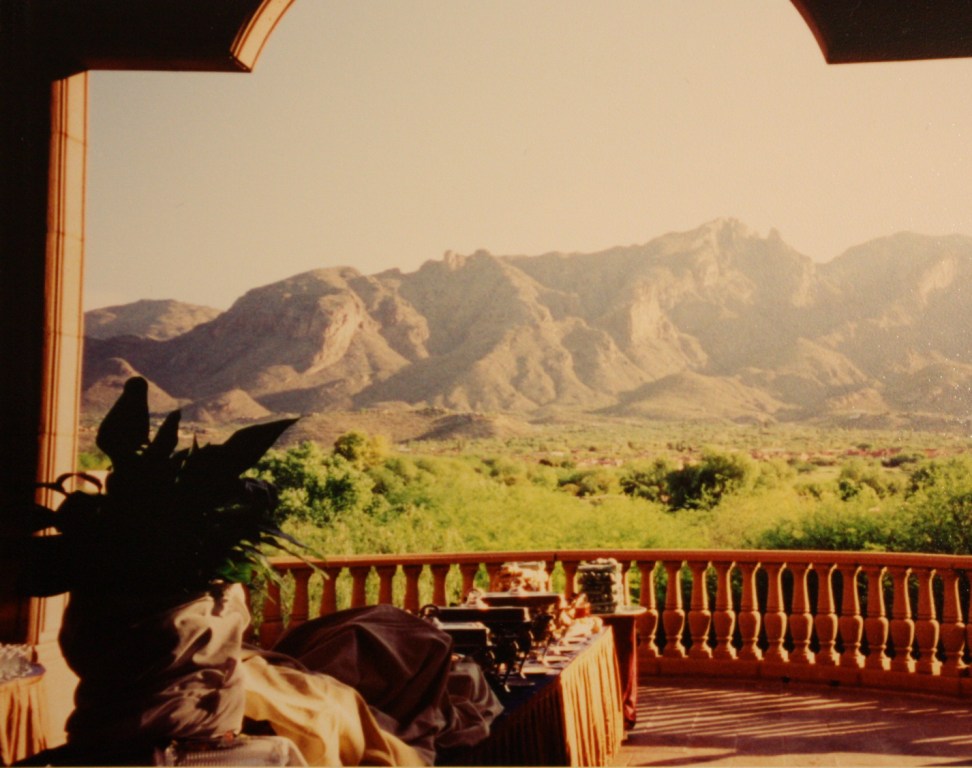
DAILY PHOTO: Mountains Near Tucson, Arizona

From a resort in Tucson, Arizona

From a resort in Tucson, Arizona

Taken in the mid-90’s.