
Taken January 26, 2014 at Lal Bagh Gardens.
There were many beautiful coxcombs at the 2014 Republic Day Flower Show, but this one looked eerily like a brain.

Taken January 26, 2014 at Lal Bagh Gardens.
There were many beautiful coxcombs at the 2014 Republic Day Flower Show, but this one looked eerily like a brain.
 Alien Sex: 19 Tales by the Masters of Science Fiction and Dark Fantasy by Ellen Datlow
My rating: 4 of 5 stars
Alien Sex is an anthology of 19 works of short fiction that revolve around sex, attempted sex, or sex-like behavior with non-human entities. While the title leads one to believe the book is specifically about sex with aliens from outer space, that’s not the case in all these stories. There are also stories where the object of affection is a lesser primate, an incubus, a new species, and a biologically-modeled robot. As one would expect with life forms from other worlds, the “sexual” act is not always what we would recognize as sex. (e.g. One planet’s whoopee might be another’s mundane act.) As a last warning about what the book is not, it’s not—on the whole—a collection of sci-fi erotica. A number of the stories probably wouldn’t be arousing to the freakiest of super-freak, and I can only assume weren’t meant to be.
While there’s a unifying theme, the works included cover a lot of ground in terms of style and format. It’s not even true to say it’s 19 short stories because there’s one poem and one chapter that reads more like an essay (i.e. lacks a narrative structure.) Some of the works are written in the language, tone, and style of erotica, but others aren’t. A few of them read like thinly veiled commentary on problems in the author’s own love life—i.e. cheating spouses, feeling a lack of attentiveness, or porn addiction. (Each work has a brief author commentary at the end, and a couple of the authors suggest that what was going on in their own life or those close to them shaped the idea.)
While the appeal of the works varied significantly, overall this was a fun and intriguing read. The works included are as follows:
1.) Her Furry Face by Leigh Kennedy
A primate handler who is in a waning marriage falls for one of his super-intelligent orangutan students.
2.) War Bride by Rick Wilbur
The world is going to end tomorrow unless you’ve been taken as a pet by one of the aliens.
3.) How’s the Night Life on Cissalda by Harlan Ellison
A man sent to investigate an alien race becomes inextricably sexually entangled with one of the aliens. Eventually, he’s forcibly separated from the alien—of a race that are apparently thin-skinned—and lives to see the descent of mankind.
4.) The Jamesburg Incubus by Scott Baker
A teacher in a Catholic school finds that he can make out-of-body nocturnal visits to some of his more attractive female students.
5.) Man of Steel, Woman of Kleenex by Larry Niven
This reads more like an essay than a short story. The work delves into the physics of why sex with Superman would be fatal for Lois Lane.
6.) The First Time by K.W. Jeter
This is a variation on the old coming of age story in which a young man is taken to a brothel for his first sexual encounter. It’s just that this encounter is of the 3rd kind.
7.) The Jungle Rot Kid on the Nod by Philip José Farmer
The premise behind the story is what if William S. Burroughs (author of Naked Lunch) had written the Tarzan stories instead of Edgar Rice Burroughs. In essence, it’s a risqué take on Tarzan.
8.) Husbands by Lisa Tuttle
After the extinction of husbands, a woman develops a new species to serve the companion role.
9.) When the Fathers Go by Bruce McAllister
A husband confesses to his wife that while she was in stasis waiting for him to come back from interplanetary travel, he sired a child with an alien. Furthermore, the child is coming to live with them. But wait there’s more…
10.) Dancing Chickens by Edward Bryant
This story reads more like an overly elaborate joke than a short story. It begins with the question, “What do aliens want?” and ends with a pun punch line. That being said, the lead is an unappealing but intriguing character.
11.) Roadside Rescue by Pat Cadigan
A stranded motorist is made an indecent proposal by a chauffeur on behalf of his alien employer.
12.) Omnisexual by Geoff Ryman
This is about an intergalactic brothel, but it’s the story in the collection that reads most like literary fiction—meant in both the best and worst possible ways.
13.) All My Darling Daughters by Connie Willis
While there are several really good works in this anthology, I’d have to rank this as my favorite—if only by a narrow victory. A sassy, sexually-liberated co-ed has her sex life torn asunder when all the young men come back from break with little, furry creatures in their possession and no interest in the female student body. Besides a neat concept for a story (though it may be implying that men are overwhelmingly rapey), the author does a great job of character development making the lead character both interesting and likable, while juxtaposing her with her apparently goodie two-shoes roommate.
14.) Arousal by Richard Christian Matheson
A woman who cheats on her husband with a stranger is cursed with permanent post-coital euphoria that swamps all interest in her family and life in general.
15.) Scales by Lewis Shiner
A woman’s husband is having an affair with what she thinks is a student assistant, but who turns out to be a soul-sucking seductress from the netherworld.
16.) Saving the World at the New Moon Hotel by Roberta Lannes
A woman waiting for her spouse to meet her at a bar to apologize for his infidelities decides to get a little herself. The man she hooks up with turns out not to be a man at all.
17.) And I Awoke and Found Me Here on the Cold Hill’s Side James Tiptree, Jr.
An experienced man offers advice to a newbie to get away before he ends up seduced by the aliens. This story talks about sex, but is about something much broader.
18.) Picture Planes Michaela Roessner
This one is a poem about alien sex, rather than a story. It stands alone as the only non-prose entry.
19.) Love and Sex Among the Invertebrates Pat Murphy
In a post-apocalyptic world, a dying scientist–who no longer believes in science–creates robots capable of engaging in the act. The creatures she makes are based on a range of real animals which are written about interspersed with the story-line.
I’d recommend this book for those who enjoy science fiction. One need not be into erotica to enjoy the stories and, the more one is seeking erotica, the less appeal the book may have. It’s a collection of big name writers in science-fiction, and the anthology’s diversity makes it particularly interesting.
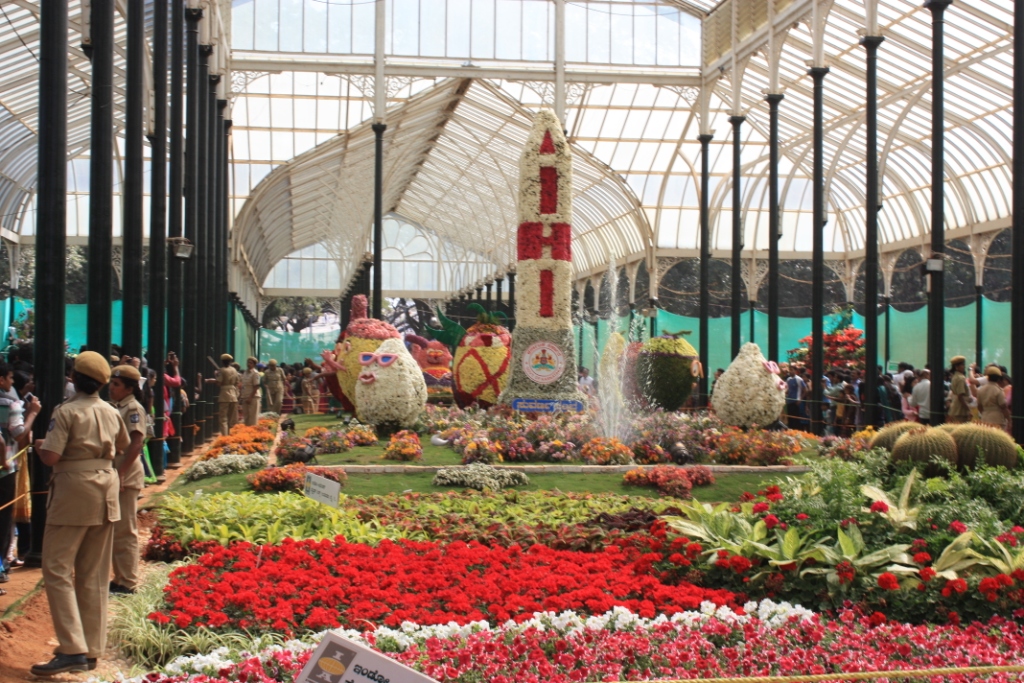
Taken January 26, 2014 at Lal Bagh Gardens in Bangalore.
The Crystal Palace at Lal Bagh gardens, which is normally roped off and empty, has been packed brimming with flowers for the annual Republic Day Flower Show that ends today.
It would be slightly more enjoyable if security wasn’t threatening to wallop one with a stick if one loiters for a second. You can see it as many times as you can fit in a day, but you must keep moving along. It’s a one way flow, so if you don’t have the desire to go through twice (once on either side) I’d recommend going on the south side (farthest from the main entrance.) For some reason the crowd was about half on that side (probably because no one anticipated the layout would make you do two half loops instead of one full loop.) Why they did it, I have no idea, but the flowers were pretty.

Taken December 2013 in Kuala Lumpur.
 In 1888 this wasn’t a tourist market, but a run-of-the-mill city market. Now it’s a crafts market selling gee-gaws, tchotchkes, knick-knacks, as well as expensive artworks to foreign visitors.
 Mind Over Medicine: Scientific Proof That You Can Heal Yourself by Lissa Rankin
My rating: 4 of 5 stars
This book is one of many that challenge the conventional approach to medical care in which a patient is a passive character who just goes to the doctor and does (or ingests) whatever the doc tells them to. In the vein of works by Deepak Chopra and Bernie Siegal, this book is written by medical doctor who has different beliefs on healing. So what’s the niche of Mind Over Medicine, given that there are already a number of prominent medical doctors preaching the same message? That message is that your body is a healing machine and will do MOST (not ALL, none of these individuals advocates abandoning modern medical science) of the heavy lifting of healing, if you create the right conditions. Rankin presents results from scientific studies as the thrust of her book. I’m not really that familiar with Siegal, but you’ll find Rankin’s work a great deal less spiritual and more scientific than the works of Deepak Chopra.
There’s a lot of scientific interest in understanding why some people experience spontaneous remissions from the most lethal of ailments while others succumb to diseases that most people weather with ease. While many people will chalk it up to divine will or chakra nudging or having one’s demons expunged, these aren’t satisfying answers for the scientifically minded individual. However, neither is the extreme skeptic’s suggestion that these are just randomly distributed flukes of nature—and it’s a waste of time to try to explain the outliers. The latter being unsatisfying because phenomena like the placebo effect are well documented.
So what conclusion does Rankin draw from the scientific literature. As suggested earlier, the conclusion is that the body is extremely good at healing what ails it, but it has to be in the right mode to have this healing take place. What’s the right mode? It has to be in relaxed mode, or, in scientific parlance, the parasympathetic system must be engaged. The problem is that when a person is under stress, the body switches into a fight or flight mode. Humanity hasn’t really come to grips with the fact that work deadlines, fears about ailments, or fears that our spouse may be cheating aren’t really the same as our ancestor’s experience of being chased by a saber-tooth tiger. When that ancestor was being chased by a tiger, his or her body shut down everything that wasn’t germane to immediate survival (e.g. digestion is interrupted, blood isn’t evenly distributed but goes to lungs and skeletal muscles, etc.) The tiger chase is over shortly, and the body returns doing its regular at-rest functions (e.g. digesting, healing, etc.) However, if we let our stressors kick us into that immediate survival mode–and just having a disease can be stressing enough in itself–then our healing can be severely or completely curtailed.
Can faith healing, karma cleansing, chakra fluffing, or sugar pills contribute to healing? Sure, but not in the way that the faithful thinks. These systems–each of which has proponents who’ll swear they witnessed first-hand the power of faith or magic or invisible energy (and they are probably not lying)–work because the person who firmly believes in these therapies is able to relax and let their bodies can do what they do.
Does this mean that those who don’t believe in religion or cosmic energy manipulation are out of luck? No. You just skip the middleman and engage in activities such as meditation, yoga, tai chi, or breathing exercises that allow you to put the body in a relaxed state. Secular meditation works just fine if practiced consistently, and particularly if one confronts, addresses, and eliminates the long-terms stressors in one’s life.
At the heart of the book is a discussion about how to go about performing one’s own diagnosis and writing one’s own prescription. As I mentioned earlier, this isn’t about cutting the doctor out. In this case one is diagnosing one’s stressors and prescribing activities to eliminate them. This doesn’t mean one should pass up medical treatment or doctor’s advice. However, it may entail switching doctors if you have a doctor that firmly believes you are incapable of getting better—you don’t need any doubts about your body’s ability to do its thing being foist upon you.
I’d highly recommend this book for scientifically-minded individuals interested in learning how they can help their bodies get into a state conducive to healing.

Taken in December of 2013 in Kuala Lumpur.
The Gombak and Klang rivers join together right in the middle of Malaysia’s capital city. The Jamek Mosque is located just North of where they meet.
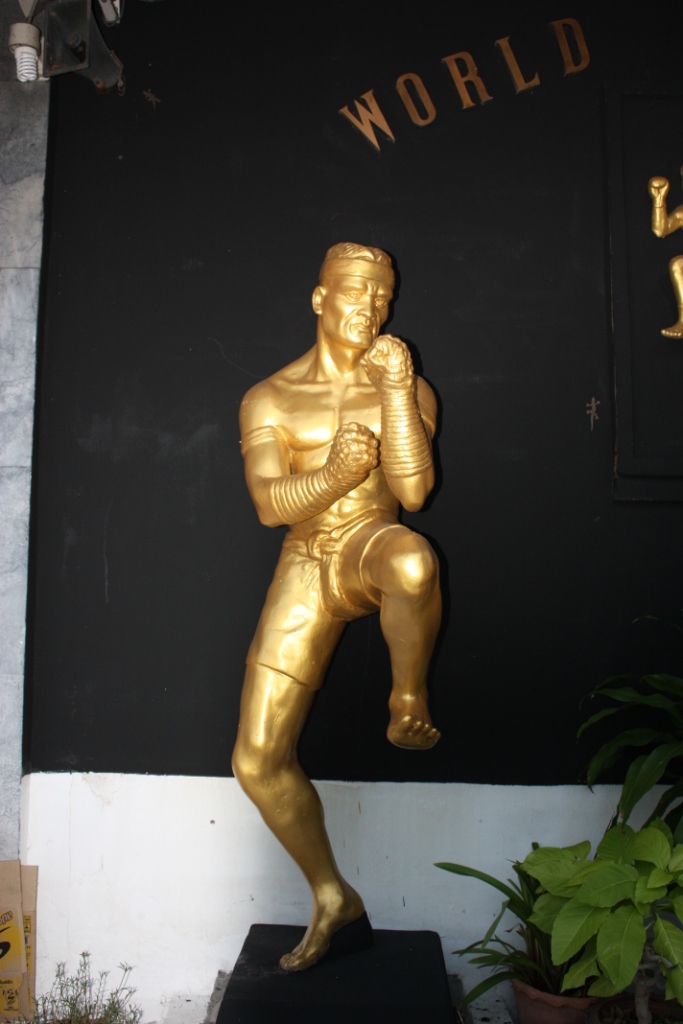 What is Muay Boran? It’s “ancient boxing,” and is considered an ancestor to the more well-known Muay Thai. Muay Boran isn’t a single unified system. Practicing Muay Boran is a bit like practicing “Karate,” which is to say there are a number of different and distinct systems that go by that generic name—some of which bear little resemblance to others. Muay Boran was originally a combat martial art, but came to be practiced as a sport as well. The latter practice included some rules, though relatively few in comparison to Muay Thai. Instead of padded gloves, they fought with their hands and wrists bound with hemp rope.
When I was in Thailand, I had an opportunity to participate in a couple rudimentary Muay Boran classes. I’d just read about this system in the June/July 2013 issue of Black Belt magazine, and was interested in seeing for myself how the discipline was distinct from Muay Thai. I’m fascinated by how martial arts that are more jissen (real combat) oriented differ from systems whose primary objective is something else (e.g. sport, wellness, etc.) If one looks at a sport martial art such a Muay Thai, one can see how the nature of the rules and equipment subtly shape the nature of the movement. For example, if crotch attacks are illegal and one wears a cup to handle the occasional accidental crotch shot, one won’t worry about that vulnerability and–as one focuses on gaining advantages or minimizing disadvantages–one may end up with a vulnerability that would be disconcerting in jissen martial arts.
Before anyone gets huffy, I should point out that this isn’t a criticism. Sports must have rules so that they can be enjoyably practiced (and watched.) Given the rules that are in place, one should optimize one’s performance to being as fast, powerful, and effective as possible. In other words, it would be silly to make one’s stance optimized to protecting one’s groin if the opponent can’t attack it (plus one has a little insurance policy against accidents) and if protecting that [non-existent] vulnerability made one any slower, less powerful, or otherwise less effective. I’m also not saying that combative sports are completely ineffective as self-protection. For sports like Muay Thai or MMA there is a huge space of overlap with the no rules combative situation, and—furthermore—the athleticism developed will allow one to adjust to the non-rule environment quickly.
That being said, I’m curious about how Muay Boran is different from Muay Thai and what that might mean in terms of jissen-optimized fighting versus sport-optimized fighting. Here are a few things that I noticed both in the classes that I had at Tiger Muay Thai in Phuket, in the aforementioned Black Belt article, and from a few videos and articles that I could find on the internet from what I believe to be reputable sources. [I should disclaim that I’m far from an authority here. Full Disclosure: I’ve had 3 hours of MB training and done some reading and research.]
1.) The basic Muay Boran guard covers the centerline. In other words, one’s hands are one fist in front of the other with both fists aligned on one’s centerline. This is as opposed to the boxing or Thai boxing guard in which either hand is to the outside of one’s head. Practitioners of Wing Chun or the system I am most familiar with, Gyokko-ryū will be familiar with what I’m talking about. I have vague theories about why protecting the centerline might be more advantageous in combat than sport. For one thing, it might help one make contact with incoming limbs in a way that supports transition into grappling. For another, it allows one to protect against coup-de-grace attacks more efficiently.
2.) The basic stance of Muay Boran is lower and wider than in Muay Thai. I suspect this has to do with ranging and protection of vulnerabilities (e.g. the groin is harder to hit.)
3.) While Muay Thai is considered the style of “8 weapons”: (leg (X2), knee (X2), elbow (X2), and fist (X2), Muay Boran is based on 9 weapons (i.e. it includes the good ole head-butt.) This isn’t a surprise. Without a head-butt prohibiting rule, one would expect people to use this devastating close-range weapon.
4.) Muay Boran utilizes attacks against the limbs. In sport Muay Thai, there is little to be gained from this, but in a combative art if one can deaden limbs one gains a big advantage.
5.) One thing that perplexed me at first is the fact that Muay Boran supposedly uses flying knees and flying elbows prolifically. (I should note these are used in Muay Thai occasionally as well, but they’re relatively rare as they are hard to land and to use without having mid-air vulnerabilities exploited.) What I found strange about this is that jissen martial arts tend to be much less flashy and rely on much simpler techniques than do sports. The old motto of KISS (Keep It Simple, Stupid) is often spoken in jissen martial art dōjōs. However, I do have a theory about why the power generated by such tactics might have made them appealing. One mindset difference between sport and jissen martial art practitioners has to do with the role of time. In combat, time is not on your side, and pacing yourself can be a lethal strategy. You want to try to land strikes that have a high probability of putting the enemy out of commission, even if at a risk. That is, of course, just a neophyte’s theory.
I enjoyed learning a few Muay Boran techniques, and I can see how it was an effective combat system.
 Veronika Decides to Die by Paulo Coelho
My rating: 4 of 5 stars
Veronika Decides to Die is about a young Slovenian woman, Veronika, who attempts suicide, fails, is institutionalized, and is informed that her attempted suicide damaged her heart and she has only five days to live. In the hospital she has to come to grips with what it means to be dying, but also what it means to be insane.
The book deals with the effect of Veronika’s death sentence diagnosis on her as well as on other patients with whom she interacts. The first patient Veronika comes in contact with is a depressive named Zedka who offers Veronika advice and insight. Then there is Maria, a woman who withdrew from her professional and family life to be institutionalized because she was having inexplicable panic attacks. Finally, there is Eduardo, a schizophrenic who is virtually non-functional when he meets Veronika, but who ends up in a relationship with the young woman nonetheless. These patients come to realize that they are hiding out at the hospital. They stay in the hospital because they are free to defy norms without judgment. When Veronika decides she doesn’t want to die hiding out, it has a profound impact on the others.
The book borrows heavily upon Coelho’s personal experience. He was institutionalized as a young man by parents who were disturbed when he went artsy and began hanging out with undesirables. Interestingly, Coelho has a cameo role in the book as himself. In the book he writes an article that playfully asks the question, “Where is Slovenia?” When Veronika is waiting to die from her overdose, she reads the article and decides to write a letter to the editor claiming that she killed herself because of the depressing effect of Coelho’s suggestion that nobody who’s anybody knows or cares where Slovenia is located.
In the end Veronika finds that she is truly free. Veronika seems to have everything at the beginning of the story: a job, boyfriends, and popularity. However, it’s those things that she comes to feel enslave her, and that’s what leads to the attempted suicide. In a way, Veronika is doubly freed. She is free because she is dying, and what can one do to a dying person. Second, she has been labeled crazy, and, having such a label, people expect her to act oddly. She has the freedom to do those things she has been too frightened to do all her life.
I’d recommend this book. It’s short, readable, and offers clear food for thought.
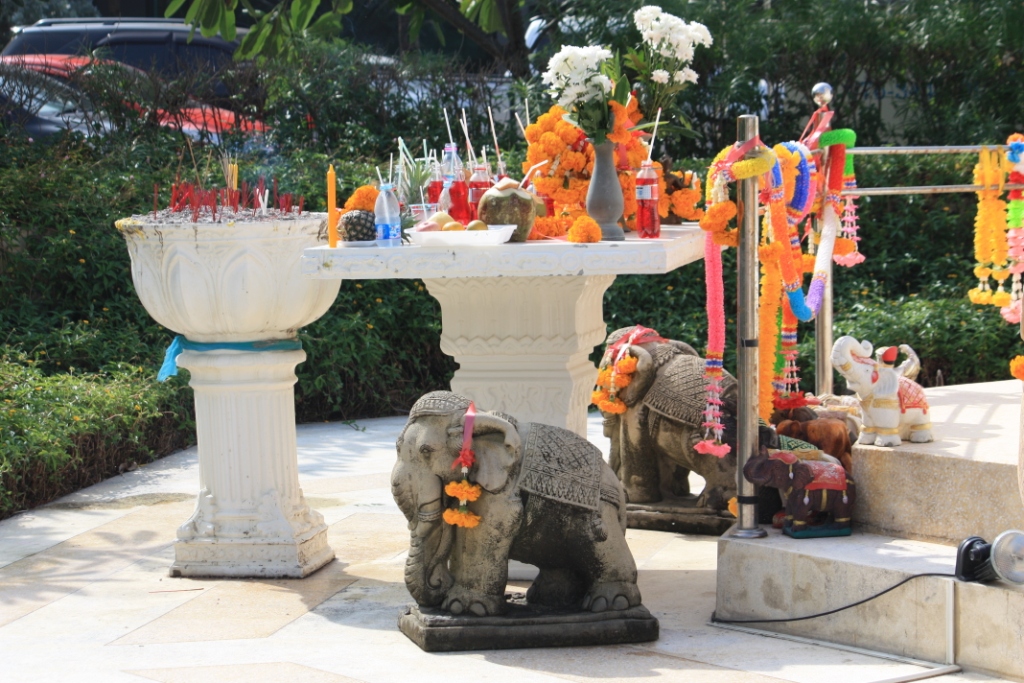
Taken in January 2014 in Patong.
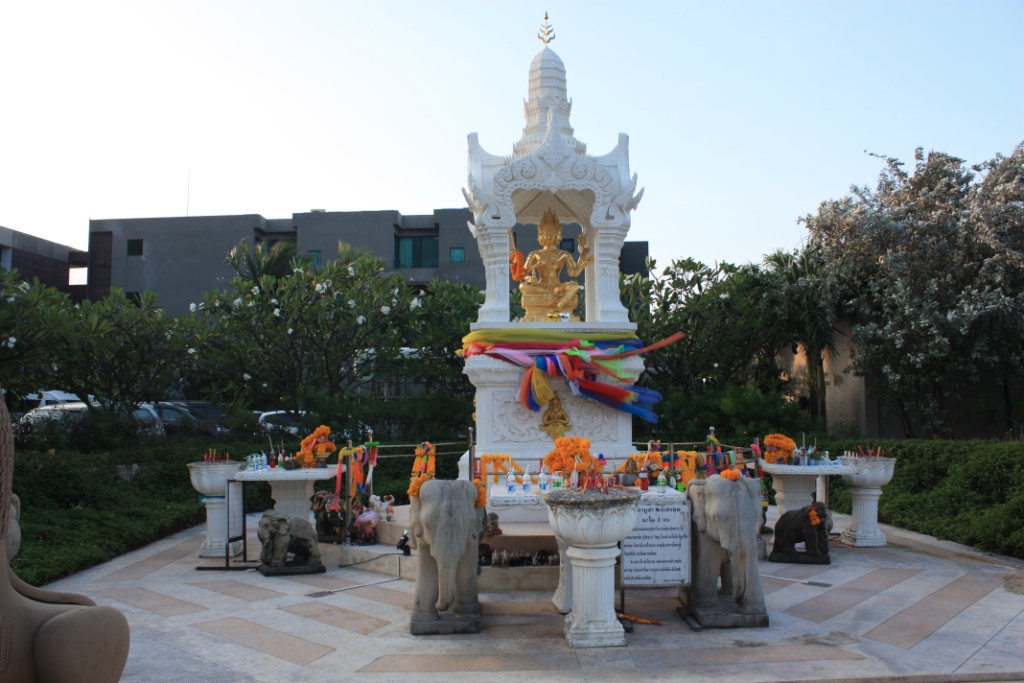
Taken January 2014 in Patong.
From this little shrine one could view Patong Beach across Beach Road. It’s a small but very active shrine at the North end of Patong Beach. There was often someone burning incense or making an offering.
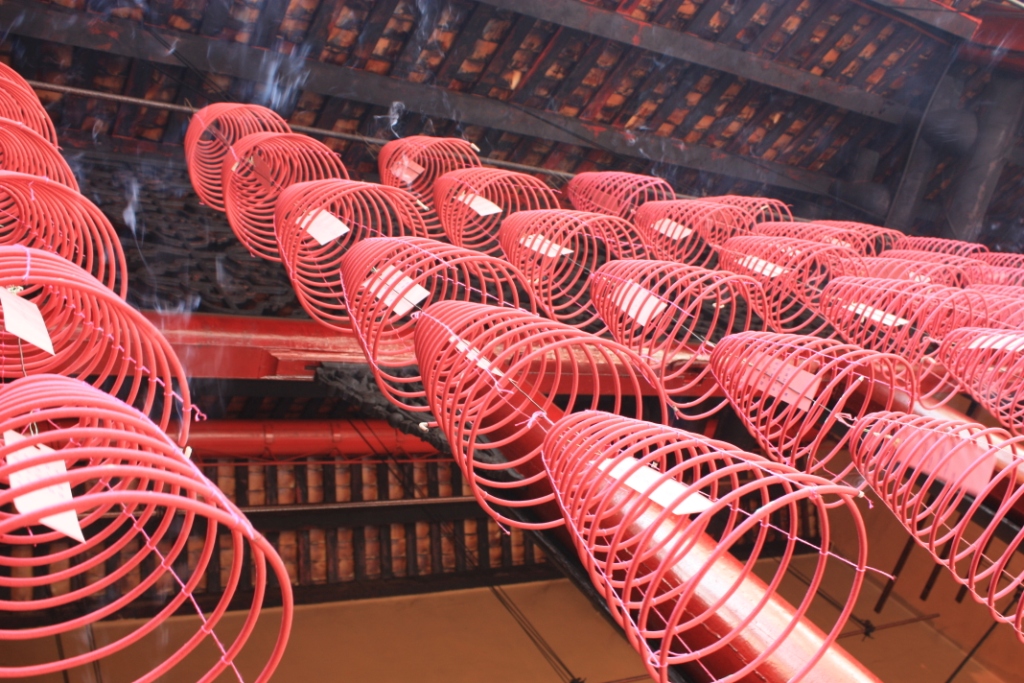
Taken in December of 2013 in Kuala Lumpur
Guan Di Temple is a shrine to the Chinese God of War. Long strings of spiral incense cones hang from the lintel to perfume the air.
One can see Guan Di in Kuala Lumpur’s Chinatown near Petaling Street.


