BOOK REVIEW: Seven Spiritual Laws of Superheroes by Deepak Chopra

The Seven Spiritual Laws of Superheroes: Harnessing Our Power to Change the WorldThe Seven Spiritual Laws of Superheroes: Harnessing Our Power to Change the World by Deepak Chopra

My rating: 3 of 5 stars

Amazon page

This is Deepak Chopra’s attempt to capitalize on society’s fascination with superheroes. By “capitalize” I’m not necessarily saying to “make money off of,” but perhaps to “use to his advantage in conveying his lessons.” [I’ll leave it to the reader to make judgments about the former.] There are books on the physics of superheroes, the philosophy of superheroes, and the mythology of superheroes, so why shouldn’t there be a book on the spiritual life of superheroes?

The book uses both the superheroes of mythology—i.e. Indian, Greek, Judeo-Christian, Muslim, and others—as well as the superheroes of comic books. While Chopra’s knowledge of the former is considerable, he enlists the co-authorship of his son Gotham (not named after Bruce Wayne’s hometown) to offer insight into the latter.

This book is also intended to capitalize (again, take that as you see fit) upon Chopra’s best-selling book, The Seven Spiritual Laws of Success, but without rehashing the same laws. The Seven Spiritual Laws of Superheroes format is as straightforward as its title. There are seven chapters, each corresponding to one of Chopra’s laws. Said laws address balance, transformation, power, love, creativity, intention, and transcendence.

As I read the book, there was something that rubbed me the wrong way about the writing. It wasn’t that I had major disagreement with Chopra’s ideas, but rather the way he was stating them. At first I thought this was the use of gratuitous assertion. He often began chapters with detailed statements about what superheroes are, do, believe, and understand without much—if any–substantiation of these claims. However, as I got into the first chapter I noticed that he would put one section in each chapter that discussed an example in-depth, offering at least anecdotal support for his claims.

This still left a bit of a bad taste in my mouth. It was because he used general statements like “superheroes know…” and “superheroes understand…,” and then provided a solitary example that fit his statement well, but leaving a vast cast of heroes that didn’t. It seemed a low form of inductive reasoning. In other words, he was attributing an enlightened way of thinking and acting to characters like Hulk and Wolverine.

Chopra and his supporters might make the claim that saying, “The Hulk understands X [insert any of the laws here]” doesn’t necessarily mean he understands them as an intellectual exercise, but rather that he shows this understanding through his behavior. Let me give a story that may make my meaning clearer.

An economist is giving a lecture on consumer behavior. Someone in the audience says, “Professor, how could consumers possibly behave in the way you suggest? Your theory requires complex Lagrangian optimization mathematics, which very few of them understand?”

The Professor replies, “Most of them don’t understand Newton’s work either, but they obey the Law of Gravity without fail.”

I thought about Chopra’s statements from this perspective, but concluded that his point was probably something entirely different. As an author of self-help books about the mind, when Chopra says “Superheroes understand X,” he’s not saying “Each and every superhero understands X,” but instead he’s saying, “If you want to be a superhero, you need to understand X.”

Accepting that that’s what Chopra meant, only one more qualm with the book remained. Laws can be clearly stated (OK, perhaps not tax law, but laws of physics—which seem to be more the kind of law he seeks to emulate), but Chopra’s discussion of his “laws” is vague and ill-defined. Each chapter begins with a large-font italics statement. I don’t know if this is supposed to be “the law” or not. It usually begins with a definition (some vaguely stated) and then statements that superheroes comport themselves in accordance with said definition. Maybe the unstated laws are supposed to be, “Superheroes live a life of balance,” and so on for the other chapters. As one trained as an economist, I’m well-aware of the wide-spread overuse of the term “law,” and maybe the ill-defined nature of Chopra’s laws is a recognition of this.

This book is written for Chopra’s usual audience of seekers of enlightenment. I don’t know that it’ll do well with hard-core science fiction or comic fans, and I don’t know that the Venn intersect of “spiritual self-help readers” and “comic book fans” is as big as Chopra would like. (But, I could be wrong.) Some of Chopra’s ideas about the potential spiritual ramifications of “quantum entanglement” are quite popular with sci-fi fans, but I’m not sure that that offers this book a clear audience. (It might. Chopra is a trained physician, and has some scientific bona fides—unlike many who share shelf space with him and who exist in a spiritual plane entirely unrelated to the world as we know it.)

All this being said, there are some thought-provoking ideas in this book, and the superhero and mythological examples help entertain and—in doing so—become the spoon of sugar that makes the medicine go down. Another testimonial is that I read most of this book in a single sitting, and I tend to jump from a chapter in one book to another book unless something really holds my interest.

View all my reviews

DAILY PHOTO: Jama Masjid

Taken October 14, 2013 in Old Delhi.

Taken October 14, 2013 in Old Delhi.

This is India’s largest mosque. It is capable of holding 25,000 worshipers–mostly in that open courtyard that can apparently be covered as needed.)  It dates back to the rule of Mughal Emperor Shah Jahan–who you may know of from his requisitioning of the Taj Mahal.

It’s located in Old Delhi and is usually matched with trips to the Red Fort and Chandni Chowk (a huge bazaar street), which are both nearby.

It’s mostly Red sandstone with white marble, as was common of Shah Jahan’s other monumental structures.

[I realize it’s a cheat that I’ve posted two “Daily Photos” in a couple of hours of one another, but it’s a new day in the States–and I’ve got a ton of photos from my recent trip.]

BOOK REVIEW: The Mind of the Guru by Rajiv Mehrotra

The Mind of the Guru: Conversations with Spiritual MastersThe Mind of the Guru: Conversations with Spiritual Masters by Rajiv Mehrotra

My rating: 3 of 5 stars

Amazon Page

The Mind of the Guru is a compilation of 20 interviews with various teachers and spiritual leaders. While most of the individuals are from Indian spiritual traditions or offshoots thereof, the author makes concerted efforts to represent a range of religious and spiritual traditions.

The list of interview subjects is impressive and includes: The Dalai Lama (Tibetan Buddhism), Thich Nhat Hanh (Zen), S.N. Goenka (Vipassana), BKS Iyengar (yoga), Deepak Chopra (medical doctor and spiritual pundit), Sri Sri Ravi Shankar (Art of Living founder), Desmond Tutu (Christianity), and The Aga Khan (Islam.)

The book is at its best when these gurus are discussing their thoughts on development of the mind and spirit. Obviously, there is a lot of this type of discussion as that is the expertise of most all of the assembled teachers.

A brief forward by The Dalai Lama sets the theme of the discussion. His Holiness states that in Buddhist tradition one becomes a teacher because one has students. Consider this in contrast to traditions that fallaciously believe the title of teacher is granted from above. A master teacher may grant a teaching licence, but that’s just a piece of paper unless someone shows up to one’s lessons. He then goes on to say that one should abandon teachers who act in an unwholesome manner. This, too, is an important point. Having invested oneself in loyalty, it can feel like betrayal to leave a teacher who no longer suits one.

His Holiness is the lead chapter interviewee. In the early part of the chapter, he presents many thoughts on Tibetan mind science. “Mind science” may seem like a strange term, but there’s an important part of Tibetan Buddhism that deals not with deities and conceptions of morality, but with understanding and improving how the mind operates.

If one comes from a tradition in which science and religion are in tension, this may seem unusual, but there is a definite scientific approach (observing the mind and playing out experiments with it.) One doesn’t see a rift between science and religion in Tibetan Buddhism. In fact, His Holiness says that if certain parts of the religious tradition were proved not to exist, they would have to be abandoned. (For those beginning to raise objections, shown to be unlikely and disproven are two different things.)

A second Tibetan Buddhist, Sogyal Rinpoche, addresses the topic of death, and lends the book one of my favorite quotes: “If you are worried about dying, don’t worry, you will all die successfully.”

The first part of this five part book also includes interviews with Thich Nhat Hanh and S.N. Goenka. The former talks about mindfulness and the “interbeing,” and the latter describes the Vipassana approach to meditation and its development. Interbeing is a term coined by Hanh to address a being who is connected to all things. For those unfamiliar with Vipassana, it’s a meditation practice that emphasizes 10-day intensive meditation retreats. There are many retreat centers where this is practiced around the world, including one in the city in which I currently live, Bangalore.

The second part deals with the unity of mind and body. BKS Igenyar, head of a self-named branch of Hatha yoga, opens the chapter with discussion of his background and approach to yoga. Deepak Chopra talks about the intersection of science and spirituality. David Frawley talks about Ayurvedic medicine as well as some more “out there” subjects, such as astrology.

I hadn’t heard of two of the three interviewees in part three, Swami Ranganathananda and Mata Amritanandamayi. However the third interview was Sri Sri Ravi Shankar, a guru well-known internationally for his soft-spoken teachings that combine yoga with a secular spiritualism rooted in Hinduism but not explicitly advocating it. Swami Ranganathananda is from Ramakrishna’s order, which was a secular spiritualism movement rooted in Vedantic traditions but embracing diversity of belief. Mata Amritanandamayi is one of only two women interviewed for the book, indicating women haven’t achieved equality in guru-hood just yet–for all the talk of enlightened thinking. (This is not a dig at the author, who probably went out of his way to include these two to have diversity in gender as well as diversity of tradition.)

The fourth part adds to the diversity by opening with an interview with Sufi Muslim, Pir Vilayat Inayat Khan. Sufi is the mystical branch of Islam. (Mysticism meaning a belief structure in which God is considered to be part of one and is accessed by mindfulness and introspection. This in contrast to the largest strands of the world’s major religions in which God is conceptually something distinct from the self and is an entity to be worshiped. Most major religions have mystical elements or a mystical branch, including Christianity and Islam.) This interview eases us away from the traditions that are either of India or have their roots in India. (By that I mean that Buddhism has its roots in India, though, for example, Zen is different from Buddhism as practiced in India today.)I say “eases us away” because the mystical nature of Sufi would not create much cognitive dissonance in yoga practitioners, Hindu spiritualists, or Zen monks, but, instead, shares much common ground.

The second chapter in part 4 is that by the other female guru, Radha Burnier, who is a practitioner of Theosophy, which means “divine wisdom.” This modern development is secular in that it doesn’t advocate a particular religion, but rather engagement to fix societal problems and eliminate biases and divisions. In the interview we get a hint of the divides that plagued this organization.

Part four is rounded out by interviews with Swami Parthasarathy and U.G. Krishnamurti (not to be confused with Jiddu Krishnamurti, who probably would have been included in this book if he hadn’t died in the 1980’s.)The former speaks about the end of knowledge and the latter about his role as an anti-guru, rejecting traditional approaches to thinking about spirituality.

The fifth part of the book is entitled “The Ethics of Engagement” and I’m afraid it’s where the wheels roll off. It has six excellent authorities, Desmond Tutu, Baba Amte, Ajarn Sulak Sivaraksa, Swami Agnivesh, The Aga Khan, and Karan Singh.I don’t criticize the selection of interviewees, but what happens here is that the chapters predominantly become about politics and policy. Some of this discussion is present throughout the earlier chapters, it’s a point that the author/interviewer finds either intriguing or salable. For example, he asks The Dalai Lama about the politics of Tibet and China, but only after much wisdom is shared.

Here is my–sure to be highly controversial–view on the subject. Wise people show the least wisdom when they’re speaking of politics and policy. I understand why readers may want to hear their thoughts, and I know that as leaders they shape movements in these domains. However, their thoughts on such subjects rarely pack the wallop of value they do when they are talking about subjects like improving one’s mind or living a moral life–subjects on which they have great authority.

What happens when the wise talk about policy is the same thing that happens when most people do, they fail to understand the complexity of the issues and they end up making a lot of “have our cake and eat it too” statements. The most common of these is that we need to: a.) raise all the poor to a certain standard of living (a noble cause), b.) eliminate attachment to materialism and consumerism (also a fine cause, no one should be addicted to “stuff.”)

As one trained as an economist, however, when I see these statements issued by the same person in the same interview, I laugh. We have no idea how to achieve these two things simultaneously; anybody who tells you they do is living in a dream world or is deceiving you. If everybody decided tomorrow that they didn’t need a bunch of new gadgets and widgets, this wouldn’t help pull the poor out of poverty. On the contrary, it would lessen their opportunities to raise their quality of life. Conversely, if you want to pull people out of poverty, they have to produce and sell things that other people want. Rising incomes result from rising productivity, and rising productivity comes with rising production–but someone has to buy that increased production. If you have a way to truly get around this dilemma and it’s one that economist haven’t thought of before and which hasn’t either been proved wrong or internally inconsistent, I will personally lobby for you to be nominated for next year’s Nobel Prize in Economics, and would place a bet on you to win.

I will say that some of the authors seem more savvy of the political and societal domain than others. For example, Mata Amritanandamayi says, “Even if we remove all nuclear weapons from our armories and transfer the to a museum [that last bit is, admittedly, a really bad idea], it wouldn’t bring an end to war. The real nuclear weapons, the negative thoughts in our mind, should be eliminated.” In other words, you can’t fix society’s problems through dictates, particularly when those dictates are in contradiction.

One of my lesser complaints with the book is that the author sometimes asks leading questions (i.e. he subsumes a conclusion in the way he forms the question.) However, almost invariably the speaker sets the record straight, but it makes one wonder about how the message is shaped by the interviewer.

There may be a little too much cultural self-congratulation going on throughout the book for some. There’s a primacy fallacy theme throughout the book that India had everything perfect until it was infected by Western ideas. This isn’t to imply there aren’t fantastic ideas and cultural developments that have come out of India. I wouldn’t have read the book if I didn’t believe there were, but there was also the caste system and some other fairly giant issues of institutionalized injustice like women essentially being sold off into marriage.

An example of this bias can be seen in the talk of Swami Ranganathananda. He says of Socrates, “Had he been in India, he would have been honored and worshipped.” Yeah, if he were of the right caste, maybe, but he also might have been bludgeoned to death in a fashion far more brutal than having to drink hemlock.

Overall, I would recommend the book. It is an impressive collection of teachers and all of them have something intriguing to offer in food for thought. One just needs to go back to The Dalai Lama’s Forward and not be so awe-inspired that you fail to look critically at the message of each.

View all my reviews

Mindfulness Meditation: Why be Mindful?

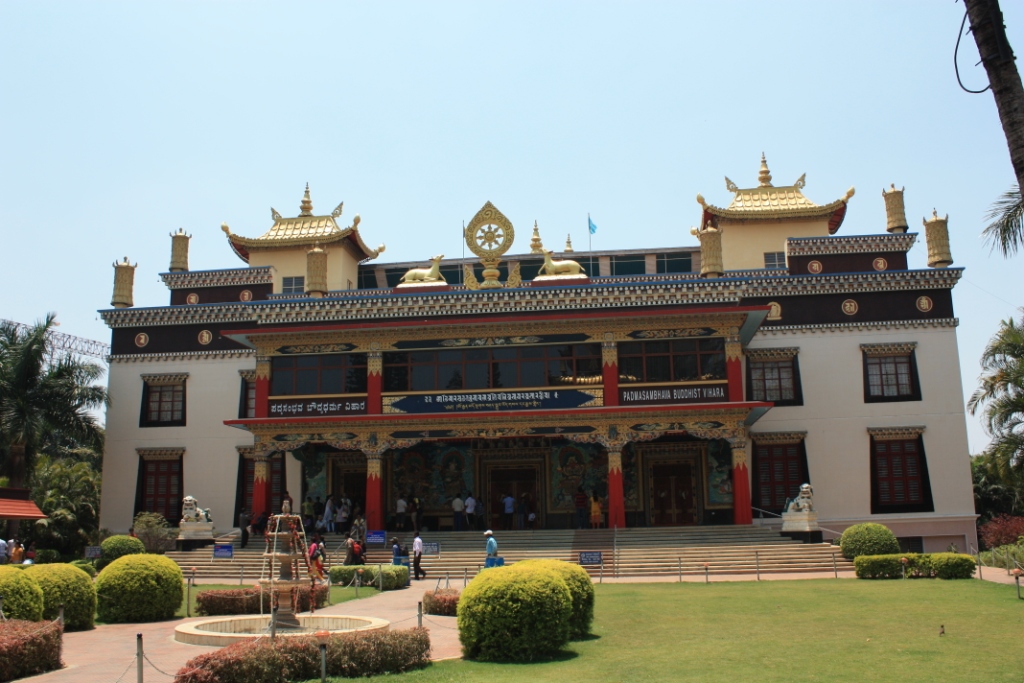
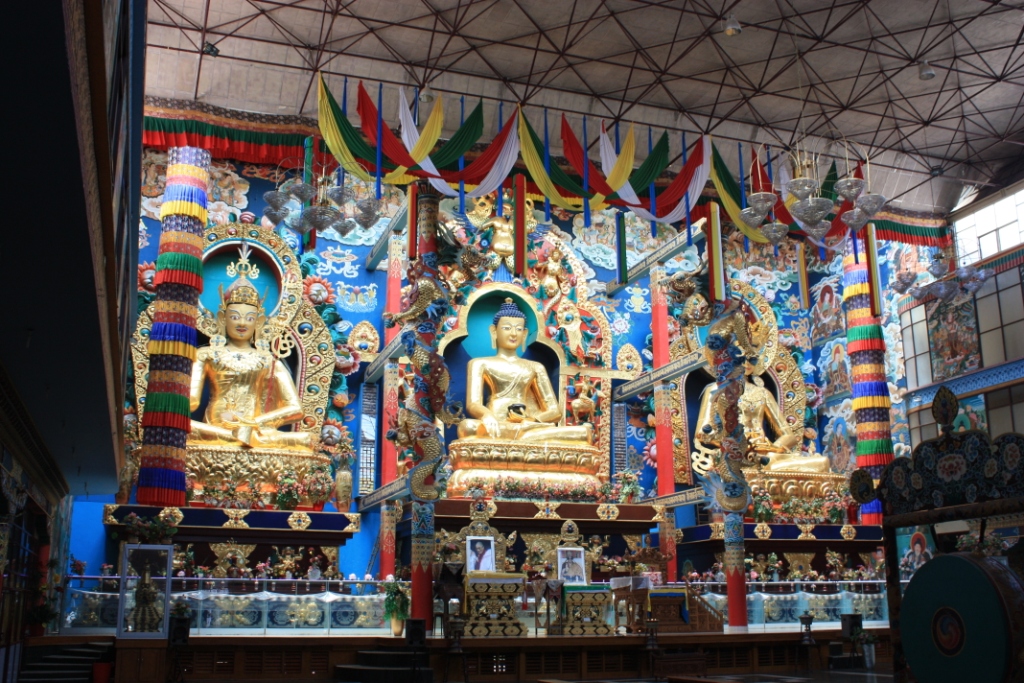
IMG_0430“Why be mindful?” That was the question asked to the group assembled at the Thubten Lekshey Ling Tibetan Buddhist meditation center on Sunday.

We had just completed a couple of rounds of mindfulness meditation. We’d been told that there are four themes of mindfulness meditation, but there can be variations on each. First, there is mindfulness of the body. This was the first type of meditation that we practiced. It isn’t about recognizing the body as an object so much as a field of perceptions.

Second, there is mindfulness of one’s feelings or sensations, in other words, mindfulness of the outside world as perceived by our sense organs. We did a meditation in which we were mindful of sound in particular. The key, we were told, was to hear everything–even the sound of silence. “Listening to the sound of silence” may sound like an oxymoron, but it makes sense as one experiences it. When one thinks in terms of hearing sounds, one begins to actively try to “catch” a sound. One may even try to anticipate sounds, particularly sounds in series–like a roofer using a nail-gun on a nearby roof. This active listening, rather than hearing, is not what one wants.

We also did a mindful eating/tasting exercise. We ate a tiny bit of snack mix. The whole processing taking many times what it normally does to shovel a bit of snack into one’s mouth and wolf it down. The food was raised to one’s face, experienced, placed in one’s mouth, experienced, chewed, experienced, and swallowed.

Third, there is meditation on the mind. That is, one watches one’s thoughts. We didn’t do one of these meditations. However, I’ve tried it in the past, and I find this particularly difficult . Watching thoughts go by as if they were rising bubbles or logs floating on a river suggests a division between the observing mind and the thought-producing mind. Recognition of the thought intrudes upon it, and this becomes a whole new line of thought.

Finally, there is meditation on emotion. We did not do one of these in this session either.

Our final meditation was another type of meditation on the body, but it was a moving meditation. We walked and experienced the motion of the body as it moved through the room. I particularly enjoyed this.

However, before the last meditation, we discussed this question of “why be mindful?” I had my own ideas, which I shared. Others had their own ideas, some closer and others farther from my own thinking, but all thought-provoking and valid.

My own thoughts were two-fold. First, mindfulness allows one to be more stable and grounded. Fear is about the future and anger and sadness are about the past. In the present one is neither afraid nor fearful. Second, by being mindful, we can come to see problems before they tumble out of control. We can catch our angry thoughts and dissect them before they do us harm. We can recognize the subtle problems with our bodies before they come full-blown ailments.

Of course, as a martial artist, I had always thought in other terms about mindfulness. There’s no time at the speed of combat to consciously recognize and consciously respond to attacks, one must be mindful to have any hope of surviving a surprise attack.

BOOK REVIEW: Know Your Mind by Sri Sri Ravi Shankar

Know Your MindKnow Your Mind by Sri Sri Ravi Shankar

My rating: 4 of 5 stars

Sri Sri Ravi Shankar is an Indian guru headquartered in Bangalore, India. In addition to his work as a spiritual leader, he heads up an organization called the “The Art of Living,” which has both a philanthropic mission and a role in spreading knowledge of yoga. Among his most important accomplishments is the development of a breathing technique for helping to attain greater emotional well-being. However, he may be most broadly known for occasional appearances on television programs such as those of CNN International.

The slim volume K(no)w Your Mind contains a series of short chapters, many of which are partly in Q&A form–coming from talks he has given internationally. The common theme of these discourses are how one can understand one’s mind and learn to live in a way that maximizes happiness.

Sri Sri’s approach is quite mainstream when compared to more controversial gurus such as the late Bhagwan Shree Rajneesh (i.e. Osho.) There is little that would raise hackles of most people. It proposes nothing magical–though Shankar supports belief in some, broadly defined and mystical, deity. His approach doesn’t rely on said deity. The book is essentially just about training the mind to look at the world in a different way.

One example that the author uses in various permutations is that people dwell on the negative. As he says, “When you are healthy, you never ask the question, ‘Why am I healthy?’When you are sick you say, ‘Oh, why am I sick?'” Similarly he mentions that, if someone tells us they like us we don’t question it, but if they tell us they hate us, then we do.

When asked how to avoid stress, he states flatly that one shouldn’t avoid it, but rather learn hope to cope with it more effectively.

On the positive side, the book conveys a lot of good information in a highly readable format. Shankar explains the mind with humor and occasionally with a parable or narrative to help make the lessons more memorable.

However, if one is looking for a systematic approach, one won’t so much find that here. It’s clear that this is a series of snippets from talks combined together. If that’s what you’re expecting, then it shouldn’t be a problem. However, if one is expecting a step-by-step guide, this book may not suit one. Occasionally it’s helpful if on has some yoga terminology in one’s head like samadhi or pranayama, but context should make the meaning clear.

I’d recommend it for someone looking for food-for-thought on bite-sized pieces on issues like memory, emotion, and mindfulness.

View all my reviews

My First Tibetan Buddhist Meditation & Lecture

Having settled into life in India over the past month, I’m now getting around to some of the self-enrichment activities I’ve planned on taking advantage of here in Bangalore. Today I attended a meditation session and discussion/lecture at the Thubten Lekshey Ling Tibetan Buddhist Meditation Center. I’ve read a few books on Buddhism and even one or two specific to Tibetan Buddhism, but this was my first time attending such a session. Also, while I’ve done several kinds of secular meditation, both in a group and individually, this was my first exposure to guided meditation in the Tibetan Buddhist tradition.

The title of the session was As the Clouds Drift by… The first hour was the meditation portion and the following two hours were the lecture / discussion portion. The session opened with a few prayers that were chanted in what I believe was Sanskrit, but there was an English translation for newbies such as myself to follow along with the meaning. Then we did a few short meditations that were much like others that I’ve done: meditation on breath and meditation on bodily awareness. Then there was a visualization as we read a sutra in English.

Transitioning into the discussion and lecture portion, we first discussed the meaning of life. No, I’m not making that up. While it might seem like a hackneyed question, some intriguing points were raised. We were directed to think of the question as having two alternative meanings. First, why am I here? Second, what is my purpose? The conversation gravitated to the latter topic. I’m not sure if this was because there was a consensus that the question “why am I here?” is meaningless, or if the question of purpose was just more intriguing. There were various opinions about whether there was a purpose, and–if so–whether it is universal or individual-specific.

After a brief tea break, the remainder of the session involved readings from The Way of Bodhisattva followed by analysis and prompted discussion. Much of the discussion revolved around the issue of how compassion is expressed and the difficulty (or ease) of being a Bodhisattva. (A Bodhisattva is one who seeks enlightenment out of compassion for all sentient beings.)

I found the session to be thought-provoking and beneficial, and thought the atmosphere was conducive to growth. Emphasis was placed on discussion rather than straight lecturing. I will no doubt be back to visit in the future.

I did learn something interesting about myself through the process of the class, and that’s that I need to learn to be still for more than two hours. While there was no prohibition on moving around–particularly beyond the meditation portion– in an effort to not be a distraction, I tried to keep fairly still. I practically ran home afterwords. I had all this pent-up energy. I would have thought myself better than average at sitting in a contemplative state. I’m a writer for goodness sake. I spend entire days at my computer. However, in truth, I rarely sit more than an hour without getting up and stretching or doing some sort of movement to limber up my body and get the blood flowing. I was raised Catholic, and so I’m not new to sitting quietly for long periods of time. Though that was a long time ago. I also have three college degrees and have spent more than my fair share of time in classrooms, but the wandering mind is not discouraged in that environment–in a way it’s encouraged.

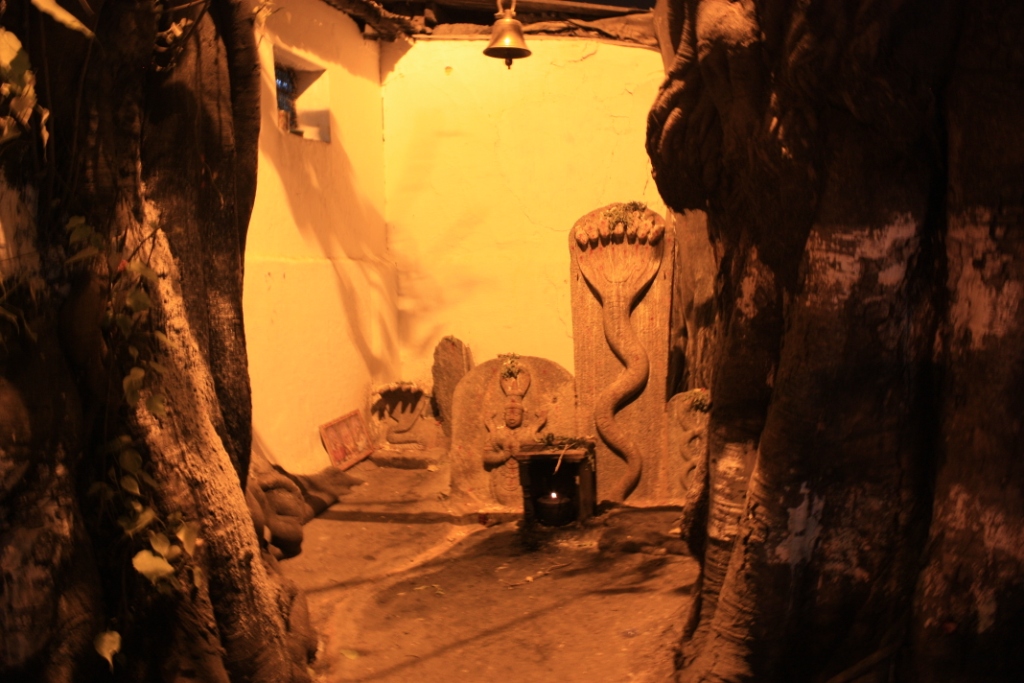
DAILY PHOTO: Bull Temple

Take September 2013 in Bangalore.

Take September 2013 in Bangalore.

This was my first experience inside a Hindu Temple, so I was completely out of my element. Fortunately, it was easy enough to follow the crowd through the procedure. (As opposed to the multi-deity temples where many disparate and complex practices may be being carried out at once.) First, one leaves one’s shoes outside, as one would at a Buddhist temple. One then walks down a corridor toward the bull. When one gets to the front of the bull, one turns to one’s left and circles the bull in a clockwise fashion, passing by a Hindu priest. There is a Hindu priest at both the head and the tail end of the idol. There’s an opportunity to make a monetary offering at both. When one gets back around to the front, the priest puts a tilaka mark on one’s forehead with bright red tikka powder. This is made in the same place one sees Hindu women wearing bindi ornamentation.

BOOK REVIEW: Wise Blood by Flannery O’Connor

Wise BloodWise Blood by Flannery O’Connor

My rating: 5 of 5 stars

Amazon page

Wise Blood is a character-driven novel about a young veteran, Hazel Motes, who becomes a devout atheist. If that sounds like an oxymoron, let me explain. After becoming enamored with a preacher (and having the blood of a preacher man in his veins), Motes begins to preach the tenets of his newly formed Church Without Christ. In essence, Motes believes in religion without believing in God (the opposite condition of that which some of us find ourselves.)

This was Flannery O’Connor’s first novel, and it’s the first of her novels that I’ve read. I have, however, read some of her stories, and Wise Blood displays a dark humor similar to that found in O’Connor’s best know story “A Good Man is Hard to Find.”

Throughout the book, Motes struggles to convey the depths of his disbelief. He attacks false prophets. He follows through on an act of self-mutilation that he had earlier discovered the preacher, Asa Hawks, could not. Thus proving his lack of faith to be stronger than the preacher’s faith. Motes is wooed by both by the nymphomanical daughter of Hawks, Sabbath Lily, and later by his landlady, Ms. Flood. While Motes doesn’t necessarily remain chaste, he does maintain a kind of priestly detachment from the pleasures of the flesh.

An interesting part of the story details Motes’s interaction with a con-man named Hoover Shoats who co-opts Motes’ preaching sessions and starts his own Holy Church of Christ Without Christ–which passers-by find to be a source of amusement–as a bastardization of Motes’ message. Motes rejects Hoover, but sees his mission being usurped anyway. Motes shows deadly seriousness in his desire to be taken seriously in the word that he preaches.

This novel was apparently built from a series of stories, and a little bit of discontinuity can be sensed early on. However, that’s just part of the charm of a book that is sometimes thought-provoking, sometimes humorous, and sometimes both.

I would recommend book for anybody, excepting those hard-core pious who grow red-faced with rage in the face of atheism or other beliefs.

View all my reviews

BOOK REVIEW: A Search in Secret India by Paul Brunton

A Search in Secret IndiaA Search in Secret India by Paul Brunton

My rating: 4 of 5 stars

Amazon page

A Search in Secret India is a travelogue by Paul Brunton as he wondered through India in search of sages. In the process, he found a number of masters of body, mind, and both. However, he finds these individuals as rare nuggets in a sea of frauds.

Brunton states up front that he won’t waste time with any of the blatant frauds or suspected frauds, but he does devote space to a number of the more impressive ones. Impressive either by way of a large following or artfulness of technique. He also finds individuals he doesn’t know what to make of. These individuals appear to have impressive otherworldly skills, but skills that he can neither reconcile with known scientific understanding nor uncover as hoaxes despite his best skeptical inquiry. Given Occam’s Razor, he seems to be left suspecting that these are masters of illusion, but he maintains skepticism of his skepticism. A prime example of this is a Yogi who seems to be able to conjure any scent upon request.

Brunton also runs across individuals who are able to do amazing things that are inconsistent with his knowledge of the world, but which his exhaustive investigations leave little room to dispute. For example, there is one yogi who can completely cease his respiration for a seemingly impossible length of time, and who resumed breathing not with a gasp but with a slow, calm series of breaths.

As suggested above, this book is really an attempt to analyze India’s spirituality through the lens of Western logical and scientific approaches. The author is a Brit and the book was first published in the 1930’s. His worldview is consistent with that status. While Brunton would like to master his own mind, he is unwilling to let himself be duped.

There is another side to this juxtaposition of East and West. The yogis and gurus with which Brunton comes into contact often have trouble grasping the Western mindset (there is one notable exception.) What these wise-men have difficulty understanding is why a people, like the British, devote so much time to mastering the external world (and with a great measure of success it must be added), but put so little effort into mastering or understanding the self. Most of the gurus appreciate that a Brit is taking an interest in the spiritual and yogic ways of India, but with their own skepticism. They find Westerners materially rich, but bankrupt of the mind. They find the Brits strong, but lacking the supple power that yoga introduces.

After completing his travels, it seems the book is set to draw to an end. However, Brunton realizes that while there were a number of skilled individuals that he came across in his travels,there is one that stands out as someone he should not miss an opportunity to learn more from. Therefore, instead of getting on a steamer back to England, he returns to South India to a man called the Maharishee in order to find out if the guru will take him as a student. The last couple chapters describe his time under the Maharishee’s tutelage as well as under one of the guru’s most advanced students. The Maharishee is a sage the likes of which Brunton has not seen in all his travels. The guru has the humility to say that he cannot teach Brunton anything, but instead can only show him some things that he learned on his own journey.

If there is a lesson for those who would like to follow in Brunton’s footsteps, it seems to be that there is an inverse relationship between how easy a guru is to find(/how eager a guru is to talk to one) and the level of skill of that teacher. In almost all cases, Brunton had to take great initiative and steer off the beaten path to find the true masters. On the other hand, most of the individuals who were easily found, and eager to talk, were just con men.

I recommend this book for those interested in development of the mind and body.

View all my reviews

BOOK REVIEW: Buddha by Karen Armstrong

BuddhaBuddha by Karen Armstrong

My rating: 4 of 5 stars

Amazon page

Karen Armstrong’s book is a biography of Siddhatta Gotama (a.k.a. Siddhartha Gautama), the man who became the Buddha. However, in the process of telling this man’s life story, she introduces the reader to the basic tenets of the religion he inspired.

Siddhatta’s story is an interesting one that many non-Buddhists know the gist of from the Herman Hesse novel entitled Siddhartha. As a boy, the Buddha-to-be was the son of a wealthy, high-caste man who attempted to shelter his child from all the ugliness of the world, e.g. poverty, disease, and death. Despite these attempts, the young man eventually sees the true world and realizes that he has been living an illusory life. Ultimately, the young man abandons his comfortable life in search of an enlightened view-point.

The Buddha’s life is what one might call “novel-shaped.” That is, the arc of Siddhatta’s life as we know it is ideally suited to being conveyed as a story. It’s a warrior’s quest tale, but one of the mind rather than physical adventure. Armstrong’s book takes advantage of this arc and is arranged accordingly. The six chapters of the book are:1.) Renunciation; 2.) Quest; 3.) Enlightenment; 4.) Dhamma (the doctrines or teachings); 5.) Mission; 6.) Parinibbana (the final rest.)

Renunciation refers to Siddhatta’s abandonment of the world he knew. The quest describes his life as he strikes out in an attempt to become enlightened. The third chapter outlines how he came upon enlightenment. This might have been the conclusion of the story of the man, but that’s when the story of the Buddhist religion becomes entwined with the story of the Buddha. Chapters 4 and 5 deal largely with how the religion spread.

If one is looking for a good overview of Buddhism, Armstrong’s book is a good place to start. It’s readable, and, by tying teaching into the Buddha’s life story, interesting as well.

View all my reviews