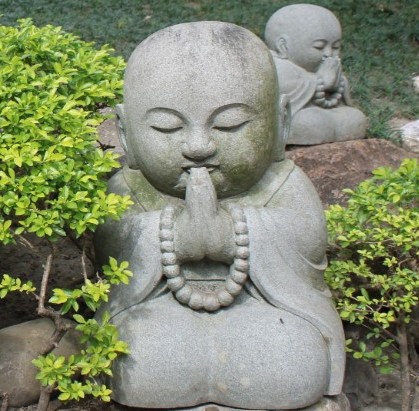
DAILY PHOTO: Wong Tai Sin Temple

DAILY PHOTO: Tin Hua Temple, Hong Kong

BOOK: “The Pocket Rumi” ed. / trans. by Kabir Helminski

The Pocket Rumi (Shambhala Pocket Library)The Pocket Rumi by Jalal ad-Din Muhammad ar-Rumi
My rating: 4 of 5 stars

Publisher Site – Shambhala

This is a selection of writings (mostly poetry) of Rumi (formal name: Jalāl al-Dīn Muḥammad Rūmī.) Rumi was a mystic of Sufi Islam, and so the poems tend toward the devotional — though with more reference to the experience of intoxication than one might expect from a 13th century Islamic poet.

This selection consists of three sections organized by poetic form, each section progressively longer than the preceding one. The first section is ruba’i, the second is ghazals, and the last is from Rumi’s Mathnawi.

The “Pocket” of the book’s title and series is figurative as the paperback is too big of both format and thickness for any pocket I own, personally, but the point is that it’s a quick read at only about 200 pages of (mostly) poetry [meaning white space abounds.]

I enjoyed reading this selection. I can’t say how true to message the translations are as I have no knowledge of Persian. I can point out that the translators opted to abandon form in favor of free verse. Hopefully, this gave them the freedom of movement to approach the message and tone of the originals.

If you are interested in a short, readable English translation of Rumi’s poetry, this book offers a fine place to start.

View all my reviews

DAILY PHOTO: Church of the Visitation of the Virgin Mary, Bratislava

Image

BOOKS: “Violence: A Very Short Introduction” by Philip Dwyer

Violence: A Very Short Introduction (Very Short Introductions)Violence: A Very Short Introduction by Philip Dwyer
My rating: 4 of 5 stars

Publisher Site – Oxford University Press

This is a brief overview of various types of violence, starting with the question of what counts as violence. The book explores violent acts carried out by individuals, mobs, movements, governments, and religions. It reflects upon how the nature of violence has changed over the centuries while hinting at potential reasons for said changes (along with counterarguments.)

This book raised some provocative questions, such as: Why would people go to watch executions? Does Steven Pinker’s hypothesis that humanity is becoming less violent hold water? [Pinker made this argument in his book The Better Angels of Our Nature, but it has been refuted on number of grounds — definitional, methodological, etc. Though Dwyer only briefly touches on Pinker’s book and its critics in this book and a detailed critique will require looking elsewhere.] How (and why) do violent tendencies vary across cultures. And, when and how did governments end up with a monopoly on legitimate use of force.

I found this book interesting and informative and would recommend it for those looking for answers as to why and how our species is so violent.

View all my reviews

PROMPT: Religion

Daily writing prompt
Do you practice religion?
Nope. Not even a little.

Lanterns [Kyōka]

rows of lanterns —
a jack-o-lantern patch —
lights the temple
on a dark, rainy night;
rain splats on a tin roof.

DAILY PHOTO: St. Gregory the Illuminator Cathedral

Image

PROMPT: Sacrifices

What sacrifices have you made in life?

I’ve thrown coins in a fountain, and I once went to a pig roast where someone prayed out loud before we ate, but I’ve never pushed anyone into a volcano — if that’s what you’re getting at.

BOOKS: “Live Like a Philosopher” by Massimo Pigliucci, Gregory Lopez, and Meredith Alexander Kunz

Live Like A Philosopher: What the Ancient Greeks and Romans Can Teach Us About Living a Happy LifeLive Like A Philosopher: What the Ancient Greeks and Romans Can Teach Us About Living a Happy Life by Gregory Lopez
My rating: 4 of 5 stars

Publisher Site — Hachette / Headline Press

This book is for a person in the market for a philosophy of life, but who only knows that they want a system rooted in Ancient Greece. While the coauthors are all Stoics, the book explores twelve additional philosophies and gives each roughly equal consideration. In addition to the expected systems, such as Epicureanism, Stoicism, Platonism, and Skepticism, there are also several lesser known or defunct philosophies such as Cyrenaic hedonism, Cynicism, Pyrrhonism, and Megarianism.

The book is organized into four parts. The first examines schools that value pleasure (Cyrenaicism and Epicureanism,) the next investigates schools that focus on virtue and character (Aristotelian Peripatetics, Stoicism, Cynicism, and Political Platonism,) the penultimate focuses on systems encouraging doubt or caution in knowledge (Socratic philosophy, Academic Skepticism, Sophism, and Pyrrhonism,) and the last set are posed as questionable candidates for a life philosophy (i.e. those of the Pythagoreans, Megarians, and Neoplatonists.) The last three schools are questioned on various grounds, including: is enough known about what its practitioners believed, did they live their philosophy or just ruminate on it, and could the system be considered a full-fledged philosophy (as opposed to a stance on a specific issue or issues.)

The book is presented in self-help fashion, with each chapter ending in a set of exercises designed to help the reader build practical understanding of each school. The goal of these exercises (as comes together in an appendix) is to help the reader determine which philosophy is best suited to their disposition and inclinations.

I enjoyed this book. The authors use stories to convey ideas and the book’s readability is kept inviting to general readers. If you’re interested in better understanding Greek schools of philosophy, I’d recommend the book as quick and easy way to get a better grasp.

View all my reviews