What brings you peace?
Being in the now, and feeling – but not feeding – emotional sensations.

What brings you peace?
Being in the now, and feeling – but not feeding – emotional sensations.
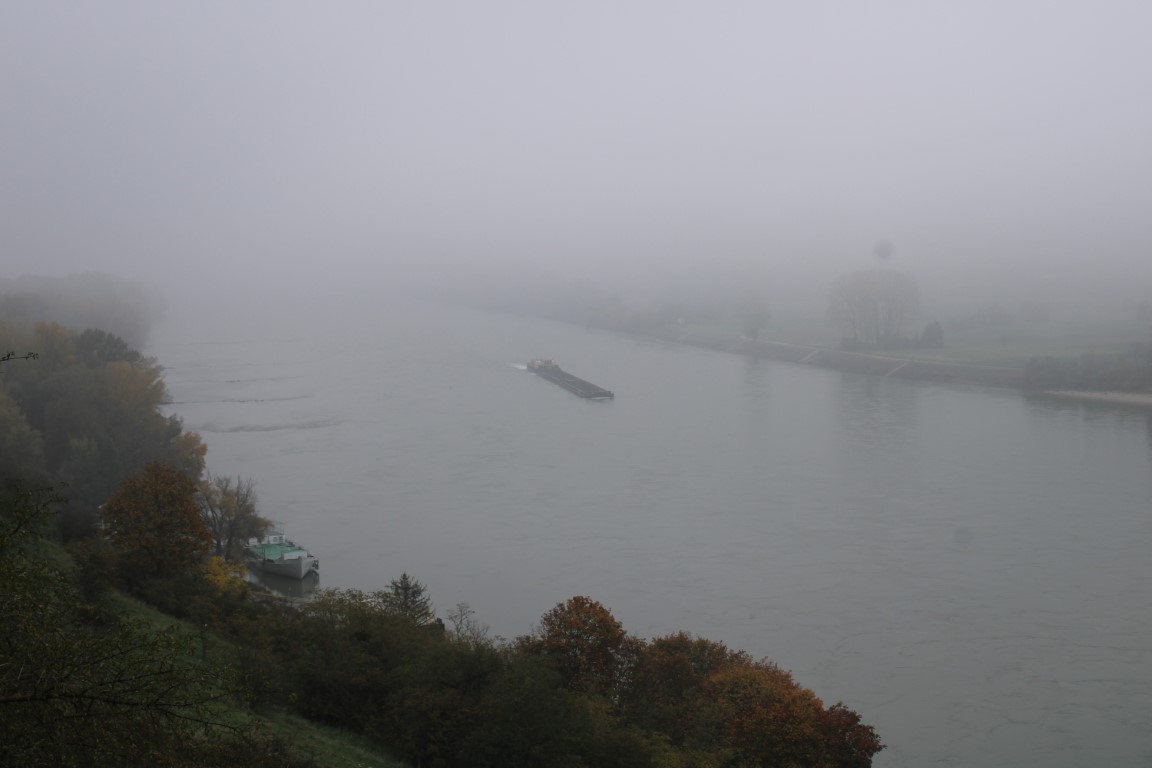
Stationed in East Anglia,
   I remember layered fog,
     fog so thick one couldn't
     see past the hood's end,

but, given a slight rise,
   one could see all the way
   down the runway -- as if
   it was a cloudless full moon eve.

As one might expect of an airbase,
   (having been built around a flat runway)
   there wasn't much topography.

But sometimes life is like that:
   a tiny rise in perspective
   allows one to see the world clearly,

but a minor dip puts one in a
   soup of unfathomability.
Every source of information is flawed and / or of limited value as a source of truth.
There is beauty everywhere (but to see it one has to let go of one’s compulsion to attach value judgements to everything.)
People who know more things for certain are wrong about more things.
A better life comes of being content with less than of having more.
There is a force, we’ll call it gravity, that keeps my feet to the floor (or insists that I either fall or expend energy to break the surly bonds.)
With respect to that which one can’t know for certain, it’s closer to truth to remain ignorant than to be deluded.
The world that I perceive isn’t the world, itself.
All else being equal, a diverse group of people is stronger, smarter, better looking, and more effective than a homogenous one.
If the same level of effort were put into fostering emotional intelligence as is put into mental intelligence… what a wonderful world it would be.
One who hands you knowledge but tells you to drop it like a hot rock if it doesn’t stand up to your own experience and rationality is more trustworthy than one who hands you knowledge and insists you hold onto it with white-knuckled intensity.
Uh, we are all seeking both. That is the fundamental strain of being human — the struggle between a need for novelty and a need for familiarity. We are all both tribesman and traveler — though in varied proportion. I love the traveler more in my own particular self.
What strategies do you use to increase comfort in your daily life?
I don’t, but I have a lot of strategies for being more content in the face of various situations and environments — including uncomfortable ones. These include the yogic practice of dispassionate witnessing, minimalism, travel (and specifically minimalist travel to places – the less familiar the better,) and intense physical activity.
I think comfort as a major objective in life is overrated, and virtually insures a discontented life. A life in which one can be content, whatever may come along, is a happy life.
Depends on the context. If I’m thinking about poetry or philosophy (which I often am,) then it pertains to the early nineteenth century movement that counterpoised the Enlightenment. Those “Romantics” disliked what they saw as the cold rationality of Enlightenment thinking; they valued spiritual and mystical experiences, and they believed it was important to not throw out the spiritual “baby” with the bathwater. That is, like many Enlightenment thinkers, they realized that it was necessary to jettison many of religion’s noxious ideas (e.g. the concept of “chosen people”) and also realized that mindlessly following moral dictates that may or may not have made sense in the pre-Christian Levant could be detrimental to their present-day life experience. However, unlike most Enlightenment thinkers, they did find value in spiritual views of the world as well as in the pursuit of mystical experiences. William Blake (even though he is often labeled pre-Romantic) provides an excellent example. His poems are spiritual to the core, and yet explicitly reject a lot of the moralizing and toxic aspects of conventional religion.
Of course, that variety of “Romantic” is usually given a big-R, and so I suspect the question is after a more colloquial definition. With that in mind, I believe “romantic” means “that which facilitates the unity of two (or more, I don’t judge) people in an immersive intimate experience of each other during a common period of time.” I’m not big on trappings. I think people obsess over trappings because it allows them to slack on the physical / cognitive demands of being fully engaged. This is why sex (done well) is such a great tool both for relationship building and for personal development. It makes it relatively easy (i.e. rewarding) to stay fully engaged in a common experience and in the moment, and to not fall into the attentional abyss.
1.) Move my body often and with vigor. 2.) Eat my veggies. 3.) Rest as though it’s an essential part of the process of living (i.e. not as though it’s goofing off between “doing stuff.”) 4.) Drop anything without value, making personal development as much a process of stripping away as it is of adding to.
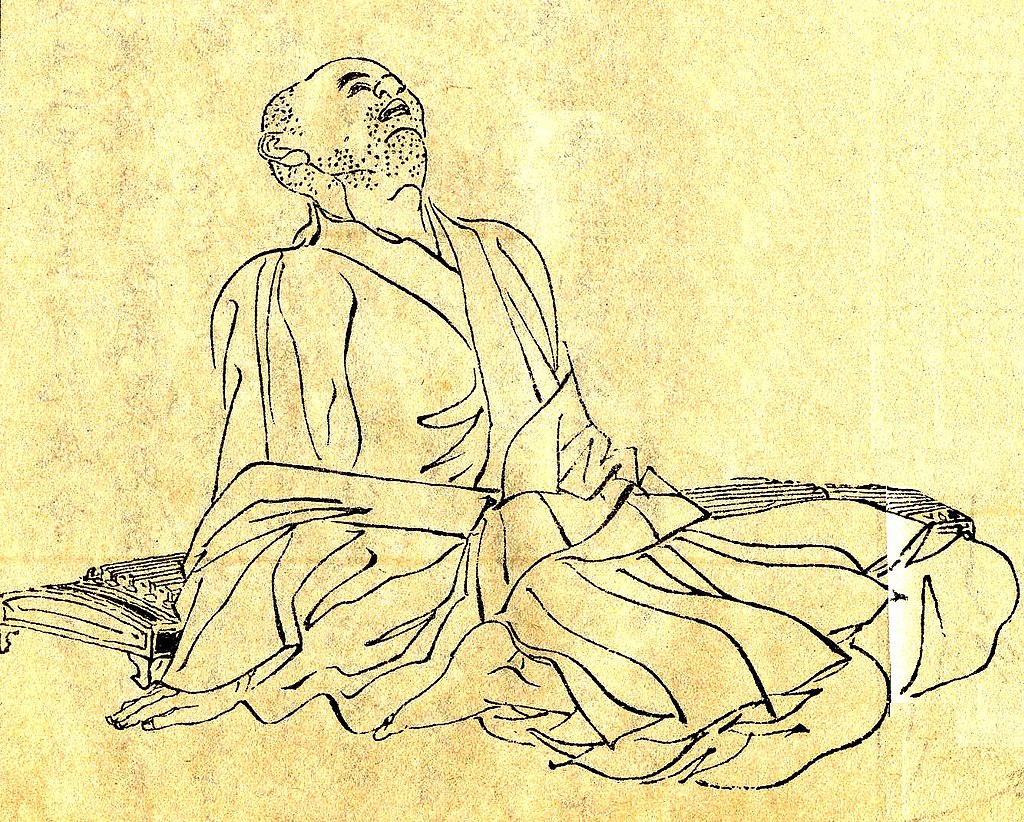
drawing by Kikuchi Yōsai
On flows the river ceaselessly, nor does its water ever stay the same.
Kamo no Chōmei, Hōjōki
No one owns a splendid view, so nothing prevents the heart’s delight in it.
Kamo no Chōmei, Hōjōki
Knowing what the world holds and its ways, I desire nothing from it, nor chase after its prizes. My one craving is to be at peace; my one pleasure is to live free from troubles.
Kamo no Chōmei, Hōjōki
These days, I divide myself into two uses — these hands are my servants, these feet my transport.
Kamo no Chōmei, Hōjōki
When I chance to go down to the capital, I am ashamed of my lowly beggar status, but once back here again I pity those who chase after the sordid rewards of the world.
Kamo no Chōmei, Hōjōki
Reference: Saigyō Hōshi, Kamo no Chōmei, Yoshida Kenkō. 2021. Three Japanese Buddhist Monks. New York: Penguin Books. 112pp.
Available Here1.) Good company; 2.) studiousness; 3.) a sense of humor, and 4.) the capacity to let go of that which has no value.
This poetry collection teaches that most challenging of human skills: how to be insanely confident that you can do anything without being a jerk about it. (Also, how to see beauty beyond the societal consensus of what’s beautiful.)
Zhuangzi by ZhuangziThe virtues of a carefree, spontaneous, minimalist, and down-to-earth approach to living explained through tiny stories.
The Tragedies of William Shakespeare by William ShakespeareA master class in things that can turn a life into a tragedy.
Titus Andronicus: Live by the sword = tragedy (An eye for an eye, and everyone dies.)
Romeo & Juliet: Grudges (+ Lust) = tragedy
Julius Caesar: handing your adversary the mic (/ the fickleness of crowds) = tragedy
Hamlet: indecisiveness = tragedy (i.e. On or off the crazy-bus.)
Othello: jealousy = tragedy
Macbeth: excessive ambition = tragedy
King Lear: needing gratuitous signs of affection = tragedy
Timon of Athens: expectations of reciprocity = tragedy
Anthony & Cleopatra: mixing one’s love and work lives = tragedy
Coriolanus: a crotchety old warrior in peace time = tragedy


