BOOK REVIEW: The Lost City of the Monkey God by Douglas Preston

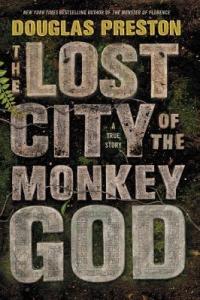
The Lost City of the Monkey God: A True StoryThe Lost City of the Monkey God: A True Story by Douglas Preston
My rating: 5 of 5 stars

Amazon page


Preston tells the story of his participation in an expedition into the Mosquitia region of Honduras in search of a lost city, alternately called the White City (i.e. La Ciudad Blanca) or the City of the Monkey God. Preston was acting as a correspondent for National Geographic and was part of a larger team including a photographer, filmmakers, archaeologists, and a team of ex-Spec Ops escorts. It’s not a simple and straightforward tale of Indiana Jones types chasing after the artifacts of a long collapsed civilization (though it does capitalize on that sense of intrigue greatly from the title to the telling of both the historic and contemporary searches for this fabled lost city.) The book tells several stories that occur about and around this search, and they are arguably more interesting.

One of these side stories is the historic accounts of past explorers who searched for the White City. Those were the individuals who more closely corresponded to Indiana Jones–both because they didn’t have an airplane with a state-of-the-art Lidar system (lidar is the light/laser version of radar or sonar), and because they were more likely to engage in tomb-raiding and artifact robbery. This isn’t to say that the expedition that Preston was on didn’t have its share of snakes, quickmud, and other hazards that are the only reason that a huge city from a past civilization would remain undiscovered in the present day. The region in which the expedition took place had not only all the natural hazards of dense jungle, but the human hazards posed by operating in territory controlled by drug cartels. That said, they didn’t have to machete through hundreds of miles of jungle with no idea of where they were likely to find their objective.

One of the most interesting side stories occurred when Preston and many of the members of the expedition came down with leishmaniasis, a nasty tropical disease vectored by sandflies. The disease has a treatment that’s almost as likely to kill one as is the disease. It’s almost impossible to completely get rid of the disease. One can be cured in the sense of being made asymptomatic, but one may remain a potential carrier waiting to be bitten again and to pass the nasty parasite onto another sandfly so they can infect someone else. There are several elements of the disease story that are intriguing. The most interesting is speculation about the role that disease might have played in the sudden evacuation of this lost city. This is informed by a broader discussion of how “Old World” diseases spread through the “New World” with crippling effect. Another is how diseases are neglected when they almost exclusively infect poor and rural people (until a National Geographic correspondent tracks it back to the continental US, that is.)

For those outside of archaeology, one of the least interesting, but still interesting, side stories is that of the intense controversy in the field. Preston is very forthcoming about his talks with scholars who were angered and outraged by the use of terms like “Lost City” which hearken back to a period in which tomb-raiding was the norm and Westerners stole and shipped priceless artifacts back to the West by the ton. These internecine wars of academia reinforce the idea that this isn’t just musty history, but involves questions that many people feel intensely passionate about.

There is a photo section that provides images of both the cast of highly discussed people and a few of the artifacts uncovered. There’s also a section of sources and citations.

I found this book to be fascinating and I’d highly recommend it. Those interested in exploration and adventure tales will find it of obvious interest, but those with a curiosity about public health may find it unexpectedly of interest.

View all my reviews

5 Books to Introduce You to Your Gut Microbiota

5.) The Wild Life of Our Bodies by Rob Dunn: This book takes a broad look at the role that hangers-on have on  human life.


4.) The Psychobiotic Revolution by Scott C. Anderson et. al.: This book focuses on the role that our gut microbiota have on our mental well-being–which increasingly appears to be substantial.


3.) Missing Microbes by Martin J. Blaser: The focus of this book is on how our love of antibiotics in every form– from pills to antimicrobial soaps–is killing us by denying us microbiotic diversity and robustness.


2.) 10% Human by Alanna Collen: Collen’s book addresses many of the same issues as the other books mentioned, but–as the title suggests–it emphasizes the fact that a human has 10 times as many hangers-on of other species as it does cells that are contiguous to the body. (If you’re wondering how this could be, it’s because the human body has some pretty big cells [some macroscopic, in fact] and the bacteria and other single-celled species tend to be relatively tiny.)


1.) I Contain Multitudes by Ed Young: This is probably the most highly-regarded of the books on this subject. It was considered one of the best science books of 2016.

BOOK REVIEW: Caesar’s Last Breath by Sam Kean

Caesar's Last Breath: Decoding the Secrets of the Air Around UsCaesar’s Last Breath: Decoding the Secrets of the Air Around Us by Sam Kean
My rating: 5 of 5 stars

Amazon page


A book about air and the gas molecules that float about in it may not sound gripping. However, Sam Kean has a gift for finding interesting little stories to make talk of nitrogen-fixing, the discovery of oxygen, and the improvement of the steam engine fascinating. Such stories include that of a vaporized resident of Mount St. Helens, a gas-belching lake that suffocated families in their sleep (not a horror movie plot—a documented event), the scientist who both made millions of new lives possible through his nitrogen-fixing process and then took killing to its most despicable with poison gas, the pig who survived nuclear fallout, and, of course, how the last breath of a Roman Emperor came to be his last–and how likely it is that you’re breathing some of it right now. Along the way you’ll learn about farts, about the use of nitrous oxide for fun and surgery, about Einstein’s venture into refrigerator design, about lighter-than-air air travel, and about what air might look like on another planet.

The book is divided into three parts and nine chapters. There are also eight “interludes” that each takes up an intriguing subject that is chemically or topically related to the preceding chapter. The first part, and its three chapters, addresses the components of air and where they come from. The three chapters explore sulfur dioxide and hydrogen sulfide as molecules released by geological processes (e.g. volcanoes,) the abundant but—without great effort—useless element of nitrogen, and oxygen—useful for breathing and setting the world on fire.

The middle part deals with how humans have used components of air for our own purposes. These three chapters discuss nitrous oxide’s invention, the exploitation of steam to power the Industrial Revolution, and the use of lighter-than-air elements for air travel.

The final part both describes ways in which humanity has changed the air, and looks at what we might have to contend with if we need to go to another planet to live. The seventh chapter explores nuclear testing and the radioactive isotopes that have been spread by it. The penultimate chapter examines the ways in which humans have tried to make weather more predictable by engineering it—usually with little to no effect. The last chapter is about what air might look like on other planets, be they planets on which we’d have to make air or ones that already have their own atmospheres.

There are a number of graphics, including molecule diagrams, photos, and artworks. There are also notes and a works cited section.

I’d highly recommend this book. I found it to be fun to read and fascinating. If you’re into science, you’ll love it, and—if you’re not—you may change your mind.

View all my reviews

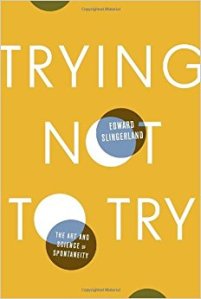
BOOK REVIEW: Trying Not to Try by Edward Slingerland

Trying Not to Try: The Art of Effortlessness and the Power of SpontaneityTrying Not to Try: The Art of Effortlessness and the Power of Spontaneity by Edward Slingerland
My rating: 5 of 5 stars

Amazon page


This book’s paradoxical title is perfect for its paradoxical subject matter, which is famously expressed in such quotes as, “When nothing is done, nothing is left undone” [ver. 48 of the Tao Te Ching.]  Slingerland lays down the ancient Chinese wisdom of wu-wei and de, but provides something novel by putting it in the context of the positive psychology and neuroscience of today. Wu-wei literally means “no doing,” but can be more meaningfully defined as “effortless action.” De (pronounced “duh”) is a charisma seen in people who have mastered the effortlessness and spontaneity of wu-wei.

While the book is built around the varied approaches of four Chinese philosophers—two Confucians (i.e. Confucius and Mencius) and two Taoists (i.e. Laozi and Zhuangzi)—the author relates this philosophy to the present-day thinking found in Daniel Kahneman’s “Thinking, Fast and Slow,” Mihaly Csikszentmihalyi’s conception of Flow, and the neuroscience of the subconscious.

The book consists of eight chapters. The introduction and the first two chapters outline the concepts of wu-wei and de using both Chinese and Western stories and examples to help clarify these arcane ideas and put them in the context of the social and spiritual spheres. Chapter 1 offers an extensive discussion of the operation of the brain as it relates to the discussion of effortlessness and spontaneity.

Chapters three through six make up the core of the book, and present the approach and thinking of Confucius, Laozi, Mencius, and Zhuangzi, respectively. This “boy-girl-boy-girl” Confucian-Taoist organization offers the reader sound insight into the varied approaches and allows one to see the evolution of thinking. Confucius gets the first cut, but his approach to effortlessness and spontaneity involves a great deal of effort and planning. It might seem that Laozi’s approach–which does away with effort and planning–might be more apropos, but it’s hard to imagine anything of benefit actually being spawned by such a loosy-goosy approach. The more nuanced approaches of Mencius and Zhuangzi offer additional insight, but do not eliminate the paradox. It’s this paradox that’s the subject of chapter seven.

The final chapter examines what the reader can take away–given that the paradox of wu-wei seems inescapable. The author proposes that, paradox or not, there is value in pursuit of effortlessness and spontaneity, and progress can be made by understanding and accepting said paradox.

The book has no graphics, but is annotated and has a bibliography–as well as an appendix table that summarizes the various approaches to wu-wei.

I enjoyed this book and found it fascinating. It’s highly readable, having humor and a wide range of examples from ancient myths to pop culture. The book offers a great value-added by considering the relevance of modern science and psychology to this ancient concept. I’d highly recommend this for individuals interested in Chinese / Eastern philosophy, as well as anyone hoping to bring a little more effortlessness and spontaneity into his or her life.

View all my reviews

BOOK REVIEW: Round Ireland with a Fridge by Tony Hawks

Round Ireland with a FridgeRound Ireland with a Fridge by Tony Hawks
My rating: 5 of 5 stars

Amazon page


When Tony Hawks and his friend Kevin see a man hitching with a refrigerator one night, a debate ensues that results in a ₤100 bet that Hawks can circumnavigate Ireland entirely by hitching rides–while carting a fridge with him. (When Kevin insists that no one could get a lift with a fridge, Hawk’s response sets the book’s tone and theme, “They could in Ireland, it’s a magical place.”) Showing a lack of business acumen, Hawks purchases a compact dorm fridge for ₤130, and sets off from Dublin in a counterclockwise fashion. The rules of the bet stipulate that Hawks must visit Tory island at the extreme north and Clear Island at the extreme south but otherwise can use whatever route he likes as long as he gets around only by hitchhiking, he keeps the fridge with him during his travels, and it takes him less than a month. Hilarity ensues.

Hawks’ book is a hoot. If there is anything that he makes funnier than a person questioning his intelligence / sanity for carting a fridge about, it’s his description of the people who politely ignore the absurdity of him hitching with a fridge. There’s also a fair amount of sour grapes humor as sometimes it seems the fridge has gained more of a celebrity status than the author. Of course, not all the humor is fridge-centric; some of it takes place in pubs with the people the gregarious Hawks meets along the way. The book mixes travelogue with humor writing, and nicely captures both the scenery of Ireland and the national character of the Irish. The book also has its serious moments, particularly as it draws to a close and the author realizes his adventure is at an ends.

In the end, Hawks proves that it can be done—in theory, at least. It should be pointed out that Hawks had the benefit of appearing on a national radio show regularly as well as on TV at the start and finish of his trip. Because of this, people were often on the lookout for him and likely more willing to give him a lift than if he were the average schlub. On the other hand, the need to meet scheduled appointments with media is one of the sources of tension in the book because they usually involve close calls. It seems it’s not always easy to call in from remote locations in rural Ireland while on the move, and the best example may be Hawks’ attempt to make it to Dublin on the last day to meet a PR event that a radio show had set up. He puts the reader on the edge of his seat, despite the lack of any real peril (it is just a guy trying to make media events related to his absurd adventure, after all.)

I’d highly recommend this book. If you’re interested in traveling in Ireland, it’s a light read to give you some ideas about places you might want to hit (or miss.) However, on its humor alone it’s worth a read even for readers who don’t normally read travel writing.

View all my reviews

BOOK REVIEW: Complete Calisthenics by Ashley Kalym

Complete Calisthenics - The Ultimate Guide To Bodyweight ExerciseComplete Calisthenics – The Ultimate Guide To Bodyweight Exercise by Ashley Kalym
My rating: 4 of 5 stars

Amazon page


“Complete Calisthenics” delivers an overview of body-weight exercises, as well as the information needed to begin a calisthenic workout program. It covers advanced exercises such as planches, levers, and flags, but it also provides simplified modifications and progressions for said advanced exercises for those who aren’t ready to leap into gymnast level practice. I’d say this book is ideal for an intermediate level practitioner or, at least, someone in sound physical shape who can knock out several push-ups and at least a few pull-ups. It offers one the information necessary to gradually progress toward the most advanced levels. While there are simplified modifications, a beginner who is out of shape may need more content on capacity-building and simplified modifications to get started.

The first six chapters form an introduction and give essential background information on equipment, nutrition, rest / recovery, warming up / mobility, and flexibility. The warming up and stretching sections provide many photos and explanations of key points, just as the latter exercise sections do.

Chapters seven through twenty describe and demonstrate the various exercises. These chapters can be divided into the first five chapters (ch. 7 through 11) that cover upper-body push and pull exercises (i.e. push-ups, pull-ups, dips, muscle-ups, and handstands.) Each of the aforementioned exercises has a range of variations offered–some easier and many harder than the basic. Chapters 12 through 16 explore levers (planche, front lever, back lever, half lever, and human flag) and these offer progressions, variations, and various approaches to entering the pose—since most practitioners will not be able to proceed straight to the full expression of the technique. Chapters 17 through 20 delve into the core, lower body, and full-body exercises. These are: floor core exercises (17), leg raises (18), lower body / leg exercises (19), and conditioning exercises–i.e. the full-body exercises that get the heart pumping (20.)

The last two chapters suggest an approach to building a training program and offer an FAQ, respectively. The approach suggested involves four levels. The first is called “the fundamental five” and it is built around push-ups, pull-ups, dips, hanging knee raises, and squats. The next builds upon the first and prepares one to transition to the third, which focuses on learning to do the levers. The final is called “complete calisthenics” and it incorporates all the advanced. The author also describes how one might approach optimizing one’s program to one’s needs and abilities.

The one thing that I missed is a discussion of intervals. Even if the author doesn’t use or recommend such an approach (timed work/rest), I expected he would discuss his rationale. In the FAQ, he does mention that the reason that he doesn’t discuss periodization (having occasional light spells for long-term recovery) is because they must be tailored to the needs / fitness level of the individual. At any rate, the role of time in workouts was conspicuously absent.

That said, I found this book to be quite well done overall. The pictures are explicit. The write-ups mention important points of consideration—e.g. safety challenges. There’s a thorough coverage of progressions and modifications. I’d recommend this book for anyone who practices calisthenics. Again, it’s probably a little more suitable for someone who either has an existing practice that they’d like to ramp up, or at least someone who has a reasonable level of fitness starting out.

View all my reviews

BOOK REVIEW: Modern Buddhism: Vol. 1 (Sutra) by Geshe Kelsang Gyatso

Modern Buddhism: The Path of Compassion and Wisdom - Volume 1 SutraModern Buddhism: The Path of Compassion and Wisdom – Volume 1 Sutra by Geshe Kelsang Gyatso
My rating: 4 of 5 stars

Amazon page


This is the first book in a three-volume overview of Buddhism that is available for free (or for the minimum Kindle book price on Amazon.) The book is written by a Tibetan Buddhist scholar-monk, and, therefore, emphasizes the Mahayana approach and specifically that of the Gelug school. (I’m a neophyte, but I don’t think this book goes into so much detail as to be controversial among Tibetan Mahayana Buddhists, but if you are thinking you’ll learn about, say, Zen or Theravadan Vipassana, not so much.) The theme of this volume is an overview of the Limram, which is a sutra describing the path to enlightenment.

The book is divided into four sections. The first offers a broad overview of Buddhism with particular discussion of the Kadam Lamrim (the specific sutra discussed) and Kadampas (which is the name for an individual who pursues practice of the Kadam Lamrim.) The other three sections describe the information needed by an initiate, middling practitioners, and advanced practitioners, respectively.

The section on persons of initial scope (i.e. initiates) emphasizes the need to recognize the limited scope of a human life, to reflect upon one’s imminent death, and to consider the importance of avoiding lower rebirth.

The section on persons of middling scope echoes the four noble truths. They are discussed by way of the four questions: 1.) What one should know? 2.) What one should abandon? 3.) What one should practice? And 4.) What one should attain? In essence, it suggests one understand suffering, the path to is cessation, and that one follow that path.

The largest section, by far, is the portion on individuals of great scope. It is divided into four parts. The first part describes the need to revise one’s approach to love by taking oneself out of the center and practicing loving-compassion for those that one doesn’t know. The second subsection outlines the six perfections (giving, moral discipline, patience, effort, concentration, and wisdom) and the importance of each. The third section is about emptiness and truth. The final section is a brief description of the Lamrim practice.

There are a small number of line drawn illustrations of important figures in the tradition. There are no notations, citations, or ancillary material.

I found this book to offer a concise overview of the subject of Buddhism—specifically from the perspective of the Gelug tradition of Tibetan Buddhism. While there are some historical stories, such as those drawn from the life of Milarepa, the book is not designed to be entertaining reading. It’s a straightforward transmission of knowledge. In that regard it does a fine job, it’s clear and concise.

I’d recommend this book for one who’s interested Tibetan Buddhism, but one should be aware that it’s not a nonsectarian overview of Buddhism as the title might suggest to a reader.

View all my reviews

BOOK REVIEW: The Men Who Stare at Goats by Jon Ronson

The Men Who Stare at GoatsThe Men Who Stare at Goats by Jon Ronson
My rating: 5 of 5 stars

Amazon page


Ronson investigates the US military intelligence community’s forays into extrasensory perception (ESP) and mind control. Those who’ve seen the movie loosely based on this book will be aware of the quirky-humorous tone it takes. (If the title wasn’t enough to convey that the author was aiming for quirky humor.) Ronson’s style, favoring punchy simple sentences, offers a kind of deadpan delivery that supports the tone of the book.

That said, the book also has a sad edge as it can be seen as a commentary on military officers who came back from the war in Vietnam damaged and grasping at straws as to how to prevent history from repeating itself. It’s as if what these men experienced made some eager to believe because they so wanted to believe they could win with the mind and avoid the carnage of war.

While the book’s sixteen chapters are not divided by the author, they can be roughly divided into three parts. The first is the pursuit of ESP starting in the late 1970’s. This includes remote viewing and the titular psychokinesis (i.e. starring goats to death.)

The middle section is the resurgence of these esoteric approaches in the late 90’s and, especially, after 9-11 (also speaking to how dire blows to the psyche lead to wild approaches.) Much of this section is about mind control rather than ESP. One may remember the news story of the “I Love You, You Love Me” song from Barney [i.e. the purple dinosaur] being played over and over again to break terror suspects. The question remaining unanswered is whether there was anything else going on besides torture by Barney song (i.e. subliminal messages or sonic / ultrasonic frequencies [as used in non-lethal weapon technology.])

The latter section deals with the famous case of a scientist who jumped from a hotel room window to his death. It was later admitted that the scientist had been the unwitting victim of hallucinogen experimentation as part of the famed MKUltra project, and his death was written off as a trip gone bad. Ronson presents the story of the scientist’s son, a man who firmly believes that the story copped to was neither the full story nor the true story.

This book is interesting and entertaining, despite the fact that many of the questions that Ronson sets out to answer remain unanswered and probably always will. While the author got several key people to talk to him, the projects discussed are highly classified and the possibility of disinformation is ever-present.

Ronson manages to walk a fine line throughout the book. He presents all this quirky and bizarre activity in a way that neither comes across as mocking nor even particularly skeptical. (His punchy delivery does hint at this intention on occasion.) He lets the reader do the mocking and be the skeptic. At times he comes across as a believer. That is, while many of the happenings of the book reflect bat-shit crazy behavior / decisions, he suggests that all but the most hardened skeptics would believe that some of the people involved had inexplicable gifts.

I’d recommend this book. If you’re interested in government sponsored esoteric activities like psi and mind control and related scandals / conspiracies, you’ll find it fascinating. On the other hand, even if you’re not, it’s still an entertaining read that provides a sort of commentary on the effects of war on the psyche.

View all my reviews

BOOK REVIEW: A South Indian Treatise on the Kamasastra ed. by Swami Sivapriyananda

A South Indian Treatise On The KamasastraA South Indian Treatise On The Kamasastra by Swami Sivapriyananda
My rating: 4 of 5 stars

Amazon page (note: they have a different edition, I can’t comment on its commentary and art.)


This book was originally entitled “Rati Ratna Pradipika.” It’s an unfinished manuscript penned by a member of the Wadiyar (Wodeyar) Kingdom over 350 years ago. The Wadiyars were a south Indian royal family that ruled out of Mysore from 1399 to 1950. Like the “Kamasutra,” which heavily influenced this text, it’s a sex manual. Readers of the “Kamasutra” will not find anything new herein. This book serves more as a window into sexuality, culture, and their overlap for the place and time written. That said, it’s a quick read to appease one’s curiosity. The edition I read was only slightly more than 100 pages and that includes extensive commentary, artworks, and front and back matter.

This treatise consists of seven chapters. Chapter one is largely about astrology and what sex acts are most auspiciously practiced on which days of the month, but it starts with a brief classification of women with regards sexual promise. There’s not much content in this chapter that has any validity outside of the culture and times of its writing, and one wouldn’t want to consider this information to be a relevant guide to one’s behavior in the present day.

Chapter two delves into greater detail in classifying women and men (by body type, demeanor, and genital size / characteristics.) Women are classified as gazelle, mare, and elephant and men as hare, bull, and horse. There’s a brief discussion of which classes are ideally paired. The influence of dosha (i.e. kapha, pitta, vata)–a three-fold classification scheme broadly referenced in yoga and ayurveda—is also described herein.

Chapter three describes “outer play” which—as the name suggests—consists of acts that don’t involve bodily penetration (at least not beyond the so-called “French kiss.”) There are subsections for embracing, kissing, nail marks, and bite marks. The nexus of pain and pleasure is seen in the discussion.

Chapters four and five both concern the practice of “inner love.” The first of these chapters discusses 27 styles of intercourse. The 27 ways of intercourse are functions of genital size, time to orgasm, and level of passion. Chapter five elaborates on the subject that most people think of when they think of Indian sex manuals, and that is the physical positions. As with the “Kamasutra,” these postures range from simple and straight-forward to contortionistic.

Chapter six describes sixteen varieties of oral sex (i.e. eight female to male, and the same number vice versa.) Perhaps reflective of the misogyny of the times, the male to female varieties reflect different physical approaches, whereas female-on-male oral includes varieties such as “post-quarrel.”

Chapter seven is sort of a miscellany chapter that describes approaches to “love blows,” sounds, and a tour of the traits of women of various regions of India. As with the rest of the book, there are some entries that read comedically. (e.g. “While the woman is either sitting on his knee or on a bed the man lovingly punches her with his fist.”… “In response to this cruel violence she will cry like a goose, cuckoo, or duck.” However, the commentary clarifies and reduces confusion over what is presumably an attempt to translate as literally as possible.

The edition that I read (ed. by Swami Sivapriyananda with art by Raghupati Bhatta) was well done. The commentary did a great job of elaborating on confusing elements in the text as well as clarifying points which are incongruous with what we’ve come to know about sex and sexuality through the lens of modern science.

As mentioned, the edition I read had artworks to help clarify the text. These paintings / drawings are exaggerated (not unlike Japanese erotic artwork) and stylistic, but give one the gist of what the author was trying to convey. Most of the pictures are in chapters five and six where they are most helpful, but a few are placed for aesthetic purposes in other chapters. There’s also a brief bibliography in the edition that I read.

I’d recommend this book for anyone who’s interested in the nexus of sex, culture, and yogic / ayurvedic thought.

View all my reviews

BOOK REVIEW: Lumbar Herniated Disc by Veritas Health

Lumbar Herniated Disc: The Essential Guide to Finding Back Pain ReliefLumbar Herniated Disc: The Essential Guide to Finding Back Pain Relief by Veritas Health
My rating: 3 of 5 stars

Amazon page


I picked up this 60 page guide when I was having low back problems involving a slight nerve impingement. The good news is that it provided enough information to eliminate lumbar herniated disc as cause of my particular problem. That’s not saying nothing because low back problems are notoriously difficult to pinpoint and a cause often remains undiagnosed. The bad news is that this, inexpensive but not free, guide didn’t offer anything that couldn’t be found at respectable online sites like WebMD or The Mayo Clinic for free.

The guide is organized into 11 brief chapters that run from understanding what a lumbar disc is and how it becomes herniated through various treatments (self- and doctor-administered.) It also explains when the situation warrants seeing a doctor.

There are plenty of graphics in the book from computer-generated anatomical imagery to simple line drawings. They are beneficial to understanding the nature of the condition.

My recommendation would be to consider whether you need to have access to this information at times when you don’t have access to the internet. If that’s the case, it’s worth the small cost. If not, you’ll probably feel it didn’t really offer any value-added over free online sites.

View all my reviews