Drinking Alone by Moonlight by Li Bai [w/ Audio]

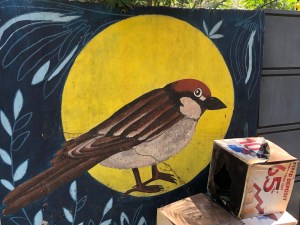
A pot of wine, under blossoms.
   I drink alone, no friends in sight.
 I raise a cup to lustrous Moon:
   Me, Moon, and Shadow will make three.
 But Moon is a teetotaler.
   And Shadow just skulks at my feet.
 Still, Moon & Shadow are my chums.
   We need a bash before Spring's end.
 But my singing makes Moon recoil.
   And Shadow flops hard when I dance.
 At first, we have a grand old time,
   But we part ways when I drift off.
 We should keep this epic friendship rolling,
   and meet again in the River of Stars.

NOTE: I produced this “translation” / arrangement, using translations by Arthur Waley, Ezra Pound, and that of “The Anchor Book of Chinese Poetry” [ed. by Tony Barnstone and Chou Ping] to get varied takes on the source poem.
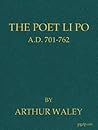
BOOKS: The Poet Li Po AD 701-762 Trans. & Ed. by Arthur Waley

The Poet Li Po       A.D. 701-762The Poet Li Po A.D. 701-762 by Arthur Waley
My rating: 5 of 5 stars

Available online at: Project Gutenberg – The Poet Li Po

Li Po, also Romanized “Li Bai,” is one of China’s most famous poets, the prolific Tang Dynasty poet wrote extensively at the nexus of intoxication and the beauty of the natural world. His well-loved and evocative poem, “Drinking Alone by Moonlight,” is a prime example [and is included in this selection.]

The selection consists of a small number of translations by [20th-century Orientalist] Arthur Waley. It’s only 20-some of the 1,000-ish extant poems of Li Bai, but it does offer variety in form and subject matter. It doesn’t include all of Li Bai’s most anthologized poems, which I consider a plus — i.e. Waley didn’t just assemble a greatest hits album.

The Waley translations aren’t as sparse as many that one will read. That offers the advantage of being clearer in meaning while losing some of the feel of the original. That said, I enjoyed this group of translations and didn’t feel they were too verbose – for the most part. It’s a selection well worth reading for those who enjoy poetry.

View all my reviews

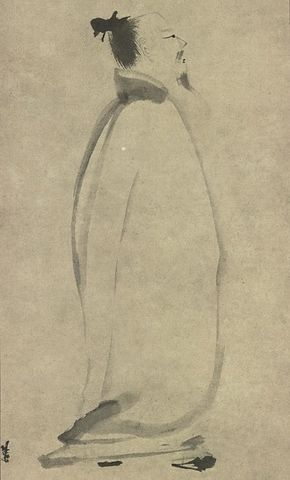
Li Bai [Lyric Poem]

Li Bai fills his cup;
 Li Bai loves his wine;
  Li Bai sits in moonlight,
 staring at the sky. 
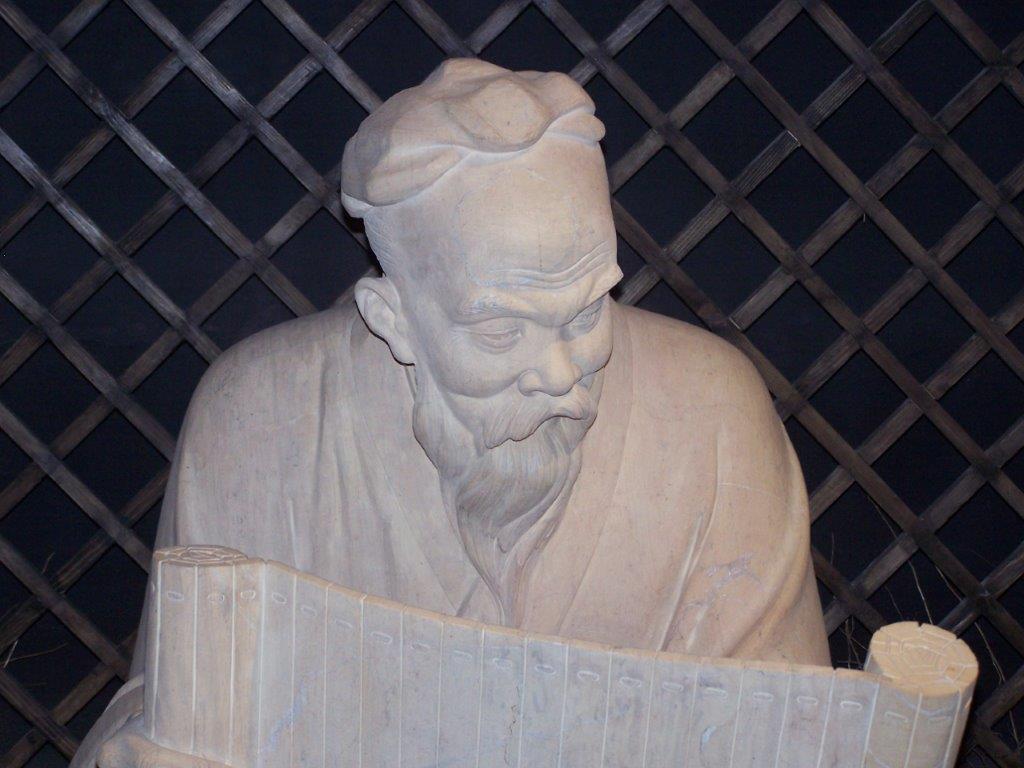
Limerick of Confucius

The great Chinese philosopher Confucius
 wrote in maxims to avoid being circumlocutious.
   [That's a word that absurdly
   describes being wordy.]
 Be like Confucius, not like this verbose doofus. 

Ikkyū’s Poetry: The John Steven’s Wild Ways Selection / Translation

Wild Ways: Zen Poems of IkkyuWild Ways: Zen Poems of Ikkyu by Ikkyu
My rating: 5 of 5 stars

This is the John Stevens selection and translation of poetry from Ikkyū’s Crazy Cloud Anthology. Ikkyū was what might be called a mad sage of the Rinzai sect of Zen Buddhism. He once showed up at a temple in his vagabond rags and was turned away, when he came back the next day in the ceremonial robes that revealed him as a preeminent monk and was subsequently treated like royalty, he took the robes off and told the abbot that it was apparently the robes that were honored and deserving of a meal. Ikkyū was known not only for his rejection of dogmatic and highfalutin approaches to Buddhism, but also for his love of sex, brothels, meat eating, and poetry. Much of the poetry touches on those two subjects (disdain for dogma and pretension and love of pleasure,) though there are also poems that explore nature and the kind of imagery one might be more likely to expect in Japanese poetry.

Ikkyū mostly wrote in quatrains, using a Chinese style of verse. Though Ikkyū was no more dogmatic about following poetic protocols than he was following monastic precepts, and often went with the flow.

I read the Stephen Berg translation, Crow with No Mouth several years ago. I would put this one on par with that one. There are actually several translated selections from the Crazy Cloud Anthology poems that are available. If you are interested in Ikkyū’s poetry, this is as good a place to start as any. It should be noted that while some of the poetry is around sexuality, it’s not particularly graphic but more suggestive.

View all my reviews

BOOK REVIEW: Dao De Jing: A Minimalist Translation by Lao Zi [Trans. Bruce R. Linnell]

Dao De Jing: A Minimalist TranslationDao De Jing: A Minimalist Translation by Lao Zi
My rating: 5 of 5 stars

Available Free on Project Gutenberg

The Dao De Jing presents the core philosophy of Taoism, a philosophy that values simplification, non-action, naturalness, spontaneity, and recognition of opposites in [and their influence on] each other. There are numerous editions (this is the Wang Bi / “standard” ed.) and English translations of this Daoist tract, and the translation matters because the Dao De Jing is at once simply stated and arcane. I liked what Linnell did with this translation, which – as the subtitle suggests – he aimed to make simple and straightforward.

One nice feature of this translation is that each of the 81 chapters has four segments: the original Chinese text, a readable English translation, a word-for-word literal translation, and notes. Having the Chinese, a literal translation, and notes can be helpful when one has trouble deciphering the more cryptic passages. Another nice feature is an appendix in which the author discusses another scholar’s hypothesis that the chapters of the Dao De Jing were composed in layers, and Linnell re-orders the chapters as suggested by this hypothesis. Finally, the book ends with a Jefferson Bible-esque excerpt collection that takes all the places where Lao Zi wrote “Thus the sage:” and builds a single composition describing a wise person.

If you’re interested in Taoist philosophy, you may want to read this translation, whether you’re new to the Dao De Jing or you’ve read other translations or editions in the past.


View all my reviews

Sun Wukong [Common Meter]

The Monkey King with magic staff
outmatched monsters and gods,
defying the Jade Emperor's
edicts against all odds.

He erased himself from out of 
The Book of Life and Death,
and lived through the Crucible --
nearly holding his breath.

Finally, the gods called Buddha,
though some had their qualms,
but the one thing Monkey couldn't do
was leap from Buddha's palm.

BOOK REVIEW: Cold Mountain Poems Translated by Gary Snyder

Cold Mountain PoemsCold Mountain Poems by Gary Snyder
My rating: 5 of 5 stars

Amazon.in Page

This collection consists of twenty-four of the three-hundred-plus surviving poems by the Tang-era poet-hermit who went by the name “Cold Mountain” [i.e. Han-Shan.] This translation was produced by the Beat poet, Gary Snyder, and both the translation and the selection are informed by Snyder’s sensibilities and worldview. Snyder is known for nature-centric poetry infused with Buddhist and Native American sentiments, but, like other Beats (though far less than, say, Allen Ginsberg,) Snyder sometimes engages in social commentary. This makes Han-Shan’s body of work a fertile field because it, too, focuses heavily on the beauty and harshness of nature, is framed by Buddhist and Taoist perspectives, and occasionally interjects a societal rebuke. The poems are mostly octave (eight-line) poems which often follow the format of a “straight” sestet that sets up a “punchline” in the last couplet. [Not to suggest the poems are jokes, but they often present a clever twist or commentary at the end.]

Han-Shan’s poems focus heavily on his life as a hermit and the dichotomy of Cold Mountain (the locale) as both a harsh place to live and the only place for him. The Snyder selection focuses heavily on the appeal of nature and the living of a simple and natural life — as well as on the shunning of materialism.

Han-Shan is a mysterious figure, but what is known of him is intriguing. He is considered a mad saint by some, though most of what is known about the man comes from his surviving poems. (Some believe that the 313 known poems maybe only about half of what the hermit composed during the course of his life.)

Even if you’ve read one of the full collections (e.g. Red Pine’s,) you may find some unique insight and imagery in Snyder’s select translation. I’d highly recommend it.


View all my reviews

BOOK REVIEW: Poetry and Prose of the Tang and Song [Trans. by Yang Xianyi & Gladys Yang]

Poetry and prose of the Tang and SongPoetry and prose of the Tang and Song by Yang Xianyi
My rating: 5 of 5 stars

Amazon.in Page

This collection includes works from eighteen prominent poets and writers from the Tang (618-907 AD) and Song (960 – 1279 AD) Dynasties of China. Among the most famous of the included authors are: Wang Wei, Li Bai, Du Fu, Bai Juyi, Wang Yucheng, and Su Shi. The included works (mostly poems but including some brief prose writings) explore subjects such as nature, social justice, patriotism, travel, and drinking. If some of those topics surprise you, you’re not alone. I may be letting my biases show, but I was surprised by how much social outrage and humor was contained in these works from the China of 750 to 1,400 years ago. That said, most of the works do present the kind of sparse imagist depictions of natural scenes one would likely expect from Chines poets in days of yore. (Think haiku, but longer — though no less devoid of analysis or judgement.)

As someone who isn’t an expert on Chinese literature or even a speaker of any of the Chinese languages, I can’t comment intelligently on how precise the translations are. However, the English language versions contained in this volume are evocative, clever, and, occasionally, funny.

To give one an idea of the kind of humor, I’ll offer this quote from a poem by Xin Qiji:

Last night by the pine I staggered tipsily
And asked the pine, “How drunk am I?”
When I imagined the pine sidling over to support me,
I pushed it off saying, “Away!”


I enjoyed this collection, and would highly recommend it.


View all my reviews