5 Thought-Provoking Novels About Mental Illness


5.) Veronika Decides to Die by Paulo Coelho

Premise: A young woman who attempted suicide is told that in the process her heart was damaged and she now has only five days to live. While it might seem that this would be all the same to a suicidal patient, it turns out to matter.


4.) Norwegian Wood by Haruki Murakami

Premise: The lead character, Toru, doesn’t suffer from mental illness, but his life is shaped by those who have. He must decide between two women. One of whom, Naoko, has been institutionalized since her boyfriend, Kizuki, committed suicide. Kizuki had been Toru’s high school best friend, and this weighs heavily in Toru’s feelings of obligation. Add into this Naoko’s roommate–a sage influence in Toru’s life, despite being institutionalized herself.


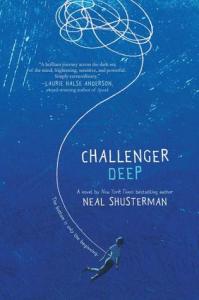
3.) Challenger Deep by Neal Shusterman

Premise: An adolescent boy, Caden Bosch, is transformed from a model student to a paranoid schizophrenic. The title refers to the deepest point on Earth, down in the Marianas Trench, and comes into play because the institutionalized Bosch believes he’s on a ship who’s Captain thinks all the treasure in the oceans got swept to the deepest point.


2.) Fight Club by Chuck Palahniuk

Premise: The unnamed narrator meets the eccentric Tyler Durden and soon Fight Club is born. It’s fueled by a feeling that men have been tamed to be turned into consumers. However, the underground fights are only the beginning, and our lead character is dismayed to discover that from the Club has sprung Project Mayhem with a nefarious terrorist plot.


1.) One Flew Over the Cuckoo’s Nest by Ken Kesey

Premise: Randle McMurphy has convinced authorities that he’s insane for the purpose of getting out of hard labor in prison and into a “cushy” insane asylum. The ward is run by the iron hand of Nurse Ratched. McMurphy on the other hand is rebellious and unruly. The clash is inevitable. McMurphy increasingly disrupts Ratched’s sedate and harmonious ward (re: heavily drugged and cowed into submission.) The story is told from the perspective of a patient named Chief Bromden who has the staff convinced that he’s deaf and mute. Like McMurphy, he’s not what he appears. The book is a scathing indictment of how mental health care was conducted in Kesey’s day.

5 Exercises to Wed Your Yoga and Calisthenic Practices

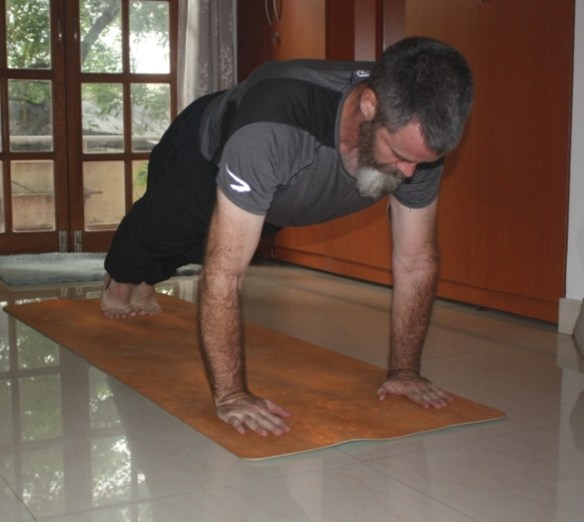
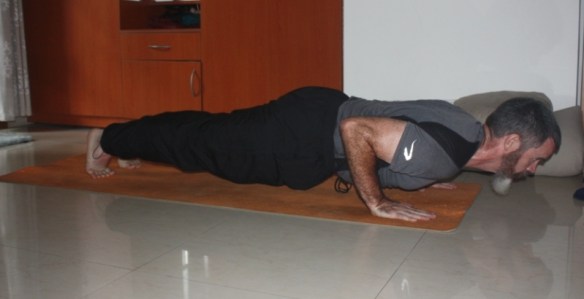
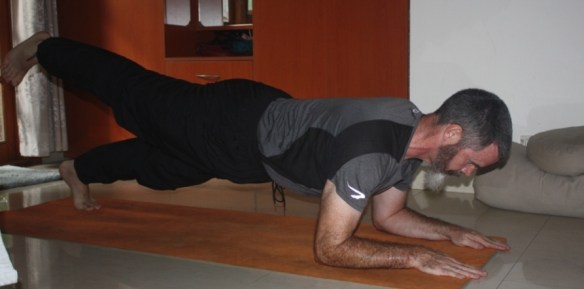
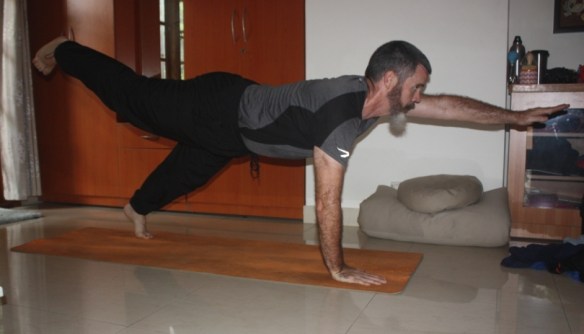
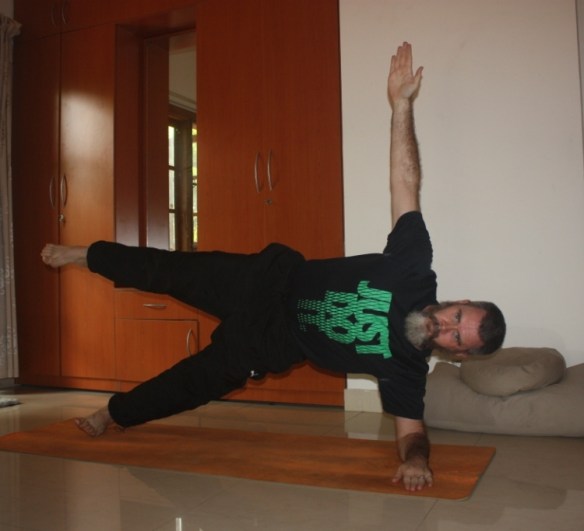
5.) Anything plank (a.k.a. adho mukha dandasana / santolanasana): Who knows how long planks have been a feature of yoga? Plank postures are a fixture in Hatha Yoga, playing a role in most versions of Surya Namaskara (sun salutations), and being used to both to build core strength and to prepare for arm balances.

Planks have also gained immense popularity with calisthenic practitioners. In my gym class days, sit-ups and crunches were the go to ab exercises. No more. Now many bodyweight fitness practitioners are ditching sit-ups and crunches altogether for a number of exercises deemed more effective–include many variations on the plank.

High plank (adho mukha dandasana)


Low plank (chaturanga dandasana)


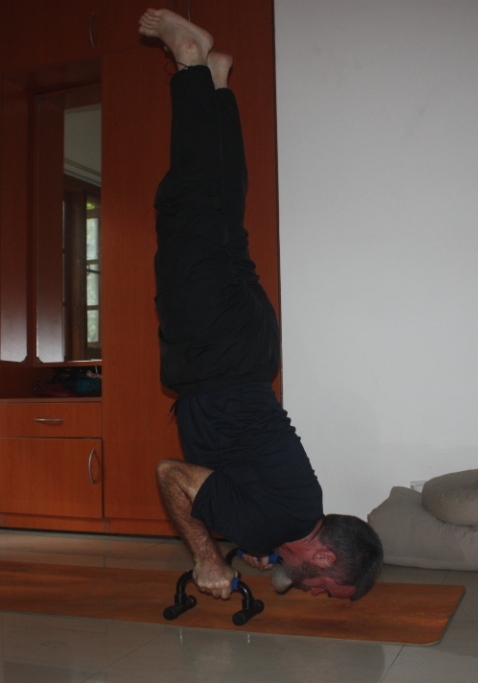
Forearm plank variation with leg up


High plank variation with alternating limbs extended


Side plank (vasisthasana)


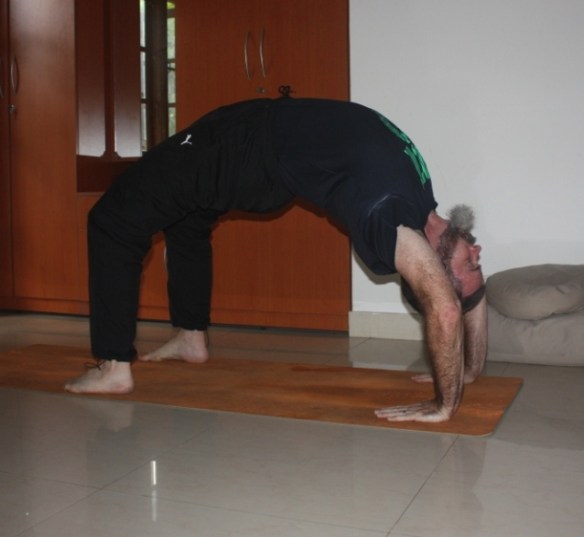
4.) Back bridge (a.k.a. Chakrasana): This is another yoga classic that’s being brought into calisthenics training in a big way. You may note a recurring theme in my selections for this post, exercises and postures (asana) that help to build shoulder joints that are strong, stable, and yet sufficiently flexible. This is a big challenge for bodyweight workout practitioners. One can get stability by bulking the muscles up, but if you don’t have the range of motion to achieve proper alignment, it’s not going to do one a lot of good.

The back bridge (chakrasana, or “wheel pose”)


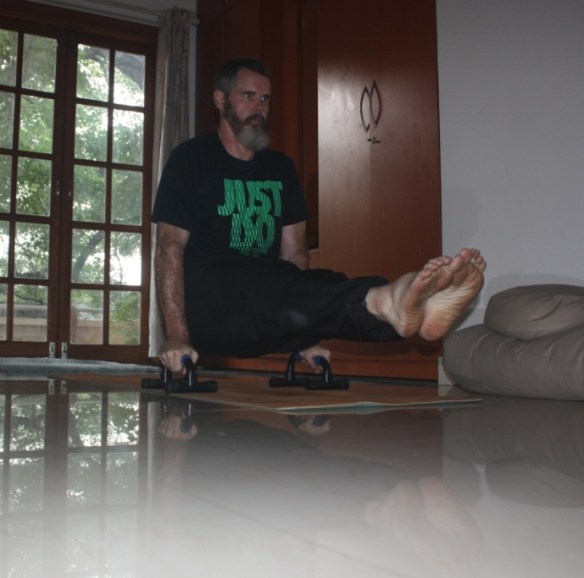
3.) L-sit (a.k.a. Bramcharyasana): Of course, the other recurring theme (besides building shoulder stability) is core strength. This exercise is both a yoga classic and is probably as old as gymnastics itself. Its Sanskrit name, Brahcharyasana, means celibate’s pose–but as far as I’m concerned that’s purely optional.

L-sit (Bramcharyasana)


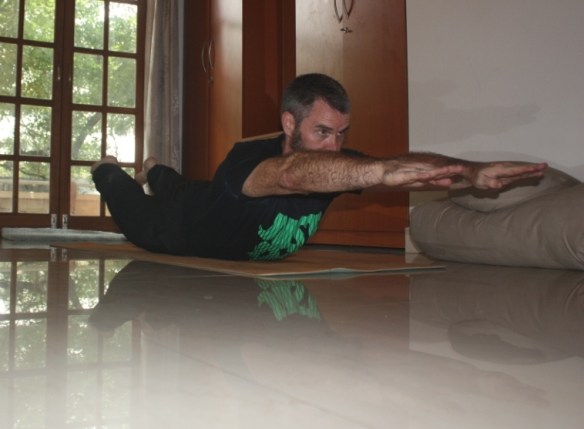
2.) “Supermans” (a.k.a. shalabasana [locust pose]): Another core exercise, but one that strengthens the back muscles.

“Supermans” (shalabasana)


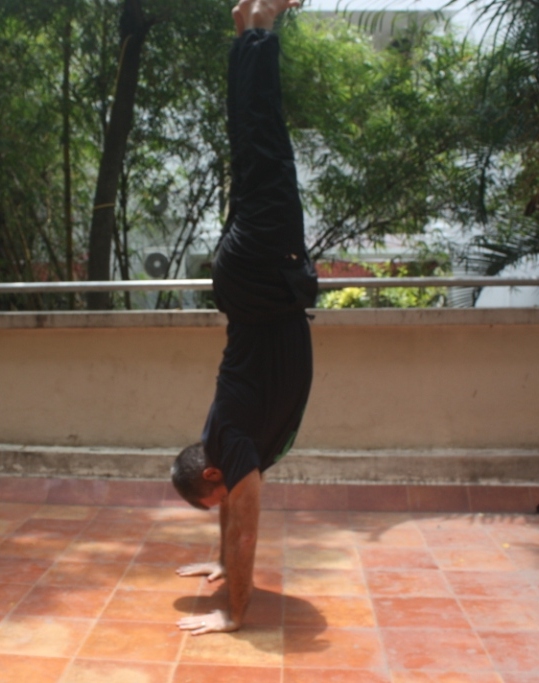
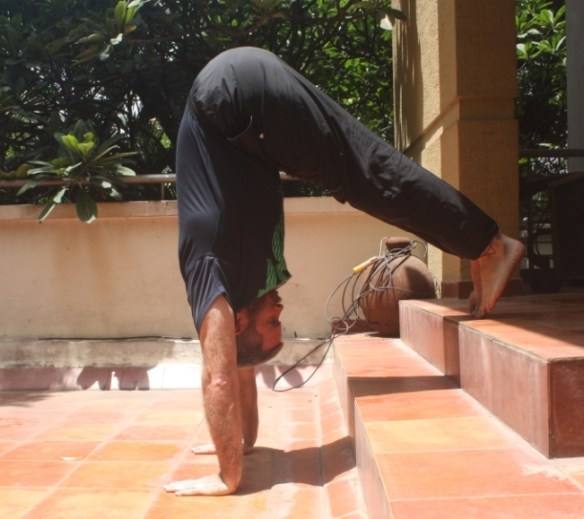
1.) Handstands and Handstand Preppers (a.k.a. adho mukha vrksasana): This practice isn’t just about looking impressive. As mentioned above, it’s hard to build shoulder joints that allow enough stability and range of motion to have the command of one’s body that one would like. Our shoulders are optimized to maximum mobility. That helped our ancestors to be awesome throwers of spears and rocks, but it makes it tough to support our weight in an inverted position. The handstand is a good way to build stability in the shoulders.

Handstand (adho mukha vrksasana)


If it’s too hard, use your legs to stabilize you (but still try to get that straight up-and-down arm position)


If it’s too easy, start doing push-ups

5 People You Probably Didn’t Know Did Evil

This post was inspired in large part by a tidbit about whiskey heir James Jameson (#1, below) in a book that I’m reading called “Crossing the Heart of Africa” by Julian Smith. It may have also been influence by having recently seen the surprisingly awesome “Wonder Woman” film, in which a central theme is the notion that good and evil vie for each person’s soul. (Note: I say “surprisingly” only because the DC movie universe has mostly been floating stinkers in recent years.)


I should note that when I started researching, there were an astounding number of candidates for the slots on this list, and so you may have a favorite example that didn’t make the list (please feel free to comment on any prime examples that I missed below.) As for criteria, I tried to avoid including people who just said horrifying things, who acted in an irresponsible or nit-witted manner that didn’t rise to the level of evil, or who were forced to make “lesser of two evil” decisions during time of war or national emergency.


I also didn’t have the time or energy to get into the he-said-she-said of politicians, because in America ideological types accuse people from the other party all manner of evil, constantly. So I didn’t wade into whether George W Bush personally flew the planes into the Trade Center towers via drone-style cockpit override technology, or whether Barack Obama had all nuclear spent fuel jettisoned onto the Arctic Circle to manufacture a climate change crisis. (Note: neither of those is a real thing, please don’t quote.) But, beyond that, I tried to pick candidates that would come as a surprise, and it wouldn’t surprise anyone that a politician did evil. (Frankly, people would be more surprised if they didn’t.)


5.) Chuck Berry: He had secret tapes made of women doing their business in the toilets at his restaurant. I don’t want to be moralistic and get into people’s kinky proclivities with this list, but this breach of trust rises above and beyond.


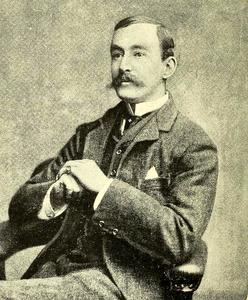
4.) Alexander Graham Bell was a dick to deaf people. The inventor of the telephone advocated for eugenics, and, specifically, trying to breed the deaf out of existence. Sure, if you invent the phone, the people who can’t use it might not be your favorites, but trying to eliminate them… that’s just cold.


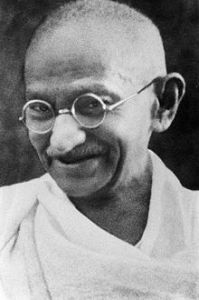
3.) Mohandas K. Gandhi: I said I wouldn’t pick on purely verbal hideous acts, of which Gandhi had a number from suggesting rape victims were responsible to supporting honor killings to racial slurs against Africans (quite a shocker for someone battling British racism so vehemently.) As far as actions, sleeping nude with his under-aged great-granddaughter is pretty vile behavior. It’s said that he was trying to challenge his celibacy, but you don’t need to bring kids into whatever oddities you need to prove to yourself. 


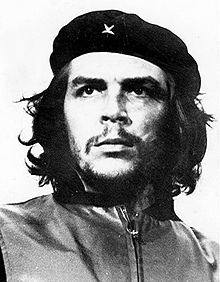
2.) Che Guevara: He had countless people executed without trials or due process. I included him because I assume that not all among the vast number of people who wear his face on their t-shirts are aware of this dimension of his character. Certainly, he was no worse than Lavrentiy Beria (Stalin’s Secret Police Chief), but I’m unaware of any idolization of Beria.


1.) James Jameson: The whiskey magnate bought an 11-year old girl so he could sketch her being victimized by cannibals in Africa. 

5 Thoughts on the Conscious Mind in Martial Arts Training

In recent years I’ve spent a lot of time trying to quiet the conscious mind in order to let the subconscious do what it does best. There’s a lot of terminology that’s used to describe the mind state in which one’s actions are effortless and one can adjust swiftly to unforeseen challenges: e.g. “in the zone,” the Flow, Zen mindset, and (in the Kotler and Wheal book I just reviewed) ecstasis. However, regardless of the name, one key to this state is a reduced activity of the part of the mind that’s self-critical and overly cautious, and that requires not letting the conscious mind do what it’s prone to do.


However, taking a course on mauythai advanced fundamentals recently has reminded me of the important roles the conscious mind plays in learning. The challenge is to use the conscious mind effectively–without letting it running amok.


The conscious mind is largely driven by anxiety about uncertainty. This makes the conscious mind a planner and worst-case scenario generator extraordinaire. (In meditation, I’ve begun to not only note what thought popped into my head before I dismiss said distraction, but I also have a classification scheme of kinds of thoughts, and “planning thoughts” are probably the most common type of thought to hijack my mind.) This planning / forecasting  proclivity can be beneficial if one is doing a job that requires such planning, anticipation of possible hazards, and the need to adjust to complex difficulties. However, it can also make one neurotic, overly risk-averse, and pessimistic.


So, here are my five thoughts on the conscious mind in martial arts training.


5.) Feed the right wolf:  There’s a well-known story about a Native American man telling his grandchild that inside each person there are two wolves at war, one good and one evil.

The child asks, “Which one wins?”

The old man replies, “The one you feed.”


This is a variation on the theme–not so much about good and evil as about positive and negative outlook. In martial arts training there are often competing emotional states. On one hand, there is often anxiety about either being injured or even about the embarrassment of being bested. (Surprisingly, it seems like the magnitude of the latter is often greater than the former.) On the other hand, there is an intense thrill that comes with making progress. For those who don’t understand how martial artists can put themselves through what they do, this is the part for which you’re probably not understanding the intensity of the high. When it clicks and you’re getting it right more often than you previously did, the feeling is transcendent.


So, when one sees either of these two feelings arising, choose the latter. If one notices the anxiety, remind oneself the promise of that awesome feeling of having it fall together.


4.) Scanning for lapses in form: The process of learning a martial art–like any movement art–is repetition of the movements until they become ingrained in one’s procedural memory. Early in the process, this feels clunky as one has to scan for imperfections in form with one’s super-intelligent but slow and cumbersome conscious mind. However, increasingly, the body begins to incorporate these movement patterns and they start to become second nature. The trick is to keep this in the moment and not let one’s thoughts linger on what one just got wrong, or any perceived ramifications of getting it wrong.


3.) Try visualization: This once would have been thought hippie guff, but now it’s entered the mainstream. Of course, the advice from #5 must be kept in mind. When I think of the technique of visualization, I’m reminded of a story that Dan Millman told about a girl that he was coaching in gymnastics. He came to check on her only to find her repeatedly cringing and grimacing. He asked what was going on, and she said she kept falling off the balance beam whenever she visualized her routine. It sounds silly, but attitude is a powerful thing, and I lot of people sabotage themselves in ways not much different from this. It’s your mind, you have the power to do the move perfectly every time, if you take the proper mindset.


2.) Conscious mind as governor of action and agent of trust: The subconscious mind can be feral. As one spars, one has to match speeds with one’s opposition so that learning can take place. While sparring looks reminiscent of fighting, the goal of sparring is learning, whereas the goal of fighting is winning (or–as a minimum in actual combat–not being destroyed.)


This is another role for the conscious mind. It can keep reminders to the fore to keep one’s movement appropriate to the occasion. It can inject an awareness that there’s a relationship of trust rather than warring competitiveness between. That one needn’t respond at the same magnitude that one would under attack.


1.) Dropping the Conscious Mind Out of the Equation: While the conscious mind is critical in the learning process, eventually one must do something that feels uncomfortable, which is shifting subconscious operations to the fore and quieting the conscious mind. Overthinking can be death in tests, competitions, not to mention, I’m told, actual combative situations. At some point you’ve got to have some trust in what you’ve trained to do up to that point. It might fail you, but not necessarily as spectacularly as if you let your conscious run amok, getting caught in a death spiral of self-criticism and futile guesswork.


Since I’ve been watching quite a few muaythai fights recently at the Rangsit Boxing Stadium, I’ve begun to wonder just how useful corner advice is. I know that people think it’s beneficial because it’s done in droves. Not only is the fighter’s trainer trying tell them what to do, but also his parents, his siblings, his granny, and a hundred random people who may or may not have put money on him. It would be interesting to see a scientific study of how fighters performed who tuned everything out between rounds versus those who tried to take in all the advice. I tried to look up whether any such study had been done, but a cursor Google search came up empty.


What comes of all the corner talk?

What comes of all the corner talk?

5 Ways to Flummox Your Adversary

5.) Acknowledge that there is a universe in which his or her point is valid: However, tell your adversary that this is contingent upon theoretical physicists being correct that there are an infinite number of universes, each governed by a different set of laws–at least a some of which would have to be stupid. This is called the bubble-verse flummox.

bubbleuniverses


4.) Challenge him or her to a duel: This will require that you carry a well-worn leather glove wherever you go. For it’s not so much the words that produce an effect as the slap across the cheek. You are going for decibels. You can’t pull this off with a cotton glove, a rusty metal gauntlet, or a stiff leather work-glove. You need the glove to have some weight and to be able to put some whip into it. This is called the Aaron Burr.

gloves


3.) Talk to your adversary as if that person were a beloved household pet. This will involve both head tousling and inquiries as to, “Who’s a good boy?” It’s called the canine gambit.

dog


2.) Ask your adversary whether he or she is trying to seduce you. It doesn’t matter how mundane or technical the subject is (trade pacts, non-proliferation agreement, etc.), this one is almost guaranteed to shut down opposition. It’s called the Mrs. Robinson.

seduction


1.) Say, “The game is afoot!” and then just walk off. It’s very important that you don’t respond to any question about what this means or whether you’re insane. Furthermore, one must break off all contact with the adversary for several days there after. Stew time is necessary. I call this one, The Sherlock.sherlock

5 Bits of Ancient Eastern Wisdom to Make Your Modern Western Life Happier

img_12811.) The Dispassionate Witness:  A person’s default setting is to repress emotions and pretend they don’t exist. On the one hand, this seems to work because others rarely notice one’s clenched jaw or downing of Prozac, and it’s true that fist-fights rarely break out in workplaces and classrooms. On the other hand, this approach leads to a lot of passive-aggressive behavior and stress-related illness. I just read in some material on Flow and business that 2/3rds of performance issues in businesses result from strained relationships.

The alternative is to take time to observe one’s emotional state, but to watch it without dumping fuel onto the fire. This process puts one’s feelings in perspective so that one can respond in a careful, but not repressed, manner. It doesn’t mean one won’t still be mad, sad, or scared, but one will be in a position to act in a manner that is neither petty and knee-jerk, nor one that consists of gobbling antacids. This brings us to #2.


2.) The Second Dart: [Siddhartha Gotama] Buddha talked about the mind’s response to an event as the second dart, suggesting that the second dart produces much more prolonged misery than the first. Imagine one is walking along and gets hit by a dart. Ow!  It hurts. But what makes it agonizing is when one’s mind becomes obsessed with the injury. It’s unfair that someone threw a dart at me. What if the wound doesn’t heal right? What if the wound heals up too well, and I don’t have a cool scar at story time?

This point is closely related to #1. One has to observe, but not let mind run wild. The first dart is real. The second dart is immaterial, a figment of the mind.


3.) Relaxation is Part of the Process: Anyone who’s attended a yoga class is familiar with closing in savasana (corpse pose.)  Occasionally, a student wants to get up and walk out at this point. They “aren’t paying __ $’s to lay around on their a##.” For Americans, rest is something begrudgingly accepted between actually doing stuff.

The problem with the “rest as laziness” approach isn’t just that one is likely to suffer a relaxation deficit, but also that the rest one gets isn’t effective. But how can rest be effective? I’m glad you asked. Because when you’re doing savasana or yoga nidra (yogic sleep) you’re not just letting your monkey mind run wild as it does when one is watching television or stuck in afternoon rush hour.


4.) Breath is Anything but Mundane: Since breathing is constantly going on and one can choose not to think about it, people dismiss it as unworthy of consideration. However, breath is the one point at which we can consciously influence our autonomic nervous system. [Well, there’s also blinking, but to my knowledge there’s no evidence that one can adjust one’s energy level or emotional state through blinking–but you can with breath.]  Breath is the key to improved physical performance, but it’s also a powerful tool to train the mind.


5.) Use the Belly: I haven’t studied a large number of martial arts, but I’ve trained in a diverse few that were extremely different in both approach and priorities. It could be said that these arts (budō, tai chi chuan, muaythai, and kalaripayattu) had nothing in common. Except they did. They all valued strength in a point below the navel. Sometimes it was called dan tien; other times tanden. However, regardless of the pronunciation, name, or the precise anatomical location, there was this commonality.

Strength in the belly is tied to both breath and mental concentration.

img_1786

2015 Book Riot Read Harder Challenge

From Goobe's Books, one of my favorite local bookstores in Bangalore

From Goobe’s Books, one of my favorite local bookstores in Bangalore

Recently, a FaceBook friend posted a link for the 2015 Book Riot Read Harder Challenge. This is a scavenger hunt for readers. There are 24 categories for which one should read at least one book each. For many categories there are also links to posts that will provide some recommendations.


While I’m not particularly good at planning out my reading, I thought it would be fun to give it a try.


What follows are my choices in each category.

1.) Author was under 25 years old:  The Icarus Girl  by Helen Oyeyemi

or possibly Everything is Illuminated by Jonathan Safran Foer

2.) The author was over 65 years old: All That Is by James Salter

3.) A short story collection or anthology: 999: New Stories of Horror and Suspense ed. Al Sarrantonia

4.) Indie press published book: I Have Blinded Myself Writing This by Jess Stoner (and, incidentally, SF/LD [Short Flight / Long Drive] Press)

or, alternatively: Go the Fuck to Sleep by Adam Mansbach (published by Akashic Books)

5.) By or about someone who identifies as LGBTQ: Confessions of a Mask by Yukio Mishima

6.) A book by someone of the opposite gender: House of Bathory by Linda Lafferty, or The Tale of the Genji by Murasaki Shikibu

7.) Book takes place in Asia: My Boyhood Days by Rabindranath Tagore

or, possibly, Kite Runner by Khaled Hosseini, or  Underground by Haruki Murakami. I’ll likely read several books in this category.

8.) Author is from Africa: Things Fall Apart by Chinua Achebe

9.) Book by or about someone from an aboriginal culture: Lightfinder by Aaron Paquette

10.) A microhistory: Banana: The Fate of the Fruit that Changed the World by Dan Koeppel

or The Emperor of Maladies by Siddartha Mukherjee, or The Pirate Coast by Richard Zacks,

but–most likely– Yoga Body: The Origins of Modern Posture Practice by Mark Singleton (Which I just realized qualified and I already have queued up to read soon.)

11.) A YA novel: Hunger Games by Suzanne Collins

12.) A Sci-fi novel: The Sirens of Titan by Kurt Vonnegut, or Wild Seed by Octavia Butler, or Tears in Rain by Rosa Montero, or Under the Empyrian Sky by Chuck Wendig. I’ll likely read several books in this category.

13.) A romance novel: Fifty Shades of Grey by E.L. James

14.) A recent winner of the National Book Award, the Man Booker Prize, or a Pulitzer: Behind the Beautiful Forevers by Katherine Boo (2012 National Book Award) or The Goldfinch by Donna Tartt (2014 Pulitzer)

15.) A retelling of a classic tale: The Story of Edgar Sawtelle by David Wroblewski (of Hamlet), or Going Bovine by Libba Bray (of Don Quixote.)

16.) An audiobook: (Truth be told, I probably won’t listen to any books this year. I used to get audiobooks all the time when I had a commute, but it’s not so convenient anymore. However, to play the game to its fullest): All the Light We Cannot See by Anthony Doerr

17.) A collection of poetry: Leaves of Grass by Walt Whitman

18.) A book someone has recommended for you: It may be cheating because I already have it down, but so far the only book I’ve had recommended for me recently (that I haven’t yet read) is Behind the Beautiful Forevers by Katherine Boo

If you want to keep me from being a dirty cheat, feel free to make me a recommendation.

19.) A book originally published in another language: Les Miserables by Victor Hugo, or Thirukkural by Thiruvalluvar

20.) A graphic novel or comic collection: Hyperbole and a Half by Allie Brosh, or Serenity: Leaves on Wind by Zach Whedon

21.) A guilty pleasure read: Never Go Back by Lee Child, or Valley of the Dolls by Jacqueline Susann, or Tropic of Cancer by Henry Miller

22.) A book published before 1850: The Aeneid by Virgil (19 B.C.), or Don Quixote by Miguel Cervantes (1605)

23.) A book published in 2014: Station Eleven  by Emily St. John Mandel, or The Martian by Andy Weir

24.) A self-improvement / self-help book: A Conversation with Fear by Mermer Blakeslee, or Golden Cloud, Silver Lining by Ashok Chopra


Well, there’s my list. Now I’ve got to go get cracking on doing the reading.

10 of My Favorite Quotes on Writing

Do not use semicolons. They are transvestite hermaphrodites representing absolutely nothing. All they do is show you’ve been to college. –Kurt Vonnegut


Write without pay until somebody offers pay. If nobody offers within three years, the candidate may look upon this circumstance with the most implicit confidence as the sign that sawing wood is what he was intended for. –Mark Twain


The faster you blurt, the more swiftly you write, the more honest you are.  –Ray Bradbury


Try to leave out the part that readers tend to skip. –Elmore Leonard


The first draft of anything is shit.—Ernest Hemingway.


Omit needless words. –William Strunk


The only rule for writing I have is to leave it while I’m still hot… –William Faulkner


Whoever wants to tell a story of a sainted grandmother, unless you can find some old love letters, and get a new grandfather?  –Robert Penn Warren


When you write the thing through once, you find out what the end is. Then you can go back to the first chapter and put in a lot of those foreshadowings. –Flannery O’Connor


As far as I’m concerned the entire reason for becoming a writer is not having to get up in the morning.  –Neil Gaiman