
Hello, Jello, my wiggly friend
It’s time you meet your fateful end
Perhaps, someday you will come back
But, having been through my digestive tract,
No one will ever love you like I did
[At least, let’s hope–heaven forbid]

Hello, Jello, my wiggly friend
It’s time you meet your fateful end
Perhaps, someday you will come back
But, having been through my digestive tract,
No one will ever love you like I did
[At least, let’s hope–heaven forbid]
Microbots may one day kill
From nano-pills you’ll get your fill
One day everything will be small
Except rayguns and the mall
Those two will be colossally large
Like a present-day garbage barge
Heaped into a humongous hill
Headed to a continental landfill
circling hawk glides
I’m glad it’s not a vulture
I must be alive
still lake reflecting
a mountainous lay of land
hiding fish below
hissing wind gusting
through narrow leaves of bamboo
calling to no one

Taken in December of 2015 in Saigon

We saw this little chapel flanked by huge billboards for a vocational college and a beer. If anyone else was out on the river-walk that night, looking steepleward for answers, he must have concluded that he should settle for a career in HVAC repair and get wasted at his earliest convenience.

#3 Party Supplies; Taken December 24, 2015 in Hue

#2 Filing Cabinets; Taken December 25, 2015 in Hue

#1 Lesser Bicycles: Taken December 25, 2015

Taken in November of 2014 in Fardapur, India
In India:
Q: “How high can you load that truck?”
A: “How high is the sky?”


Taken on October 11, 2015 in Bangalore
This is the “impulse buy” shelf next to the line for the register at a popular toy store. Thus confirming my belief that taking kids to a toy store might lead parents to get serious about their drinking.

Taken on September 20, 2015 in Bangkok’s Chinatown
I wonder if scale of the diagram is indicative of the degree to which each is a problem, or what?
In writing this post, I realized that Monty Python provides the I-Ching of life wisdom. If they don’t say it, it may not need being said. So I’ve let them expound upon my points wherever possible.
1.) Always Usually look on the bright side: Our brains are programmed to constantly be on the look for potential problems and ruminate over solutions. This isn’t without its advantages. However, as your brain takes flight with this problem anticipation mode, it can begin to taint how one sees the world.
My high school psychology teacher told us a story of what he called the “gestalt of expectations.” The story goes like this: One is driving across southwestern America and there’s a gas station coming up, but one still has half a tank. Being from the East, one doesn’t realize how rare service stations can be in the desert, so one passes it by. Of course one runs out of gas (it wouldn’t be much of a story otherwise.) As one is walking back toward the service station, one begins to obsess over how the service station attendant is going to screw one over. After all, the unknown individual knows one is in a desperate situation. The more one walks under a burning sun, the more one inflates the gas station attendant’s ill-intentions, and one suitably escalates one’s mentally rehearsed response. Finally, disheveled and weary, one reaches the service station. A concerned-looking attendant bursts out of the station to meet one, saying, “Geez, you look beat, what can I do for you?” And that’s when one punches him right in the nose.
 The good news is that one can gradually train one’s brain to take a more positive perspective. A neuroscientist, Rick Hanson, has written a few books on how one can go about this cognitive rewiring. Buddha’s Brain is probably the most well-known of these books. The book lays out the science behind the brain and negative thinking in particular, and then goes on to present suggestions as to how one can change this cycle and yield the benefits of a more positive outlook. While the title of this book makes it seems like a religious tract, it’s really secular and scientific. If you’re still concerned, you might check out the more secularly titled Hardwiring Happiness.
2.) Make rest part of the process–and an essential one at that: Duh? Yeah, it sounds self-evident, but too many people think of rest as the slacking off that one does between doing “useful stuff.” What isn’t valued is given short shrift. Don’t think of rest as a necessary evil. Equating rest with goofing off results in two problems. First, the obvious one, people don’t get as much rest as they should. Second, while one thinks he or she is resting, one may be under chronic stress (the bad kind) as one’s minds churns over what they should be doing and the adverse impacts of not doing it. Just as one should have rests built into one’s workout for maximal effect, one should have rest times built into the day, week, and year.
3.) Find your bliss, and just do “it”: You probably think that by “it” I’m referring to sex. Actually, sex isn’t a bad “it,” as its go, but it’s not the only it. Exercise, work the heavy bag, do a vinyasa (yoga flow sequence), go to work solving the problem at hand, or practice your Silly Walk. This also sounds like a “duh!” kind of statement, but far too many people wallow when they feel overwhelmed. What do they wallow in? Negative feelings. They worry that they can’t possibly hit the deadline or find the perfect solution. They worry that they’ll let someone down. They get angry at other people, the world, or a god or gods for putting them in their present predicament. They bristle at the unfairness of the universe. All of this snowballs into a stress monster–to mix my metaphors up nicely. If one can’t meditate or keep one’s mind on one’s breath, one may find relaxation in exhaustion. It’s all about inertia. It’s hard to get moving when one thinks one’s world has gone to shit, but that movement will make one feel much better–even if it doesn’t seem it can solve the problem at hand. One might need to change one’s life’s course altogether and become a lumberjack.
4.) Don’t create false monsters: Remember what Michel de Montaigne said, “My life has been full of terrible misfortunes most of which never happened.” As this is really just expanding on a point in item #1, instead of elaborating, I will offer you this Monty Python skit to consider.
5.) Exhale: Each exhalation trips the “rest & digest” circuit (i.e. the Parasympathetic Nervous System [PNS]) just a little. Granted, this subtle relaxation effect is easily overwhelmed by the countervailing forces of stressors and even the antagonistic effect of inhalation with its–also minute–fight or flight mode (of the Sympathetic Nervous System [SNS.]) Still, if you don’t know what to do, controlling your breath while elongating each exhalation is a good start. This will help in two regards. First, it helps the PNS gain a little ground. Second, it’ll break your conscious mind’s obsession with the problem (or potential problem) at hand. One’s mind will wander and one will lose track of the breath, but the more one practices quietly returning one’s attention to the breath the better off one will be. Becoming frustrated with these diversions only strengthens the stress monster–so don’t do it.
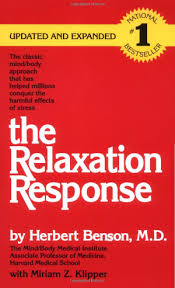 The bible of the rest and digest mode is Herbert Benson’s Relaxation Response. This book was first written over a quarter of a century ago, but it remains readily available. It’s telling that Walter B. Cannon’s work on “fight or flight” mode predates Benson’s work by such a long time. In other words, the medical and scientific community were researching the body under stress for decades before it ever occurred to anyone to think in terms of rest mode as a state that could be studied and advanced–as opposed to just being the normal state of affairs. This should give one an insight into how the human mind goes about considering problems.
6.) Recognize that stress is like cholesterol–there’s a good kind as well as the bad: Acute stress can serve one well during instances of danger. We have this response for good reason. The problem is chronic stress. When one’s body is in a stressed state, it’s not taking care of general maintenance tasks like healing itself. That’s fine in a short term, but problems compound over time. Chronic stress brings a high likelihood of illness because the body isn’t dealing with its run of the mill chores as it should be.
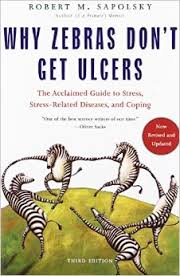 There are a number of books that expand upon this issue and which offer advice for keeping one’s stress of a healthy type. Robert Sapolsky’s Why Zebras Don’t Get Ulcers is among the best. It’s a long book and goes into great detail, but Sapolsky’s sense of humor helps to continue reading when the scientific minutiae might seem overwhelming. Another book on this topic that I found to be quite informative was Lissa Rankin’s Mind Over Medicine. Rankin is a medical doctor, and so she offers a little different perspective from that of Sapolsky. (The latter is a biologist / neurologist.)
7.) Realize that you are a speck in a vast universe and, so, how big or long-lasting can your problem be?: Yeah, it’s a double-edged sword because it’s–in a way–a demoralizing thought as well as a comforting one. Therefore, one should first watch this bit of Monty Python wisdom:
But then one can keep things in perspective through the realization that one is not yet dead.

Gone rogue
So, the whole “dick move Mondays” concept may require clarification. First of all, some readers may be saying, “Every day is dick move Monday at our dojo.” However, readers who train at more orthodox schools may be wondering how such an apparently ludicrous idea would even come up. The idea’s origins are the result of seeking a martial art’s correlate to the “bad pass Fridays” that have been instituted in many basketball practices in recent years. On “bad pass Fridays” coaches give players passes that are catchable–but just barely. I’ll get into the scientific argument for this kind of training below, but for now suffice it to say that the idea is to have regularly scheduled instances in which the individual is taxed to his or her limits and forced to try to cope with worst case scenarios. While there needs to be some limitations for safety’s sake, I’ll argue that there’s some advantage to applying this concept from the sports science and motor learning literature to martial arts training. [Note: if your objective in practicing martial arts has nothing to do with being able to succeed in the context of a sporting match, an actual combat situation, or both (i.e. a situation in which an opponent is trying to clobber you and vice versa) then this isn’t really relevant to you. But feel free to read it any way.]
Here’s some low-down on the science. Historically, it’s been popular to teach / coach sports (and non-sport martial arts) using a “partial and blocked” approach. This method is extremely popular because: a.) it’s simple to organize and conduct practice sessions, b.) short-term growth is rapidly visible, and c.) it looks neat and tidy. “Partial” means that a particular skill (or even sub-skill) is extracted from the overall skill set of the activity at hand and practiced in isolation. This could be a throw, a strike, or a means of receiving or defending. “Blocked” practice means that one skill or sub-skill is practiced over and over again under the exact same conditions until it’s deemed time to move onto the next. “Whole and random” practice represents the opposites of “partial and blocked.” “Random” means that one drills a skill under an ever-changing situational context (e.g. one may still be drilling hip throws repetitively, but not against a static partner who’s standing in the same place–there’s movement and pushing and pulling, and possibly a few dick moves.) “Whole” practice simulates the actual event that one is practicing for–whether it’s a Muay Thai match or a parking deck brawl.
For a good explanation of the problems associated with blocked practice, watch the video by Trevor Ragan of “Train Ugly” that’s linked below. (fyi: “Train Ugly” is an apropos name for an approach that involves more “whole and random” practice because there will be more short-term failure and one won’t look masterful at what one is doing by the end of a practice session. However, long-term skill retention and the ability to integrate those skills and sub-skills into a more realistic environment is higher.)
As Ragan points out, the random approach requires one read the situation and environment and respond in a way that won’t leave one worse off. (I don’t like the word “planning” applied to martial arts because there’s never time to do any planning in the sense of using one’s conscious mind. However, I’d say reading is a very apropos concept, and there is a need to adjust to one’s context.)
So what would “whole and random” training look like in a martial art? First of all, one should realize that one doesn’t need to make every training session “whole and random” from the very beginning. In the beginning a lot of “partial and / or blocked” practice is necessary. The problem is that if one doesn’t ever move beyond that, one’s performance will be hindered. Second, all practice doesn’t have to be both whole and random; one can spend a lot of time with random drilling of a particular skill. One can drill a particular skill while moving around freely, applying counters, making timing more random, and making the approach less regimented. “Whole and random” practice in the martial arts involve sparring or randori. Jigoro Kano did a brilliant thing in making the techniques and practice environment safe enough that randori (free form) training became possible. For many years, I would have said that Kano Sensei made a system that was less “realistic” by paring out the dangerous elements of jujutsu. However, today I don’t see it that way. I’ve come to realize that the ability to train randori keiko actually added back in a great deal of realism. Who’s to say what the net effect on realism is. I certainly see the advantage over the old way in which one trained in a regimented fashion devoid free form components for years and then one day one went out on musha shugyō (warrior’s errantry) and may be the day you learned of a deficiency in your technique was the day you died.
So “dick move Mondays” is really a way to add randomness into training. One can’t ignore the reading portion of the attack because one never knows what whacky ass attack one’s opponent is going to come up with.
If you do implement “dick move Mondays” in your school or gym, you may want to review this instructional video by Master Ken because the “bitch slap” is sure to enter into your training.
[Disclaimer: Master Ken video included as farce. Readers are advised not perform any techniques suggested by Master Ken or his Amer-i-do-te practitioners.]


 Tiger Riding for Beginners