PROMPT: Live Anywhere

If you could live anywhere in the world, where would it be?

First of all, I’d say that I probably could live most places in the world, and the few I couldn’t (e.g. North Korea) have no appeal to me as a place of residence. Having lived several places in the US, a couple years in England, and now over ten years in India, I’m under no illusions that there is a Shangri-la out there, a perfect utopia. Most places are fine places to live if one is flexible-minded and can adapt to that place’s rhythms and peculiarities. There may be a honeymoon period during which some place seems better than the rest, but even the most seemingly idyllic place will lose its luster in time.

That’s why I recommend travel. Everyplace offers beauty and life lessons when taken in bite-size pieces.

Uncle’s Shop, And Other Mysteries of The Indian Auto-Rickshaw

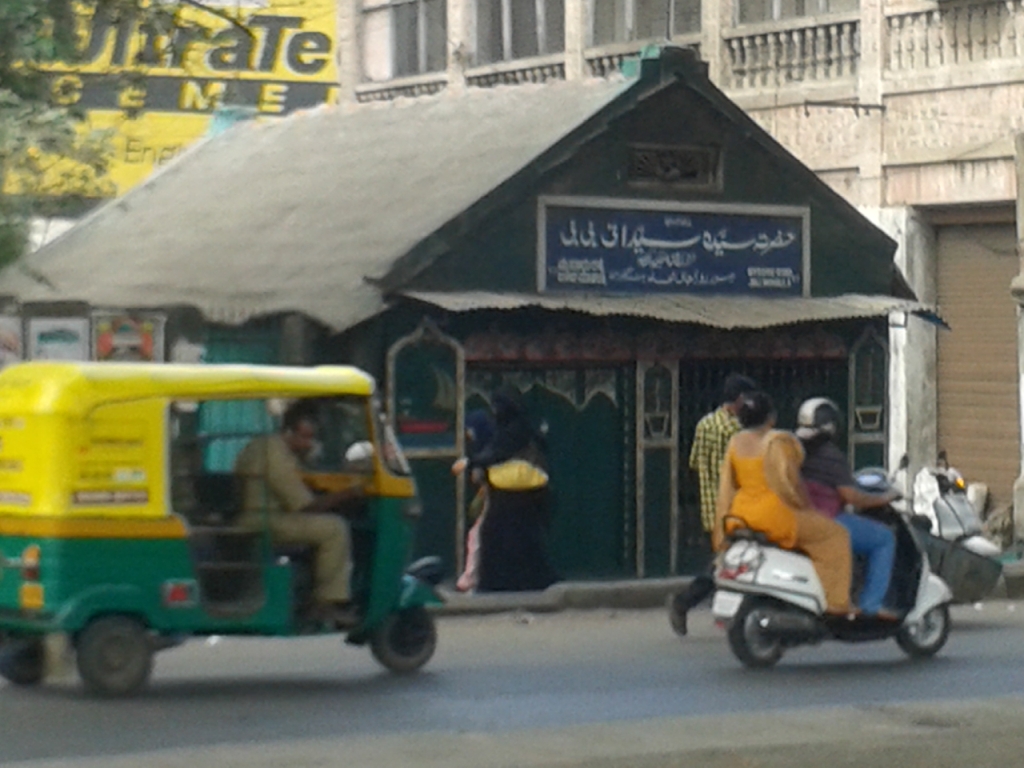
20140219_152150Where is Uncle’s shop? It’s where you are going if you got into an auto-rickshaw with a driver who has volunteered to drive you around for less than the metered rate. It may not be where you want to go, where you think you’re going, or where you’d like to go. But in the driver’s eyes, by taking him up on a reduced fare, you’ve entered into an implicit contract to be taken to a random store and nagged into buying something expensive enough that the shop can happily recoup the driver’s finders fee.

FYI- Bangalore auto-rickshaw fare is currently 25 rupee (Rs) for the first 1.9km, and 13Rs  for every kilometer thereafter. If the driver offers to take you around for 10 or 20Rs, you know they have plans. (Although there is a small chance that they are counting on you to be ignorant of the fact that the place they are offering to take you is 50 feet away.) Usually, a driver will offer to take you to a place for 4 to 8 times the metered rate (sometimes more if he has no idea where said place is–a not uncommon condition in Bangalore.) In other words, the driver will normally try to rip you off in the old-fashioned way (which eats at your pocket-book, but not at your time.)

If you find the new-fangled rip-off scheme to be a deplorable con, just remember to save some of your wrath for FaceBook, Google, and the other websites you commonly use. They almost all work on the same model. You get charged little or nothing to use said sites in exchange for agreeing to be shamelessly pitched stuff you don’t want or need.

What does Uncle’s shop sell? I hope you like a good mystery, because there’s no telling whether Uncle’s shop sells anything in which you have the slightest interest. If you are a single male, Uncle’s shop probably sells saris and pashminas. If you have a tiny apartment, Uncle’s shop probably specializes in 14 foot tall bronze statues of Ganesha. It could sell woven goods, knick-knacks, bric-a-brac, widgets, tsotchkes, or relics of a religion you know nothing about so you can engage in some low-grade impiety. (FYI- You may not realize this but for the devoted, it can be a bit offensive for a bunch of non-believers to be wearing “OM” symbols or having Buddha statues who aren’t Hindu/Yogic or Buddhist, respectively. Sort of the way many hardcore Christians feel about how Christmas was shanghai’d by a jolly old elf or Easter was overtaken by a giant bunny.) In some cases, Uncle’s shop will sell all of the aforementioned items and more.

Surely I will get an outstanding deal at Uncle’s shop, right? I mean, Uncle is not going to rip off his nephew’s customer, right? Wrong. First of all, there is an infinitesimally small chance that the driver is biologically related to the store owner in any way, shape, or form. It’s probably more likely that they’ve never formally met.

Second, let’s do some Uncle’s shop mathematics. We will call the wholesale cost of the product “C” and the bloated profit that the store owner would like “W” (for “wishful thinking profit”)  and the lowest profit “Uncle” is willing to accept “R” (for “reservation price profit.”) If you just walked into the shop off the street and bought said item you’d pay some amount ≤(C+W) and ≥(C+R).

However, now the driver expects a reward. [Granted, it may be nominal in the scheme of things.] We’ll call the fixed-rate payment to the driver “S” (for “sucker wrangling charge.”)  [You may wonder why I’m assuming this is a fixed-rate payment. Fair enough, if the driver is savvy, it will be percentage. However, my finding has been that between 60% and 80% of autorickshaw drivers in Bangalore don’t understand the concept of a map. I’m not saying they don’t know how to use a map. I’m saying that they don’t get that it’s a representation of the streets surrounding them. My point being, auto-rickshaw drivers are–as a group–not savvy. Granted, certain among them are really savvy. However, my point holds as long as we can except that S>0, for all S–whether fixed or a percentage.)

Long story short, now you will pay between (C+W+S) and (C+R+S), where S>0.  Long story shorter, going to Uncle’s shop with an auto driver will not save you money (unless you’re looking for something specific, and it will save you the value of time to have a guide to show you where to get what you’re after. Good luck with said guide being an auto driver, the driver doesn’t care what you want, he wants you to buy whatever Uncle’s shop is selling. You can buy what you want on your own time.) It’s true that you may find it worth it to pay the nominal extra amount for many reasons, i.e. convenience, a likable driver, etc. Just be informed.

How come it’s called Uncle’s shop, when nobody involved is the Uncle of anybody else involved? Indians use “auntie” and “uncle” as honorifics for older individuals who are in positions / stature commanding respect–it needn’t be a relative by blood. For auto drivers, this includes random shop owners who’ll pay them 50 rupee for dragging hapless tourists into the store.


The Non-shopping Firang

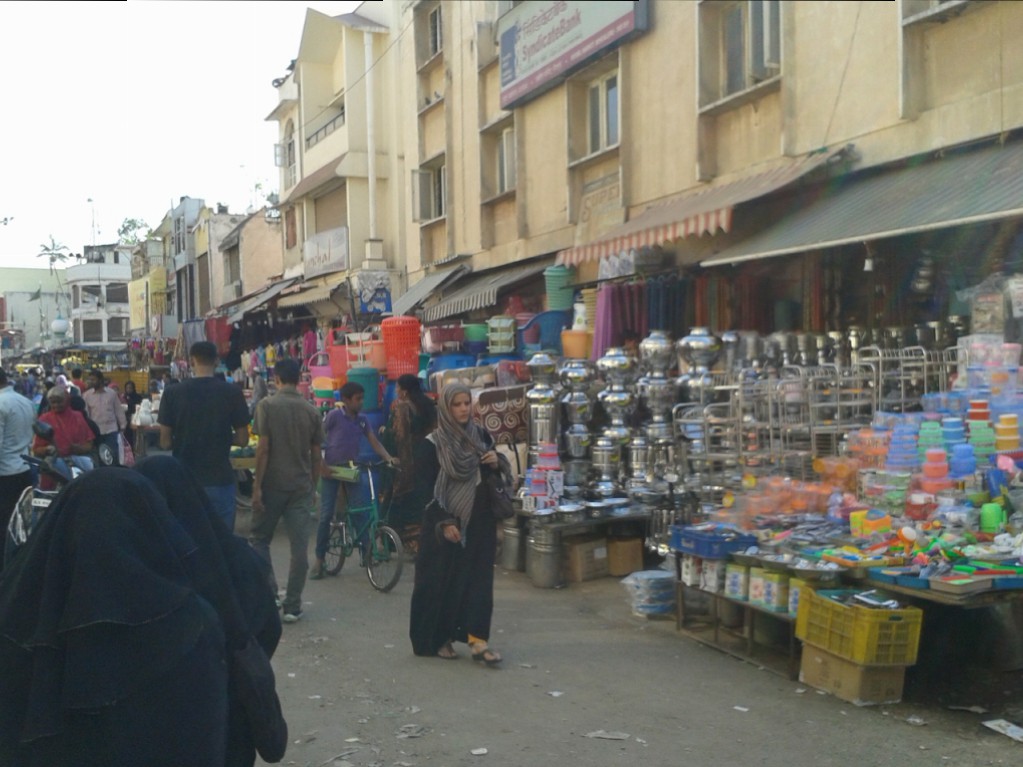
20140316_160803With the notable exception of books, I hate shopping. There are few endeavors more painfully tedious to me than wandering through stores looking for clothes, tsotchkes, knick-knacks, bric-a-brac, widgets, or doo-dads. I do go shopping, in part because I like to eat, and in part because societal conventions require that I wear clothing (you’re welcome.)


Were I not married, I’d be a complete fashion nightmare because I have only three questions when shopping for clothes. 1.) Does it look like it fits? 2.) Does it look comfortable? 3.) Is the price reasonable? (i.e. given that I’m a cheapskate for which stylishness and/or trendiness mean diddlysquat.) If the price of two shirts of the same size is identical, I will buy the one that’s closest to the cash register–or which will otherwise get me out of the store the quickest.


You’ll note, I didn’t include the question: “Does it match?” Correct. I’m not even sure I know what that means. If it’s a shirt, it matches pants because you wear them together, right? A shirt would not match another shirt, unless one could wear one over the other? If you can’t wear the two items at the same time, they definitely don’t match, but that doesn’t come up often. (I know all the bits that need covering, ergo, I can succeed at picking a group of garments that covers all the essential anatomical area.)


I also didn’t include “Does it look good?” It had to look good to someone–they made the damn thing. Who am I to say my taste is better than theirs? I think we’ve already established that I know not thing-one about being fashionable. Now, if it has feathers or a cape, I wouldn’t buy it on the grounds of lack of functionality (have you ever gotten your cape caught in an elevator or escalator?), but I don’t judge on taste. There but for the grace of my wife, go I… looking like non-sparkly Elton John.


So where am I going with this, you may ask? What’s intriguing is that, despite the fact that I hate shopping, I get asked if I want to be taken to a market, mall, or commercial district about four times per day (fyi, that’s roughly the number of times I go shopping per annum.)


Imagine a white person walking down the sidewalk wearing a t-shirt and sweatpants, said person has a full duffle-bag on their shoulder that is long enough to accommodate a standard size yoga mat when rolled up. Where is this person going?

A.) He /she is going to the yoga studio.

B.) He /she is going to a gym.

C.) He / she is going to a martial arts studio.

D.) There isn’t enough information to determine between A,B, or C.

E.) He /she desperately wants to go shopping.


If you answered “D” you’re a keen and astute observer. If you answered A, B, or C, you have drawn a reasonable conclusion, but did so too quickly and without sufficient information for that degree of specificity.  If you answered “E,” you drive an autorickshaw (tuk-tuk) for a living.


For a while, I thought that this was just blatant ignorance, as all forms of racism are. Could these drivers truly not fathom–despite all evidence to the contrary–that I (i.e. whitey) spent my time doing things other than shopping? Did they really think that my days were divided between counting infinite piles of cash and spending it on crap for which I had no real need?


Then I realized that it was tenacious hope that drove these inquiries, and not biases. I came to this conclusion as I was watching a few of the recent Superbowl ads. If I don’t get enraged at Madison Avenue, I can’t really get mad at the aforementioned driver. Advertisers and that driver are both just trying to persuade me that something that I don’t need and have no interest in is somehow pursuit-worthy.


The driver knows that I’m going to yoga or kalari or a funeral (or wherever the evidence might suggest I’m headed at the moment), but they’re just holding out the thin hope that I can be diverted from that funeral to go buy some gee-gaw from which they can obtain a commission. In a way, they’re like the guys (or girls, to be non-discriminatory) who hit on a person who is way out of their league. It takes a lot of confidence to suffer repeated crushing rejection with such low probability of success. There’s a guy in the building where I get both my haircuts and Tibetan thukpa, who invites me into his carpet shop every single time I enter the building–despite the fact that the first 100 times I’ve shown zero interest. As long as said persistent wooer doesn’t resort to stalking, it’s kind of endearing. (Of course, it’s a thin line into stalker territory, and then it becomes instantly intolerable.)


There’s another reason I’ve discovered I shouldn’t hold this persistence against the drivers. That’s that they’re stereotyping isn’t without basis. Most of my expat compatriots do love themselves some shopping. I’m very curious about the root of this behavior. I suspect that it’s the vestigial evolutionary programming of hunter/gatherer behavior carried over into people who don’t like to get their toes muddy, to have to touch anything “icky,” or–in general–to be outdoors.


However, I’m a little out of my league, because I only have this compulsion to shop for books. I’m sure that’s residual hunter / gather behavior, but there’s a goal that can be understood. Through book shopping, I’m searching for a kind of nourishment–not the kind that ends hunger pangs, but the kind that’s an assault on my stupidity. I still don’t have a theory for how this applies to Hello Kitty stickers, Chia Pets, a second (or 403rd) pair of sneakers, or any of the other inane crap the people really–but unbelievably–purchase.

IMG_2160

Indonesian Snake Massage

A Python, but no massage

A Python, but no massage

What could be more relaxing and luxuriating than laying on a massage table and having pythons heaped upon one to slither and writhe their way around one’s body? Many people might answer that question with replies like, “being set on fire”, “a prostate exam”, or “a pop math quiz.” Yet, some people dig this unusual form of therapy, and are willing to pay big bucks for it.

If you’ve traveled in the third world, you know that there are ever new and innovative attempts to bilk tourists out of cash. However, there has to be something to a weird idea for it to really take hold. Consider the ubiquitous Southeast Asian “fish massage.” I’ve tried it. It isn’t really a massage, but it does involve fish–namely little fish that eat away one’s dead skin cells to exfoliate and tickle at the same time. I don’t know if the fish massage does much good, but it feels weird, has some novelty to it, and is a good way to both get off one’s feet and experience ten minutes without someone trying to sell one something else odd and questionable.

Will the python massage (no, that is not a euphemism, innuendo, or a phrase from bad erotica) survive? I believe it will. Why? Because behind every insane idea there are drunk backpackers with Type-A personalities challenging one another to “go for it.”

My First Tibetan Buddhist Meditation & Lecture

Having settled into life in India over the past month, I’m now getting around to some of the self-enrichment activities I’ve planned on taking advantage of here in Bangalore. Today I attended a meditation session and discussion/lecture at the Thubten Lekshey Ling Tibetan Buddhist Meditation Center. I’ve read a few books on Buddhism and even one or two specific to Tibetan Buddhism, but this was my first time attending such a session. Also, while I’ve done several kinds of secular meditation, both in a group and individually, this was my first exposure to guided meditation in the Tibetan Buddhist tradition.

The title of the session was As the Clouds Drift by… The first hour was the meditation portion and the following two hours were the lecture / discussion portion. The session opened with a few prayers that were chanted in what I believe was Sanskrit, but there was an English translation for newbies such as myself to follow along with the meaning. Then we did a few short meditations that were much like others that I’ve done: meditation on breath and meditation on bodily awareness. Then there was a visualization as we read a sutra in English.

Transitioning into the discussion and lecture portion, we first discussed the meaning of life. No, I’m not making that up. While it might seem like a hackneyed question, some intriguing points were raised. We were directed to think of the question as having two alternative meanings. First, why am I here? Second, what is my purpose? The conversation gravitated to the latter topic. I’m not sure if this was because there was a consensus that the question “why am I here?” is meaningless, or if the question of purpose was just more intriguing. There were various opinions about whether there was a purpose, and–if so–whether it is universal or individual-specific.

After a brief tea break, the remainder of the session involved readings from The Way of Bodhisattva followed by analysis and prompted discussion. Much of the discussion revolved around the issue of how compassion is expressed and the difficulty (or ease) of being a Bodhisattva. (A Bodhisattva is one who seeks enlightenment out of compassion for all sentient beings.)

I found the session to be thought-provoking and beneficial, and thought the atmosphere was conducive to growth. Emphasis was placed on discussion rather than straight lecturing. I will no doubt be back to visit in the future.

I did learn something interesting about myself through the process of the class, and that’s that I need to learn to be still for more than two hours. While there was no prohibition on moving around–particularly beyond the meditation portion– in an effort to not be a distraction, I tried to keep fairly still. I practically ran home afterwords. I had all this pent-up energy. I would have thought myself better than average at sitting in a contemplative state. I’m a writer for goodness sake. I spend entire days at my computer. However, in truth, I rarely sit more than an hour without getting up and stretching or doing some sort of movement to limber up my body and get the blood flowing. I was raised Catholic, and so I’m not new to sitting quietly for long periods of time. Though that was a long time ago. I also have three college degrees and have spent more than my fair share of time in classrooms, but the wandering mind is not discouraged in that environment–in a way it’s encouraged.

7 Perqs of Life in India

1.) Vegetarian restaurants: While I’m not of the vegetarian persuasion, my wife is. This can make finding a mutually acceptable restaurant a pain. However, it’s vastly easier to pick a restaurant in India. Except for the very rare American-style steak house, she can eat anywhere and the menu will be at least half vegetarian.

In Atlanta, I’d estimate that she could eat healthily and well in about one in five restaurants. American Southern cooking doesn’t offer one a side of green beans without a ham bone in it. I’d say we’ve cut our restaurant selection time to about a quarter of the time it took in the US.

IMG_0512

2.) Cheap books: While English is secondary to Kannada as the spoken language here, it’s not second  in the bookstores by any means. Bookstores are common and offer some new options. I’ve spent a lot of time in bookstores, so I usually don’t see a lot that’s new, but there are books printed by Indian publishers here that don’t usually appear on the shelves of Barnes & Noble.

And, unlike in Cambodia where books are  cheap by means of photocopying, the books here aren’t cheap by virtue of stiffing the writer.

BlossomBooks

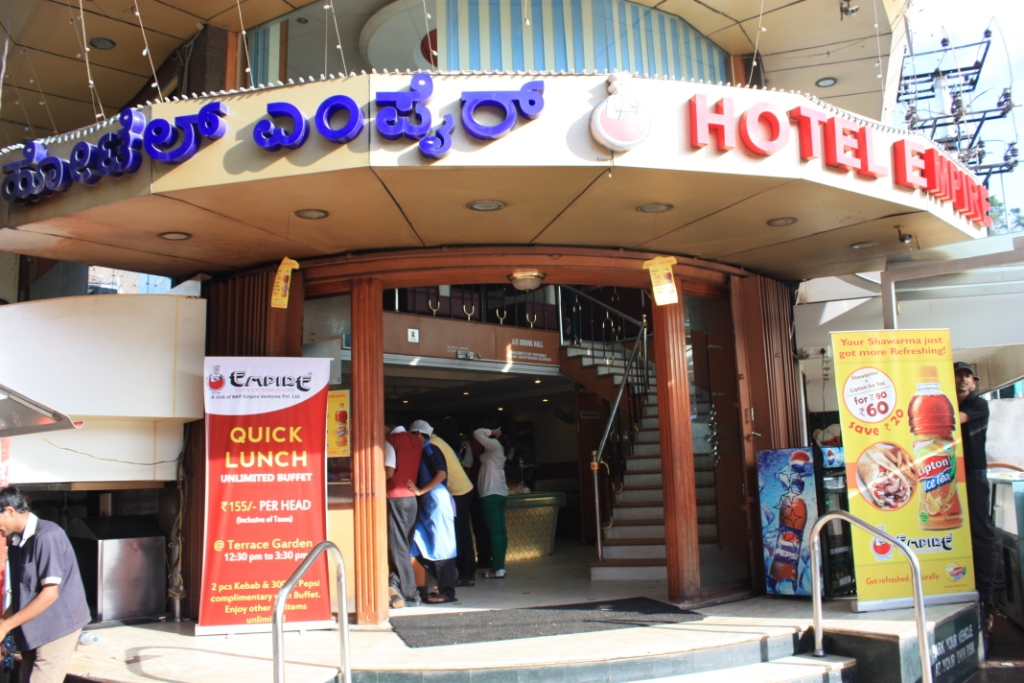
3.) Amazon: On a related note, I can still buy Kindle books just as easily as I did in the states. There are some websites that don’t work here, such as Hulu and Netflix, but Amazon operates just fine.

4.) Walk-centric life: Bangalore is not an easy city to walk in because the traffic is horrendous, there is no system for traffic lights, and sidewalks are about as dangerous as walking in the street. (If your eye isn’t constantly on the sidewalk, you might just plunge into a sewer.) However, being in the heart of the city, there’s nothing I need that I can’t get via a short walk.

5.) Servants: I haven’t mowed lawn, swept a walk, done laundry, or washed a dish since I left the US, and yet it’s always done. After a brief period of feeling awkward, it’s beginning to grow on me. The hardest part will be going home, once I’ve become accustomed to a certain level of service.

6.) Climate: There’s been a pleasant breeze coming through my window pretty much all day. I haven’t had to use the AC since we’ve been here. And it’s starting to not rain every night. Of course, this one is not so much about India as Bangalore specifically. On the whole, India’s climate is not so pretty.

7.) Loan words:  I suspect it’s harder for the locals to talk about foreigners behind their backs here than most countries because there are so many English loan words. They’ll be a couple of locals talking in Kannada, and you’ll here: “Waa-wah-waa-wah-waa-wah-super convenient-waa-wah-waa.” So it’s like having a rudimentary grasp of a language, you can kind of get a feel for the general drift of what is being talked about-even if you don’t know any specifics. At least this makes bad-mouthing foreigners a mental exercise.

The Deferential Calculus of Being an American in India

Every time I come home, the security man at the desk at our apartment building jumps to his feet and proceeds to stand at attention until I pass. This makes me uncomfortable, as do the many other ingrained acts of deference that occasionally border on obsequiousness. I’ve considered stopping to tell him he can be permanently “at ease” with me, but given the language barrier I’m afraid I’d just confuse the issue–plus have him standing at attention that much more longer. So, when in Rome…

If you’re an American, but not, say… General Pershing, you’d probably find this makes you uneasy as well. I think one of the reasons that Americans have historically excelled at technological development  is that we were in a hurry to have machines do our laundry, wash our dishes, or trim our nose hairs so that we wouldn’t have to have some other human apparently kowtowing to us. (This may be why the 19th century North was considerably more technologically advanced than its Southern counterpart, which had successfully rationalized a subclass of human being.)

There’s a guy who stands at the end of the lane and lifts a swing arm up and down every time a car (or, oddly, a pedestrian such as myself) comes down the lane. The first couple times I walked around the end in hopes of indicating to him that, “Hey, see you don’t really need to swing that thing up, I can just walk right around it, easy as pie.” I think I hurt his feelings, or–perhaps worse–undermined his reason for getting up in the morning. My point is that operating a swing-arm barrier is a perfect example of the type of job that has been completely mechanized in America.

I’m sure that cultural differences are the root of my discomfort. India is coming from the caste system, whereby who you were born to determined your status in a rigidly hierarchical structure. While Indians may have dropped the caste system, the underlying thought process dies hard. I, on the other hand, come from a culture which believes that on a fundamental level we are all equal. Americans are often stymied as to why we are viewed as being arrogant by other cultures. This may be a failure to see things in the same light. It’s not so much that we project that we are better than the average Joe, it’s that we don’t accept that the kings and holy men those cultures hold dear are above us. This is true. I don’t think I’m better than the door man, but I also don’t think the King of [Fill in the blank] is better than me. [OK, the perception of arrogance is also partly that we’re loud and expect a ubiquity of comfort that is simply not available in much of the world. There is that. And the fact that our leaders often think they can fix every problem everywhere, and–given this is not actually true–we have left a lot of chaos in the our wake since our rise to hegemony.]

So the whole culture thing is part of it. However, I also worry that the man who brings my food with a warm smile and a bow is spitting in it. I wonder if the lady who launders my clothes, and then goes the extra mile by ironing them (though they mostly consist of T-shirts and jeans), might be preparing an itching powder attack. I wonder if the security guy standing at attention is just waiting for me to lock myself out of my apartment so that he can exercise some passive aggressive payback. [I suspect this is why Indian bureaucracy is notoriously slow and prickly. It’s a desire to exercise the leg up on has while one is in other ways part of an underclass.] I heard a comedienne of Indian origin say that her mother always flew British Airways just for the delight of bossing a Brit around. All of this consternation is because I worry that they think that I think I’m superior to them, which I don’t.

Yesterday I was eating at an Indian fast food joint called Kaati Zone. It’s one of those places that you order at the counter, get your food at the counter, and take it to one’s table. (FYI- this set up is much less common here except for little holes in the wall where one stands to eat.) When I was done, I pitched my trash in the trash can and put my tray on top, just like one would at a Wendy’s. When I turned around there was a young woman with her jaw agape and eyes wide looking right at me. My first thought was that I had pitched my wallet or my journal in the trash. I did a pat down and found I was alright. As I left, it dawned on me that her surprise may have had something to do with my handling of my own garbage.

Enough with the Indian Food Warnings, Already

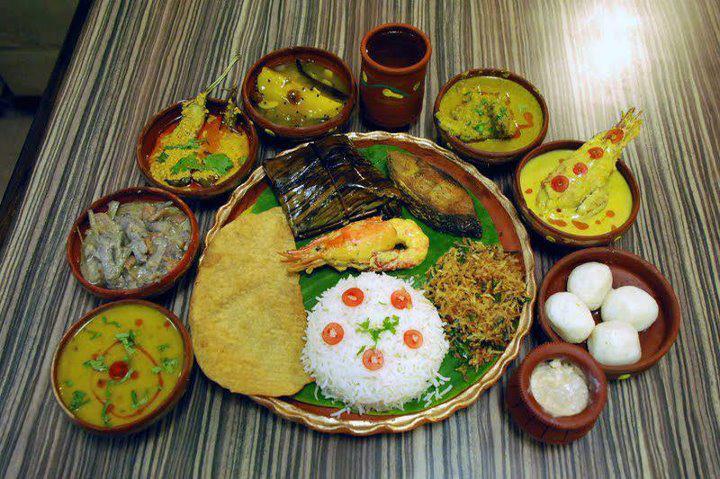
Bengali Authentic Full Meal; Source Nandinissaha (via Wikipedia)

Bengali Full Meal; Source Nandinissaha (via Wikipedia)

When I tell people that I’m moving to India, a common–but strange–response is for them to issue warnings about the food and water. I find this odd for two reasons.

First, said warnings are often issued without much firsthand experience of developing world dining (not including high-brow resorts), and without knowledge of my dining history.

Here are few facts that might help one to better understand my approach. I’ve dined on cold seafood salad in a Phnom Penh cafe. I’ve noshed on snake-on-a-stick in China. I once supped at a home/restaurant in the Peruvian Andes whose latrine consisted entirely of a squat-hole cantilevered out over a  cliff side. A couple of days in Bangkok, I consumed nothing but street-food. I was raised on a farm with non-pasteurized milk, and had a father who wasn’t above cooking up a nice-looking piece of road kill. Not a bloated opossum mind you– but I’ve gnawed clean the drumstick of a pheasant that died not by birdshot, but on the grill of a Peterbuilt. (Funny story, spellcheck wanted to change “pheasant” in the preceding sentence to “peasant.” That would have really freaked you out.) So while my home life has been first world, I’ve got a little third world in my gut.

Now you’re probably thinking, “This idiot is infinitely lucky to be alive, and given his behavior he will probably die soon.” Au contraire mon frère. It’s not that I randomly engage in high-risk behavior. Even locals get Delhi Belly if they don’t choose wisely–despite the full panoply of aggressive gut organisms working on their behalf. I’m quite aware of the hazards, and take calculated risks backed up with sensible precautions.

It’s funny that people live in terror of street food–not that there aren’t some carts that one should run from screaming. However, do you really know what the pimply-faced teenager is touching or scratching during the act of assembling your burger at Chili’s? I know exactly what the hands of the old lady grilling my moo ping on Sukhumvit Road looked like. I got a good look because there was always a line that I had to wait in– and gladly so. (FYI – sanitary wipes or hand sanitizer are one thing you should take with you wherever you go in this world.)

I’m not saying that I’ve never gotten an upset stomach, but I’ve done some remote third world travel and never experienced anything worse than resulted from any given trip to Taco Bell.

I’m quite fond of Indian food, and am sure I will cope well with having it for the majority of my meals for the next couple years. Yes, I’ll have to severely reduce my intake of ice-cold beverages and raw foods. (Ice and wash water are the hidden killers that probably cause more food-borne ailments than anything else.) However, ice-cold beverages –while refreshing and pleasant– are not really that healthy for a body in high temperatures anyway. (Flash heating or cooling of things at the other end of the temperature spectrum is bound to cause problems–one’s organs aren’t that different.) While I like raw vegetables, the human body is more efficient at extracting nutrients from cooked food, so there’s a side advantage there as well.

I think people freak themselves out and miss out on some excellent food. One individual who traveled widely once told me that she never ate the local food for fear of getting sick. I felt bad for her. She traveled to the source of some of the world’s best food, and then dined on American fast food–that’s a squandering of no small part of the travel experience. Of course, some people have very weak systems, and that may have been the case for her. (American fast food may be bad for you, but it is uniformly bad throughout the world.)

The second thing that I find strange is that when I was moving to England 25 years ago, no one warned me that I would be going to one of the most gastronomically unappealing places on the planet. Let’s face it, the reason Britain took over India in the first place was so that they could get something decent to eat. Curry is also the reason they didn’t let go easily.

Is there some bias whereby people tend to respond with negativity when one says that one is moving to the developing world, versus positive responses to moving within the developed world?  One probably shouldn’t respond with negativity to news someone is moving anywhere, but–if you must– you should tailor it to the individual concerned.  For example, if one said to me, “That shrill flute in their music is going to get on your last nerve.”  Well, sorry, but that’s probably a correct statement. (No offense, I’m sure it sounds lovely if you were brought up with it, but it will be–at best– an acquired taste for me.)

Outsourced as a Guide to Indian Corporate Culture?

As my wife and I prepare for our move to Bangalore, we are doing research to help us avoid inadvertent insult and blasphemy . We’ve learned such useful facts as: a.) don’t tug on a Sikh man’s beard, and b.) don’t buy a statue of the goddess Durga to use as a hat rack.

Source: Dipankan001 (via Wikipedia)

Durga Source: Dipankan001 (via Wikipedia)

These are just the kind of faux pas a well-meaning but uninformed American couple might make. (Oh, you say, not really?)

Every culture has its little proclivities that seem insane from the outside, but which are so deeply ingrained as to be invisible from the inside. (In fact, I had trouble thinking up such American cultural proclivities, but I believe they exist. Our norms are just so ingrained as to be hard to see. Of course, we are also a  diverse society, a young nation, and tend toward the irreverent in the social domain– all of which may make our cultural idiosyncrasies look a bit different from those of more traditional societies.)

We’ve been reading books like Culture Shock! India, which is one of a series of books that explain the various cultural idiosyncrasies of different countries. (I was first introduced to the series through Culture Shock! Cambodia, though I have read other such books about China and Japan.)  Such guides are extremely useful for explaining do’s and don’ts. However, they don’t necessarily prepare one for the corporate culture of India, which is a mix of Indian, Western, and   multinational business cultures. For insight into the corporate culture we turned to:

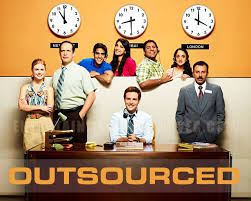
OutsourcedFor those of you unfamiliar, Outsourced was a sitcom that ran for one season (2010-2011) on NBC. The premise of the show was that the manager of a novelty company call center is moved from the US to Mumbai. He becomes acquainted with Indian culture as he must teach his staff enough about American culture  so that they can communicate with the customers they are on the phone with all day. Some of the humor comes from the exposure of a very conservative workforce to products that include dildos and slutty Halloween costumes, but much of it is just cultural tension more broadly. The show was popular with critics and Americans familiar with India. Unfortunately, that was not enough to keep it on the air, particularly when Americans who buy tacky crap and couldn’t find India on a map were the butt of the joke at least as much as were Indians. (Americans who buy tacky crap and are geographically illiterate are a large demographic within the television viewing public.) At any rate, the show was clever and well-acted.

One may scoff at the use of a sitcom as reference material, but the show seemed to be well-researched. For example, I know that its discussion of the famous Indian head bobble matched the description in the cultural guide quite well. The bobble is a non answer that can mean virtually anything. The video below gives a more detailed explanation, but the visual is not so good. From what I’ve seen, most people tend to do this action more with the top of the head staying relatively stationary while the jawline swings side-to-side.

This left us wondering whether other elements of the show will ring true. The show introduced me to a new term, “holiduping.” This is when one’s employees convince a manager that a day is a holiday, when in reality it isn’t. To get the joke, you must know that Indians have enough work holidays to make US Federal employees say, “Damn, that’s a lot of holidays!” Furthermore, not all the holidays are national. There may be days taken off in Karnataka that are not in Gujarat, and vice versa. This can make it a challenge for new comers to keep track.

I’m curious as to the views of people in-the-know about how accurate Outsourced was. Most of the cast were Americans of Indian origin, but it doesn’t look like the same was true of the lead writers.