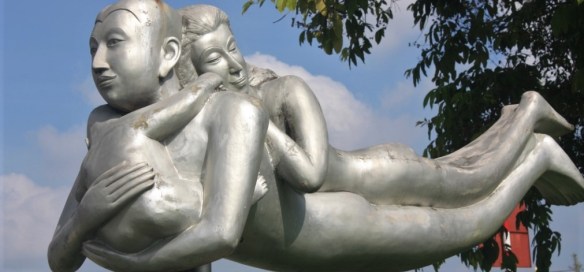
Taken at Lake Lanier in October of 2011.


Taken at Lake Lanier in October of 2011.

Looking at the water’s surface, seeing the reflection on display, a fuzzy and easily perturbed version of the trees beside and clouds above, I feel the watery world is less real than my own.
Then I consider the fish. At best, the fish sees those trees and clouds as a hazy and rippling representation, dim or, perhaps, shimmering. On the other hand, I suspect the fish sees the yellowed bases of the cat’s tail stalks and the rumpled car that a teenager drove into the lake twenty years ago in high-definition clarity, though I cannot see those things even with my nose to the water.
As my intraspecific conceit can only stretch so far, I’m left with the reassuring (or disconcerting) realization that all of it is equally real (or none of it is real at all.)
 They scribble sacred statements on the wall,
and climb the towers, shouting sacred calls.
And, swiftly, people come from far and near
to gather around at the sacred halls.
Some sing beloved songs; others mantra chant
’til sacred sounds are bouncing off the walls.
They read inscriptions carved into the rock,
deciphering meaning from sacred scrawl.
They’re all sure it’s sanctified from on high,
but sacred ‘s what you let hold you in Thrall.

I
rustling leaves,
i hear only chaos;
the blind man hears
a single leaf fall,
hitting others as it drops
II
the sunshine
glows on my eyelids,
warms my face;
i see movement in
shifting dark blotches
III
the city noise,
so chaotic when looking,
becomes ordered
when I close my eyes
and sit with the sound
 Madness: A Very Short Introduction by Andrew Scull
My rating: 5 of 5 stars
This is yet another of the many “Very Short Introduction” books from Oxford University Press that I’ve been pleased to read and review. The series offers concise overviews of a wide range of topics that are presented by scholarly experts. This particular book is a historical examination of the changing approaches to mental illness from the ancient world where such a condition might be attributed to demonic possession to more recent times in which drugs and decarceration / defunding of asylums have become the dominant approaches to mental illness. Along the way the book shines a light on the immense difficulty experts have had in understanding what mental illnesses are and how they can best be dealt with. The book not only looks at the real-world response to mental illness, but also explores how it’s been treated in fiction from “Hamlet” to “One Flew over the Cuckoo’s Nest.”
The book consists of six chapters. As one would expect of a book from a historian’s-eye view, its organization is chronological, but the arrangement of time periods by chapter reflects changing approaches to mental illness. Chapter one focuses on the ancient world, during which we begin to get glimpses of madness in the written record. Chapter two, entitled “Madness in Chains,” focuses on the 16th through 18th century, during which Bethlem [Bedlam] Hospital was the cutting edge. That the institution’s nickname becoming a synonym for chaos and confusion says a lot. It was a time of brutal measures that did little to reduce the trauma of mental illness. The chapter also discusses madness in Elizabethan literature, famously that of Shakespeare.
Chapter three shifts to the 19th century, an era in which incarceration became more widespread as well as coming to be thought of as the best that could be done for the insane. In Chapter four, we learn about the rise of psychoanalysis as well as the increasing employment of treatments that involved the physical body – infamously, the lobotomy.
Chapter five is one of the most intriguing parts of the book. Entitled “Madness Denied” it opens with an exploration of the difficulties that arose from all the war-related cases of mental illness that came about as a result of the two World Wars (and others.) It also discusses a movement to overturn the prevailing approach to insanity, most famously and vociferously argued by the Scottish psychiatrist R.D. Laing, a clinician who had a mix of promising and disastrous results from his experimental approach which used LSD, but few other medicines. What I found most interesting, however, was the discussion of the growing recognition that there was a false front in the idea that psychiatry was beginning to really understand mental illness and its treatment. This was exemplified by the Rosenhan experiments in which sane volunteers checked themselves into asylums and, for the most part, the doctors and staff couldn’t tell that they were sane (though, interestingly, in at least some cases the other patients did call it out.) The troubles in classifying and diagnosing mental illnesses have also seen in the vexed history of the “Diagnostic and Statistical Manual of Mental Illness” [DSM,] a guide meant to get mental health experts on the same page about what’s what. [As opposed to ten psychiatrists offering ten different diagnoses of a given patient.] While a worthy attempt, the DSM has not – thus far – succeeded, though it could probably be argued that progress has been made.
The last chapter brings the reader up to the current period, a period dominated by two trends – first, mental illnesses being treated overwhelmingly pharmaceutically; and second, the closing of asylums and the concurrent ill-effects that have come about, societally speaking.
The book has a few graphics, mostly black and white art and photos used to enhance the reading experience. There are also appendices of references and recommended readings.
If you are interested in the history of psychiatric medicine, I’d highly recommend you check out this brief guide. It may not give you all the information you’re looking for, but it’s a good first stop to organize your thoughts on the subject.
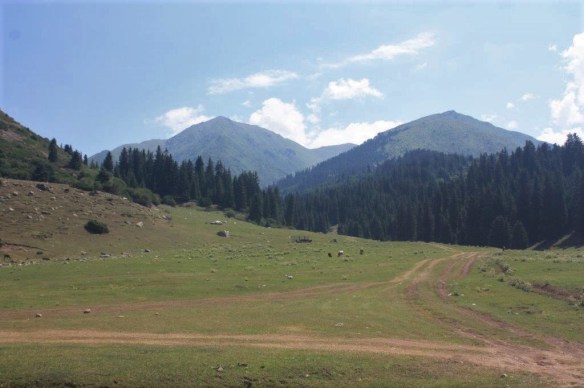
Taken in the summer of 2019 near Jeti Oguz
 V for Vendetta by Alan Moore
My rating: 5 of 5 stars
This graphic novel is set in a fascist, dystopian Britain that grew up in the wake of an apocalypse that left England relatively untouched but ripe for the rise of a fascist political party, Norsefire. The book was written in the eighties at the height of the Cold War, and imagines this fascist Britain in the late 1990’s. The nature of this dystopia is part Orwell’s “1984” and part Atwood’s “The Handmaid’s Tale,” meaning it’s an authoritarian surveillance state, but religion (and the morality thereof) is definitely an active participant in the abuse of power.
While the protagonist is a shadowy figure who goes only by the nom de guerre “V” and whose backstory is gradually revealed over the course of the book, another central character – one who presents a more human face – is Evie Hammond, a young woman who is turning tricks on the street to get by. The book opens with Evie being cornered by a couple of “Fingermen” (Brownshirt-like secret policemen who intend to rape and murder her) when she is rescued by a Guy Fawkes-mask wearing mystery man, V. V takes Evie back to his hidden lair, and while their paths diverge and converge over the rest of the story, Evie remains a crucial character to the bitter end.
In the early part of the story, we see that high-ranking fascist party members are being murdered in ways and with clues that are clearly meant to make a statement. In the first half of the book, a police detective, Finch, is trying to solve the murders – which first requires figuring out a motive. About the time he comes to understand the basis of a revenge motive, it becomes clear that V intends much more than just getting personal revenge for the wrongs done to him at a concentration camp.
At the beginning of Part II, Evie is separated from V after a falling out over an action she participated in against a pedophilic Bishop that ended in a murder that she found distasteful. However, she has a change of heart about the use of lethal force when the man she is staying with receives a visit from the Fingermen. She makes an amateurish attempt to invoke street justice that is interrupted by a man she assumes to be with the authorities. In reality, it is V conducting a clever ruse designed to put her through what he went through so that she can experience the freedom of mind that he acquired when his fear died.
In Part III, V’s grand plan unfolds, sinking London into chaos in the hopes that something glorious (or at least better) will arise in its place. Alan Moore was a proponent of anarchism, and the suggestion is that by tearing down the existing political order, a period of peaceful anarchic or quasi-anarchic coexistence might come to be. I should point out that Moore doesn’t tell the story as an ideologue. He creates sympathetic characters among the fascists and ensures that a light is shone on V’s dark side. He also leaves the outcome open. The reader doesn’t really see what grows out of the ashes.
In addition to being political fiction, “V for Vendetta” can be read as a kind of superhero story. It’s not known precisely to what degree V is superpowered, if any. He does seem to possess some degree of superhuman ability, but it might just be that he’s crazy enough to succeed in activities such as taking on multiple armed opponents at once. It seems that the experimentation that was done on him, which killed most of his fellow subjects, may have made him stronger and / or more physically capable, or – alternative – maybe being preternaturally robust in the first place allowed him to survive what others couldn’t. Still, it is clear that he is not invulnerable.
I enjoyed this story tremendously. It’s thought-provoking, both at the political level and at the level of individual psychology. We are led to consider what brings people to accept authoritarianism, and to also wonder whether people could accept an anarchic approach to social existence. But there is also the question of what is freedom for an individual, and in what way one can have freedom within when there is no freedom to be had without? If you’re intrigued by these themes, I’d highly recommend reading this book.

They shut down all the asylums…
That’s one way of looking at it.
Another is that they widened
them to admit us all inside.
Now with the riots underway,
there’s no haven from the strife.
Leaving us only one option,
we must go nuts in earnest.
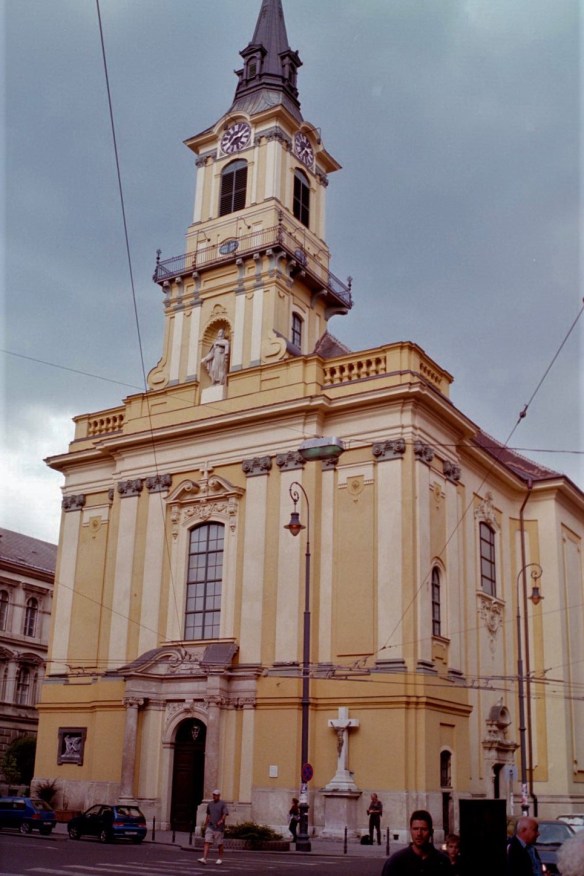
Taken in the summer of 2002 in Budapest.