Unknown's avatar

About B Gourley

Bernie Gourley is a writer living in Bangalore, India. His poetry collection, Poems of the Introverted Yogi is now available on Amazon. He teaches yoga, with a specialization in pranayama, and holds a RYT500 certification. For most of his adult life, he practiced martial arts, including: Kobudo, Muay Thai, Kalaripayattu, and Taiji. He is a world traveler, having visited more than 40 countries around the globe.

BOOK REVIEW: A Natural History of the Future by Rob Dunn

A Natural History of the Future: What the Laws of Biology Tell Us about the Destiny of the Human SpeciesA Natural History of the Future: What the Laws of Biology Tell Us about the Destiny of the Human Species by Rob Dunn
My rating: 5 of 5 stars

Amazon.in Page

Out: November 9, 2021

Maybe you’ve seen “Save the Humans” bumper stickers. They came about due to twin realizations. First, the desire to save whales proved too remote to spur humanity into better behavior. Second, the sci-fi subtext that humans don’t need other species and that we can survive any form of cataclysm [including those that kill off everything else] is wrong on both counts.

Dunn’s book explores what changes Earth’s lifeforms can expect of the future. As one might expect, these changes are heavily influenced by climate change, but Dunn also looks at the effect of other factors – notably the growing resistances that results from heavy use of biocides (e.g. pesticides, antibiotics, etc.)

Dunn investigates the effect of islands on evolution and speciation, and goes on to show that not all islands are surrounded by water. (By geographic definition they may be, but in terms of constraints that restrict the movement, interactions, and well-being of lifeforms there are many besides water.) This is important because climate change will drive species to attempt migration to areas that present the conditions to which the species is evolutionarily adapted. Some will fail and may go extinct. Some will succeed, but will upset the ecological applecart of the location into which they’ve moved.

Chapter nine discusses a crucial principle: being able to break a thing doesn’t mean one can readily fix it. Dunn describes plans to use robotic drones to replace the extinct bee pollinators that play a crucial role in our ecosystem, as well as the ways the drones are likely to fail to live up to their predecessors.

I found this book to be immensely thought-provoking. One can argue whether the author is too gloomy about human future (“human future” because Dunn is clear that life on the planet will go on), but it’s impossible to ignore that challenges exist.

View all my reviews

Kathmandu Limerick

A proprietor of old Kathmandu
epitomized the spirit can-do,
selling hippies and monks
neckties and swim trunks,
and even sold ascetics kazoos.

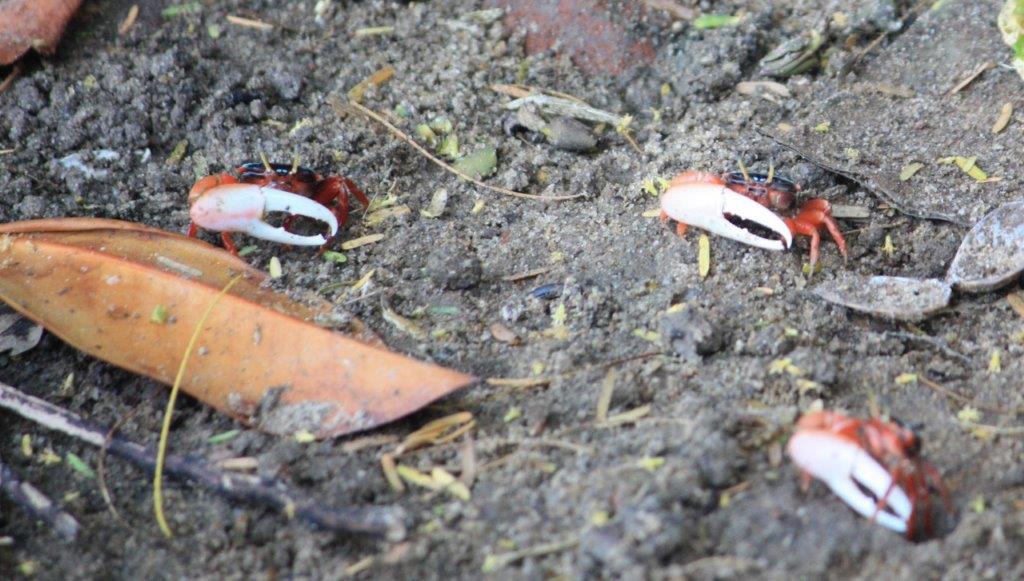
Crab Phalanx [Haiku]

fiddler crabs
form a phalanx;
claws ready

DAILY PHOTO: Candelabra Bush, Arikamedu

Taken at Arikamedu, India in 2019

DAILY PHOTO: Ta Prohm Colonnade

Taken in October of 2012 at Angkor (Ta Prohm)

Four Eyes [Haiku]

the glint in the eye
makes it look round and lustrous,
though it’s a moth wing

Kuala Lumpur Limerick

Two builders working in Kuala Lumpur
vied to outdo each other's grandeur;
but one tower is straight,
and the other one ain't.
So, I guess we know who won that war.

DAILY PHOTO: Standing at the Parapet Wall, Nandi Hills

Taken in November of 2013 at Nandi Hills

BOOK REVIEW: Phaedrus by Plato

PhaedrusPhaedrus by Plato
My rating: 5 of 5 stars

Amazon.in Page

“Phaedrus” is one of the middle Socratic dialogues of Plato (experts propose that the middle dialogues increasingly contain Plato’s own ideas [versus those of Socrates, himself.]) The subject of the dialogue is love and whether it is worth pursuing. Phaedrus has a speech by Lysias that he’s is quite excited about, one which claims that it’s better to have a “platonic” relationship than a loving one. As Phaedrus and Socrates walk, they debate about the speech. Phaedrus presses Socrates to deliver his own speech on the subject. Socrates delivers two; the first aligns with Lysias’ view and the second takes the opposing side.

Socrates concludes that, while love is a form of madness, it’s not the madness of human infirmity. Instead, it’s a form of divine madness, and – as such – should not be poo-poo’d too quickly. Socrates proposes that there are four varieties of divine madness (theia mania): prophetic, ritual, poetic, and erotic, and – of these – the latter is best and (again) shouldn’t be dismissed lightly.

After Socrates’ second speech and conversation that summarizes and clarifies it, the philosopher discusses how one can be led astray by elegantly formulated words, and how a philosopher should evaluate what is said to determine whether the speaker is wise or whether he (or she) just sounds sage by virtue of his (/her) poeticism.

While this dialogue can be a bit ethereal and mystic for my taste, it has some fascinating things to say. While I don’t necessarily believe in the “divine” part of divine madness, I do see that there are some people who are able to become unyoked from custom and convention, and to do so in a way that is not anxiety-riddled. I think this is a useful state to understand, and this dialogue is an excellent place to start.

View all my reviews

The Murder [Kyoka]

a murder of crows
congregates on the concrete,
and I feel angst.
sure, I’m smarter than a crow…
but smarter than the murder?