
Taken on November 29, 2013 in Mysore.
This neo-Gothic cathedral sits in downtown Mysore. It was built in 1936 and its design was influenced by the cathedral in Cologne.
The saint for which it was named was a martyred Greek princess.


Taken on November 29, 2013 in Mysore.
This neo-Gothic cathedral sits in downtown Mysore. It was built in 1936 and its design was influenced by the cathedral in Cologne.
The saint for which it was named was a martyred Greek princess.

Taken November 29, 2013 in Mysore
[I missed my Daily Photo post yesterday due to being on the road to Mysore, so I’m doubling up today.]
Dariya Daulat is Tipu Sultan’s palace at Mysore. There’s a similar structure in Bangalore, where the Sultan conducted meetings while in town. The Mysore palace is much more impressive from the inside. The murals have been restored and there are exhibits of furniture, arms, and artworks from the era.
However, the outside the structure is much less impressive because of ugly green blinders that are used for the twin purposes of keeping the light and tourists photos out. (There is no photography allowed inside.)
This is the gate which stands inline but opposite Dariya Daulat.
Happy Thanksgiving everybody.
I’m thankful for:
-my wife.
-family and friends.
–budō.
-my health and the good health of others.
-beef (when you live where 90% of stores sell only chicken and mutton–because those are the only edible animals that managed to avoid offending the sensibilities of one of the major belief systems–you have to go rogue every once in a while. We found a place were we could get fresh, and safe, pork and beef today.)
-Bangalore’s great climate.
-monkeys.
-silliness.
–pad thai.
-gravity.
-that humanity has not yet proven too smart for its own good.
-that humanity has not yet proven too stupid to survive.

Taken October 14, 2013 on Chandni Chowk in Delhi.
The base of this statue of Swami Shraddhanand (1856–1926) is a popular point for feeding the birds. It’s located in front of the Town Hall building on Chandni Chowk.
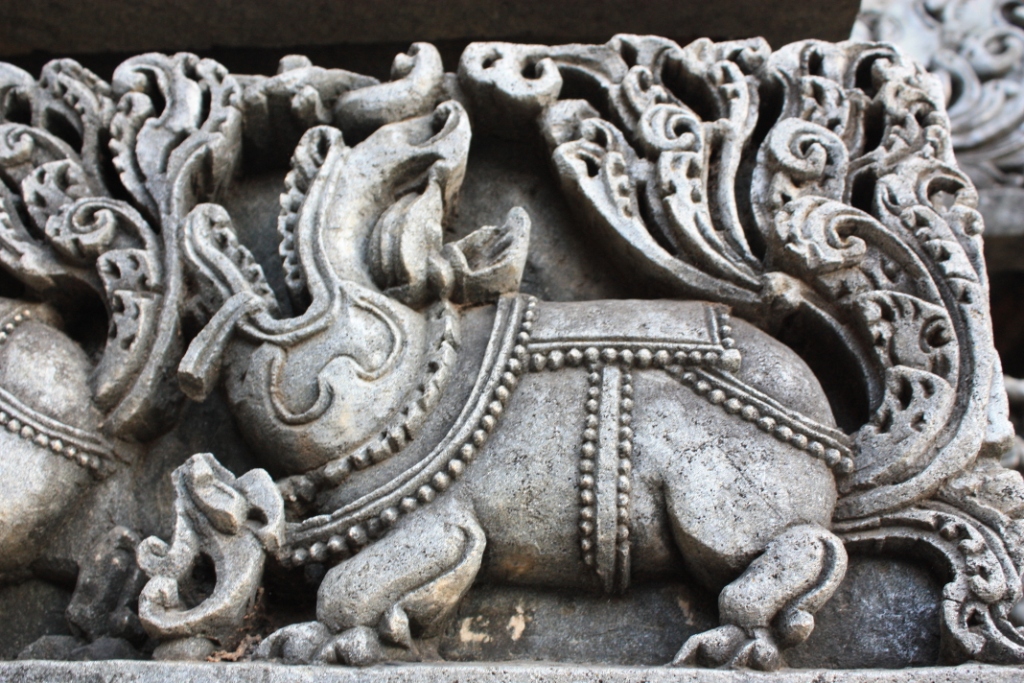
Hands of a surgeon,
Fins of a sturgeon…
Wait, no… that’s not right.
Let me admit that I have no gift
for mythical fliers that get lift.
One can’t just throw wings on a rat.
Of course you can, we call it a bat!
Alright, bad example…
One can’t draw wings on a whale,
and through the sky expect it sail.
Much better.
How did the likes of primitive man
create the myth of a flying orangutan?
They did no such thing.
Fair enough, then answer me this:
Who came up with ogres that eat babies?
Does a crescent-moon werewolf give you rabies?
Who first saw a spiraling dragon,
and how many drops remained in his flagon?
From whence came the fearless griffin
body of a lion and the head of a… chicken?
If by her shrill scream you know a banshee,
how’d you know it’s not any old woman she?
In how many beds are succubi layin’
in which the occupant ain’t already strayin’?
Leprechaun stories come from notorious drinkers,
and Gorgons and Sirens from a culture of thinkers.
My deficit, it seems, is as aligns with my fears.
Quick, get me a stack of books and a case of beers.
 Heart of Darkness by Joseph Conrad
My rating: 4 of 5 stars
Heart of Darkness is a story within a story (i.e. a frame narrative) in which the protagonist, Marlow, tells a group of men on a ship on the Thames about his adventures captaining a boat on the Congo River. The use of a frame narrative both gives this novella/ novel a confessional feel, but also imagines Marlow’s audience feeling his tale particularly viscerally as some of them might be caught up in similar intrigues themselves.
Marlow’s job in the Congo is transporting ivory. However, the core of the story revolves around a trip to extract an agent of the ivory trade named Kurtz, and to transport the ill man to medical care. Kurtz is an intriguing character. This isn’t a man one can feel indifferently towards. Some love his intellect, charisma, or even his ruthlessness. Others despise him as the face of villainy. Kurtz represents imperialism at its most vile. Some natives are at war with him. Others respect and fear him. However, he’s willing to destroy them all on a whim to make the flow of ivory come more swiftly.
Marlow isn’t a member of Kurtz’s fan club initially and thinks the agent is completely insane, but he becomes intrigued with him as their journey progresses. In a way, Marlow is the moderate face of Imperialism. He doesn’t like the way the natives are treated, or the power plays and bureaucracy of the trade. However, he’s an active and willing participant, and, ultimately, when given a choice to work against the system or in support of it he chooses the latter. He hands over Kurtz’s report on the “Suppression of Savage Customs.” He also shows his sympathy towards Kurtz through his interaction with the dead man’s fiance.
This is definitely 19th century literature. While the book is very short, it’s readability isn’t high by today’s standards. It’s organized into just three parts or chapters, and the prose isn’t built for speed. Also, while it turns out to be a gripping tale, it’s slow off the blocks. It must also be put in the context of 19th century literature because the themes of imperialism and suppression of “savagery” have long since been settled. Viewed through today’s lens, the story might not ring true. Though I suppose there’s still a heart of darkness in urban environments today, behind walls rather than across seas.
What are the book’s strengths? While it may seem silly, the title is pure-D awesomeness. Also, while it’s not organized or written for readability by today’s standards, by 19th century standards it’s a page-turner. It’s certainly a compact tale. As I indicated, I’m not sure whether to call it a novel or a novella. Reading this book isn’t a major time investment, and it does pay off. Conrad’s use of descriptive language is often beautiful. Conrad’s characters all ring true and serve to sit one in a world of darkness beyond the imaginings of the London elite, where sad and terrible things happen to make their world possible.
Lastly, the book makes one think. Like Kurtz, one is likely to love it or hate it.

Taken November 23, 2013 from Shravanabelagola Hill
The other day I posted a pic of the gigantic statue of Bahubali that’s located on Shravanabelagoli Hill. This is the view from the hill looking down toward the village. A Jain adherent was standing on the edge of the temple base looking down at path up to the temple.
 Rashomon and Other Stories by Ryūnosuke Akutagawa
My rating: 5 of 5 stars
Six stories make up this brief collection. All six are intriguing, well-written, and shine a light onto the dark side of mankind. The works of Akutagawa collected herein are all morality tales, but aren’t written in a moralistic tone. In fact, it’s not clear that the author wishes to convey lessons on virtue and vice as he’s intrigued with the instant at which an ordinary person turns bad. That instant, and the inflamed passions that often inspire it, is a prevailing theme throughout most of this small anthology. Akutagawa beats AMC by the better part of a century in showing us how bad breaks.
The first story is entitled In a Grove. This is a murder mystery in which we are given conflicting accounts of a man’s murder through the process of the investigation of the act. The final account that we are offered is that of the victim himself–as presented by a psychic medium. [Only two of these stories contain supernatural elements–this one and the last. Most of the collection involves realist premises. One must remember that Akutagawa was writing in the early part of the 20th century, and scientific rationality hadn’t yet gotten as strong a hold as it does today.] In this case, the use of a psychic is really just a plot device to give the reader insight into a truth which couldn’t otherwise be revealed. Having heard the perspectives of the murder and the dead man’s wife, one is left with questions owing to the self-serving nature of those statements. Of course, the final section reveals a twist–that I won’t spoil.
The second story is the title story, Rashōmon. The title is the name of a gate in Kyōto, the largest gate of Kyōto, in fact. However, Kyōto has fallen on hard times, and our protagonist is a newly masterless samurai who has sought the gate’s shelter from the rain. There, he contemplates whether he should take up a life of crime, which seems to be his only means of survival in the current economy given his skill set. The gate has become a repository for the corpses that are amassing as victims of the hard times accumulate. Within the gate, he finds an old hag who loots bodies for a living. His interaction with the old woman helps him to decide his own destiny.
The third story is called Yam Gruel. While “yam gruel” (or anything with the word gruel in it) might not sound appealing given today’s usage, a fact one must know is that during the time of the story it was a highly-prized and rare dish. The story follows a milquetoast administrator who leads a rather pathetic life in which he has but one ambition, to eat his fill of yam gruel. As a member of the samurai class, he’s invited to an Imperial banquet each year. However, because of his low status and the high-value of yam gruel, he never gets more than a taste. One year he openly bemoans the fact that he never gets his fill. A powerful samurai overhears this complaint, and it puts a seed of mischief in his mind. While this tale isn’t about breaking bad, it is about inflamed passions.
The fourth story sticks out as different from the others. While the bulk of the stories center on that moment at which a more-or-less good person goes bad, The Martyr tells us about a protagonist that never goes bad, despite having every right to. This might seem like a sea change in theme, but in reality it’s just another way of shining a light on the dark seed that resides in people. Only this time it does it by way of contrast. All of the other characters are deeply flawed, and we see that most vividly when contrasted against the one who always behaves virtuously. In this case, that virtuous character is Lorenzo, a novice monk who is accused of a severe breach of good conduct. Lorenzo becomes an outcast and a vagrant due to these allegations. Yet, despite all this, he acts heroically–even to assist those who’ve betrayed him.
In the fifth story we revisit the theme of breaking bad. In Kesa and Morito we are presented with two regret-filled accounts of the instant at which an adulterous couple decides to kill the husband of the woman involved in the affair. Each member of the cheating couple thinks that the other desperately wants the killing to go forward. In reality, both consider it a foolish decision driven by a brief moment of passion. This is another tale about letting one’s passions get out of control.
The final work is a retelling of the story of a monk named Hanazō who decides to prank his fellow monks because they chide him about his huge nose. Hanazō sets up a sign that says a dragon will appear from the local lake at a certain time and day to fly up into the heavens. The joke doesn’t turn out at all as the monk intended. I won’t go into the moral of the story to avoid giving too much away, but suffice it to say there is a moral.
I highly recommend this collection. As I’ve suggested, the collection isn’t just a disparate collection of tales, but has an integrating theme. Akutagawa was truly one of the masters of the short story. He wrote 150 stories before dying at the age of 35 in a suicidal drug overdose.
For those who like to see how literature is portrayed in, below one can watch the film version of Rashōmon.
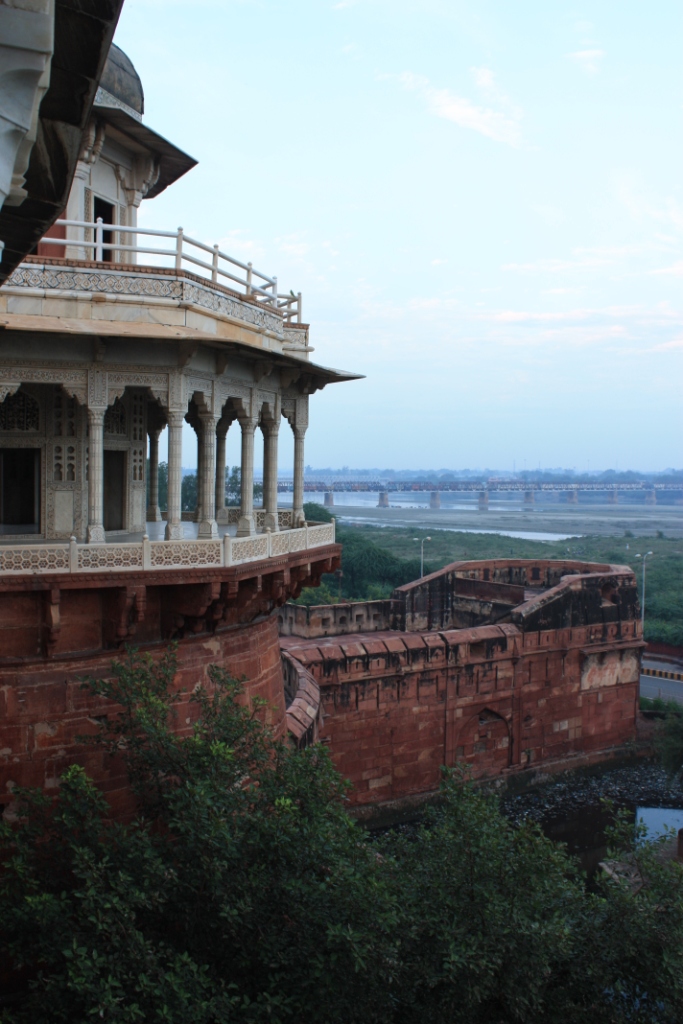
Taken on October 12, 2013 at Agra Fort.
The top of this tower is where Shah Jahan was imprisoned by his son, Aurangzeb–the latter being the 6th Mughal Emperor. The 5th Emperor’s “cell” offered a great view of the Taj Mahal, the monument that Jahan built to his wife, Mumtaz Mahal.
This just goes to show that just because one kills off one’s brothers who are ahead of one in line for succession, and imprison one’s own dad, doesn’t mean one has to be completely heartless.
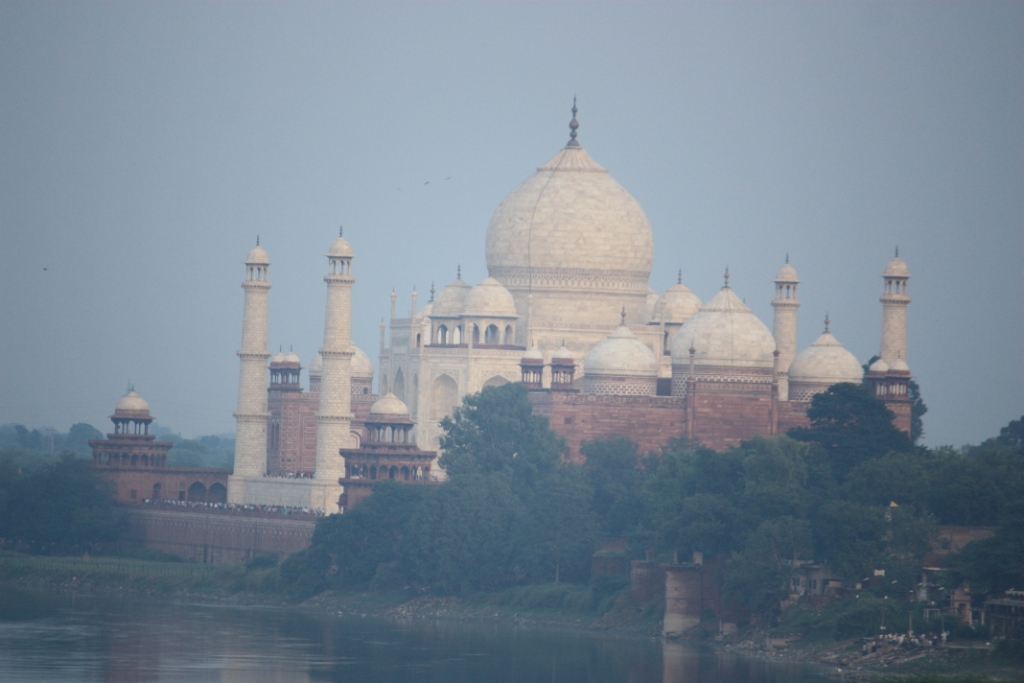
This is what Jahan would have seen– except from about one story up and a couple hundred feet to the left.
 The Color of Magic by Terry Pratchett
My rating: 3 of 5 stars
Amazon page
The Color of Magic is a hero’s journey tale done in comedic fashion. It’s the first book in Prachett’s disc world series. An incompetent wizard, Rincewind, becomes the guide to a goofy but wealthy tourist named Twoflower. However, as it happens the events that confront these two on their journey are part of a game being played between gods. I loved the humor, liked the story, but wasn’t a fan of the organization of the book.
I should admit up front that fantasy is–hands down–my least favorite genre, and I can’t say that view didn’t jaundice my perception of this book. However, it’s a testament to Pratchett’s humor and readability that I continued reading it.
What is my beef with fantasy in general? First, once one introduces magic, how does one maintain tension in an environment in which anything can happen effortlessly? Obviously, fantasy fans find plenty of tension to keep them reading, but I just don’t get it personally. I know that one retort is that the same could be said of other speculative fiction genres. To the degree that is true, I also don’t care for those other genres so much either. However, sci-fi (for example) has a basis for constraints that can be widely agreed upon. Second, the appeal of feudal society for setting perplexes me. I guess there is a certain romance to these periods for fans (perhaps because they imagine themselves in the statistically-unlikely role of king or knight as opposed to the much more likely position of serfdom, but whatever), but I see this type of society as backward and unsustainable (a ten millennia old kingdom maybe possible in a world of magic, but not in a world as we know it.)
I know fantasy fans will be able to come up with examples of how their favorite authors avoid both of the pet peeves mentioned. In truth, Pratchett does a good job of negating these pitfalls. With respect to the magic problem, he makes the protagonist wizard really inept and, therefore, easily in situations over his head. Simply put, he makes his lead weak relative to those confronting him. With respect to the setting issue, Pratchett creates an entirely different kind of world, the disc world. This is not Charlemagne’s Europe with wizards.
Prachett is often compared to Douglas Adams. In fact, if you Google “the Douglas Adams of fantasy,” you are sure to pull sites pertaining to Pratchett. One can see the same type of absurdist humor in Prachett’s work. Here’s a compilation of a few of my favorite lines:
“Being Ymor’s right-hand man was like being gently flogged to death with scented bootlaces.”
“No, what he didn’t like about heroes was that they were usually suicidally gloomy when sober and homicidally insane when drunk.”
“Yah. I outnumber you one to two.”
“He wondered what kind of life it would be, having to keep swimming all the time to stay exactly in the same place. Pretty similar to his own, he decided.”
“But the captain had long ago decided that he would, on the whole, prefer to achieve immortality by not dying.”
“Your affected air of craven cowardness does not fool me.”
Pratchett appeals to the downtrodden in all of us. This can best be gleaned from the tale of Goldeneyes Silverhand Dactylos. Dactylos is a superb craftsman who is blinded, has his hand cut off, and suffers ever greater indignities because the Emir wants him to never again produce anything as lovely. It’s like the myth about Shah Jahan having the hands cut off Taj Mahal craftsman, except Pratchett’s Emir keeps asking the same man of increasing handicaps back to construct ever greater marvels of engineering.
The book is arranged in just four chapters. This is a bit of an oddity for commercial fiction, and I don’t really care for the sparse employment of breaking points in this book. Again, if I was enough of a fan of fantasy to read this in a single sitting (or even a few sittings) I would likely not find this to be an issue. However, I read it over time and interspersed with many other books (a lot of which were more captivating to me personally.) This might seem like a ridiculously nit-picky point, but for those of us who have a lot of reading up in the air at once, being able to readily put a book down and pick it up seamlessly later without losing the story is of great benefit.
If you like humor, this book will appeal to you. If you like fantasy, I suspect you’ll doubly like it–as long as you have a sense of humor. If you don’t like either, this book will not be for you.


