My 2014: A Year in Review [w/ Photos]

2014 will be our first full year living in India. Having said that, I spent almost 50 days in Thailand, and Lilla and I will spend the last two weeks of the year in Hungary. So, in truth, I will have lived about ten months of 2014 in India.


The four months of 2013 that we lived in India largely involved acclimating and getting our feet under us, though we did see some important sights in India including the Taj Mahal, Delhi, Fatehpur Sikri, Hampi, Mysore, Belur, Halibidu, and Shravanabelagola.


2014 was an interesting and learning-intensive year, so I’ll review some of the year’s key happenings.


January:

From the 1st through the 18th, I was in Phuket, Thailand. Lilla and I spent the holidays there, and–upon her return to Bangalore–I stayed another couple of weeks training at Tiger Muaythai. Tiger is probably Phuket’s largest and most well-known Muaythai gym.  In addition to Muaythai classes, I took advantage of their broad class offerings to learn a little about Krabi Krabong, Muay Boran, Western Boxing, Mixed Martial Arts, Brazilian Jujutsu, as well as taking daily Yoga classes. I was particularly keen to learn about Muay Boran, MuayThai’s more combative ancestor art.

20140105_163231

While my training schedule (up to six hours / day, 6 days a week) didn’t allow for much sightseeing, I did get to see a little of Phuket Town and a couple of the beaches that Lilla and I skipped while we were traveling together. Phuket displays a lot of Chinese influence and there are many brightly colored Taoist, Confucian, and Chinese ancestral shrines and temples around Phuket Town. Rang Hill overlooks the island’s main “metropolis”, and I was able to take advantage of that vantage point. The beaches I visited were Karon and Kata which were middling between the two beaches Lilla and I visited together. That is, they weren’t as quiet and secluded as Naiharn, but neither were they as frenetic and overrun as Patong.

IMG_2015

February:

February was marked by two firsts. First, I began taking classes in Kalaripayattu two mornings a week. While this Indian martial art is far afield of the Japanese art I was raised on, I wanted to take advantage of living in India to learn something of the indigenous martial arts. One reason for my interest is the widespread belief that Indian martial arts—and Kalaripayattu specifically—are ancestors to many of the Asian martial arts–including the Chinese martial arts that are said to be predecessor to the Japanese arts I’ve studied. While I’m somewhat skeptical of that claim, I’m not in a position to altogether dismiss it. (I believe that in the face of combat, martial arts evolve rapidly to adapt to local conditions and needs. Also, I believe that ancestral arts continue to evolve as much as their off-shoots. Together this means that a martial art could look quite different from its ancestor in short order.)
20140220_085958


The reason I’ve kept training is that Kalaripayattu is an awesome workout. I see a two-fold strength in the art. For one thing, it builds bodily capacity. I mean one is able to leap higher, stretch farther, and endure more through the practice of this art. I’ve realized that the idea of a martial art solely as a means to ingrain movements that worked in the past is limited.  Another thing that the art does is help build a variety of fearlessness.  One has to throw one’s body around in a ways that can be intimidating, and one must build confidence that one will—like a cat—land on one’s feet. Further down the line, the metal weapons practice—choreographed as it may be—takes a special kind of inner calm. By “further down the line” I mean—as of this writing–I haven’t yet begun to learn weapons. I’ve passed through the first two levels and it’s been suggested that it might be time for the third test (though I’m far from skilled with some of the required jumps), but these levels are all unarmed.


The second activity I began in February was volunteering that the Don Bosco Mane Center, which is home and bridge school for young boys in central Bangalore. (A bridge school is a school used to prepare kids to go to regular public school, which is what they try to do a soon as possible, but some of the kids haven’t been to school and aren’t ready to leap in at the appropriate grade level.) BOSCO is one of the major charities working on children’s issues in Bangalore, and particularly in trying to intercept kids coming into the bus and train stations before the pimps and slavers get their hooks into them. They also run a help / reporting phone line.  If it’s possible, they try to get the kids back to their families, but if that’s unsafe or impossible the children live at one of the centers like Mane.


BOSCO also has a person trying to match kids to foster homes. Foster homes are a relatively new and undeveloped approach in India as compared to the West, but–as it’s a much better approach when it works—they’d like to see more of it. I volunteered here over the course of two months, before I started Yoga Teacher Training. Because I was only volunteering one day a week, and given the nature labor costs in India, they weren’t always sure what to do with me. Such a facility in the West would probably tend to be much more undermanned, but that didn’t seem to be so much the problem here as the challenge of funding and resources. At any rate, I have talked to the head priest about going back to teach martial arts and /or yoga. It was amazing to see how well-adjusted and respectful the kids were, given the hard life they’ve had.
 

March:

March wasn’t a big month for travel or new experiences. Lilla was in the middle of her busy season, and I continued learning Kalaripayattu and volunteering at BOSCO. Otherwise, I was writing or working out. I’ve been keeping my Gyokko-ryū koshijutsu and Kukishin-ryū jōjutsu training going as much as I can, and work on Muaythai as well.  As part of my yoga training, I started doing yoga with Lilla three mornings a week (this began in January or February), and—after going through yoga teacher training—this will become a regular class that I teach MWF from 7 to 8am. I attended about four studio sessions a week at a1000 Yoga in Indiranagar during March.
IMG_1278


We did take one long weekend trip at the end of the month. We went to Coorg and stayed a couple of nights at a coffee / tea plantation near Madikeri. We stopped along the way to visit the Namdroling Monastery, which is a Tibetan Buddhist monastery set up by exiled Tibetans in the early 1960’s. It’s one of the largest Tibetan communities in South India, and is the largest teaching center for the Nyingma sect of Tibetan Buddhism in the world. The monasterial campus was impressive.

IMG_1599


The serenity of the plantation provided a welcome respite from the horns and chaos of Bangalore. The Golden Mist Plantation is owned by a German who spends part of his year in Germany and part of the year in Coorg. Interestingly, they sell only organic products, which they largely export because organics are just beginning to catch on in India and not at the same scale as in Europe and other parts of Asia. The food was great, and—needless to say—the coffee and tea were fresh as can be.  We had a couple nice hikes in the Coorgi countryside, and I had authentic Coorgi pork—that’s a popular Indian dish from these parts.

IMG_1838


April:

April saw me begin my 200 hour yoga teacher training course (RYT-200) at a1000 Yoga. This course ran about 4 hours a day for five days a week through May 23rd.  The first hour and a half to two hours each day was yoga on the mat, and then we got into a broad range of subjects dubbed “theory” in the afternoon. These included yogic philosophy, Indian approaches to the body (chakras, nadis, granthis, kundalini, koshas, prantas, etc.), Western anatomy and physiology, and the historical development of yoga. The most unusual practice we learned was jala neti, in which one pours warm salt water in one nostril such that it drains out the other, cleansing the nasal passages. It wasn’t as bad as it sounds, and—given the dustiness of India—it’s a valuable skill to stave off sinusitis. Most of the course was about learning yoga, but the last week focused on learning about teaching.

IMG_1536


May:

The RYT-200 course occupied most of my time during this month as well. Even after the course ended on May 23rd, there were many requirements to be met and they all had to be documented. This included seva, which was charitable teaching requirement that we did at another of Bangalore’s (unfortunately) many orphanages.  This was a smaller shelter than the BOSCO center, and was run by an individual man rather than a large organization. Again, the kids were enthusiastic and well-behaved and made the process a happy one. I also had class observations to make as well as documenting my own teaching experiences from the guesthouse class and sadhana (my personal practice.)

IMG_1603


At the beginning of May, I completed a workshop in Tok Sen. Tok Sen is a Thai approach to massage that uses a mallet and a wooden chisel-shaped tool. While it sounds less than pleasant, it’s actually quite enjoyable. I had no idea what to expect besides that it was a Thai approach to body work that used wooden tools.

shoulder_work_on_me


Toward the end of the month there was a Kalaripayattu demonstration. This was the first time I’d seen the art practiced besides in Kalari sessions. Needless to say, it was much more acrobatic and stunning than day-to-day training. It featured many weapons, including the urumi, which is a four to six-foot flexible sword that old-time practitioners wore as a belt. Urumi demonstrations are about as edge-of-the-seat as one can imagine. While the demonstration is choreographed, the urumi is a severe injury waiting to happen. It requires the utmost attention on the part of both participants.

20140523_212734


June:

June was an intense month for my yoga practice. In addition to my own personal practice, which I was still documenting for my RYT-200 certification, I was attending 5 to 7 studio sessions per week. I was also able to do some refresher training with my Thai Yoga Bodywork teacher as he was running the Level I and II course in Bangalore, and I attended a few days.

IMG_0068


July:

In July I finally got my RYT-200 journal in and accepted, completing the requirements for a RYT-200 Yoga Teacher certification. Through the first half of the month, I was largely working on finishing up the last of the requirements and typing it all up into a 54 page account of my yoga life (not even double-spaced) since the courses beginning including my teaching, personal practice, observation of master teachers, etc.


We made our first trip to Kerala, another of the states in south India—bounding the Arabian Sea. We overnighted on a houseboat in the backwaters, got our first Ayurvedic massage, stayed at a resort in tea country, and toured the historic Malabar spice capital of Kochi (Cochin.) We were very fortunate with the weather in that we visited Kerala during the heart of rainy season, but stayed dry for the most part.

IMG_0178


Our houseboat stay was great. Our cook was skilled and the meals were outstanding. Chugging through the backwaters, I felt like a young Martin Sheen heading into the jungle to track down a rogue Army officer who became a cultist chieftain. Except that there was so much life and the ubiquitous Indian flare for color and sound. We got to see a snake boat crew in training, and saw so many colorful houses ornamenting the lush dikes—usually with verdant rice paddies as a backdrop.

IMG_0274

Ayurvedic massage was an unusual experience. It was the most oily I’ve ever been. Days later I felt a little like greased pig. It took place on a massive hardwood slab that had a channel carved through the middle to keep the oil from sluicing over onto the floor, an event that would cause the most skilled masseuse / masseur to slip fatally. The table looked a little like an autopsy table carved out of hardwood. It was a very impressive looking piece of furniture and not the least bit comfortable on one’s bony parts.


Munnar, amid the tea plantations, was green hill country and the low hanging clouds and vast expanses of tea bushes made it a scenic wonder. There were also some waterfalls in the area. It was misting part of the time we were here, which brought out the full jungle feel.

IMG_0565


Kochi is an enigma: ancient and modern, small but global. Its history is shrouded in the mists of time. It’s been an important center of commerce since who knows when. While trade with Arabs, Jews, and Chinese are all well-documented, it’s said that this port was familiar to the Greeks and Romans as well. When spice was king, Kochi ruled.

IMG_0977


August:

Lilla and I attended a yoganidra workshop this month. Yoganidra literally means “yoga sleep” and it’s a relaxation technique in which one maintains a state that is neuro-electrically like being on the edge of sleep. As you may know from visions that pop into your head right before sleep, those dreamlike random fragments that don’t make a lick of sense, this is a fertile state for the subconscious mind.


My second visit to Thailand took place in August and September. I left out on the August 20th and returned on September 17th.  From the 20th to September 3rd, I was training at the Muay Thai Institute (MTI) in Rangsit, Thailand. This involved training four hours a day—i.e. two 2-hour sessions. Unlike Tiger, which offered a wide range of classes, MTI specializes in Muaythai and all my training time was devoted Muay Thai. (At Tiger I generally trained one Muay Thai session per day and one other session in boxing, grappling, or muay boran.)  I was in the freestyle tract, and had a well-rounded experience of footwork drills, bagwork, pad drills, shadowboxing, and a bit of sparring.

IMG_4881


While I was training at MTI, I took one day trip with other trainees to play paintball, ride ATV’s, and go rafting. This also involved stops at a couple of temples at Ayutthaya, one of which I’d visited on my 2012 trip and another which was new to me. The one I’d visited before is Wat Mahathat, which famously appears in Jean-Claude Van Damme’s Kickboxer movie.  Wat Mahathat is particularly famous for a Buddha head that’s enveloped by Strangler Fig roots.

20140825_134351


I also took a boat trip around Koh Kret, which is an island in the middle of the Chao Phraya River—i.e. the river that runs through Bangkok. Koh Kret has a popular market and is known for certain unusual street foods like fried flower petals.  The only other place I visited during training was the J.J. Market, Bangkok’s sprawling weekend market where one can buy everything from pets to artworks to cheap tsotchkes to Louie Vattan (that’s how it’s spelled there) purses to street food. I’d been once before in 2012, but still got lost in its maze-like corridors packed with goods.

IMG_1360


September:

After I finished my second training week at MTI, I moved into Bangkok to a guesthouse in Chinatown.  This was a short walking commute to the Wat Po Thai Traditional Massage School where I completed the General Thai Massage course and the Foot Massage course. These courses were each 5 days long, and the first one is a prerequisite for just about everything at the Wat Po School.

IMG_2074


In the morning I would work out in one of two nearby parks frequented mostly by elderly fitness-buffs doing tai chi, chi gong, takraw, or Jianzi (the latter two being hacky-sack like games played with a woven ball [Thai] or a feathered weight [Chinese], respectively.)  On several occasions I went to the Thai Yoga (Russi Dutton) classes that were run inside the temple grounds. Then I would go to class for the day. The General Thai Massage sequence was gradually taught by parts defined by position (supine, side, prone, and seated), and it was not so different from the Chiang Mai style I’d learned in Bangalore. With the Foot Massage course, we began doing the entire sequence from the very outset, which meant one got to practice it about 10 times over the course of the five days.

GeneralThaiMassage2


I was glad to visit Wat Po this time, as it’s the most important Bangkok sight that we missed during our 2012 visit. I also made it across the river to Wat Arun. I also made a trip across the river to a popular seafood restaurant on the edge of town with a group of fellow students from my General Thai Massage Course. With the same of Thais and Germans, I had dinner at the top of the tallest building in Thailand, the Baiyoke Tower.

IMG_1634


After I returned to Bangalore, there were two small events of note. I attended a function for the children at the KAMMS put on by Lilla’s firm, Grant Thornton, which is the third youth shelter /orphanage I’ve visited. This was the largest group of kids I’ve seen, because, unlike the other shelters, it was both genders and a wide-ranging age group. Again, the kids were very pleasant to be around.

IMG_1668


I attended another Kalaripayattu demonstration. This one was out of town at the Kalari Gurukulam, which is the parent school to the Kalari Academy where I’ve been attending classes. This would not be noteworthy except that I was briefly interviewed by a Canadian film crew who were making a documentary about old martial arts in Asia. They’d previously interviewed the Master of Bokator in Phnom Penh, and were making their rounds through the rest of Asia. (I almost visited that same school in Phnom Penh in 2012, but our limited time didn’t allow it. There was a time when it looked like moving to Cambodia might be a possibility.)

IMG_2246


October:

The big event in the month was our 20th wedding anniversary.

IMG_4492


Our big trip this month was to Mysore for the Dasara festival. We took the train, our first Indian train ride. Mysore is a city that’s only about an hour and a half away from Bangalore.  While it’s much smaller than Bangalore, it’s also more popular with tourists and travelers than Bangalore because of its history as a long-standing capital of the Wodeyar Kingdom and as a global center for yoga. It’s a yoga mecca because it was the home of T Krishnamacharya, who was the guru to some of the most famous yogis of the modern era, including B.K.S. Iyengar, Indira Devi, Pattabhi K. Jois, and T.K.V. Desikachar. Pattabhi Jois, founder of the Ashtanga Vinyasa style of yoga, also lived in Mysore and ran a school there until he passed away in 2009.

IMG_1714


Anyway, Dasara is huge in Mysore. They celebrate all 10 days with various events around town. However, the processional and the torchlight parade on the last day are the major draws, and we had seats for both of those events. For the processional we were right up front at the start of the parade route. For the torchlight parade our seats were not as great, but close to the front. We revisited the Zoo, which this year was rated the best in India by a TripAdvisor survey. There was flower show in progress for the festival.

IMG_2111


I attended a 10-day Advanced Hatha Yoga workshop that focused on building the capacity to do challenging intermediate and advance yogasana (postures.)


November:

I did a couple of sessions of intern/assistant teaching of corporate yoga for a1000 yoga, and will do some more after the beginning of the New Year.


Lilla and I went to a talk on philosophy which introduced me to an organization near our home that we were completely unaware of called the New Acropolis. It’s a school of practical philosophy. This led me to sign up for their introductory course, which takes place every Tuesday night. The class covers a wide range of topics in the domain of practical philosophy. (By practical philosophy, I mean philosophy geared toward substantively improving oneself, as opposed to sitting around staring at one’s navel and bemoaning our inability to know whether anything is real or whether we are all heads floating in vats.)  As of this writing, I’ve attended three of the first four sessions (I was in Maharashtra for one of the classes) and have found it to be a fascinating experience.


As you may know from my recent posts, this month I traveled to the Indian state of Maharashtra. Lilla and I were going to Mumbai to visit a relative, and I decided to take advantage of the relative proximity to visit the Buddhist caves at Ajanta and Ellora. The caves are among the most important archeological sites in India, but are out in the boondocks, and so they aren’t as well-known as, say, the Taj Mahal. However, in their own way I would rate them—as I do Hampi—as far more impressive than the Taj. A city of about 1.2 million, called Aurangabad, was my base from which to visit the caves. Aurangabad has a few sights of its own, most notably a copy of the Taj Mahal that is from the same era. Aurangabad also has its own set of caves that are nowhere near as extensive as the ones at Ajanta and Ellora, but are worth a visit, and it has remnants of fortification from the days when it was Aurangzeb’s capital.

IMG_0310


December:

Because the last graduation date occurred while I was in Thailand, I attended the graduation to get my RYT-200 certificate.

IMG_1584


We have one more trip for the year. Lilla and I will be traveling to Hungary in the middle of the month and will be there through New Year’s Day. We last visited Budapest in the summer of 2011, and haven’t been there in the winter since 2008. We haven’t experienced seasons, in the conventional sense, for a year and half–so that’ll be interesting.  (Bangalore has two seasons, rainy and dry, and even those can be muddled, as they were this year.) While I’ve been to Hungary many times, I hope to see some new sights this time, including a possible trip to Pécs, which will be my first Hungary trip south of Balaton. There are also some quirky Budapest locations listed on Atlas Obscura that I’d like to check out.

Skating_rink


The Upcoming Year:

I hope to do some new and interesting things in the upcoming year as well. Probably the oddest activity for the year will be attending the Vipassana Meditation Course. It’s 10 days on the outskirts of Bangalore with no books, notebooks, or electronic devices of any kind, and during which my only interaction with other people will be daily meetings with a teacher. It’s meditation all day every day for 10 days straight. From accounts I’ve read it’s an amazing or insanity-inducing experience.


Writing: The past year hasn’t been as productive as I’d like on the novel front. As I mentioned, I’ve traveled quite a bit and had major time commitments on the Yoga Teacher Training front. A fragmented life disagrees with novel writing because novels are long and fictional, so if you get away from it for any length of time you have a lot of reacquainting to do when you come back to it. If you’ve ever put a book you’re reading down for a month and had trouble getting back into it, multiply that by 100 and you’ll know the challenge of doing the same for a book you’re writing—so many details for which continuity needs to be maintained.  I tossed my first to chapters out entirely and rewrote them from scratch, having to update the rest to accommodate the new beginning. I’ve hemmed and hawed for days over certain plot points and devices.


Having said all that, I’m converging on a product that I’ll be ready to submit sample chapters to agents from in 2015. Most of the points that have been giving me problems are worked out as well as I think they are likely to.


I’ll do some revamping of my website, part of which I’ve already begun.


Martial Arts:  I expected that the jumping-intensive level of Kalaripayattu would be the end of that martial art for me. I’m not built for leaping. However, having cut some weight and built my fitness, I’ve found that my old body has taken the acrobatic craziness surprisingly well. So I’ll continue taking classes at the Kalari Academy as long as my body holds up.

IMG_1226


I plan to check out another martial art as well. There are a number of Muaythai places in Bangalore, and I may see if any of those work for me.  I don’t have any plans to travel to Thailand in the upcoming year, but—if I do—I’ll make sure to squeeze in some Muaythai.  (Actually, wherever I go I’ll try to squeeze in some of the indigenous arts.) Alternatively, there are Krav Maga classes offered at the New Acropolis, and that would be convenient to check out.


Yoga: I’d originally planned to do the 300-hour course that would complete my RYT-500 certification, but it doesn’t look like it will work with my travel schedule. However, I do intend to continue my studies, and—in particular—may pursue specialty teacher training courses in Children’s Yoga and /or Prenatal Yoga. There are also some intriguing workshop opportunities in Ashtanga Vinyasa and Iyengar Yoga (props yoga.) I may even try out the yoga in Mysore.

Natarajasana_Hatha_side

I’ll continue to teach my MWF courses as long as there is interest and will maintain my own personal practice. Also, I’ll try to do some interning / teaching of corporate yoga classes.


Travel: We don’t have any specific trip planned past our December Hungary trip, but we’re sure to see some fascinating places in 2015.


It looks like I may have to make a trip to the US during the summer time-frame. However, if I don’t have to take care of business with the house, I’ll probably stay in Asia and visit some other country—possibly Burma. Lilla and I are planning to make a trip to the Himalayas sometime during the summer. This may involve a trip to Amritsar (location of the Sikh Golden Temple) in conjunction with visiting McLeod Ganj / Dharamsala (home of the Dalai Lama and the Tibetan government in exile) and Shimla or Ladakh or other Indian portions of the Himalayas. Alternatively, we may go to Nepal.


Among the Indian locations that remain on our list to see are Khajuraho, Varanasi, Pondicherry, Hyderibad, Chennai (with Kanakapura), Kolkata, and Darjeeling. That’s not to mention countries nearby that we’d like to visit while we’re here like Burma and Sri Lanka. It’s unlikely we’ll pack all that in to 2015, but hopefully we can make a dent in it.


Well there’s my 4,500 word narcissism-fest, but it has pictures.

BOOK REVIEW: The Hindu-Yogi Science of Breath by William Walker Atkinson

The Hindu-Yogi Science Of BreathThe Hindu-Yogi Science Of Breath by Yogi Ramacharaka

My rating: 3 of 5 stars

Amazon page

I got this book as a Kindle freebie. It’s made available for free because it’s in the public domain, not necessarily because it was so bad that the author couldn’t even get people to pay $0.99 for it. It was written by an American named William Walker Atkinson, who also went by the pseudonym of Yogi Ramacharaka. Atkinson was an American who lived in the latter 19th and early 20th century, and authored more than 100 books. If you’re wondering why you’ve never heard of an author this prolific, it’s in part owing to his love of nom de plumes and the fact that he dodged the spotlight.

This book is short—less than 100 pages—and is organized into 16 chapters. The early chapters provide background for an audience that would’ve been fairly unaware of yogic practices, and the latter chapters are more along of a how-to book—giving instructions on various yogic breathing techniques. The first part of the book also tries to discuss the science of breath in terms of anatomy and physiology, but in layman’s terms. All in all, the book’s organization is logical.

This book’s readability is not bad, considering its era. However, it is 19th century writing, and so sentences can be long and tortuous by present-day standards. In the instructional parts, he uses bullet pointing to explain sequences.

The book runs into some problems, in my opinion, by trying to explain breath both in terms of modern science and yogic physiology. Imagine the story of the creation of the universe being told simultaneously in terms of the big bang and the Biblical account. These explanations are at odds, and any attempt to merge them into an integrated explanation will convolute the principles of one system or the other. Furthermore, explanations of respiratory and nervous system operations from Atkinson’s day are a bit out-of-date.

I would recommend this book for someone who has a scholarly interest in yoga and how it came to be introduced to the West. I can’t say that I would recommend it for its originally intended purposes of putting pranayama (breathing techniques) in the context of Western medical science or teaching the techniques of breathing. There are better books for the former (e.g. Coulter’s Anatomy of Hatha Yoga, chapter 2—though this is a much more technical account), and a teacher is needed for the latter. If one is an intermediate (or above) student of pranayama, then experimenting with Atkinson’s methods may prove interesting. However, from what I could read, it’s not clear where Atkinson learned pranayama. The fundamentals (e.g. abdominal, thoracic, and yogic breathing) seem sound, but there are other techniques that are unfamiliar to me and seem a bit unconventional. I can’t vouch for whether these are things I haven’t learned or whether Atkinson got them wrong. However, mostly there is just not enough information to communicate the fine points of the practices, and practicing pranayama is not without its risks.

View all my reviews

BOOK REVIEW: Yoga Mala by Sri K. Pattabhi Jois

Yoga Mala: The Seminal Treatise and Guide from the Living Master of Ashtanga YogaYoga Mala: The Seminal Treatise and Guide from the Living Master of Ashtanga Yoga by K. Pattabhi Jois

My rating: 4 of 5 stars

Amazon page

Yoga Mala is a guide to yoga by one of the most influential yogis of the modern era, Sri K. Pattabhi Jois. Sri Jois, who passed away in 2009, developed an approach to Hatha Yoga that is alternatively called Ashtanga Vinyasa or Ashtanga Yoga. Herein, I will use the term Ashtanga Vinyasa to represent Sri Jois’s style of yoga, which relies on a fixed sequence(s) conducted with vinyasa, i.e. flowing transitions that link postures. The reason I chose one term over the other is that the term “Ashtanga Yoga” long predates Jois and is a more generic name for the practice of all eight limbs of yoga as described in Patanjali’s Yoga Sutras.

Having mentioned the “eight limbs of yoga,” it should be noted that this book really only gets into half of them: yama (rules for interacting with others), niyama (rules for conducting oneself), asana (poses), and pranayama (breath exercises.) Furthermore, three-fourths of the book’s pages are devoted to asana. This is not unusual as many yogis consider it a waste of time delving into the higher level practices (pratyahara [sensory withdrawal], dharana [focus], dhyana [meditation], and samadhi [liberation] with individuals who haven’t yet made headway into the more fundamental practices.

After brief discussion of yama, niyama, and pranayama, Yoga Mala launches into description of the postures of the Ashtanga Vinyasa preliminary series. This begins with the two variants of the Surya Namaskara (Sun Salutations) practiced in Ashtanga Vinyasa and progresses through the poses of the standing, seated, and finishing sequences in the order in which they occur in the Preliminary Series. There are clear black and white photos of the optimal version of each asana. The written descriptions explain the entire set of vinyasa for that asana—i.e. the flowing transitions that connect one pose to the next. Most asana have a header paragraph that tells how many vinyasas are associated with the pose and which vinyasa constitutes the asana proper. This opener is followed by a “Method” section that lays out the vinyasa in detail, and—in many cases–a “Benefits” section that explains what the posture is said to do for one–and occasionally what major the contraindications are. (However, this is a poor reference for contraindications as it mostly only says what pregnant women shouldn’t do and doesn’t get into much detail beyond that.)

There are a couple of things that I think could have been improved—mostly formatting / editorial critiques. The first is that the text increasingly lags the photos so that one has to flip forward several pages to view the associated photos. Also, the author often refers to a movement through a position using the numbering system of an earlier set of vinyasa, and this necessitates a lot of flipping back and forth. For example, the instructions often say “then go to the 4th vinyasa of the first surya namaskara sequence” whereas if he said “then do chataranga dandasana [or low plank]) they would have saved words and obviated need for the back and forth.

Sri Jois was very devout man. For those of a similar mindset, you’ll likely find the book resonates. However, if you’re the kind of person who prefers explanations rooted in a logical or scientific approach, then you may find explanations a bit summarily invoked for your tastes. In other words, he’s prone to say, just do what the Vedas and your teacher tell you and everything will be rosy. I don’t know that this is a critique so much as fair warning. If you think that the Vedas were divinely written by infallible authors, then Jois’s approach may sound good to you. However, if you think that the Veda’s reflect the biases and limited knowledge of another era (just like our present writings reflect our current biases and limitations), you may find a few comments suspect. For example, Sri Jois makes a point of saying that the Vedas state that one can do a headstand for three hours straight without adverse effects. (To be fair, he does point out that you must do it properly and under the supervision of a teacher.)

If you practice Ashtanga Vinyasa, or intend to, this is a must-read book, but it’s a useful book for those who practice Hatha Yoga of other styles as well. It’s a good summary of classic asana, and you may find something in Sri Jois’ explanation of yama and niyama to be helpful to you on your personal path.

I should point out that those who aren’t sure whether they want to practice this form should be forewarned that Ashtanga Vinyasa is an intense practice. The vinyasas require a high level of core strength as well as upper body strength for Uth Pluthi (lifts) and vinyasa motions requiring that one load all one’s bodyweight onto one’s arms. Also, the fact that one is doing the “Preliminary Series” shouldn’t falsely lead one to believe that these are all the “easy” asana. That isn’t the case; there are a number of challenging poses both in terms of flexibility and strength requirements. If you haven’t done yoga before, I would only suggest Ashtanga Vinyasa for those who have a fairly high fitness level.

View all my reviews

DAILY PHOTO: Swami Vivekananda in CMH Park

Taken on October 25, 2014 in CMH Park, Indiranagar, Bangalore.

Taken on October 25, 2014 in CMH Park, Indiranagar, Bangalore

Swami Vivekananda is one of India’s most famous yogis, though he lived only to the age of 39 and died about 112 years ago. Considering his short life, he was quite prolific and wrote a number of important texts on yoga. He was also instrumental in introducing yoga to the Western world. He was the chief disciple of Ramakrishna, and founded the Ramakrishna Maths and Missions. His name and image are ubiquitous throughout India.

BOOK REVIEW: Your Brain on Yoga by Sat Bir Khalsa

Your Brain on YogaYour Brain on Yoga by Sat Bir Khalsa

My rating: 4 of 5 stars

Amazon page

This Harvard Medical School Guide presents the findings of many scientific studies on the benefits of yoga, and it does so in a manner suitable for the layman. The book is written by Dr. Sat Bir Khalsa, a long time practitioner of Kundalini Yoga and a neuroscience researcher at Harvard, and is co-authored by a science writer trained in journalism.

I became aware of Khalsa’s work when reading William Broad’s The Science of Yoga, a book that is complimentary of Dr. Khalsa and his studies—a favor which Khalsa doesn’t return as he rejects Broad’s work as being overly sensationalist. The book does talk about Khalsa’s research, such as a study with young musicians at Tanglewood that examined how the practice of yoga increased their equanimity. That said, this isn’t merely a summation of Dr. Khalsa’s work. It’s what in academia would be called a literature review, but “literature review” implies a far more dismal reading experience than one gets from this book. It does present anecdotes in a way that is useful for a layman’s book, but would not be well-respected in an academic setting. This work isn’t designed for medical colleagues but rather to be of benefit to run-of-the-mill yoga students and teachers.

This is a very short book at only about 50 pages. The book consists of five chapters after an introduction which sets the stage and gives some relevant background on Dr. Khalsa. Chapter one delves into the effect of stress on the body and mind, and how yoga (and meditation more generally) has been shown to help counter the effects of bad stress (not all stress is inherently bad, as is addressed in the chapter.) Chapter two examines the effect of yoga on the body and in countering a number of common ailments. The third chapter considers how yoga might actually help one to be smarter and more creative. Chapter four presents the results of studies of how yoga can counter depression and improve one’s mood. Chapter five is in a different vein, and might well have been included as an appendix. The last chapter gives an overview of the various types of yoga to assist readers new to yoga on what style might best meet their needs and disposition. This is a nice feature for those new to yoga, but also for veteran practitioners who’ve practiced one style and might not be aware of the wide range of styles out there. (A few of the styles mentioned are popular in India, but I don’t think are as well-known in the West.)

For such a thin book, this work covers a wide range of topics including–but not limited to–the effects of yoga on sleep, the immune system, neural plasticity, memory, math skills, and mood. A nice feature of the book is a series of brief exercises that one can practice to help reduce stress or achieve a desired goal. These practices are generally located at the end of chapters. Finally, while this book isn’t written primarily for doctors and other scientists, it’s endnoted so those interested in tracking down the studies the book references can readily do so.

I’m a big fan of applying a scientific approach to the study of ancient methods such as yoga. I would, therefore, recommend this book for yoga teachers and students who are interested how precisely these practices can assist them. It’s extremely short and easily digested. It’s in no way overbearing with medical jargon and is readily understood by anyone with a basic education in biological science.

View all my reviews

BOOK REVIEW: The Heart of Yoga by T.K.V. Desikachar

The Heart of Yoga: Developing a Personal PracticeThe Heart of Yoga: Developing a Personal Practice by T.K.V. Desikachar

My rating: 5 of 5 stars

Amazon page

This book’s author, T.K.V. Desikachar, was the son and student of T. Krishnamacharya. If you’re not a well-read and/or Indian yoga practitioner, there’s a good chance the latter name means nothing to you, and yet your practice has likely been influenced profoundly by him. He was the teacher of B.K.S. Iyengar, Pattabhi Jois, and Indira Devi. Iyengar, who recently passed away, popularized the use of props (blocks, straps, bolsters, etc.) as a means to achieve proper alignment until one’s flexibility was sufficient to achieve perfect alignment without assistance. Jois developed the vigorous and flowing Ashtanga Vinyasa style of yoga, which is the direct ancestor of Power Yoga—a popular style among fitness buffs in the West. Indira Devi was a Westerner actress who took an Indian name and was among the first teachers to introduce yoga to America and to adapt it to American needs. While Desikachar wrote the book, his father’s presence is seen throughout the book in photos and quotations.

After reading the book, it will not come as quite the surprise that T. Krishnamacharya was teacher to several of modern yoga’s most innovative teachers. A central concept of Krishnamacharya’s teaching philosophy was that yoga is a personal path that must be optimized to the individual. That’s what this book tries to do. Its aim is not to teach one yoga for all, but to help individuals tailor yoga to their own needs.

The Heart of Yoga is divided into four parts. The first two parts form the core of the book, and make up the bulk of its length. The first introduces yoga at a basic level and then goes on to impart practical lessons on asana (poses), pranayama (breathing exercises), and bandha (locks.) The second part instructs on the philosophical aspect of yoga, and how an individual can bring these concepts into their life. This includes ideas that are traditionally associated with Yogic philosophy as well as those of Samkhya (Yoga and Samkhya are two of the six orthodox schools of Indian philosophy, and are closely related.)

Part III of Desikachar’s book is his translation of Patanjali’s Yoga Sutras with commentary. Some will appreciate that the sutras are written in Sanskrit, a Romanized phonetical Sanskrit, and in English. In addition to this, Desikachar’s commentary not only elaborates on each sutra individually, but offers insight into how they are grouped and what meaning their organization conveys. For those who have read Yoga Sutras, you’ll know that they consist of 196 lines of instruction, each so laconic as to be cryptic. Commentary is essential, particularly if one is reading the translated sutras and doesn’t have the historical, cultural, or linguistic background to distill the meaning from these mega-concise aphorisms.

Part IV is called the Yoganjalisaram, which is a poem of 32 stanzas each consisting of three to six lines. “Poem” might be a misleading description. Each Sloka (i.e. like a stanza) is a lesson in yoga. It touches on diet, physical technique, philosophy, and religion.

In addition to what I thought were well-written, concise, and informative chapters, there are a number of ancillary features that are beneficial. There’s an appendix that describes some of the prominent historical texts that are commonly referred to throughout the book. Another appendix provides a series of asana sequences that are consistent with the teachings of Part I of the book. There is a glossary of terms that are used throughout the book. Up front there is an interview with T.K.V. Desikachar that deals mostly with his father’s approach to yoga. In addition to the many photos of Krishnamacharya, simple line drawings are put to good use to convey ideas where necessary.

I think what I found so appealing about this book is that the author has a pragmatic, down-to-earth, and open-minded approach to yoga. Some yoga books are way out there in the stratosphere, and their ethereal qualities don’t inspire confidence in me that the author knows of what he/she speaks. Others are doctrinaire about absolutist beliefs and values one “must” hold to be a true yogi or yogini. Desikachar is neither an ideologue nor flighty. He may have benefited from his education as an engineer. His lessons are presented simply and practically, so as to give confidence that he knows of what he speaks.

I’d recommend this book for any practitioners of yoga–be they beginner or advanced. It provides food for thought for bringing yoga into one’s life at a physical and psychological/philosophical level, and in a personal way.

View all my reviews

BOOK REVIEW: The Bhagavad-Gita Translated by Barbara Stoler Miller

The Bhagavad GitaThe Bhagavad Gita by Anonymous

My rating: 4 of 5 stars

Amazon page

The Bhagavad-Gita is a philosophical poem, the title of which is translated as “Song of the Lord.” It’s often read as a stand-alone work, but it’s included in the sixth book of longest known epic poem, entitled the Mahabharata.

In The Bhagavad-Gita, Krishna teaches the warrior-prince Arjuna about sacred duty (dharma.) The setting is the battlefield at Kurukshetra as a war is about to get underway. Arjuna asks his charioteer, Krishna, to halt the vehicle between the opposing armies. Arjuna is struck with a crisis of conscience. He doesn’t want to fight and kill the men on the opposing side–some of whom are related to him by blood and others of whom are well-respected elders. Arjuna can see no virtue in the war.

Krishna, after briefly mocking what he describes as Arjuna’s newly developed cowardice, goes on to offer his explanation of why it is that Arjuna should fight. The first argument is that nobody really dies because consciousness is reborn. This makes sense if you believe in reincarnation… otherwise, not so much. A concise restatement of this argument is presented in the 11th teaching: “I am time grown old, creating world destruction, set in motion to annihilate worlds; even without you, all these warriors arrayed in hostile ranks will cease to exist. Therefore, arise and win glory! Conquer your foes and fulfill your kingship! They are already killed by me. Be just my instrument, the archer at my side!”

Another of Krishna’s argument is that if Arjuna fails to fulfill his duty he will be thought less of by others. This is an odd argument to make as Krishna makes a more compelling case for ridding oneself of ego, whereas this seems to be saying that one should put what others think of one above doing what one believes is right. That sounds a lot like succumbing to ego rather than eliminating. In the 12th teaching, in fact, Krishna tells us that the best of men are “Neutral to blame or praise…” This suggests that perhaps one shouldn’t be moved by what others will think of one.

At the core of Krishna’s argument is that one cannot escape the Karmic cycle by engaging any acts but those that are selfless. Like the reincarnation argument. One may find this logic compelling or not depending upon whether one believes in Karmic theory. Karma is the idea of cause and effect. If you do good, you’ll receive good effects and if you do bad you’ll experience bad effects. Ultimately, however, the goal is to break free of the Karmic cycle and, in theory, the only way to do that is to engage in acts that are selfless—hence doing your sacred duty. If your driver isn’t God, it’s not entirely clear how you know what your sacred duty is, at least not by way of this work. (Presumably, God talks to kings and princes, and kings and princes tell the unwashed masses what they are supposed to do. If you happened to have already done away with such a system—as most of the planet has—you may have trouble with this logic.) However, if one takes the lesson to be that one should not be consumed with personal gain when one acts, one has an argument of more general appeal.

Another argument is that devotion to God is all important, not a man’s actions in any absolutist sense. From the 9th teaching, “If he is devoted to me, even a violent criminal must be deemed a man of virtue, for his resolve is right.”

It should be noted that Krishna delivers a number of lessons beyond the need to comply with one’s dharma, and, in my opinion, many of these ancillary lessons are more compelling than Krishna’s explanation of why Arjuna must fight.

One such lesson is to concern oneself with the journey and not the destination. Krishna states it as such, “Be intent on action; not the fruits of action…” Furthermore, there are a great many teachings that will be familiar to Buddhists, such as the need for non-attachment and moderation.

The poem contains lessons of Samkhya (e.g. discussion of the three gunas) and Yoga. It describes concepts from the three original forms of yoga (predating yoga as a fitness activity by centuries): those being of action yoga (karma yoga), knowledge yoga (jnana yoga), and devotional yoga (bhakti yoga.) While The Bhagavad-Gita predates the formulation of eight limbs of yoga as described by Patanjali, it does address certain among them in varying detail. Early on, it speaks about pratyahara—withdrawal from the senses—in considerable detail. There are also references to pranayama (breath/energy control exercises) and most of the yama and niyama are listed among the virtues in the latter part of the teachings. Of course, samadhi (liberation / yoga’s 8th limb) is a central concept in this work.

While The Bhagavad-Gita remains widely cited and relied upon for guidance to this day, it’s not without its controversial elements. In the fourth teaching, Krishna explains how he created the caste system. Of course, Krishna might not have intended it to be the stain it became.

The Miller translation that I read has a few nice ancillary features. There is an introduction that offers background and context for those who have little knowledge of Indian history or mythology. There’s also a glossary that goes into detail about terms that are frequently used in the work. It’s not that there are Sanskrit words mixed into to the text. The glossary explains what the English words should be taken to mean in the context of the Hindu worldview.

What is most intriguing, however, is the afterword which is entitled, “Why Did Henry David Thoreau Take the Bhagavad-Gita to Walden Pond?” Of all the thinkers that have cited The Bhagavad-Gita, the use of Thoreau and Emerson as examples raises intriguing questions. The Thoreau of Civil Disobedience and the Emerson of Self-Reliance would seem to be as far from the message of The Bhagavad-Gita as possible. Krishna is telling Arjuna to ignore his conscience, and just do what God tells him to do—be a selfless instrument of destruction. Thoreau and Emerson both preached that one’s conscience should always be one’s ultimate guide. Thoreau went to jail because he refused to pay taxes that would support the war with Mexico. I suspect Krishna would say to Thoreau, “Hey, I’m throwing this war, and you’d damn well better do your part.” However, there are ideas in The Bhagavad-Gita that work with the American Transcendentalist philosophers. The idea of removing self-interest and egotism as a way to eliminate delusion before one makes one’s own decision is a consistent suggestion.

I have mixed feelings about The Bhagavad-Gita. Like many (most?) sources of religious doctrine, I think the central message of The Bhagavad-Gita is just another means by which to keep the masses under the control of an elite—and, specifically, fighting the wars of the royalty. However, I–like Thoreau and Emerson—also see a great deal of insight into how to be a better person in this poem.

I think The Bhagavad-Gita is worth a read, regardless of how you may ultimately feel about its message. It offers a concise summary of key ideas in Indian philosophy and psychology. It will give one a better understanding of the Indian worldview, and may teach you something about how to live in the process.

View all my reviews

Thai Yoga & Hatha Yoga: Compare and Contrast

During my recent trip to Thailand, I attended Thai Yoga (a.k.a. Rusie Dutton, i.e. “ascetic exercises”) classes at the Wat Po Temple. As a yoga practitioner, I took note of the similarities and differences between Thai yoga and the Hatha Yoga of India. It’s no surprise that Thai Yoga would display the influence of India. Indian influence from olden times can be seen throughout Thailand. The roots of Thai Massage (a.k.a. Thai Yoga Bodywork or Nuad Bo Rarn) itself are attributed to Shivago (also, written/pronounced Chivako), a north Indian doctor in the Buddha’s community of followers.

One can plainly see the influence of Hatha yogasana (postures)  in these Thai exercises, but the details vary. I’m interested in how movement systems (e.g.  martial arts) with a common ancestry diverge over time in response to the unique needs of a different culture. I believe that not only the new system evolves, but there’s also a continuing evolution in the original line. One can, therefore, end up with systems that look little alike over the course of several generations.

The degree to which the Thai Yoga poses vary from Hatha Yogasana varies. In the Thai Yoga class we did a simple lateral bend with interlocked fingers that was identical to a  Sivinanda Yoga pose named tiryaka tadasana.

Lateral Bend (tiryaka tadasana)

Lateral Bend (tiryaka tadasana)

Balancing poses made up much of the Wat Po Thai Yoga sequence. This makes sense as the course was aimed at practitioners of Thai Massage and balance is important in this massage system because there are techniques that involve standing on one foot as one applies pressure with the other fort or in which one must stand to apply stretches. (Obviously, it’s bad for business to step on the recipient in an uncontrolled fashion or to topple onto them.) There were poses that were reminiscent of Natarajasana (Shiva’s Dancer pose), Vrksasana (tree pose), and Utthita Hasta Padangusthasana (hand to big toe pose). Each of these varied in the details. The most prevalent Thai variation was bending the support leg to lower one’s center-of-gravity. In Hatha Yoga, it’s usually taught to keep the support leg as straight as one can manage (this both contributes to the stretch and can prevent loading the tendons.)

NATARAJASANA: There were two variants of this pose practiced at Wat Po. Both folded the torso more forward than one would typically see in Hatha Yoga, as well as bending the support leg more.  The first version (palm on front knee) is as such:

Version 1 from Thai Yoga (Palm on Knee)

Version 1 from Thai Yoga (Palm on Knee)


The second version has the front hand up in a manner similar to the Hatha version, but the torso isn’t kept upright and the support leg is deeply bent.

Thai Version 2 (hand out front)

Thai Version 2 (hand out front)


In contrast, the Hatha version is more upright.

Natarajasana

Natarajasana


VRKSASANA: There are two variants of tree pose in the Thai Yoga. In both the ankle is kept on top of the thigh and the support leg is bent. Version one is as follows:

Vrksasana1_Thai_Front

Version 1 begins and ends in Pranamasana (hands in prayer pose) With hands out to the side in between.

Version 1 begins and ends in Pranamasana (hands in prayer pose) but hands are taken out to the side in between


Version 2 includes a wrist stretch with the balance pose. One puts fingers on thigh facing upward and the squat folds the wrist back.

Version 2 with wrist stretch.

Version 2 with wrist stretch


The Indian version:

Vrksasana_hatha_front


UTTHITA HASTA PADANGUSTHASANA: There are also two variations of this pose. Note the bending of the support knee. Version 1 holds the foot with the same side hand and places the opposite palm on the knee.

Version 1 from front

Version 1 from front

Version 1 from side.

Version 1 from side


Version two holds the extended foot with both hands.

Version 1 from the front.

Version 1 from the front

Version 1 from the side

Version 1 from the side


For comparison, the Hatha Yoga version:

Utthita Hasta Padangusthasana from side

Utthita Hasta Padangusthasana from side


UTKATA KONASANA: There are three variants of a pose that is usually called Goddess pose or Utkata Konasana.  The difference here primarily deals with how the hands are positioned, but given the many variants within Hatha Yoga for hand position, this can be seen as a virtually identical pose.

Thai version 1 of Godess pose.

Thai version 1 of Goddess pose

Thai version 2 of Goddess pose

Thai version 2 of Goddess pose

Thai version 3 of Goddess pose

Thai version 3 of Goddess pose


Goddess pose with hands in Chin mudra.

Goddess pose with hands in Chin mudra.


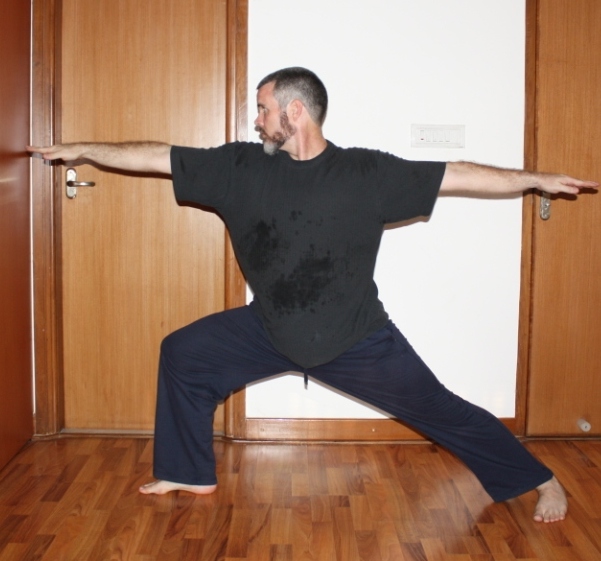
VIRABHADRASANA: There is a series of five lunge poses that are reminiscent of the Virabhadrasana (Warrior). I’ve dropped the first one because it requires a photo taken from a back angle becuas it involves pulling one’s wrist behind one’s back.

Thai Version 2 hand on front knee

Thai Version 2 hand on front knee

Thai version 3 twist

Thai version 3 twist

Thai version 4 looking back

Thai version 4 looking back

Thai version 5 taking aim

Thai version 5 taking aim

Virabhadrasana I

Virabhadrasana I


BOOK REVIEW: Warrior Pose by Brad Willis / Bhava Ram

Warrior Pose: How Yoga (Literally) Saved My LifeWarrior Pose: How Yoga (Literally) Saved My Life by Brad Willis

My rating: 5 of 5 stars

Amazon page

It may strike one as hokey that this book has one author, but two names on the byline. But, it’s apropos of an autobiography describing the fundamental transformation of a man.

Part I is the story of Brad Willis, a journalist on the rise. Willis goes from stumbling into a reporter job at one of the smallest markets in the country to being the Asia bureau foreign correspondent for NBC (National Broadcasting Corporation, one of the largest American television networks.) There’s no mention of yoga in this part of the book. It’s the story of a driven journalist covering major world events. Willis made a name for himself reporting from Soviet occupied Afghanistan in the 80’s. He tells harrowing tales of covering the drug war in Latin America, the Desert Storm Gulf War, and human trafficking in Thailand. He was also one of the few American journalists to visit North Korea. There was nowhere he wouldn’t go for the story, and he took serious risks along the way. His highly driven nature is the one point of consistency throughout the book. Willis is not a man to do anything half-assed, be it following a story or pursuing the yogic path.

Then Willis’s world was torn asunder by health problems, and this is the subject of the second part of the autobiography. First, a fall caused a hairline fracture in one his vertebrae that became crippling when Willis refused to take time off from work or to do anything for it. He couldn’t be diverted from his on-the-go foreign correspondent’s pace. Considering the dangerous places Willis traveled, it’s ironic that he initially broke his back on vacation at a Caribbean resort while closing a window during a storm. When the deterioration of his vertebrae made work untenable, he underwent a surgery that failed and left him “permanently disabled.”

Then Willis was diagnosed with a cancer in his throat that spread from his tonsils into lymph nodes. On top of the ailments themselves, Willis’s health rapidly declined because he became dependent on painkillers and other prescribed medications, and—against advisement—he began to drink alcohol in conjunction with these meds. Not only did he become hooked on the medications and alcohol, he became dependent on a back brace, a cane, and a lethargic lifestyle that kept the body from healing itself. Yoga is only briefly mentioned in passing in this part of the autobiography.

The third part is about Willis’s transformation into the yogi Bhava Ram, and his successful battle against cancer. After an intervention that resulted in drug rehab, he was referred to a pain center at Scripps that employed alternative therapies. (As an aside, the book is in part an indictment of a healthcare system in which this Pain Center both helped many people and was completely unsustainable because insurance companies could reject claims on the basis of the treatments being unconventional—but because it was staffed by medical professionals it was too expensive for most people to afford without insurance. Willis points out that there was never a rejection of any claim for any of the expensive medications or surgery that failed to helped him, but the Pain Center that put him on the road to good health went under due to failure to pay.) The Pain Center was the key to his turn around. After progressing with physical therapy, biofeedback, and—most uninsurable of all—Jin Shin Jyutsu, Willis is introduced to Yoga.

The final part charts Willis’s pursuit of yoga both through a series of teachers as well as any books that he can get his hands on. He voraciously reads up on the subject, and begins a sadhana (personal practice) that is marked by all the drive he had earlier given to his journalism career. The practice starts out rough. His muscles have atrophied, his spine curved, and he gained a tremendous amount of weight on a steak, potato, and beer diet mixed with a sedentary lifestyle. However, over the period of a couple of years, well beyond when he had been told he would be dead, he transforms his body and his mind through an intense daily practice and an adjustment of his world view.

I’d recommend this book for anyone. It will definitely be of interest to yoga practitioners—though don’t be surprised that yoga doesn’t come into play until the final quarter of the book. It could also benefit individuals with serious health problems as a way to reconsider how they approach health and treatment. Willis points out that falling into the role of victim was one of the main killers. He inherited a bad situation through an accidental fall and a case of cancer that he believed was attributable to his experience in Iraq (i.e. related to depleted uranium shells.) However, it was only when he stopped gorging on food, alcohol, and self-pity that he made a turnaround.

Even if I wasn’t interested in yoga and alternative approaches to healing, I would’ve found this to be an intensely engaging read. Willis’s journalism career gave him a unique insight into some of the major world events of the 1980s and 90’s. Willis builds lines of tension and sustains them. One wonders what will happen to his marriage to a woman who married one man (a confident and successful foreign correspondent in Hong Kong) and found herself in a marriage with another—first a lethargic addict and then a man who sunk himself hook-line-and-sinker into to the yogic lifestyle. One wonders whether his cancer remission will hold. One wonders whether he can keep clear of the pain meds and stick to the life of a yogi. I haven’t read a book that caught me this much by surprise in some time. I hadn’t heard of this book before I bought it, and didn’t have particularly high expectations (it was on sale on Kindle or I probably never would have picked it up), but I quickly became hooked.

View all my reviews

TODAY’S RANDOM THOUGHT: Yoga, Mirrors, & Proprioception

OLYMPUS DIGITAL CAMERAThis morning a yoga teacher I’ve studied with posted this article on her Facebook feed. It’s by an Indian yogini who moved to the U.S., and it offers five differences between the practice of yoga in India and in America.

It occurred to me that one additional difference that’s frequently commented upon is that mirrors are ubiquitous in American yoga studios, but a rarity in Indian studios.

There are many possible explanations of this point of divergence. Among the more cynical interpretations is that when yoga spread internationally it was never explained that there are no asana (postures) whose drishti (focal point of gaze) is the reflected “bootilicious”, yoga-panted backside of other students.

The explanation one is likely to hear, however, is that a student needs mirrors to be able to see whether his or her alignment is correct. Sounds logical? Actually, it’s lazy in the same way as saying, “I wanted to know what Lord of the Flies is about, so I rented the movie.” (Read the damn book.)

Yes, looking in the mirror will give one instantaneous feedback, but it won’t help one develop the bodily awareness that’s a huge part of the value of yoga. One should be seeking to enhance one’s proprioception. That’s a fancy way of saying, “know where your parts are.” Proprioception is defined as:  “the ability to sense the position, location, orientation, and movement of the body and its parts.” The body has a built-in ability to determine where one’s various parts are in space and whether said parts are straight or crooked. One may not realize this because one may have poor proprioception… because one looks in the mirror instead of closing one’s eyes and listening to what one’s body has to say.